
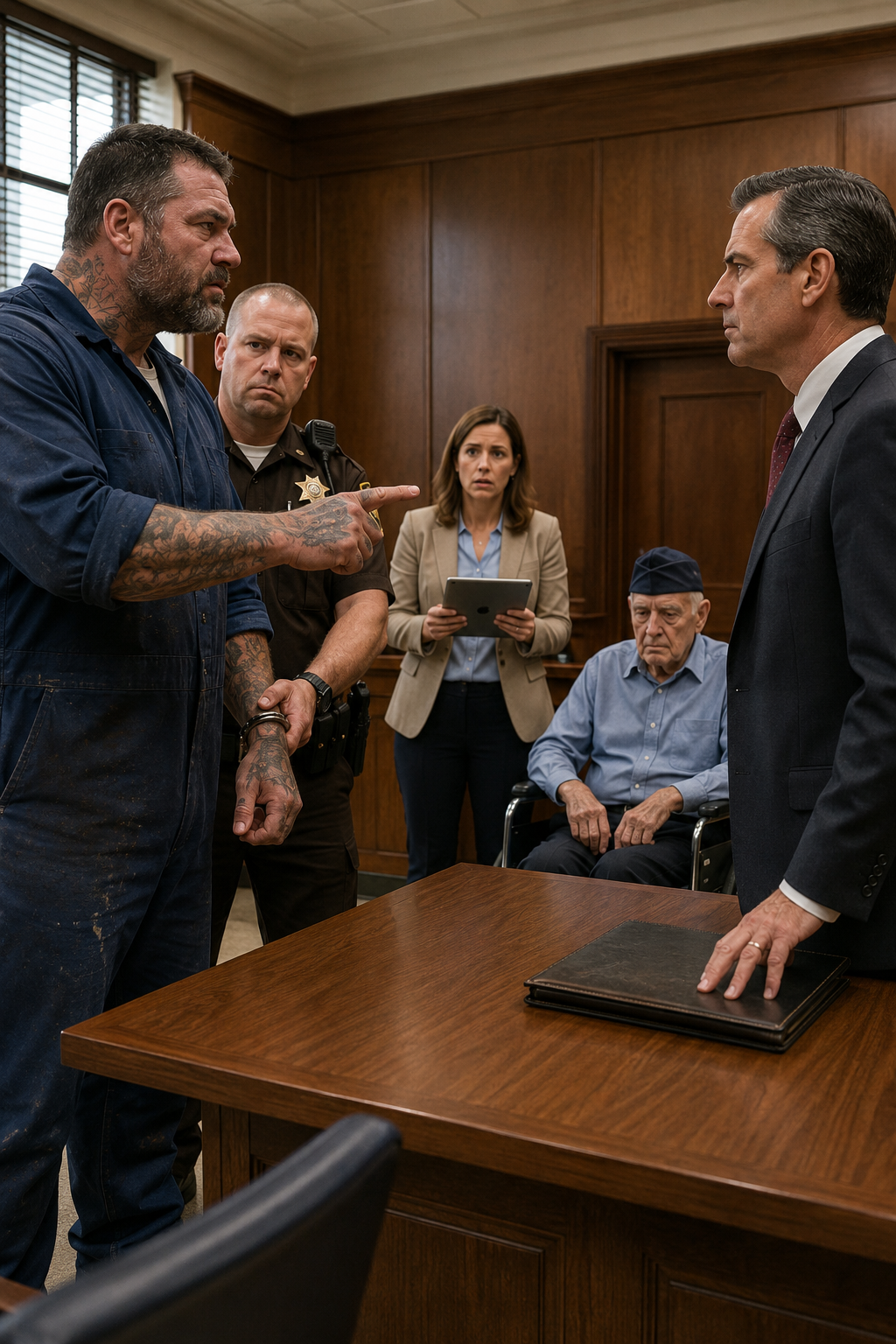
The man in Walter’s cap gave his name as Daniel Rusk.
He said it quietly, as though the name belonged to somebody else.
The fire alarm stopped after less than a minute. There was no smoke, no heat, no evacuation order from the fire department. Someone had pulled the station beside the records corridor, and the courthouse cameras covering that section had gone dark thirty seconds earlier.
Walter’s niece was no longer in the courtroom.
Neither was her attorney.
Marcus stood beside the bailiff with one cuff still hanging from his wrist. He did not demand an apology. He only asked to use a phone.
I called the rehabilitation center myself.
The receptionist placed me on hold. A piano version of an old hymn played for nearly four minutes before the nursing supervisor answered.
When I asked for Walter Briggs, she became careful.
“Mr. Briggs was discharged this morning.”
“To whom?”
There was a pause.
“To family.”
“Which family member?”
Another pause, longer this time.
“The authorization lists you.”
The room seemed to tilt beneath me.
I told her that was impossible. I had been at the county offices since seven-thirty. I had not signed a discharge order, arranged transport, or spoken with Walter’s physician.
The supervisor read the document number aloud.
It matched my employee identification.
Marcus held out his hand for the phone. I almost refused, then remembered the apartment number whispered into my ear.
He asked one question.
“What vehicle took him?”
The supervisor checked.
“A private medical van. White Ford Transit. Indiana plate ending in four-one-nine.”
Marcus closed his eyes.
“I saw it outside his house Tuesday.”
He handed the phone back and walked to the courtroom window. His shoulders looked too wide for the narrow frame, but his voice stayed low.
“Walter called me three weeks ago. Said his niece wanted him to sign something about the house. I told him not to sign anything until I got there.”
“You were in the photographs,” I said.
“I was repairing his furnace.”
“With eight men?”
“They work for me. The basement steps had collapsed.”
Every detail I had treated as evidence of intimidation began changing shape.
The tow trucks had carried lumber and tools. The mechanics had replaced the steps. The confrontation described in the petition had been Marcus refusing to leave Walter alone with the attorney.
I had never spoken to Marcus before signing.
I had relied on the niece’s statements, the attorney’s affidavit, and a physician’s letter claiming Walter lacked the capacity to manage his affairs.
Marcus looked at me then.
“Which doctor?”
I gave him the name.
He went still.
Not surprised. Not confused.
Afraid.
“That doctor died in January.”
The bailiff checked from his computer. An obituary appeared within seconds.
Dr. Samuel Pike had died eight months before the letter was dated.
Daniel Rusk began to cry.
He had been sitting against the wall with his wrists secured in front of him, watched by two deputies. Until then, he had answered only basic questions. Now his whole body folded inward.
“They said nobody would touch me,” he whispered.
Deputy Ross crouched beside him.
“Who said that?”
Rusk shook his head.
Marcus did not move closer. He seemed to understand that size alone could silence a frightened man.
I sat on the floor across from Rusk instead.
The hospital tag behind his ear had been cut from an identification bracelet and fixed there with medical adhesive. The patient number belonged to Walter, but the barcode contained an additional sequence not shown in the printed text.
I scanned it with the county tablet.
A transfer record opened.
Walter Briggs had not been discharged to his home.
He had been transferred at 8:14 that morning to a hospice facility outside Muncie under a different name.
The diagnosis listed was terminal respiratory failure.
Walter had never been terminal.
Marcus took one slow breath through his nose.
“Call the hospice.”
I did.
The woman who answered confirmed that a patient had arrived under the false name. She would not release further information without authorization.
Then I heard a voice behind her.
A man asking why the new patient still had bruises from a seat belt across his chest.
Marcus heard it too.
Before I could speak, the hospice employee lowered her voice.
“Someone is here to collect him.”
“Do not let them leave,” I said.
The line went silent for several seconds.
Then she whispered, “They have a signed order from your office.”