
PART 3
By the time I reached Eli’s curve, there were red lights everywhere.
State police.
Fire trucks.
An ambulance angled across Route 6.
Doc’s pickup sat nose-down in the drainage ditch, its front end buried in brush.
The passenger door hung open.
But Crow was gone.
Bishop reached the scene seconds after me with Nash and Tomas behind him.
He didn’t even shut off his motorcycle before running toward the trooper.
“Where is he?”
The trooper held up one hand.
“Sir, stay behind the line.”
“My brother was in that truck.”
“Driver’s already been transported.”
“Passenger.”
The trooper checked his notes.
“Christopher Maddox?”
“Silas.”
“Silas Maddox. Yes. He was ambulatory after the crash.”
“Then where is he?”
“We don’t know.”
That answer made no sense.
Doc had apparently lost control when a deer crossed the road.
The truck struck the guardrail and rolled once into the ditch.
Doc suffered a broken collarbone and concussion.
Crow climbed out on his own.
A motorist saw him standing beside the truck.
Then he walked away.
“Which direction?” Bishop demanded.
The trooper pointed down the road.
Toward the bend.
Toward the place where Eli had died.
Bishop swore.
“I knew we shouldn’t have let him hear that recording.”
I looked at him.
“You think he’s going to do something to himself?”
Nobody answered.
That frightened me more.
We started walking.
The curve looked ordinary.
That was the cruel thing about places where terrible things happen.
Trees.
Guardrail.
A shallow ditch.
Wildflowers.
Cars passed every day without knowing that one family’s life had ended there seventeen years earlier.
Then Nash pointed.
“There.”
A man was sitting beyond the guardrail.
Huge shoulders.
Gray beard.
Black T-shirt.
Crow.
Bishop moved first.
Crow heard us and turned.
“Don’t.”
We stopped.
He wasn’t near the drop-off.
He wasn’t holding a weapon.
He was sitting beside a small weathered wooden cross almost hidden beneath weeds.
ELI MADDOX
2001–2008
Crow had one hand resting on it.
I exhaled.
Bishop did not.
“You scared the hell out of us.”
Crow looked toward Doc’s wrecked truck.
“Sorry.”
“Doc’s going to live.”
“I know.”
“How?”
“Paramedic told me.”
“Then why did you walk off?”
Crow looked at the cross.
“I needed five minutes.”
Bishop laughed bitterly.
“You’ve had seventeen years.”
“No.”
Crow shook his head.
“I’ve had the same four seconds seventeen years.”
Nobody had an answer to that.
He pulled something from his pocket.
A cheap black plastic audio player.
Nash had apparently copied the recovered file onto it before Crow left the bakery.
“You brought it?”
Crow nodded.
Then he pressed play.
Not from the beginning.
He had found the final message.
Eli’s weak voice floated into the evening air.
Tell Dad to fix stuff.
Static.
Broken stuff.
Then Rachel:
What stuff?
And Eli’s answer:
Not people.
Crow stopped the recording.
His thumb remained on the button.
“I spent seventeen years trying to fix what happened.”
Bishop sat beside him.
“You couldn’t.”
“I know that now.”
Crow stared at the road.
“I thought if Marcus suffered enough, it would somehow balance something.”
“Did it?”
“I never touched him.”
“You wanted to.”
Crow gave him a tired look.
“Every day.”
That was the first honest thing anyone had said about Marcus Vale.
Crow continued.
“I kept thinking there had to be a person responsible.”
“Sometimes there is.”
“Yeah.”
He looked down.
“Sometimes there are three.”
Rachel looked at the phone.
Marcus drove drunk.
Crow had called during an argument he should have ended hours earlier.
No single fact erased the others.
That was the truth Crow had resisted because anger prefers simple mathematics.
One villain.
One victim.
One debt.
Reality had given him something worse.
Shared failure.
We went to the hospital first.
Doc was furious.
His left arm was immobilized.
His forehead had six stitches.
The moment Crow entered, Doc said:
“You walk away from another crash scene and I’ll kill you myself.”
Crow pulled up a chair.
“Fair.”
“You okay?”
“No.”
Doc nodded.
“Good answer.”
For several seconds, neither spoke.
Then Crow said:
“You should’ve told me.”
“I know.”
“Seventeen years.”
“I know.”
“I might never forgive that.”
“I know.”
Crow looked at him.
“But you kept the recording.”
Doc nodded.
“You could’ve destroyed it.”
“Yes.”
“Why didn’t you?”
Doc stared at the hospital blanket.
“Because someday I hoped you’d become the man who could survive hearing it.”
Crow laughed once.
“You overestimated me.”
“No.”
Doc looked at him.
“I timed it pretty well.”
Crow shook his head.
Then he reached out.
The two men clasped forearms.
Not forgiveness.
Not yet.
But something.
Crow went to Marcus Vale’s tow yard the next morning.
I know because he asked me to drive him.
That surprised me.
“Why me?”
“Bishop will threaten him.”
“True.”
“Doc can’t drive.”
“Also true.”
“Nash talks too much when nervous.”
“Definitely true.”
“So you.”
I agreed on one condition.
“If you start a fight, I leave you there.”
Crow looked at me.
“You think I need a ride home after a fight?”
“I think you need someone to remind you what Eli said.”
That silenced him.
Marcus Vale’s business sat behind a chain-link fence south of Mill Creek.
Rows of damaged cars filled the lot.
A yellow tow truck idled beside the office.
Marcus was changing a tire when we arrived.
He was forty now.
Thin.
Balding.
Nothing about him matched the monster I had imagined from Crow’s silence.
He saw Crow.
The lug wrench slipped from his hand.
For several seconds, neither moved.
Then Marcus said:
“You finally found out.”
Crow nodded.
Marcus wiped his hands on a rag.
“How much?”
“All of it.”
Marcus looked toward me.
“Who’s she?”
“My friend.”
Crow said the word awkwardly, as if he didn’t use it often.
I stayed near the car.
Marcus walked closer.
“You here to hit me?”
“No.”
“You sure?”
“No.”
That was brutally honest.
Marcus nodded.
“Fair.”
Crow took the audio player from his pocket.
“My son said your name.”
Marcus’s face changed.
“I know.”
“You heard the recording?”
“Part of it.”
“When?”
“Before sentencing.”
Crow’s jaw tightened.
“And you let me think you crossed the center line.”
“I was drunk.”
“That wasn’t my question.”
Marcus looked away.
“My lawyer said the reconstruction was messy. Your wife couldn’t remember clearly. The prosecutor had a dead child and a drunk driver.”
“So you took the deal.”
“Yes.”
“Six years.”
“Yes.”
“For something you didn’t cause.”
Marcus looked back at him.
“I helped cause it.”
Crow said nothing.
“I was drunk enough that I reacted late. Maybe if I was sober, I miss the car completely. Maybe I stop sooner. Maybe the rollover never happens.”
“You don’t know.”
“No.”
Marcus’s voice hardened.
“And neither do you.”
That landed.
Crow looked at the wrecked cars surrounding them.
“You ever hate Rachel?”
“For a while.”
“Me?”
Marcus laughed without humor.
“Definitely.”
“Why?”
“You called her.”
Crow flinched.
Marcus continued.
“You spent years letting everybody believe I killed your kid.”
“I believed it too.”
“I know.”
“Doesn’t make it better.”
“No.”
Silence.
Then Crow asked:
“Why didn’t you tell people after prison?”
Marcus looked toward the tow truck.
“Tell them what? That the grieving mother looked at a phone before I hit her car while drunk?”
He shook his head.
“I would still be the drunk guy trying to blame a dead kid’s mother.”
Crow stared at him.
Marcus added:
“And Eli was dead either way.”
That was the sentence that ended the confrontation.
Not because it solved anything.
Because it couldn’t be argued with.
Crow removed the old rocket charm from his pocket.
It had broken off the music box when it fell.
He held it between two fingers.
“Eli liked fixing things.”
Marcus looked at it.
“I remember.”
Crow frowned.
“How?”
Marcus hesitated.
Then walked into the office.
He returned carrying a small cardboard box.
“I’ve had this seventeen years.”
Crow froze.
Inside was a red plastic toy motorcycle.
One wheel missing.
A child’s name written beneath it in black marker.
ELI
Crow stared.
“Where did you get that?”
“Roadside.”
Marcus swallowed.
“After the wreck. Before the ambulance took me.”
He picked it up.
“It was near my truck.”
“Why keep it?”
“I thought someday I’d give it back.”
“You had seventeen years.”
Marcus gave a sad smile.
“So did you.”
Neither man looked away.
Then Crow laughed.
A tiny, exhausted sound.
“Everybody in this story is bad at timing.”
Marcus almost smiled.
Crow took the toy.
One wheel missing.
Handlebar bent.
Paint scratched.
Broken stuff.
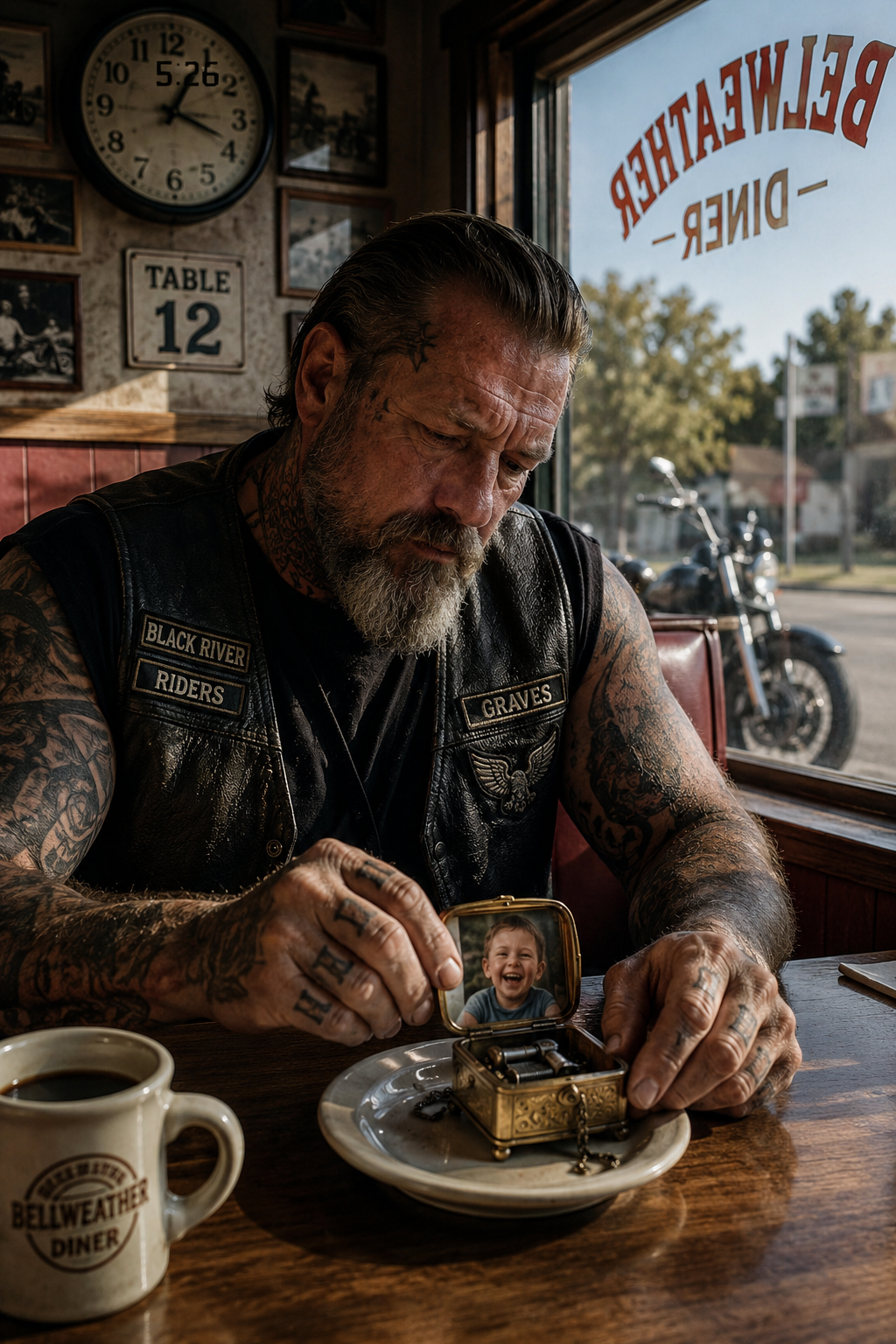
Three weeks later, table twelve changed.
The broken music box was repaired.
Nash recovered both recordings and created multiple backups despite Crow objecting to “putting Eli in a cloud.”
Crow still came every Friday.
Still ordered black coffee.
Still ordered a cinnamon roll he rarely ate.
But at 5:26, he stopped closing the lid after four seconds.
The first Friday he let it continue, every Black River Rider was there.
So was Owen.
The boy who had accidentally broken the box sat with his grandmother two tables away.
The laughter played.
One second.
Two.
Three.
Four.
Crow’s thumb hovered over the latch.
Five.
The hiccup.
His whole body tensed.
Then:
“Dad, you better not turn mean again.”
Bishop looked down.
Doc wiped his eyes.
Owen stared at Crow.
Crow let the recording continue.
All eleven minutes.
Nobody spoke.
When it ended, Crow closed the box gently.
Owen approached.
“Was that your son?”
“Yes.”
“He was funny.”
“Thought he was.”
Owen pointed to the damaged toy motorcycle beside the music box.
“What happened to that?”
“Needs fixing.”
“I can fix it.”
Crow studied him.
“You know motorcycles?”
“No.”
“Excellent qualification.”
For the next hour, a seven-year-old boy and a fifty-five-year-old biker sat at table twelve trying to attach a wheel to a plastic motorcycle with glue, a paper clip, and advice from four men who disagreed about everything.
It looked ridiculous.
Crow loved every second.
Months later, he made one more change.
The white raven stitched inside his leather vest disappeared.
In its place was a tiny embroidered rocket.
Underneath it were four words:
FIX STUFF. NOT PEOPLE.
I asked him whether Eli would have approved.
Crow looked at the patch.
“He’d complain the rocket’s crooked.”
“Was he like that?”
“Annoying kid.”
He smiled.
Not the half-smile he used around strangers.
A real one.
Then he opened the music box.
The laugh began.
This time he didn’t watch the clock.
He didn’t count the seconds.
He just listened.
For seventeen years, Crow had believed stopping the recording protected the last good memory he had of his son.
He thought the sixth second would destroy him.
In a way, it did.
It destroyed the story he had built around grief.
The villain.
The hatred.
The punishment.
The certainty that anger was the only thing keeping Eli close.
But what came after the fifth second was not another tragedy.
It was a child telling his father exactly how to live without him.
Don’t stay angry forever.
Don’t turn mean.
Fix what can still be fixed.
Leave people alone when they cannot.
Crow could not repair the crash.
He could not recover seventeen years.
He could not make Rachel look up from the phone.
He could not make Marcus sober.
He could not stop himself from making that call.
He could not bring Eli home.
But there were still motorcycles.
Friendships.
Broken toys.
A scared little boy in a bakery.
A man he had hated who had been carrying guilt of his own.
Those things were still here.
Those things could be touched.
And some of them could be repaired.
Every Friday at 5:26, the diner still heard Eli laugh.
But nobody heard Crow close the box at four seconds anymore.
Because he had finally learned that sometimes the part of a memory we fear most—
is the part that was trying to set us free.