
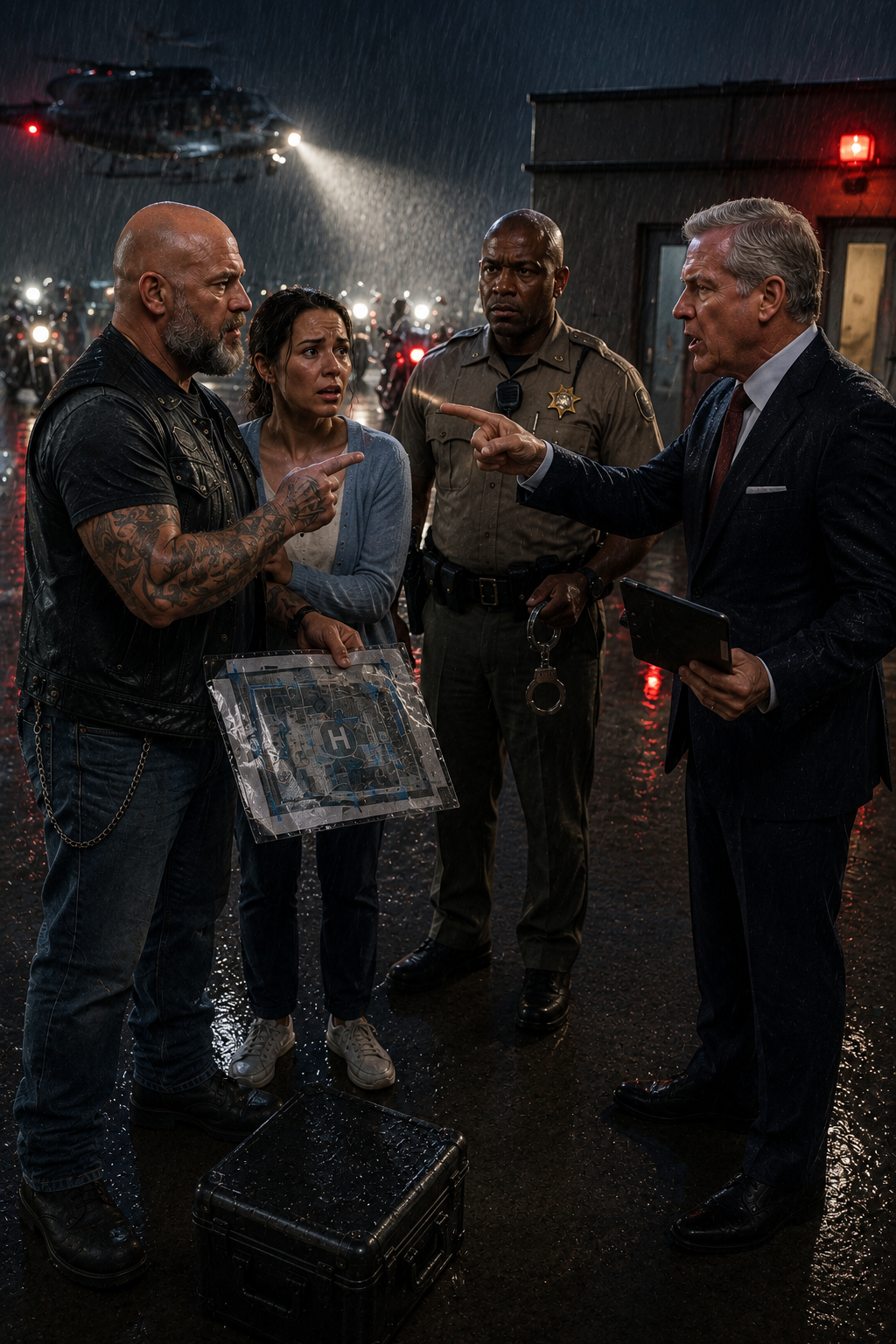
The administrator did not answer.
Rainwater ran from Silas’s beard onto the concrete while the transplant team disappeared through the rooftop doors with the cooler. Behind them, the helicopter remained idling, its blades beating the storm into sheets of white spray.
Administrator Cole stared at the burned control unit inside the metal case.
“That equipment was damaged tonight.”
Silas shook his head.
“The fire happened twelve days ago.”
One of the deputies crouched beside the case. The casing had melted along one edge, but a county inspection sticker remained visible beneath the soot.
Cole stepped between him and the riders.
“This is hospital property.”
“It was hospital property,” Silas said. “Then someone paid me to dispose of it.”
I looked at him.
“You removed the landing system?”
“No, ma’am. I found it behind my shop.”
Silas explained that three weeks earlier, a facilities electrician named Owen Price had brought him the airfield diagram and asked whether motorcycle headlights could mark an emergency landing zone if the rooftop circuit failed.
Owen said the hospital board had postponed replacing the control unit again.
Silas thought it was a drill.
Then Owen vanished from work.
Cole told staff he had resigned.
The metal case arrived outside Silas’s garage two nights later with no return address. Inside were the burned controller, maintenance photographs and a handwritten note containing one date.
Tonight’s date.
The storm had been forecast, but the blackout had not.
My hands went cold.
“You knew the power would fail?”
Silas looked toward Cole.
“Someone did.”
Cole ordered the deputies to clear the roof. Neither moved.
The rescue pilot shut down the helicopter and climbed out, carrying his helmet beneath one arm.
He examined the burned unit.
“This isn’t only a lighting controller,” he said.
He pointed to a smaller relay fused into the back panel.
“It also reports whether the helipad is available to regional dispatch.”
If the relay showed the pad as closed, transplant aircraft would be redirected to another hospital nearly forty miles away.
Mateo would not have survived that delay.
Cole began saying the relay had malfunctioned during the storm.
The pilot interrupted him.
“Our system showed this pad unavailable before the first power failure.”
Silas’s jaw tightened.
“What time?”
“Six forty-two.”
The hospital lights had gone dark at seven seventeen.
Thirty-five minutes after someone electronically closed the helipad.
A nurse appeared at the rooftop door and called for me. Mateo was in surgery. The donor heart had reached the operating room intact, but the team had found another problem.
His blood type in the transplant file did not match the blood type confirmed at admission.
For one terrible second, I could not understand the words.
Mateo’s type had never changed. He had undergone dozens of tests while waiting for the transplant.
The nurse said the surgical team had caught the discrepancy before transfusion, but someone had altered the electronic record that afternoon.
The deputy turned toward Cole.
His expression was no longer uncertain.
Cole backed away from the metal case.
Silas did not follow him.
Instead, he reached beneath the burned controller and removed a narrow memory module protected inside a clear evidence sleeve.
“Owen said this records every manual override.”
Cole stopped moving.
Silas handed the module to the pilot.
Before the pilot could examine it, the rooftop access doors locked automatically behind the nurse.
The emergency lights switched from white to red.
Then a voice came through the hospital intercom.
It belonged to Owen Price.
“If the transplant arrived,” he said, “Cole has already changed the second file.”