
Part 3 — Eight Minutes Beneath My Seat
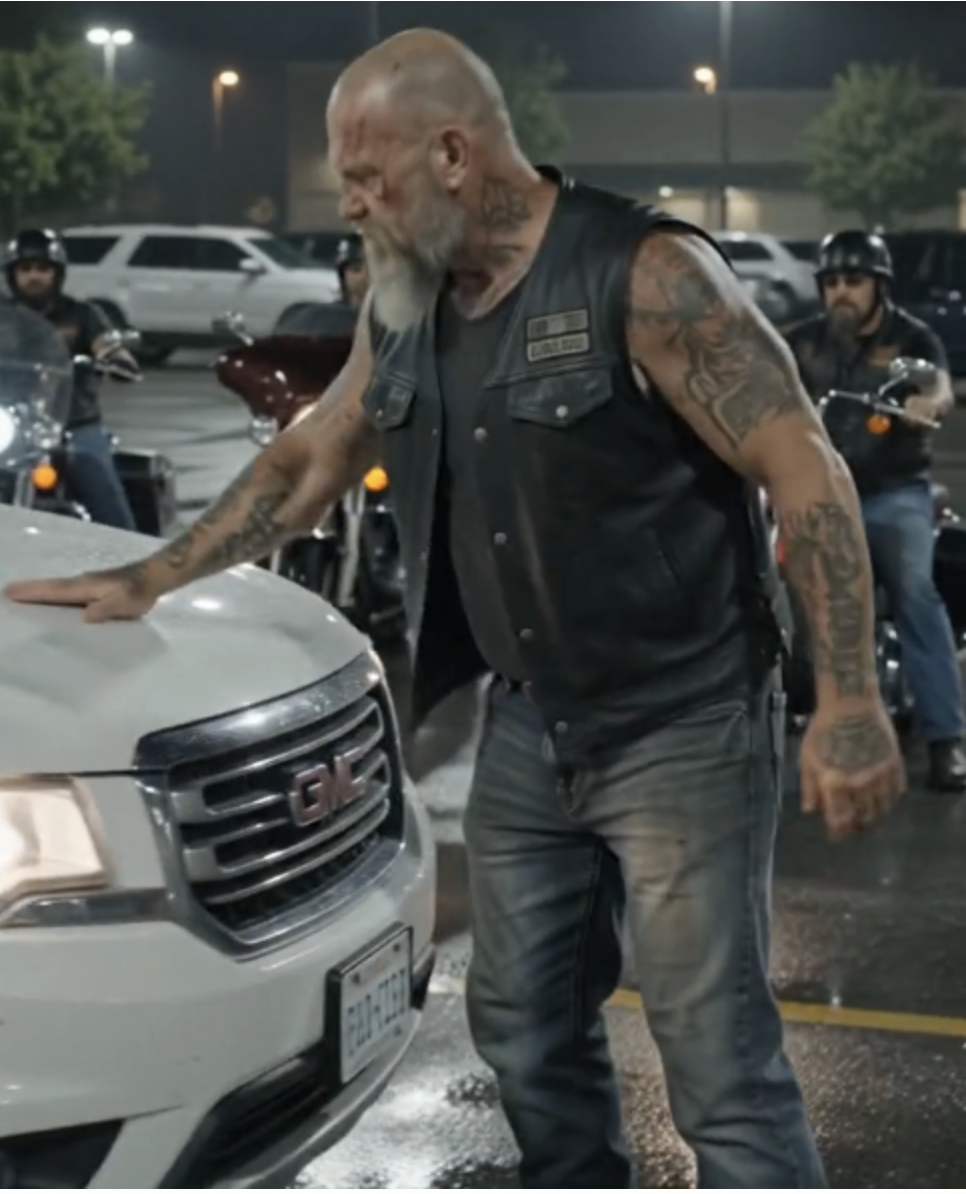
The first minute felt like an attack because I could see only the circle. Headlights struck every mirror. Chrome flashed through the rain. Men in black leather occupied each possible exit, and the largest one kept his body close to my door.
Inside the SUV, I told the dispatcher my name, location and license number. My voice sounded calm on the recording. I was not calm. Nurses learn to report facts while fear waits somewhere below the throat.
The dispatcher already had another caller—Mouse—on the line.
“Eleven motorcycles,” I said.
“We know about the motorcycles,” she answered. “Do not exit the vehicle.”
That answer terrified me. I thought the police had been watching the club. I did not know Mouse had reported a man concealed below my driver’s side and described the bikers’ plan to contain him.
Outside, Gravel bent near the window.
“Hands where I can see them,” I shouted.
He lifted both hands without argument.
That confused me.
Criminals did not usually obey requests from terrified nurses, I thought. Then again, Daniel had warned me against making rules for criminals. People did not behave like television characters simply because I needed them to.
Gravel pointed toward the passenger side. “Move across.”
“I’m not opening the door.”
“Good. Don’t.”
He looked underneath the SUV again, then at Mouse, who stood ten feet away with his phone raised.
“How long?” Gravel asked.
“Police are close.”
The man beneath my vehicle shifted. I felt a faint knock through the floorboard, followed by the drag of fabric against metal. Gravel stepped closer to my door, not away from it.
Jace moved too.
Gravel caught the young prospect by the vest and shoved him backward.
“You touch him, you give him a reason to move.”
“He’s under her car.”
“I know where he is.”
“We can pull him out.”
“No.”
The control in that single word stopped Jace, but anger remained in his shoulders. He paced beside his Harley, fists opening and closing, while another rider kept one hand around his elbow.
Later, I learned this was the first test of the brotherhood. They were eleven large men against one concealed suspect. Every instinct told them they could end it faster than the police.
But faster was not safer.
A hospital security cart arrived during the third minute. The guard, a twenty-two-year-old student named Nolan Price, saw the motorcycles and assumed I was being threatened. He drove toward the circle, shouting for the bikers to move.
Preacher stepped into his path with both palms open.
“There’s somebody underneath the white SUV.”
Nolan did not hear him over the cart’s electric alarm and my horn. He reached for the radio on his shoulder. Preacher backed away immediately, but from inside my vehicle it looked as though he had approached the guard to stop him from calling for help.
I began recording with my phone.
The video later received millions of views after someone leaked it online. For the first ninety seconds, it appeared to show exactly what I feared: rough-looking men surrounding a lone woman while their leader issued orders through her locked window.
It did not show the pavement.
It did not show the second danger.
During the fourth minute, the hidden man tested the passenger side. Mouse saw the shadow move and angled his Harley closer, leaving less than eighteen inches between the motorcycle and my door.
I screamed at him to get away.
He heard me. His face tightened, but he did not move.
“Sorry, ma’am,” he said. “Not yet.”
Those were the only words Mouse spoke to me that night.
Gravel crouched again. “We see you,” he told the man beneath the SUV. “Police are coming. Keep both hands down.”
No answer came.
I heard another scrape, closer this time, then felt something strike the underside of my driver’s door. My legs were still across the passenger seat. Had my feet remained on the floor, I might have panicked and opened the door without thinking.
Gravel watched my face.
“That’s why I told you to move.”
“Who is under there?”
“Don’t look.”
“Who is he?”
“Doesn’t matter yet.”
That answer made no sense until afterward. Gravel did not care about the man’s name, excuse or history while I remained at risk. Identity belonged to the police. Position belonged to him.
The fifth minute brought two hospital employees and several visitors into the lot. Phones appeared. Someone yelled that the bikers had kidnapped a nurse. A man in scrubs grabbed a tire iron from his truck and moved toward the circle.
Preacher intercepted him.
“Put it down, brother.”
“Get away from her.”
“You’re angry at the wrong thing.”
The man raised the tire iron. Three riders turned toward him, but Gravel never left my door.
“Preacher,” he called.
“I got it.”
No one struck anyone. Preacher kept backing up until Nolan finally reached the hospital employee and took the tool. The restraint looked like intimidation from a distance, yet it was the only reason the parking lot did not become a fight before police arrived.
Then the man beneath me pulled my driver’s-side handle.
The door stayed locked.
The sound was small—a plastic click beneath the rain—but it remains the loudest thing I remember.
I screamed. Gravel dropped onto both knees, planting one boot near the door and the other against the pavement.
“Stay down,” he ordered.
A voice came from beneath the SUV.
“She dropped something.”
Gravel’s expression changed.
“What did she drop?”
No answer.
“What did she drop?”
“I was getting it.”
“You’ve been under there six minutes.”
“I’m stuck.”
Gravel looked through my window. “You know him?”
I shook my head.
The man below began kicking against the chassis. My vehicle rocked once. Jace surged forward again, and this time three riders held him.
“Let me get him!”
Gravel turned so sharply his beard swung across his vest.
“You want to help her? Obey me.”
That stopped him.
Police cruisers entered the lot during the seventh minute. The first officers saw a woman trapped in an SUV, eleven bikers around her and a young prospect struggling against his own club. They drew their weapons and ordered everyone to the ground.
Gravel faced a choice.
If the circle broke too quickly, the hidden man could reach my door. If the bikers refused police commands, officers might treat them as the main threat.
Gravel raised his hands.
“Two officers on her driver’s side,” he shouted. “One underneath.”
“On the ground!”
“There’s a man under the SUV.”
“Get down now!”
Gravel lowered himself, but he did it beside my door, leaving his body between me and the gap beneath the vehicle. Mouse lay down beside his motorcycle. Preacher stretched both arms across the wet asphalt. One by one, the circle opened.
Something moved below me.
An officer named Laura Kim saw a gloved hand emerge near the rear wheel. She dropped to one knee, aimed her flashlight under the chassis and shouted for the person to show both hands.
He pulled back.
Another officer approached from the front. Gravel remained facedown in the rain, his head turned toward my door.
“Stay locked, Emily,” he said.
I had never told him my name.
That frightened me almost as much as the man below.
Officers ordered the hidden person out. For several seconds, nothing happened. Then they saw an object in his right hand and warned him to release it.
Metal struck pavement.
A folding knife slid into the blue light.
Four officers pulled the man from beneath my SUV. He wore black gloves, a green jacket and a knit cap darkened by rain. Plastic restraints were found in one pocket. My photograph—taken from a hospital employee page—was later recovered from his backpack near the drainage wall.
When police lifted him, his face turned toward my window.
I had seen him before.
He had been sitting in the emergency-room waiting area three nights earlier, watching the nurses’ station without checking in.
I thought that was the end of the story.
Then Gravel stood, reached slowly inside his leather vest and removed a worn police challenge coin bearing Daniel Carter’s badge number.
Part 4 — The Name Inside Gravel’s Vest
The officers kept me inside the SUV until they had searched the suspect, the surrounding spaces and every motorcycle in the circle. I remained curled across the passenger seat, unable to lower my feet even after the danger had been handcuffed.
Gravel stood ten yards away with his hands visible. Rain ran from his beard. One officer questioned him while another collected names from the club, yet Gravel kept looking toward my windshield as if he still expected something to move beneath me.
Officer Kim opened my passenger door.
“You’re safe now.”
I did not believe her.
Safe people did not shake so hard that their teeth struck together. Safe people did not stare at the floorboard as if a hand might pass through it.
Kim placed a blanket around me. When I stepped onto the pavement, my knees folded. Gravel moved instinctively, but two officers blocked him.
“Stay back.”
He stopped immediately.
That mattered.
The man everyone had mistaken for an attacker did not argue, threaten or invoke what he had done for me. He simply took one step back and closed his scarred fist around the challenge coin.
I saw Daniel’s badge number between his fingers.
“Where did you get that?”
Gravel looked at Officer Kim. “Can I answer her?”
Kim nodded.
“Your husband gave it to my daughter.”
My mind rejected the sentence. Daniel had carried dozens of coins, trading them with officers from other departments and giving them to children at school events. Gravel could have obtained one anywhere.
Then he said Hannah’s name.
Fourteen years earlier, before Daniel and I had Sophie, nineteen-year-old Hannah Mercer finished a closing shift at a grocery store near Eastgate Mall. She reached her car at 11:20 p.m. and noticed a set of keys beside the driver’s door.
When she bent to pick them up, a man rolled from beneath the neighboring vehicle and grabbed her ankle.
Hannah kicked free, but he caught her coat. Daniel was driving through the lot after interviewing a store manager about a theft. He heard her scream, crossed two rows of parked cars and reached them before the man pulled Hannah between the vehicles.
The attacker ran. Daniel chased him across an access road and made the arrest behind a dumpster.
Hannah required six stitches in one hand. The physical injury healed quickly. The rest did not.
For months, she could not walk through a parking lot alone. She stopped attending night classes. She slept with the bedroom lamp on and called Gravel whenever headlights remained behind her for more than one turn.
Gravel did not know how to help.
He drove her everywhere, searched beneath every car and threatened anyone who looked at her too long. His rage made Hannah feel watched from both directions. Eventually she asked Daniel to speak with him.
Daniel met Gravel at Rourke’s Diner.
According to Gravel, my husband sat across from a furious 270-pound tow-truck driver and told him the hardest part of protecting someone was learning when fear belonged to the protector instead of the person being protected.
“You can’t build her whole life into a locked room,” Daniel said. “Get her home tonight. Tomorrow, help her walk out again.”
Gravel remembered every word.
Daniel began meeting Hannah twice a week after her evening classes. He never treated her like a helpless victim. He parked one aisle away and let her walk to her vehicle while he watched. The following week, he waited near the exit. Then he waited across the road.
By the end of the semester, Hannah walked alone.
On the final night, Daniel gave her a challenge coin. One side carried the Tulsa police emblem. The other bore his badge number.
“You don’t need this,” he told her. “That’s why you get to keep it.”
Hannah later became a physical therapist. She married, moved to Denver and had two daughters. On the morning of Daniel’s funeral, she mailed the coin to Gravel with a note.
He taught you how to stand back. Keep remembering.
Gravel had carried it ever since.
The phrase stitched inside his leather vest—where no stranger could see it—was GET HER HOME. It was not a club motto. It was Daniel’s instruction.
That was why Gravel recognized my name.
When his headlight crossed my memorial decal, he knew exactly whose widow sat behind the glass. He also knew that revealing the connection would waste seconds I did not have.
“I couldn’t tell her all that while somebody was under the car,” he told Officer Kim. “First, we get her home.”
There was another twist.
The Ash Creek Riders had not stumbled into the hospital lot by chance. Hannah’s attack had changed the club long before it existed. After prison, Gravel formed the group with Preacher and three other riders. Their first rule was simple: no member left a waitress, nurse, cashier or cleaner walking alone after closing if that person wanted company.
They called it Last Light.
They never advertised it. They did not post rescue photographs. They waited outside diners, garages and hospital entrances. Sometimes employees accepted an escort. Sometimes they refused. The riders left when asked—unless they saw a clear, immediate danger.
That night, they saw one.
Gravel’s criminal record complicated everything. The responding officers initially treated his description with skepticism, while witnesses insisted the bikers had threatened me. A video recorded from the hospital entrance appeared to show Jace trying to attack someone as other riders restrained him.
Only Mouse’s 911 recording clarified the order of events.
At 12:38:14, before the motorcycles surrounded me, Mouse told the dispatcher: “Adult male under a white SUV, east lot. Female walking toward it. We’re blocking him in.”
The bikers had called first.
Security video confirmed the rest. The suspect arrived forty-seven minutes before my shift ended. He moved between vehicles, watched the employee entrance and tried two door handles. When I appeared, he crouched beside my SUV, waited until I passed the rear bumper and slid underneath while I unlocked the driver’s door.
He was already below me when I sat down.
The motorcycles did not trap me with danger.
They trapped danger beneath me.
Part 5 — What Daniel Had Left on the Road
Detectives questioned me until nearly four in the morning. Sophie woke at my sister’s house and found eleven missed calls on my phone when I finally contacted her. I told her there had been an incident in the parking lot but that I was safe.
She heard the lie inside the word.
When I reached my sister’s house, Sophie ran barefoot across the living room and wrapped both arms around my waist. I held her so tightly that she complained she could not breathe. Then I loosened my grip and began crying into her hair.
Gravel did not come with me. He and every Ash Creek rider remained at the hospital to give statements. Several allowed officers to examine their motorcycles and phones. Jace sat apart from the group, soaked and ashamed because he had nearly disobeyed the order that kept the situation from turning violent.
Gravel joined him on the curb.
“You wanted to protect her,” he said.
“Yes.”
“You wanted to punish him more.”
Jace stared at the pavement.
“That’s where you almost lost her.”
Gravel did not remove Jace’s prospect vest that night, although some club members expected him to. Instead, he ordered the younger man to attend every court hearing with me if I wanted the club present.
“Learn the long part,” he said.
The long part began Monday.
Detectives discovered that the suspect, thirty-six-year-old Mark Veller, had visited the emergency department three times without requesting treatment. He followed two nurses into the parking lot on previous nights but abandoned both attempts when other employees appeared.
His backpack contained gloves, restraints, a flashlight, a second folding knife and printed images taken from public social-media pages. Mine was among them.
Police also found a spiral notebook listing shift changes and vehicle descriptions. They did not release every detail, but they confirmed that I was not chosen randomly. The dark section of the parking lot, my repeated weekend shifts and the fact that I often walked alone had made me a target.
That knowledge changed ordinary things.
A shopping cart became a hiding place. A loose plastic bag became footsteps. A stranger sitting too long at a bus stop became someone waiting for me. For six weeks, I could not approach my SUV without checking beneath it from twenty feet away.
I stopped working nights.
Then the unpaid bills arrived.
Sophie heard me speaking with the hospital scheduler and offered to quit her music lessons. She placed her violin case beside the kitchen table and said she had never wanted lessons that much anyway.
She was lying.
The following afternoon, a black Road King stopped outside our house.
I watched through the curtains as Gravel removed his helmet. No other riders accompanied him. He wore a plain denim shirt instead of his leather cut and stood at the curb rather than entering the yard.
He called my phone.
“I won’t come closer unless you ask.”
That was the first reason I opened the door.
Sophie remained behind me. Gravel looked larger on our narrow walkway than he had among the motorcycles, but his hands stayed loose at his sides.
He held Daniel’s challenge coin.
“This belongs to your family,” he said.
I did not take it.
“Hannah kept it.”
“She sent it back.”
“To you.”
“Long enough.”
He placed the coin on the porch railing and stepped away. The metal was scratched almost smooth around the edges. Daniel’s badge number remained visible.
“Why didn’t he ever tell me about Hannah?”
Gravel glanced toward the street. “Probably didn’t think saving somebody required a report at dinner.”
That sounded like Daniel.
It hurt.
Sophie stepped onto the porch. She picked up the coin and studied it beneath the afternoon light.
“My dad helped your daughter?”
“Yes, ma’am.”
“And you helped my mom?”
“Had friends.”
“Because of Dad?”
Gravel considered the question.
“Because a man was under her car.”
Sophie waited.
Gravel’s beard moved when his jaw tightened.
“But I stayed because of your dad.”
He then gave me a folded card with eleven phone numbers. The Ash Creek Riders had created an escort schedule for hospital employees after late shifts. They had already spoken with administrators, who agreed to designate a well-lit pickup area beside the emergency entrance until permanent cameras and lights could be installed.
I had not asked them to do that.
Gravel seemed to read the objection in my face.
“It isn’t only for you.”
That was the second reason I trusted him.
He did not make my fear into a monument to himself. Last Light would serve housekeepers, technicians, nurses, patients and visitors—anyone leaving alone. The riders would stay near the entrance, accept no money and leave immediately if hospital security asked them to.
The hospital resisted at first. Administrators worried about liability and public image. One vice president said leather-clad motorcyclists outside the emergency department might make patients uncomfortable.
I attended the meeting.
“These men frightened me,” I said. “Then they saved my life while everyone who looked respectable stood inside filming.”
The room became quiet.
Gravel sat against the far wall. He did not smile.
The hospital approved a sixty-day trial.
During the first week, most employees avoided the bikers. By the second, a lab technician named Ruth asked Preacher to walk her to the south garage. A janitor recovering from knee surgery accepted a ride in a security cart while Mouse followed behind. Two nursing students began leaving together after seeing the riders wait beneath the canopy.
The circle grew differently.
Meanwhile, my video continued spreading online. Edited clips accused the bikers of surrounding and terrorizing me. Strangers posted Gravel’s prison record. One local commentator called the rescue a staged publicity stunt.
Gravel refused every interview.
“They can call me what they need,” he said. “She got home.”
I agreed to speak publicly only after a woman online identified Jace and threatened his family. At a press conference, I stood beside Officer Kim and explained what the camera angle had missed.
Then a reporter asked Gravel why eleven men were necessary.
He looked at me, then at the cluster of microphones.
“There was one woman in a locked car and one man under it,” he said. “We didn’t know what he had or where he’d move. So we closed every direction.”
“Did you know Mrs. Carter?”
“Knew her husband.”
“Was this repayment?”
Gravel shook his head.
“You don’t repay a dead man,” he said. “You carry forward what he started.”
That sentence appeared in newspapers across the state.
It was the only interview Gravel gave.
Part 6 — The Long Part
Mark Veller’s case took seventeen months to reach trial. His attorney argued that he had crawled beneath my SUV to retrieve property, that the knife was a work tool and that the photographs had been collected from public pages without criminal purpose.
The security footage told a different story.
So did the door-handle recording captured by my phone. So did Mouse’s 911 call, the notebook, the restraints and testimony from the other nurses he had followed.
I testified for almost three hours.
Gravel sat in the last row. Jace sat beside him for every hearing, exactly as ordered. He wore no club vest inside the courtroom, only a clean gray shirt that failed to hide the tattoos across his hands.
When the defense attorney asked why I had not simply driven away, I looked toward Gravel.
“Because a man outside my window told me not to move.”
The attorney raised an eyebrow. “A convicted felon?”
“A man who could see what I couldn’t.”
Veller was convicted of attempted kidnapping, stalking, possession of burglary tools and weapons-related charges. The sentence was substantial. I remember the number, but it matters less to me than the sound of the courtroom door closing behind him.
Gravel did not celebrate.
He and Jace walked me to my car.
The courthouse garage was bright, crowded and protected by cameras. I still stopped several yards from my SUV. My breathing changed. The old panic returned through my legs.
Jace started forward to inspect beneath it.
Gravel stopped him with one hand.
“Ask her.”
Jace turned to me. “Would you like us to check?”
The question returned something the attack had taken.
“Yes,” I said.
He checked, then stepped back. “Clear.”
I unlocked the car myself.
Last Light continued after the hospital’s trial period. Administrators hired two additional guards, installed brighter fixtures and trimmed the shrubs near employee parking. The riders no longer needed to appear every night, but they came on Fridays and Saturdays when shifts ended late.
I returned to night duty gradually.
The first evening, Gravel waited near the entrance with two motorcycles. He did not walk beside me. He stayed about fifteen feet back while I crossed the lot, repeating the pattern Daniel had used with Hannah years earlier.
The next week, he waited farther away.
By the fifth week, I walked alone while he watched from the hospital canopy.
At my SUV, I turned around.
“You can go,” I called.
Gravel lifted two fingers from his side.
Then the Road King started, its low rumble passing across the asphalt as he left for Route 66.
Sophie began volunteering at the Ash Creek Riders’ grocery deliveries. She was wary of the motorcycles, so Gravel never asked her to ride. Instead, he gave her control of the inventory clipboard and followed her instructions as she counted canned goods.
The first time she met Hannah, both women held Daniel’s challenge coin between them.
Hannah was thirty-three, with short brown hair and a faint white scar near her right thumb. She told Sophie that her father had not only saved her from an attacker. He had shown her how to reclaim the places fear had taken.
Sophie looked at me.
“You’re doing that too.”
I placed the coin back in her hand.
“We’re trying.”
Years passed. The internet moved on to other videos, other villains and other heroes. The footage of eleven bikers surrounding my SUV remained online, usually without context. Every few months it resurfaced, and strangers argued again about what they thought they saw.
Gravel never corrected them.
He knew the angle from which a story was filmed could not change what happened beneath the frame.
Part 7 — The Space Around the Car
It has been six years since the night the Ash Creek Riders surrounded me.
Gravel is sixty-four now. His beard has gone almost entirely white, and his left hip makes him walk unevenly after long rides. He still keeps Daniel’s words stitched inside his vest, though Sophie carries the challenge coin.
Jace earned his full patch. Before receiving it, he had to explain the lesson Gravel believed mattered most.
“Protection ends when punishment begins,” he said.
Gravel made him say it twice.
Last Light now includes riders, hospital security officers, taxi drivers and volunteers who walk late-shift employees to their vehicles. They do not act like vigilantes. They observe, stay visible and call police when something is wrong.
Every November, on the anniversary of Daniel’s death, Gravel rides to our house alone. He parks at the curb, removes his helmet and waits for Sophie to bring out three cups of coffee.
We sit on the porch.
Daniel’s name is rarely spoken at first. Gravel asks about Sophie’s college classes. She asks whether his hip hurts. I complain about the hospital’s new computer system, and he tells me every electronic device becomes useless once a committee approves it.
Before leaving, he places one scarred hand on the porch railing where he once left the challenge coin.
Last year, I finally asked what would have happened if he had not recognized Daniel’s memorial decal.
Gravel looked toward the darkening street.
“We still would’ve circled your car.”
“Then what difference did Daniel make?”
He pulled on his gloves.
“I knew whose lesson I was using.”
That night in the hospital lot, I believed eleven motorcycles had closed every road to safety. I saw leather, tattoos, boots and a wall of men whose faces frightened me.
I did not see Mouse calling 911.
I did not see Preacher stopping an armed bystander from creating another threat. I did not see Jace fighting the urge to become the very kind of danger he hated.
Most of all, I did not see the man beneath my seat.
Gravel did.
He closed the distance because I could not. Then, when the danger was gone, he stepped back far enough for me to walk again.
His Road King started at the curb. The V-twin shook rainwater from the gutter while Sophie stood beside me holding her father’s worn coin.
Gravel pulled away without waving.
The red taillight became smaller along Route 66, surrounded for a moment by the lights of ten other motorcycles waiting at the intersection.
They formed a circle around him.
Then they opened it toward home.
Follow our page for more unforgettable biker stories about misunderstood riders, quiet courage, and the lives protected behind leather, thunder and road-worn scars.