
Part 1
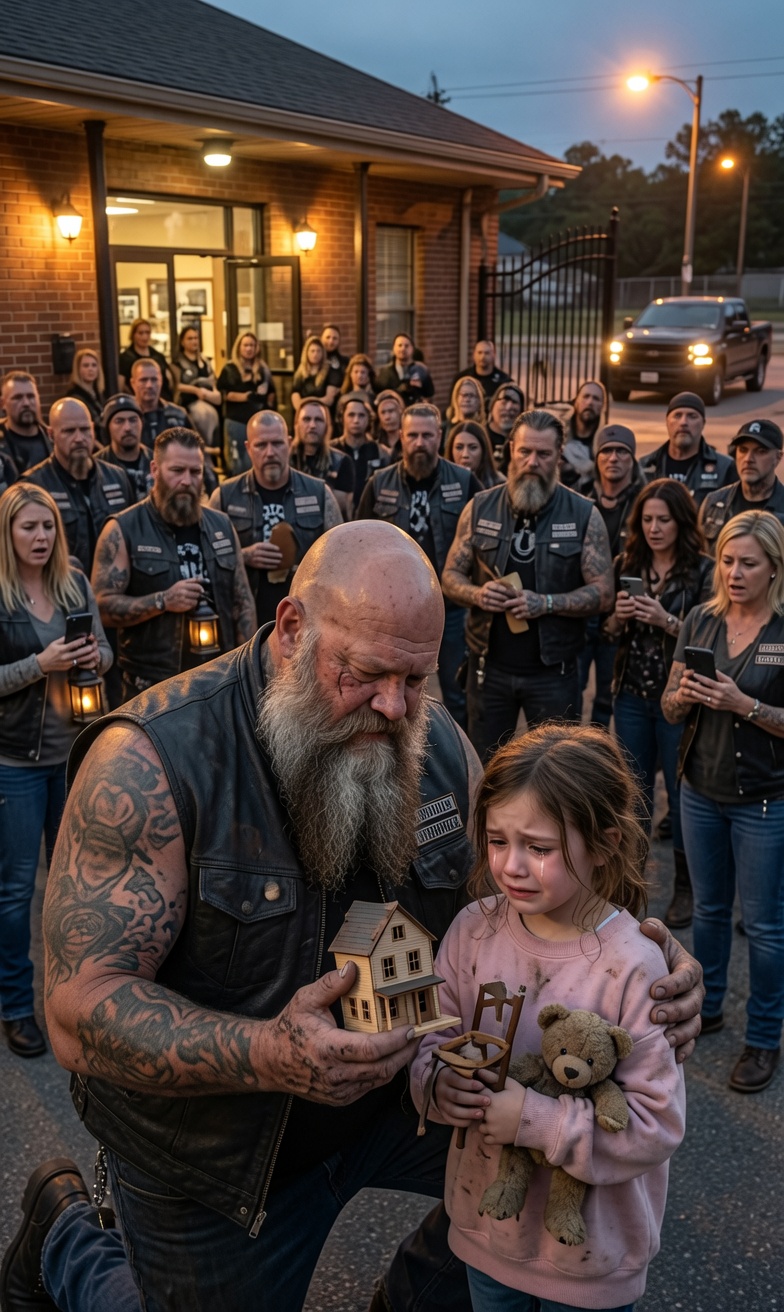
Thirty-five tattooed bikers surrounded a frightened seven-year-old outside a family shelter, and several mothers raised their phones to film — until the girl recognized what their president carried in his hand.
Jonah “Grinder” Hayes looked like the last man a shelter would ever invite inside. He stood six-foot-four, weighed nearly 290 pounds, and wore a leather vest over tattooed shoulders.
In his huge, scarred hand rested one miniature chair with a broken leg.
It belonged to Ellie.
Her father had destroyed the dollhouse she used as an imaginary refuge whenever their real home became frightening. After authorities removed her, Ellie cried for its tiny family because she believed she had failed to protect them.
Her aunt Naomi asked the Black River Riders whether they repaired wood.
Thirty-five arrived.
Some wanted the father’s name. Grinder refused to let anger turn the club into another group of frightening men in Ellie’s life. Instead, they submitted to background checks, protected the shelter’s location, and worked without photographing a single resident.
They padded their hammers and moved their saws outside because loud noises made Ellie hide. Each room received one surviving piece from the original house.
Then the project grew too large to leave in the workshop.
The bikers had one night to dismantle everything they had built. When Ellie saw them tearing down the walls, she thought they had betrayed her.
But before Grinder removed the final panel, a vehicle stopped beyond the shelter gate — and Ellie’s reaction revealed who had discovered where she was staying.
Part 2
Ellie froze. Her hands gripped the hem of her sweater. Headlights from the old pickup truck swept across the yard, and in that moment she was no longer the little girl watching men take apart her dream house — she was the girl who had learned to dread the sound of a car door slamming before the beatings began.
“Dad,” she whispered, so quietly only Naomi, standing right beside her, heard it.
Naomi spun around, her heart hammering. Grinder, though nearly twenty meters away with a piece of wood still in his hands, heard it too — thirty years of listening for frightened whispers had trained his ears for exactly that. He set the board down without a sound and walked toward the gate, motioning for the others to hold their positions.
The truck’s engine kept running. The window rolled halfway down. A gaunt man in a wrinkled flannel shirt stared at the crowd of bikers standing in the shelter’s yard — a place no one outside the staff was supposed to know.
“I’m here for my daughter,” the man said, his voice trembling even as he tried to sound tough. “I have rights to see my kid.”
Grinder didn’t answer right away. He planted himself between the gate and the truck, arms loose at his sides but his body a living wall. Behind him, a dozen club members quietly spread out — not to surround the man, but to form a silent barrier between him and the shelter door.
“This is a protected location under court order,” Grinder said, his calm almost eerie. “You’re not allowed here.”
“I know my rights,” the man snapped, though his eyes kept darting across the crowd of leather vests, calculating. “I just want to talk to Ellie.”
Inside, Ellie had started shaking violently. Naomi knelt and wrapped her arms around her, feeling her niece’s heart flutter like a trapped bird. One of the shelter staff, Patricia, had already quietly dialed the police, her hand shaking but her voice steady enough to give the address.
The truck still hadn’t left. The man looked at the wall of bikers and seemed to realize he’d miscalculated — he’d expected a few timid social workers, not a living wall of steel.
“You people don’t have the right to stop me,” he said, though his confidence was fading.
A woman in the group — call sign “Doc,” a former military nurse — stepped up beside Grinder. “We don’t need a right,” she said softly. “We’re just standing here.”
The simple statement was, strangely, more terrifying than any threat. Thirty-five men and women, motionless, fists unraised, simply existing as a wall between fear and a child.
In the distance, sirens began to wail.
The man in the truck glanced around one last time, then gunned the engine, spun the wheel, and sped off in a spray of gravel.
Grinder didn’t move until the taillights disappeared around the bend. Only then did he turn back, and his hard, weathered face softened when he saw Ellie pressed against Naomi, watching him through the window with wide eyes.
He raised a thumbs-up, a gentle gesture strange for a man whose hands were big enough to snap someone’s neck.
But that night, after the police finished their report and left, Grinder sat down on the shelter steps, head bowed, and for the first time since the project began, he wondered whether protecting Ellie was enough — or whether they needed to do more.