
Part 5 — The Soldier Behind Thomas Dawson’s Compass
Walt checked himself out of the hospital against advice at 7:40 Sunday morning.
His neighbor drove him to Riverbend Landing in the borrowed manual chair. He claimed he wanted his fishing rod, but the rod was already inside my office.
He wanted to see whether Hammer would return.
At 8:03, the first Harley rounded the curve above the lake.
The V-twin rumble arrived before the motorcycles became visible. Forty riders descended between the trees in two close columns, their headlights pale beneath the morning clouds.
No one revved an engine.
No one waved.
They parked along the gravel shoulder and shut the motorcycles off together.
The sudden silence carried across the water.
Colt opened the cargo trailer.
Hammer and Moses rolled out the new chair, but they stopped twenty feet from Walt. Ray’s beard had been washed clean of blood. His right arm remained close to his body, and fresh medical tape covered two fingers.
Walt studied the chair without moving.
The frame was matte black. A waterproof compartment protected Helen’s photograph beneath the armrest. A fishing-rod holder extended along the left side, and a small emergency handle sat below the oxygen bracket.
The red-and-gold combat-engineer insignia gleamed near the wheel.
Behind the seat hung Thomas Dawson’s field compass.
Walt recognized the dent in its brass cover.
He had made that dent with a rifle butt while breaking the jammed clasp on Thomas’s safety harness during the bridge rescue.
“Where did you get that?” he asked.
“My father kept it.”
Walt’s eyes remained on the compass. “Tommy alive?”
“No.”
“When?”
“Eleven years ago.”
Walt lowered his head.
For half a century, he had imagined Thomas living somewhere beyond reach—driving trucks, raising children, perhaps leaving two beers on another veteran’s porch. The truth arrived without ceremony beside a lake.
Hammer did not fill the silence.
Finally, Walt looked at the chair.
“You buy this overnight?”
“Daniel Ruiz did.”
Elena Ruiz stepped forward and introduced herself. She explained that the chair had belonged to her son but had never carried him. Walt listened with both hands locked around the rims of the borrowed chair.
“I’m sorry,” he said.
“So am I,” Elena answered. “That’s why it should move.”
Doc explained the modifications, the certified batteries, the temperature alarm, the manual emergency release, and the seating adjustments copied from Helen’s records.
Walt looked up sharply.
“You knew my wife?”
Doc handed him the folder.
Inside were Helen’s notes, warranty documents, medical measurements, and one photograph taken at the Iron Saints clubhouse. Helen sat in Daniel’s chair with a mischievous half-smile, holding a paper sign.
WALTER WILL COMPLAIN ABOUT THE COLOR.
The chair had originally been blue.
The club painted it black.
Walt laughed once.
It broke halfway through.
He pressed Helen’s photograph against his chest and turned toward Hammer.
“You knew about this yesterday?”
“No.”
“When?”
“After.”
“So throwing my chair wasn’t part of some plan?”
“No.”
“You just decided for me.”
“Battery decided.”
“You could’ve explained.”
“Did.”
“You said move.”
Hammer considered that.
“Was short on time.”
Walt rolled closer.
“You broke my hand off the wheel.”
“Yep.”
“You threw the last thing she gave me into the lake.”
“Yep.”
“And you expect this to replace it?”
“No.”
The answer stopped Walt.
Hammer crouched despite the pain in his shoulder.
“Nothing replaces it. Chair was hers. This one’s yours.”
He handed Walt the blank metal strip beneath the unit insignia.
“What goes here?”
Walt examined it.
“Names?”
“If you want.”
“Dates?”
“If you want.”
“My wife?”
“If you want.”
Walt looked toward Thomas’s compass.
Then he shook his head.
“Leave it blank.”
Hammer nodded.
Walt later told me that blank space was the first gift anyone had offered without instructing him how to feel about it.
Karen Liu supervised the transfer. Hammer stayed several steps away until Walt called him forward.
“My shoulder won’t hold me,” Walt said.
“Mine ain’t great either.”
“Then don’t drop me.”
“Wasn’t planning a second video.”
The riders laughed softly.
Hammer locked his left arm beneath Walt’s chest while Moses supported his hips. Together they moved him into the new seat.
The cushion settled.
Walt adjusted the controller and drove forward six feet.
He turned.
He reversed.
He approached the dock ramp, stopped at its top, and tested the brake. The chair held.
Then an alarm sounded.
Everyone froze.
A red light blinked near the battery compartment.
Doc dropped to one knee. Switch reached for the emergency release. Hammer pulled Walt’s seat belt free and prepared to lift him.
The alarm stopped.
Karen examined the display.
The warning came from a loose temperature-sensor plug, not heat. It had shifted during transport.
Doc reseated it and ran the diagnostics twice.
Walt watched every movement.
Yesterday, he would have told them to ignore it.
Now he waited.
Only after the system passed did he roll onto the dock.
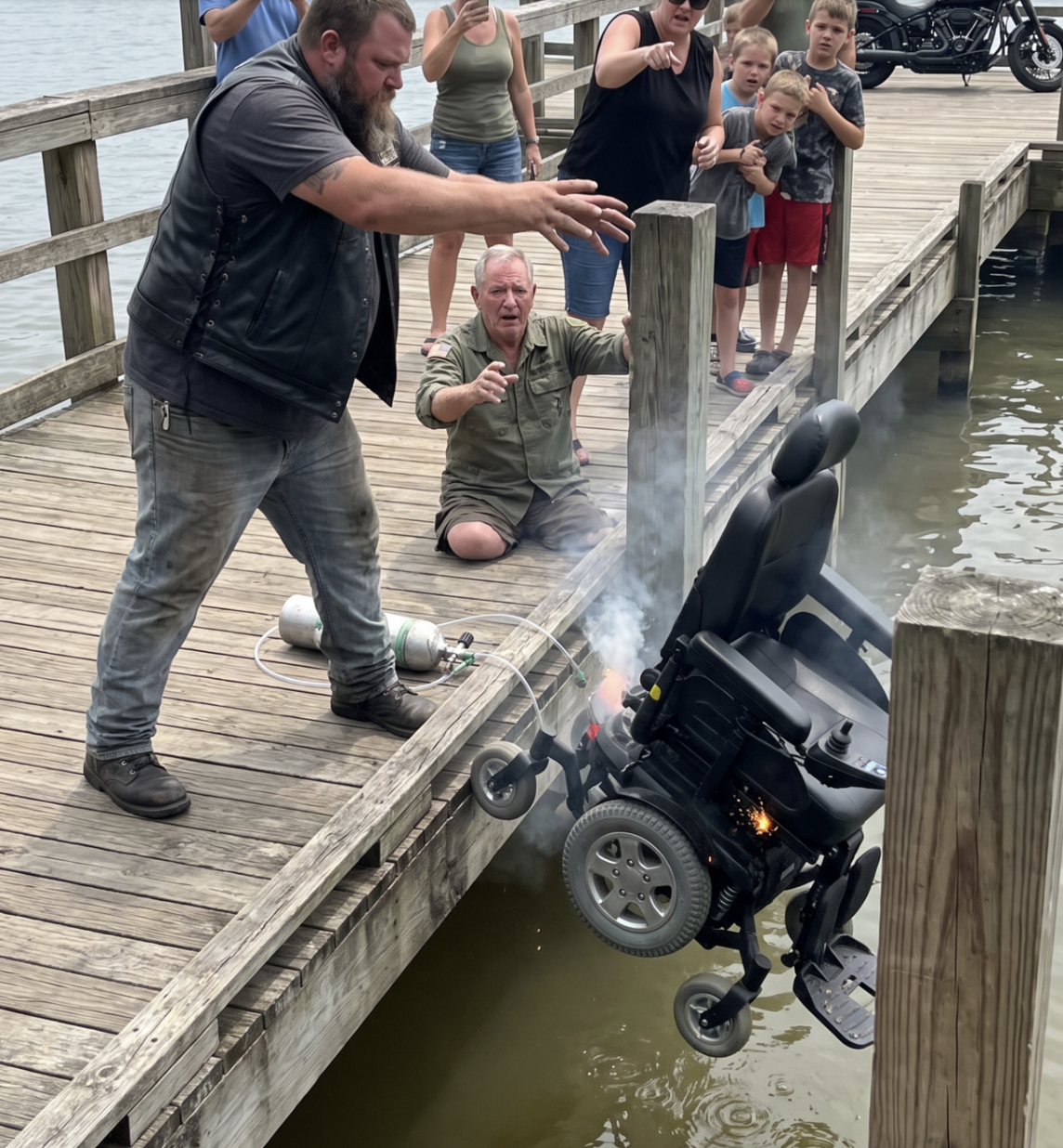
At the place where his old chair had entered the lake, Walt stopped and looked through the boards at the dark water below.
“You saved my life,” he said.
Hammer stood behind him.
“Saved some kids too.”
“Still angry.”
“Allowed.”
“May stay angry.”
“Your schedule.”
Walt turned the chair.
“Tommy ever tell you what happened at the bridge?”
“Pieces.”
“He froze.”
Hammer’s face tightened.
Walt continued before Ray could defend his father.
“Everybody froze. I was his sergeant. I just froze in a direction that looked useful.”
He explained that Thomas had climbed back into the overturned vehicle after escaping because another soldier remained trapped. The embankment collapsed during the second attempt. Walt went after both men and lost his legs when the bridge support shifted.
Thomas had not been a coward.
He had been nineteen.
He survived because Walt carried him, but Walt survived the first impact because Thomas held a beam off his chest until help arrived.
They had saved each other.
Thomas spent the rest of his life telling only half the story.
So had Walt.
Hammer removed his father’s letter from his vest. The final pages remained sealed along a fold he had never opened.
He handed it to Walt.
The veteran read silently.
Thomas had written that he returned to Walt’s porch each year because sitting beside the man was the only hour he did not feel required to deserve survival. He apologized for stopping after Ray entered prison.
He believed his son’s mistakes proved he had poisoned another life.
Walt closed the letter.
“Your father was wrong.”
“About which part?”
“You.”
Hammer looked away.
Walt placed Thomas’s compass in Ray’s scarred palm.
“This belongs to you.”
Hammer closed Walt’s fingers around it again.
“Chair needs one honest thing.”
Walt hung the compass behind the seat.
Then he drove toward the end of the dock, carrying two dead men’s unfinished conversation with him.
Part 6 — Every Second Saturday at Riverbend Landing
The Iron Saints did not repair their clubhouse roof that summer.
Instead, members spread tarps above the workshop and placed buckets beneath the worst leaks. Local roofers eventually heard what happened and donated labor, although Hammer insisted the club purchase every piece of lumber.
The original viral video disappeared beneath the longer recording.
For several weeks, strangers drove to Riverbend Landing hoping to photograph Hammer and Walt together. Most left disappointed.
Hammer avoided cameras.
Walt charged ten dollars per interview question and donated the money to Daniel Ruiz’s mother. That reduced the crowd faster than any sign could have.
The mobile repairman who installed the counterfeit battery was charged with fraud and reckless endangerment after investigators found seven other veterans using altered packs. Three showed signs of dangerous overheating.
Doc inspected them all.
No one was billed.
Riverbend Landing added a fire-resistant charging area away from the wooden dock. The county installed emergency guidance for mobility-device battery failures, and Switch taught our staff how to recognize heat, odor, swelling, popping sounds, and vapor without turning the training into a story about heroes.
“Warning signs first,” she said. “Names later.”
Walt returned every second Saturday.
He arrived at 8:00, ordered black coffee, and inspected the blank metal strip beneath his unit insignia. It remained empty.
The new chair carried scratches within a month. Catfish slime marked the fishing-rod holder. A wheel cover cracked when Walt misjudged the bait-shop doorway.
He brought it to Hammer’s workshop.
“You promised repairs?” Walt asked.
“Never promised.”
“Your dead father did.”
“Old man keeps spending my time.”
Hammer repaired the cover.
Walt began staying at the shop. He labeled donated equipment, insulted Colt’s welding, and taught younger veterans how to transfer without apologizing for taking space.
Daniel Ruiz’s mother visited monthly.
Sometimes she sat in the chair’s former storage corner and listened to Walt complain about its turning radius. She said Daniel would have liked him.
Walt answered that Daniel clearly had good judgment.
Hammer and Walt never discussed forgiveness.
They discussed battery temperatures, fishing line, coffee, old engines, and whether Thomas Dawson had been the worst card player in the United States Army.
That was enough.
On the anniversary of the bridge operation, Walt placed two unopened beers beside Thomas’s compass. Hammer sat next to him on the dock until sunset.
Neither man drank.
Before leaving, Walt handed one can to Ray.
“For your father.”
Hammer placed it inside his saddlebag.
The second remained beside Walt.
“For me,” he said.
The lake went dark around them.
No cameras were raised.
Part 7 — The Blank Plate Beneath the Insignia
One year after the wheelchair went into Chickamauga Lake, Riverbend Landing hosted its first Roll and Ride fishing morning.
The name embarrassed Hammer.
Walt chose it.
Twenty-three disabled veterans arrived with wheelchairs, scooters, prosthetic limbs, canes, and enough criticism of the event’s organization to prove they felt welcome.
The Iron Saints handled equipment inspections. Riverbend staff carried breakfast to the dock. Elena Ruiz distributed fishing licenses purchased from a small fund bearing Daniel’s name.
Nobody made the veterans pose beside the motorcycles.
Near noon, a young Marine named Caleb noticed the blank strip beneath Walt’s unit insignia.
“You forget to engrave it?”
“No.”
“What belongs there?”
Walt looked toward Hammer, who was repairing a loose rod holder with a wrench between his teeth.
“Something might, someday.”
Caleb did not understand.
He would later.
After lunch, Walt drove to the exact board where Hammer had torn his hand from the smoking chair. The lake below looked ordinary. Boats crossed the distant channel. A child dropped bread for ducks.
Walt removed Thomas Dawson’s compass from behind his seat.
For a moment, I thought he intended to throw it into the water.
Instead, he gave it to Hammer.
“Your turn to carry him.”
Hammer accepted it.
Walt then produced a small engraved plate from his medication bag. He had finally decided what should occupy the blank space.
It carried no soldier’s name.
No date.
No declaration about courage.
Just three words:
WE BOTH RETURNED.
Hammer installed it beneath the old combat-engineer insignia.
His hands shook once.
Then they steadied.
At sunset, Walt drove up the accessible path beside Hammer’s slowly moving Harley. Forty Iron Saints followed at walking speed, engines idling low enough that the veteran could hear the lake beside them.
The chair bore scratches now.
The black paint had faded near the footrest. Helen’s photograph remained dry beneath the armrest, Daniel’s cushion carried Walt’s weight, Thomas’s compass rested in Hammer’s saddlebag, and the old unit insignia caught the last red light above the water.
People turned to watch.
This time, nobody mistook the sound.
Drop HAMMER in the comments and follow the page if you want the next chapter about the riders who rebuilt a veteran’s road.