
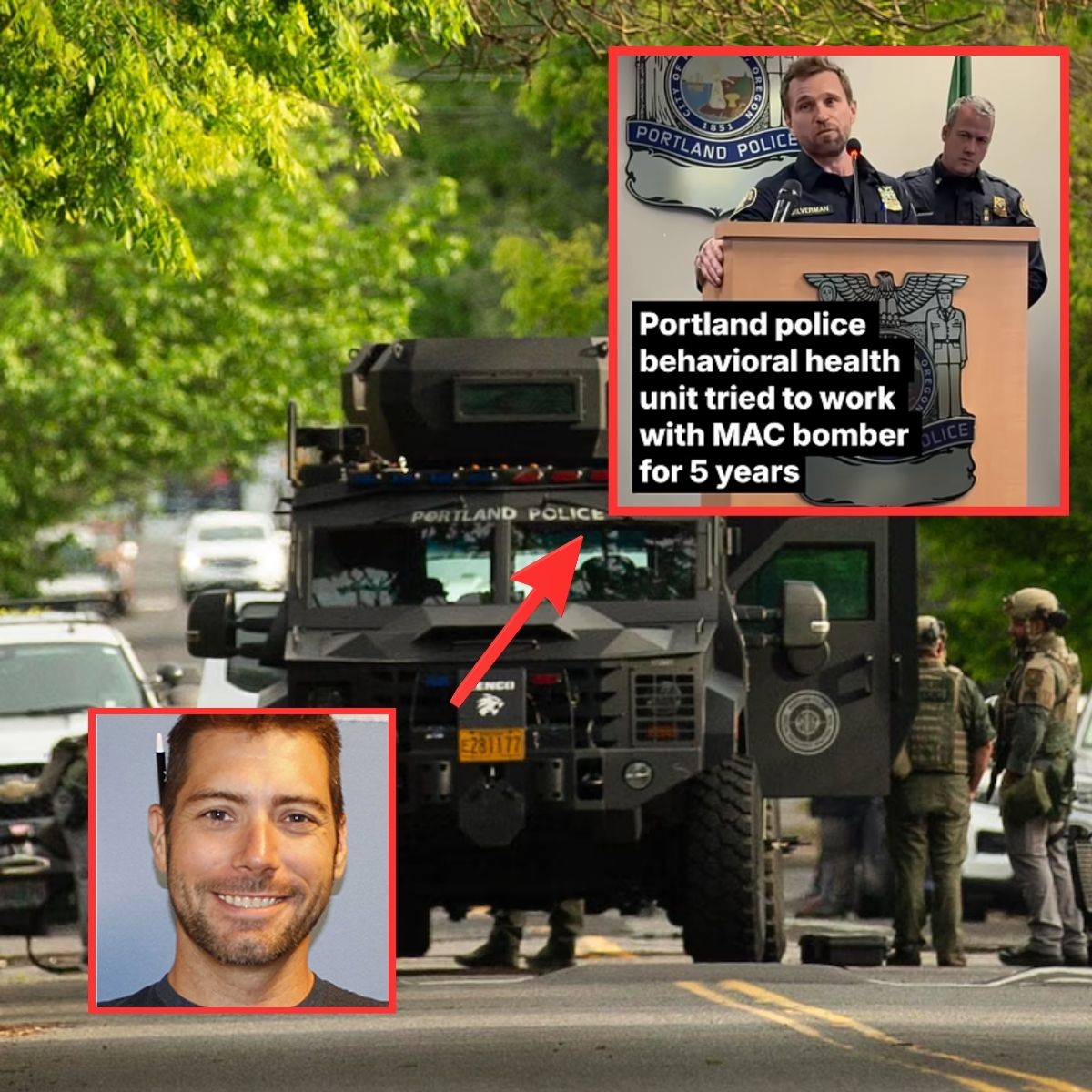
Portland, Oregon – On a fateful May morning, the city of Portland narrowly escaped witnessing one of the bloodiest attacks in modern history. If not for a random traffic collision on the highway, Bruce Whitman’s explosive-laden SUV could have reduced the Multnomah Athletic Club (MAC) to rubble. However, behind this “stroke of luck” lies an even more horrifying truth: the security and healthcare systems had 1,825 days to stop the perpetrator, yet they chose to stand by.

A 5-Year File: A Foretold Time Bomb
The post-incident investigation has exposed an alarming record regarding Bruce Whitman, a former employee of the MAC club. Far from being someone who “suddenly turned evil,” Whitman had been on the radar of the Portland Police Bureau’s Behavioral Health Unit (BHU) since January 2021.
For five years, teams of psychiatric experts and police officers made numerous direct contacts with Whitman. However, every time they arrived, Whitman refused to cooperate. He lived in a delusional world of resentment following his termination, firmly believing he was being persecuted and frequently threatening to “burn down” his former workplace.
More strikingly, the community surrounding Whitman did everything they could. Ten neighboring families, in absolute terror, co-signed a letter to Whitman’s family, pleading with them to seek treatment for him as they feared for their own lives. Yet, these cries for help fell into the void of legal regulations.
The Paradox of “Releasing the Tiger Back to the Wild”
Why was such a dangerous individual still able to walk free and manufacture bombs? The answer lies in the excessively high legal threshold for involuntary mental health treatment in Oregon. According to statistics, approximately 94% of individuals held for mental health evaluations in the state are released after just two weeks because they do not meet the strict criteria of “imminent danger” required for long-term civil commitment.
Whitman was the living embodiment of this loophole. He was held for psychiatric evaluation in 2022 and as recently as February 2026, but both times he was released after a short period of supervision. With each release, Whitman’s resentment only festered, and he began quietly preparing for a large-scale destructive plan.
Banning Guns but… Forgetting the Bombs
The American legal system often prides itself on “Red Flag” laws intended to prevent gun violence. In Whitman’s case, this law worked “effectively” in a narrow sense: police successfully confiscated his firearms on two separate occasions.
However, losing his firearms did not stop Whitman. He pivoted to a weapon that was easier to manufacture and possessed even greater destructive power: Improvised Explosive Devices (IEDs). Right in his bedroom, under the watch of a mother who believed her son was “recovering,” Whitman established a bomb-making workshop. With 20 propane tanks and dozens of pipe bombs filled with industrial-grade explosive powder, he transformed his SUV into a mobile ammunition dump.
The Calm Before the Storm
One of the most shocking details is the psychological shift in Whitman just before the day of the attack. The suspect’s mother shared that she found her son suddenly “calmer and more stable” recently. She mistook this for a sign of healing, but criminal psychologists suggest otherwise: it was the state of “extreme resolve” of a man who had already chosen his day to die and wanted to take as many people with him as possible.
He chose to “blend in” to deflect suspicion, quietly installing complex detonator circuits without raising any red flags for his family.
A Lucky Ending and Unhealed Scars
On that morning, the IED-laden SUV sped down the highway, heading straight for downtown Portland where hundreds of MAC club members were gathered. Only because of a sudden collision that caused the vehicle to catch fire and expose the explosive devices was the tragedy averted. Whitman died at the hospital due to severe injuries, taking all his secrets and motives to the grave.
The incident ended with the death of the perpetrator, but it leaves behind a haunting question for all of America: Whose liberty are we protecting? The right of a dangerously delusional individual to refuse treatment, or the right of hundreds of innocent citizens to live in safety?
The event in Portland was not a random occurrence. It is a damning indictment of a fragmented behavioral health surveillance system, where pieces of danger are reported daily by neighbors and coworkers but are never connected in time to prevent a catastrophe.
If we continue to let “time bombs” like Bruce Whitman slip through the cracks due to bureaucratic legal hurdles, Portland’s luck today may not repeat itself a second time.