
The silence that descends upon Anfield after a monumental era ends is not merely an absence of noise; it is a vacuum. When a manager who has redefined the identity of a club—who has delivered the Holy Grail of a Premier League title and restored a global aura—departs, the following chapter is never just about tactics. It is about psychology. It is about transition. It is about whether the successor can withstand the gravitational pull of the past.
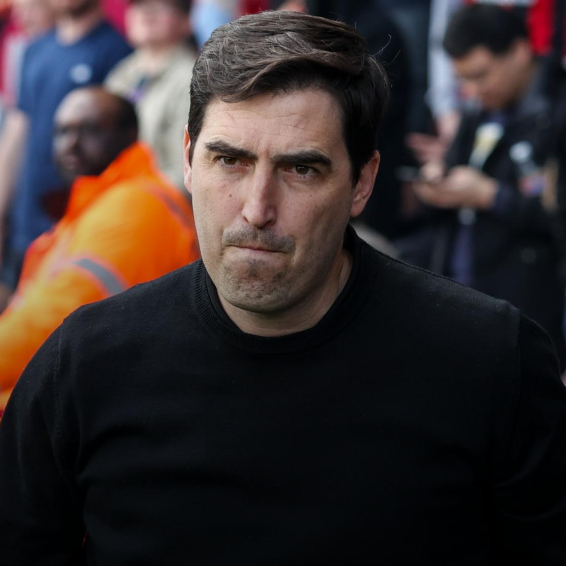
It is into this heavy, expectant atmosphere that Andoni Iraola has stepped. The appointment has been met with a spectrum of reactions, ranging from clinical excitement among data analysts to palpable apprehension among the Anfield faithful. Perhaps no voice carries the weight of that anxiety quite like Jamie Carragher.
Carragher, whose loyalty to the club is matched only by his pragmatic approach to its structural health, recently voiced a concern that is echoing through the pubs of Merseyside and the boardrooms of Fenway Sports Group alike. Discussing the transition, Carragher noted:
“The thing I always go back to is: we had a manager who won the league. The performances last season were so poor, I get it, I understand. But a manager from Bournemouth who’s never had much European experience managing a Champions League season, three games a week—that’s a risk. I do think it’s a risk.”
This sentiment, while framed through the lens of caution, is the definitive starting point for the conversation surrounding the Iraola project. Is this a genius pivot to a modern, tactical mind, or is it a gamble that underestimates the unique pressures of the Liverpool hot seat?
The Shadow of the Legend
To understand Carragher’s apprehension, one must first confront the “Successor’s Dilemma.” Liverpool spent nearly a decade under the total-football stewardship of Jürgen Klopp. Klopp was more than a coach; he was the primary architect of the club’s modern culture. His departure left a void that is, frankly, impossible to fill like-for-like.
Carragher’s focus on the fact that Liverpool had a manager who won the league is a poignant acknowledgment of how high the bar was set. In the Premier League era, success is defined by consistency, and greatness is defined by silverware. When you replace a serial winner, you are essentially asking the fanbase to trade the certainty of “proven success” for the potential of “theoretical brilliance.”
The “risk” Carragher highlights is not necessarily a slight against Iraola’s intelligence. Rather, it is a critique of the jump in scale. Managing Bournemouth—a club where expectations are capped by survival and mid-table consolidation—is fundamentally different from managing Liverpool, where a draw at home is treated as a minor crisis.
The European Ceiling
Carragher’s most pressing concern—the lack of European experience—is a legitimate tactical hurdle. The Champions League is not just a competition; it is a different sport entirely.
In the Premier League, you are playing teams you face twice a year, often with a clear stylistic familiarity. In the Champions League, you are entering a theater of the unknown. You are playing against different tactical cultures: the rigid defensive blocks of Italy, the high-pressing transitions of Germany, the technical dominance of Spain.
Managing the “three games a week” intensity is where many promising managers have seen their projects unravel. It requires a level of squad management, rotation, and tactical flexibility that Iraola, for all his plaudits, has not yet had to exercise at the highest level.
When playing midweek against a team like Real Madrid or Bayern Munich, and then turning around for a Sunday lunchtime kickoff against a gritty, direct Premier League side, the margin for error is non-existent. Carragher’s fear is that the learning curve for Iraola will be too steep, and the “tuition” for that education will be paid in points—points that, at the top of the table, are the difference between a trophy and a disappointment.
The Case for the “Risk”
However, to stop at the “risk” narrative is to miss why Liverpool’s recruitment team—arguably one of the best in the world—looked at Iraola in the first place.
If we look at the data, the picture changes. At Rayo Vallecano, Iraola turned a team with limited resources into a side that terrified the giants of La Liga. At Bournemouth, he implemented a high-octane, aggressive pressing system that prioritized verticality and organized chaos.
Modern football is moving away from the “established winner” model. We are seeing a shift toward the “process” model. Clubs are no longer looking for a manager who has won a trophy; they are looking for a manager who has the intellectual framework to build a sustainable system.
Iraola is a disciple of the modern, tactical evolution. His teams are drilled to be physically relentless. If Liverpool’s goal is to transition from the heavy-metal football of the last decade to a more controlled, yet equally aggressive, style of play, Iraola represents the cutting edge of that philosophy. The “risk” Carragher identifies is actually the cost of innovation.
The Tactical Translation
Can Iraola’s system translate? At Bournemouth, the pressure was lower. The consequences of a missed defensive line were mitigated by the fact that the opponent was rarely clinical enough to punish them.
At Liverpool, the scrutiny is absolute. Every pass is analyzed, every substitution debated, and every defensive lapse magnified. The challenge for Iraola is to maintain his tactical identity—the pressing, the quick transitions, the high line—while introducing the necessary pragmatism that European football demands.
There is a fear that his rigid adherence to his system could leave Liverpool vulnerable in the Champions League, where tactical flexibility is often rewarded more than ideological consistency. Yet, this is exactly what makes the appointment so compelling. If it works, it is a masterstroke. If it fails, it will be cited as the reason for the decline.
The Verdict of the Anfield Faithful
Liverpool fans are perhaps the most discerning in England. They are fiercely protective of their club’s standards, but they are also deeply sentimental. They are currently in a state of mourning for the Klopp era, while simultaneously trying to embrace the new reality.
The discourse among the fans mirrors Carragher’s: there is an excitement about the “new way,” tempered by a visceral fear of losing the “winning way.”
If Iraola starts well, the “risk” narrative will be forgotten, replaced by the narrative of a “bold new era.” If he struggles, the comparisons to the previous regime will be immediate, and the pressure will mount exponentially. The irony is that the fans who are most skeptical now are the ones who will be most vocally supportive if the team displays the grit they associate with the Liverpool shirt.
Conclusion: A High-Stakes Bet
Ultimately, Jamie Carragher is right. This is a risk. But in the landscape of elite football, stagnation is a greater risk than change. Liverpool could have hired a “safe” option—a manager with European experience, a steady hand, and a proven track record. But that, too, would have been a risk: the risk of becoming boring, predictable, and obsolete.
By choosing Iraola, Liverpool has opted for the road less traveled. They are banking on the fact that intelligence, tactical rigor, and a modern approach to the game are more valuable than a resume full of dusty trophies.
The coming season will be a litmus test for the club’s philosophy. It will tell us whether the “Liverpool Way” is tied to a specific individual, or if it is a structural strength that transcends any single manager.
Jamie Carragher has asked the question that every Liverpool fan is secretly pondering: Can he handle it?
We are about to find out. The stones of Anfield have seen legends come and go. Now, they watch with bated breath to see if a new legend—or a cautionary tale—is in the making.