
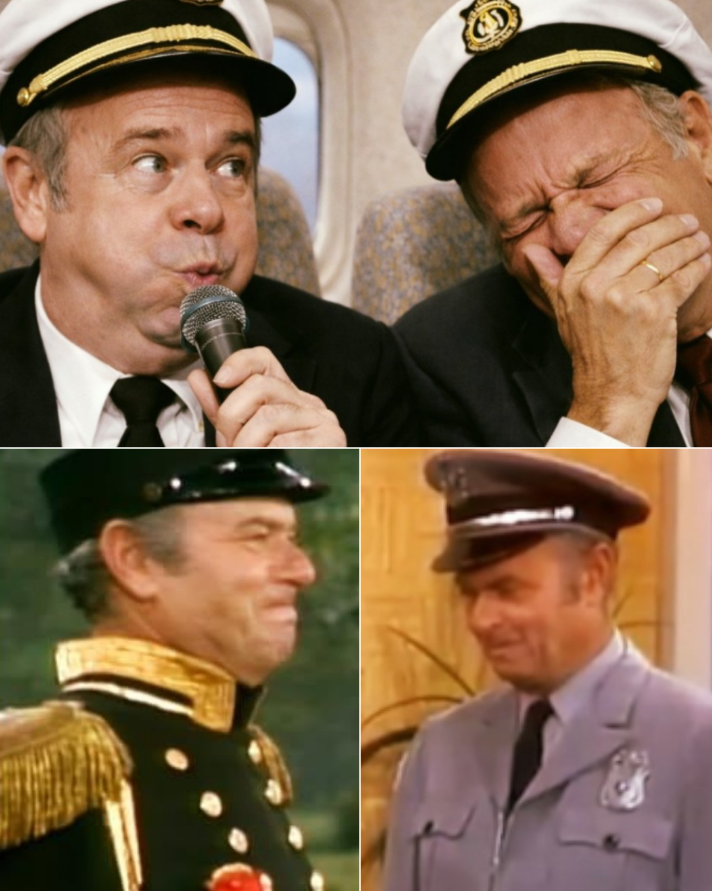
In the hallowed halls of television history, there exists a rare category of moments known as the “corpse.” In theatrical terms, “corpsing” is the act of an actor breaking character by laughing uncontrollably during a performance. While many shows edit these moments out, one legendary variety program turned them into an art form. But even by those high standards, the “Flight Deck” incident—better known to fans as the “Airline Pilot” or “Old Man Pilot” sketch—stands as a monument to the power of unscripted comedic genius.
It was the moment a simple airline sketch took a sudden, bizarre turn into vocal acrobatics and ridiculous sound effects, leaving a comedy titan physically unable to breathe, let alone deliver his lines. This is the story of how Tim Conway, Harvey Korman, and a pair of intercom sound effects “broke” the internet’s favorite funny bone decades before the internet even existed.
The Setup: A Masterclass in Anticipation
To understand the chaos of the “Flight Deck Fiasco,” one must understand the dynamic between Tim Conway and Harvey Korman. On The Carol Burnett Show, Korman was the ultimate “straight man”—a versatile, classically trained actor who could play any role with dignity. Conway was the “assassin”—a comedic predator whose sole mission in life was to make Korman laugh on camera.
The premise of the sketch was deceptively simple: Harvey Korman plays a nervous, high-strung passenger on a commercial flight. He is already on edge, perhaps a bit of a “white-knuckle” flyer. Enter the pilot, played by Tim Conway in his recurring “Old Man” persona. The “Old Man” character was defined by his agonizingly slow movements, his shuffled gait, and a voice that sounded like it was being filtered through a century of gravel and confusion.
The tension in the sketch initially comes from the physical comedy of the Old Man attempting to navigate the narrow aisle of the plane. But the real “Fiasco” began when the action moved to the cockpit—or rather, the intercom system.
The Pivot: When the Script Went Out the Window
The “Flight Deck” sketch was scripted to be funny, but the version that aired was a product of Conway’s relentless desire to surprise his co-star. During the dress rehearsal, the sketch played relatively straight. However, as any fan of the show knows, the live taping was Conway’s playground.
The moment that “broke” Harvey Korman occurred when Conway’s character picked up the flight deck microphone to address the passengers. Instead of delivering the scripted flight information, Conway began an improvised sequence of vocal acrobatics. He didn’t just speak; he transformed the simple act of using a radio into a symphony of bizarre static noises, “popeye” mumbles, and nonsensical sound effects that sounded like a malfunctioning radiator cross-bred with a walrus.
Korman, sitting just inches away, was trapped. As a professional, he tried to maintain the “serious passenger” persona, but as Conway leaned into the microphone, producing a series of “pppbthhh” and “whizz-bang” noises that were never in the script, Korman’s defense began to crumble.
The Exact Second He Lost It
The “Flight Deck Fiasco” reached its peak when Conway decided to describe the flight path. He began making a high-pitched whistling sound—a “vocal slide”—to represent the plane taking off, followed by a sudden, violent “thud” sound made entirely with his mouth.
The camera catches the exact second Korman’s soul leaves his body. His shoulders begin to shake. He bites his lip so hard it turns white. He looks away from Conway, staring desperately at the “window” of the plane set, trying to find any anchor in reality. But Conway, sensing blood in the water, doubles down. He moves the microphone closer to his mouth and delivers a final, wet, sputtering sound effect that implies the engines are being powered by a very tired hamster.
Korman explodes. He doesn’t just chuckle; he doubles over, gasping for air, his face turning a shade of purple that concerned the lighting technicians. He is “gasping for air,” literally unable to inhale because his diaphragm is locked in a spasm of genuine, hysterical laughter.
Why It “Broke the Funny Bone” of Generations
Why does this specific moment still resonate today? Why has a sketch from the 1970s become a viral sensation in the 2020s?
- The Authenticity of the Break: In an era of highly polished, single-camera sitcoms and edited-to-perfection content, seeing two masters of their craft lose control is deeply humanizing. We aren’t just watching a sketch; we are witnessing a genuine friendship and a shared moment of joy.
- The “Old Man” Mystery: Tim Conway’s ability to remain perfectly in character while causing total destruction around him is a feat of psychological warfare. He never cracked. He stayed in that slow, shuffling persona, watching Korman die of laughter with a look of innocent confusion that only made the situation funnier.
- The Sound Effects: Comedy is often about the unexpected. There is no logical reason for a pilot to make “boing” noises over the intercom, and it is that absurdity—the “vocal acrobatics”—that bypasses the brain and hits the “funny bone” directly.
The Legacy of the Fiasco
The “Flight Deck Fiasco” became a blueprint for what we now see on Saturday Night Live when actors “break” during a sketch. However, unlike modern breaks which can sometimes feel forced, the Conway-Korman breaks were legendary because Korman desperately wanted to stay in character. He hated that he couldn’t stop himself, which made the struggle against the laughter a comedy sub-plot in its own right.
Decades later, fans still “cry with laughter” when the clip appears on social media feeds. It serves as a reminder that the best comedy isn’t always what is written on the page—it’s what happens in the spaces between the lines, when two geniuses decide to play, and one of them ends up gasping for air.
The “Flight Deck Fiasco” wasn’t just a prank; it was a gift. It was a moment of unscripted brilliance that reminded us all that sometimes, the most professional thing you can do is completely lose your mind with your best friend.
Watch the Legend Live
If you look for the “Tim Conway Airline Pilot” sketch, you will see the exact second where the “vocal acrobatics” begin and Harvey Korman realizes he is not going to make it through the scene alive. It remains, quite simply, the funniest flight in the history of aviation.