
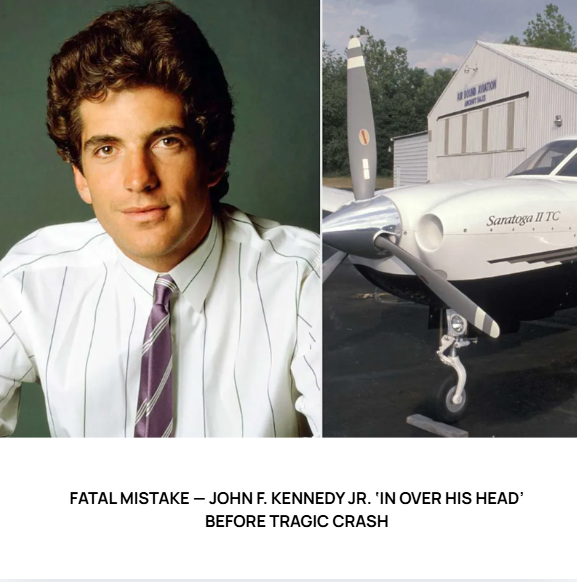
On the night of July 16, 1999, the world stood still as news broke that a small Piper Saratoga aircraft, piloted by John F. Kennedy Jr., had vanished over the Atlantic Ocean. On board were John, his wife Carolyn Bessette-Kennedy, and her sister Lauren Bessette. The subsequent discovery of the wreckage and the recovery of their bodies marked the end of an era and the final, devastating chapter of the “Kennedy Curse.”
Recent retrospectives, including insights shared in various television documentaries and articles, have reignited the conversation surrounding that fateful night. The central thesis emerging from contemporary analysis is a haunting one: John F. Kennedy Jr., despite his charisma, athleticism, and resources, was “likely over his head” long before the clouds obscured the horizon. This article explores the intersection of high-altitude expectations, psychological pressure, and the technical failures that led to one of the most publicized tragedies in American history.
Part I: The Making of a Prince
To understand the crash, one must first understand the man. John F. Kennedy Jr. was born into the closest thing America had to a royal family. From the moment he saluted his father’s casket as a three-year-old, he was a symbol of national hope and tragic legacy.
The Burden of Expectation
Living as “John-John” meant living under a microscope. Every career move—from failing the bar exam twice (becoming the “Hunk who Flunked”) to launching George magazine—was scrutinized. Unlike his father or his uncles, John did not seek traditional political office early in life. Instead, he sought to redefine the Kennedy brand for a new generation. However, the expectations of the public and the internal pressure of the Kennedy lineage created a unique psychological landscape. He was expected to be superhuman, yet he was inherently, and sometimes dangerously, human.
The Pursuit of Aviation
Aviation was, for John, a way to escape the paparazzi and the physical constraints of life in Manhattan. In the air, he was just another pilot. However, experts suggest that his approach to flying may have been influenced by a “Kennedy bravado”—a characteristic trait of the men in his family who often pushed boundaries. He began flying in the 1980s but didn’t receive his license until 1998. By July 1999, he had approximately 300 hours of flying time, a relatively low number for the complex conditions he would face.
Part II: The Fateful Flight – A Chain of Errors
The crash was not the result of a single catastrophic failure but a “chain of errors,” a common phenomenon in aviation disasters.
1. The Delayed Departure
The flight was originally scheduled to depart from Essex County Airport in New Jersey in the late afternoon, while there was still daylight. However, Lauren Bessette was delayed at work, and the flight didn’t take off until after 8:00 PM. By the time the Piper Saratoga was over the water, darkness had fallen completely.
2. The Physical Constraint: The Broken Ankle
One of the most overlooked factors in the crash was John’s physical condition. He had recently broken his ankle in a paragliding accident and had only had the cast removed a day before the flight. While he was cleared to fly, his ability to operate the rudder pedals—essential for stabilizing the plane during a “graveyard spiral”—was likely compromised. He was flying a high-performance aircraft with a healing injury, at night, over water.
3. Haze and Spatial Disorientation
The weather that night was described as “hazy.” While not a thunderstorm, the haze created a “milk bowl” effect where the horizon disappeared. For a pilot not yet certified for Instrument Flight Rules (IFR), this is a death trap. JFK Jr. was flying under Visual Flight Rules (VFR), meaning he needed to see the ground or the horizon to navigate. When the horizon vanished, he succumbed to Spatial Disorientation.
In aviation terms, this is when the inner ear tells the brain the plane is level, while in reality, it is banking or diving. Without looking at his instruments—or without the training to trust them over his own senses—John likely tried to “correct” the plane’s movement, inadvertently driving it into a steep, high-speed dive known as a “graveyard spiral.”
Part III: “Over His Head” – The Psychological Component
The phrase “likely over his head” refers to more than just the flight conditions. It refers to the state of John’s life in the summer of 1999.
Marriage and Magazine Stress
At the time of the crash, George magazine was struggling financially, and rumors of marital strife between John and Carolyn were rampant in the tabloids. Carolyn was reportedly struggling with the intense pressure of being a Kennedy and the constant harassment from photographers. Friends have since noted that John was “distracted.” In aviation, a distracted pilot is a dangerous pilot. The decision to fly that night, despite the late hour and the haze, may have been driven by a desire to please his family and get to his cousin Rory Kennedy’s wedding on Martha’s Vineyard.
The “Kennedy” Factor
There is a documented history of “risk-taking” behavior in the Kennedy family. From Joseph Kennedy Jr.’s fatal mission in WWII to the various accidents involving Teddy and others, there was a sense of invincibility that often bordered on recklessness. John was aware of this legacy. Some analysts argue that he felt he had to be the one to fly them there—that calling a professional pilot or taking a commercial flight would be an admission of limitation that a Kennedy could not afford.
Part IV: The Investigation and the Aftermath
The NTSB (National Transportation Safety Board) investigation was exhaustive. They recovered the wreckage from the sea floor and examined every component.
The Findings
The final report was blunt: the cause of the accident was “the pilot’s failure to maintain control of the airplane during a descent over water at night, which was a result of spatial disorientation.” There was no evidence of mechanical failure. The engine was working; the fuel was sufficient. The failure was entirely human.
The Media Reaction
The world’s reaction was a mix of grief and judgment. While millions mourned the loss of “America’s Prince,” aviation experts were quick to point out the “avoidability” of the crash. It became a cautionary tale used in flight schools across the globe. The tragedy was compounded by the loss of the Bessette sisters, two young women who were not part of the Kennedy bloodline but were caught in its orbit.
Part V: Legacy and Lessons
Twenty-five years later, the crash of JFK Jr. serves as a complex cultural touchstone.
The End of Camelot
For many, the 1999 crash was the final end of the “Camelot” era. John was the last great hope for a restoration of the Kennedy presidency. His death effectively shifted the family’s influence from the center of the political stage to the wings of history and philanthropy.
Aviation Safety
The tragedy led to a greater emphasis on the dangers of “VFR into IMC” (Visual Flight Rules into Instrument Meteorological Conditions). It highlighted how even wealthy, successful individuals are subject to the laws of physics and the limitations of human biology.
A Humanized Hero
In recent years, the narrative has shifted from seeing John as a fallen god to seeing him as a man who was under immense pressure. By acknowledging that he was “over his head,” we don’t diminish his memory; rather, we humanize him. He was a man trying to navigate a life of impossible standards, and on one hazy night, the variables simply became too many to manage.
Conclusion: The Final Descent
John F. Kennedy Jr. lived his life in the public eye, but he died in the lonely, silent darkness of the Atlantic. The article from Yahoo Entertainment and the documentaries it cites remind us that the “Kennedy Curse” was often just a combination of high-risk lifestyles and the heavy weight of expectations.
John was not a victim of fate, but a victim of a moment where his skill could not match his ambition. He was a man who loved the sky because it offered him freedom, but in the end, the sky was where he met the limits of the Kennedy name. As we look back, we see a figure who was quintessentially American: bold, beautiful, flawed, and ultimately, gone too soon.
The wreckage of the Piper Saratoga rests as a reminder that even those born with the world at their feet must respect the elements. John F. Kennedy Jr. will always be remembered not just for how he died, but for the grace with which he carried the heaviest name in history—until the burden simply became too much to carry through the clouds.