
The café had gone quiet long before anyone realized it. Not a peaceful quiet, but the heavy, suffocating sort—the kind that settles when people decide it’s safer not to see what’s happening right in front of them. It was the sound of a dozen breaths held in unison, of eyes glued to tabletops, and of the sudden, sharp clinking of silverware against ceramic that felt like a scream in the stillness.
Three men, clad in scuffed leather and smelling of stale exhaust and aggression, had claimed the center of the room. They hadn’t asked; they had simply occupied. Their heavy boots thudded against the hardwood floor like a heartbeat out of sync. Their laughter, jagged and cruel, cut through the filtered morning light, making the young waitress behind the counter tremble so violently that she wiped the same clean spot on the Formica over and over again.
No one wanted trouble. In a town like this, trouble usually meant a broken window or a bruised jaw, and most people here had too much to lose. So, they looked away.
Except for Carla.
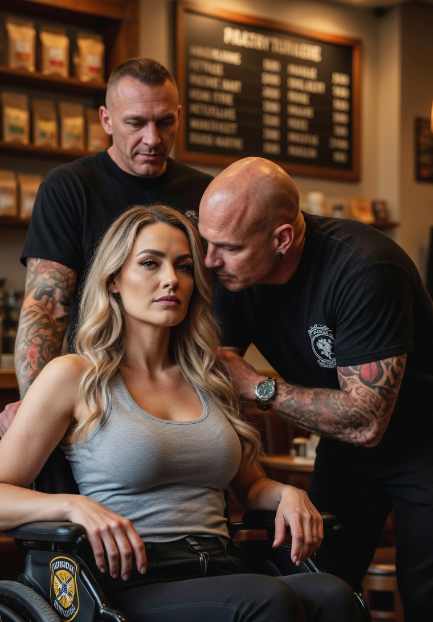
She sat in the far corner, tucked away at a small circular table. A cup of black coffee sat before her, long since gone cold, its surface undisturbed. Carla didn’t look like the centerpiece of a confrontation. She sat in a sleek, high-performance wheelchair. She wore a simple gray tank top that revealed toned, muscular arms, black jeans, and dark hair that fell in loose waves over her shoulders.
At a glance, a casual observer might think life had taken too much from her. Her legs were still, and the chair was a permanent fixture of her existence. But those who looked closer felt something else. It wasn’t pity. It was stillness. The kind of stillness that doesn’t come from a lack of movement, but from having survived things that would have shattered most people. Her eyes—dark, steady, and hauntingly calm—followed the bikers. She wasn’t afraid. She wasn’t challenging them. She was simply aware.
And that awareness was what drew the leader in.
Vince was a man who lived for the flicker of fear in a stranger’s eyes. When he didn’t see it, he felt insulted. He stood up slowly from his stool, rolling his shoulders, the leather of his jacket creaking. His two companions, sensing the shift in his mood, followed like shadows.
They walked toward the corner. Every step was a declaration of ownership. Every thud of their boots was a threat.
“Well,” Vince said, stopping just inches from her table. He loomed over her, his shadow swallowing her small frame. “Look at this.”
He leaned in, his eyes scanning her with a judgmental, predatory curiosity. “A pretty thing like you, all by herself. Seems like a waste of a good morning.”
Carla didn’t blink. She didn’t recoil from the smell of tobacco on his breath. “I’m fine,” she said. Her voice was quiet, melodic, yet possessed the weight of a stone.
That should have been the end of it. But to a man like Vince, her calm felt like a slap in the face. It felt like defiance. He needed her to cower. His eyes dropped, searching for a weakness, and landed on a small, polished metal badge fixed to the side of her wheelchair. It was a simple insignia—a winged dagger over a shield. To the uninitiated, it was a trinket. To those who knew, it was a mark of the elite.
“What’s this?” Vince sneered, reaching out a greasy finger to tap the metal. “You a fan of the army or something? Buy this at a surplus store to feel special?”
Carla’s gaze sharpened. The temperature in the room seemed to drop five degrees. “I earned it,” she replied.
A beat of silence followed. Then, Vince erupted. It was a loud, ugly sound that echoed off the walls. “You earned it?” he repeated, looking back at his friends who joined in the mockery. “Yeah, right. What did you do? Trip over a cable in the office? They letting people like you into elite units now just to fill a quota?”
The café shrank into itself. A few patrons looked up, their faces twisted with a mix of shame and horror, but no one moved.
In a booth nearby, a young man named Elias—a soldier home on leave—clenched his fists so hard his knuckles turned white. He knew that badge. He knew the Special Operations unit it represented. He knew the legend of the “Silent Shield” team that had been caught in an ambush in the mountains of the Hindu Kush two years ago. He knew that only one person had stayed behind to hold the line so the rest could escape.
Elias looked at Carla, then at the three thugs. He saw Vince place both hands on the arms of her wheelchair, invading the only space she had left.
“You got an attitude problem, sweetheart,” Vince whispered.
Then, he shoved her.
It wasn’t a playful nudge. It was a violent, disrespectful heave. The wheelchair lurched forward, the wheels skidding. Carla’s table slammed aside, and her cold coffee spilled across her lap, soaking into her jeans and splashing onto the floor.
Gasps erupted from the patrons—quick, sharp intakes of breath—before the silence returned, heavier than before.
Carla looked down at the mess on her lap for a brief second. Then, she looked back up at Vince. Her expression hadn’t changed, but something behind her eyes had shifted. The calm was gone, replaced by something colder, sharper, and infinitely more dangerous. It was the look of a predator who had decided the time for patience was over.
Elias couldn’t take it anymore. He stood up, but he didn’t head for the bikers. He walked out the front door. He pulled out his phone and made a call he had been told never to make unless it truly mattered—a direct line to a “emergency contact” provided to his unit.
“Sector four café,” Elias said into the receiver, his voice trembling with a mix of rage and reverence. “They’re mocking the Captain. It’s turning physical.”
“ETA three minutes,” a voice responded. The line went dead.
Inside the café, time slowed to a crawl. The bikers, emboldened by the lack of interference, pulled up chairs around Carla, cornering her against the wall.
“What’s wrong now?” Vince sneered, leaning back and propping his dirty boots on the edge of her overturned table. “Not so tough anymore? Where’s that ‘earned’ medal taking you now?”
One of his cronies flicked a sugar packet at her. It bounced off her shoulder and fell into the puddle of coffee on the floor. They laughed, the sound grating and hollow.
Carla sat perfectly still. Her hands rested lightly on the arms of her chair. Her posture was perfect. Her breathing was steady. She was a statue of bronze amidst a sea of trash. And somehow, her refusal to break made them angrier.
Vince reached out, his hand closing around the badge on her chair, intending to rip it off. “I think I’ll take this as a souvenir. You don’t deserve to carry—”
He never finished the sentence.
A new sound broke through the air. It wasn’t the sound of voices or plates. It was the deep, rhythmic thrum of high-displacement engines. Not the erratic roar of motorcycles, but the disciplined, low-frequency growl of heavy-duty SUVs.
Every head in the café turned toward the windows. Two matte-black SUVs rolled up to the curb. They didn’t park; they occupied the space. The doors opened in perfect synchronization.
Eight men stepped out.
They didn’t wear uniforms. They wore tactical flannels, dark jeans, and boots that had seen more miles than the bikers’ motorcycles ever would. There were no badges, no insignias, and no shouted commands. There was only presence. The kind of presence that comes from men who have seen the end of the world and decided to come back anyway.
They moved toward the entrance. They didn’t rush. They didn’t look aggressive. They moved with the terrifying certainty of a landslide.
The bell above the door rang once as they entered. Suddenly, the café didn’t belong to the bikers anymore. It didn’t belong to the terrified patrons or the trembling waitress. The air in the room changed instantly—the pressure rose, making it hard to breathe.
The bikers didn’t notice at first. They were too busy laughing at their own cruelty. But Carla noticed. Her eyes shifted toward the door. For the first time, a small, knowing smile played at the corner of her lips. It wasn’t relief. It was recognition.
Vince felt the shift in the room. He turned around, his sneer still in place. “Hey! This is a private party! Get lost!”
The eight men didn’t stop. They didn’t spread out to surround the bikers. They didn’t need to. They simply walked toward the corner, their eyes locked onto the mess on the floor and the hand Vince still had on Carla’s chair.
One man stepped forward. He was older than the rest, with salt-and-pepper hair and eyes that looked like they were made of flint. He didn’t look at the bikers. He didn’t even acknowledge their existence. He walked straight to Carla.
The room held its breath. Vince shifted his weight, his bravado beginning to leak out of him like air from a punctured tire. “Hey,” he started, his voice cracking slightly. “You got a problem, old man?”
The man didn’t slow down. He stopped in front of Carla, looking at the spilled coffee, the tilted table, and the three men surrounding her. Then, he looked at her.
“You good, Cap?” he asked. His voice was quiet, but it carried to every corner of the room.
Carla held his gaze. For two seconds, the world stood still. Then, she gave a microscopic nod. “I’m fine, Miller.”
Miller exhaled slowly. It was a sound of controlled restraint. Then, he turned.
And finally, he looked at the bikers.
In that moment, the balance of power didn’t just shift; it vanished. Vince looked into Miller’s eyes and saw a void. He saw a man who didn’t care about his leather jacket, his loud bike, or his petty threats. He saw a man who had been trained to eliminate threats, and currently, Vince was the only threat in the room.
“You have three seconds,” Miller said. There was no heat in his voice. Just a statement of fact. “One.”
Vince’s hand flew off the wheelchair as if the metal had turned white-hot. He backed away, stumbling over his own feet. His friends were already halfway to the door, their faces pale, their eyes wide with the realization of the massive, catastrophic mistake they had made.
“Two,” Miller continued.
The bikers didn’t wait for three. They scrambled out the door, the sound of their frantic footsteps fading as they practically ran to their bikes. The roar of their engines as they sped away sounded like a whimper.
The café remained silent. Miller reached down and easily righted Carla’s table. Another of the eight men—a giant with a beard—produced a clean microfiber cloth from a pocket and began to wipe the coffee from her lap with the gentleness of a brother.
The patrons watched, mesmerized. They realized then that Carla wasn’t just a woman in a wheelchair. She was the heart of a brotherhood. She was the one they had come for.
Elias, standing by the door, snapped a sharp salute. Carla looked at him, gave a small nod of appreciation, and then turned back to her team.
“You’re late,” she said to Miller, her voice finally holding a hint of a tease.
“Traffic was a beast, Cap,” Miller replied, a rare, grim smile touching his face. “Besides, we knew you had it under control.”
As the eight men stood around her, forming a wall of silent, unbreakable protection, the rest of the café finally began to breathe again. They had witnessed something they would never forget: that true strength doesn’t roar, and true honor doesn’t need to shout. It simply stands its ground, waiting for the moment when the silent men walk in and change everything.