
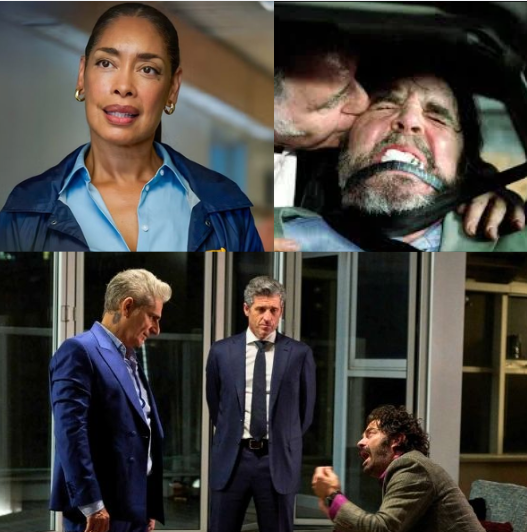
The television landscape is littered with police procedurals and psychological thrillers that promise to “keep you on the edge of your seat.” Most, however, eventually settle into a comfortable rhythm of case-of-the-week predictability. When FOX debuted Memory of a Killer last year, it signaled a departure from that safety. It wasn’t just a show about a crime; it was a visceral exploration of the reliability of the human mind. Now, as the promotional engine roars back to life with the chilling tagline—“The past doesn’t just haunt—it hunts”—it is clear that Season 2 is not just a continuation. It is an escalation.
If Season 1 was a slow-burn descent into the fog of trauma, Season 2 is a high-velocity collision with the truth. As the lines between memory and manipulation blur, Memory of a Killer returns to prove that in the world of high-stakes crime, the most dangerous weapon isn’t a gun—it’s a secret you’ve forgotten you ever kept.
The Haunt vs. The Hunt: A Shift in Narrative Velocity
The brilliance of the inaugural season lay in its atmosphere. We watched as the protagonist navigated a world where their own recollection was the primary antagonist. The past “haunted” them—it was a ghost in the periphery, a nagging feeling of guilt, a fractured image in a mirror. It was psychological. It was internal.
Season 2, however, promises a radical shift in tone. The showrunners have made it clear: the ghosts have stopped lingering and started pursuing. To say the past “hunts” suggests an active, predatory force. In the upcoming episodes, the consequences of Season 1’s revelations are no longer just mental burdens; they are physical threats. The narrative has moved from the abstract to the lethal.
This “ruthless” approach is reflected in the pacing. Early screenings suggest that the contemplative, noir-heavy beats of the first season have been injected with a dose of adrenaline. Every memory is no longer just a clue to be decoded over a glass of whiskey; it is a weapon that can be turned against the holder.
The Architecture of Betrayal: “No One Walks Away Clean”
One of the most provocative hooks for the new season is the insistence that “no one walks away clean.” In the golden age of anti-heroes, Memory of a Killer is pushing the boundary further. It suggests a world where the moral compass isn’t just broken—it’s irrelevant.
The show explores a terrifying reality: if your memories can be manipulated, can your morality be far behind? Season 2 dives deep into the “weaponization of secrets.” We are introduced to a landscape where every character—from the lead detective to the most secondary witness—is hiding something that could destroy them. The tension doesn’t just come from the “whodunnit” aspect of the plot, but from the “who-is-actually-good” dilemma.
As the lines between truth and lies start to blur, the audience is forced into a state of hyper-vigilance. The show challenges us to “trust nothing” and “remember everything.” It creates a unique, participatory viewing experience where the fans must piece together the narrative alongside the characters, knowing full well that the characters themselves might be unreliable narrators.
Breaking the Rules: Technical and Creative Upgrades
FOX has clearly upped the ante for this sophomore outing. Visually, Season 2 appears to have shed the muted, gray palette of the first season for something more high-contrast and visceral. The cinematography utilizes “shaky-cam” urgency and claustrophobic framing to mirror the mental state of the characters. When a “memory” hits, the visual effects aren’t just flashbacks; they are jarring, sensory-overload sequences that aim to “hit the viewer where it hurts.”
Creatively, the stakes have been raised through a “bigger, darker” scope. While Season 1 felt intimate—almost like a stage play at times—Season 2 expands the conspiracy. We move from the personal trauma of one individual to a systemic corruption that threatens an entire city. The “rules” that defined the first season—the standard investigative procedures, the reliance on forensic evidence—are being systematically dismantled. In this new world, the only evidence that matters is the one buried in the subconscious.
The Psychological Toll: Every Secret is a Weapon
What sets Memory of a Killer apart from its peers is its commitment to the “science” of memory. The show doesn’t treat amnesia or trauma as a convenient plot device; it treats it as a devastating reality. Season 2 explores the concept of “False Memory Syndrome” and how it can be used as a tool of warfare.
In the upcoming episodes, we see characters being gaslit not just by others, but by their own minds. This creates a profound sense of unease. When the promo says “Every move could be your last,” it isn’t just talking about physical combat. It’s talking about a mental misstep. One wrong recollection could lead a character down a path of no return.
The concept of the “past hunting” is personified in a new antagonist who doesn’t use brawn to win. This villain uses the characters’ own histories against them, digging up the “shards” of their past and sharpening them into blades. It is a psychological chess match where the board is the human brain.
Why Season 2 is “Ready to Break You”
The marketing for Memory of a Killer has been unapologetically aggressive, using words like “ruthless,” “intense,” and “unclean.” This isn’t just hyperbole; it’s a promise to the audience that the show isn’t interested in a happy ending. It’s interested in the truth, no matter how ugly it is.
The “intensity” of Season 2 comes from its lack of compromise. It refuses to give the audience an easy out. There are no clear-cut villains, and the heroes are often their own worst enemies. By “hitting you where it hurts,” the show targets our fundamental fears: the fear of losing our identity, the fear of being forgotten, and the fear that our past mistakes will eventually catch up to us.
Conclusion: Trust Nothing, Remember Everything
As the premiere of Memory of a Killer Season 2 approaches, the anticipation is palpable. FOX has managed to take a successful premise and evolve it into something far more dangerous. By shifting from the “haunting” to the “hunting,” the series has transformed from a mystery into a survival thriller.
In this new season, the truth isn’t something you find; it’s something you survive. The stakes have never been higher, and the cost of entry is everything the characters hold dear. As the screen fades to black and the “WATCH NOW” prompt appears, one thing is certain: you might start the season as a spectator, but by the end, you’ll be looking over your shoulder, wondering what secrets your own memory is hiding.
The past is coming for us all. Are you ready to be hunted?