
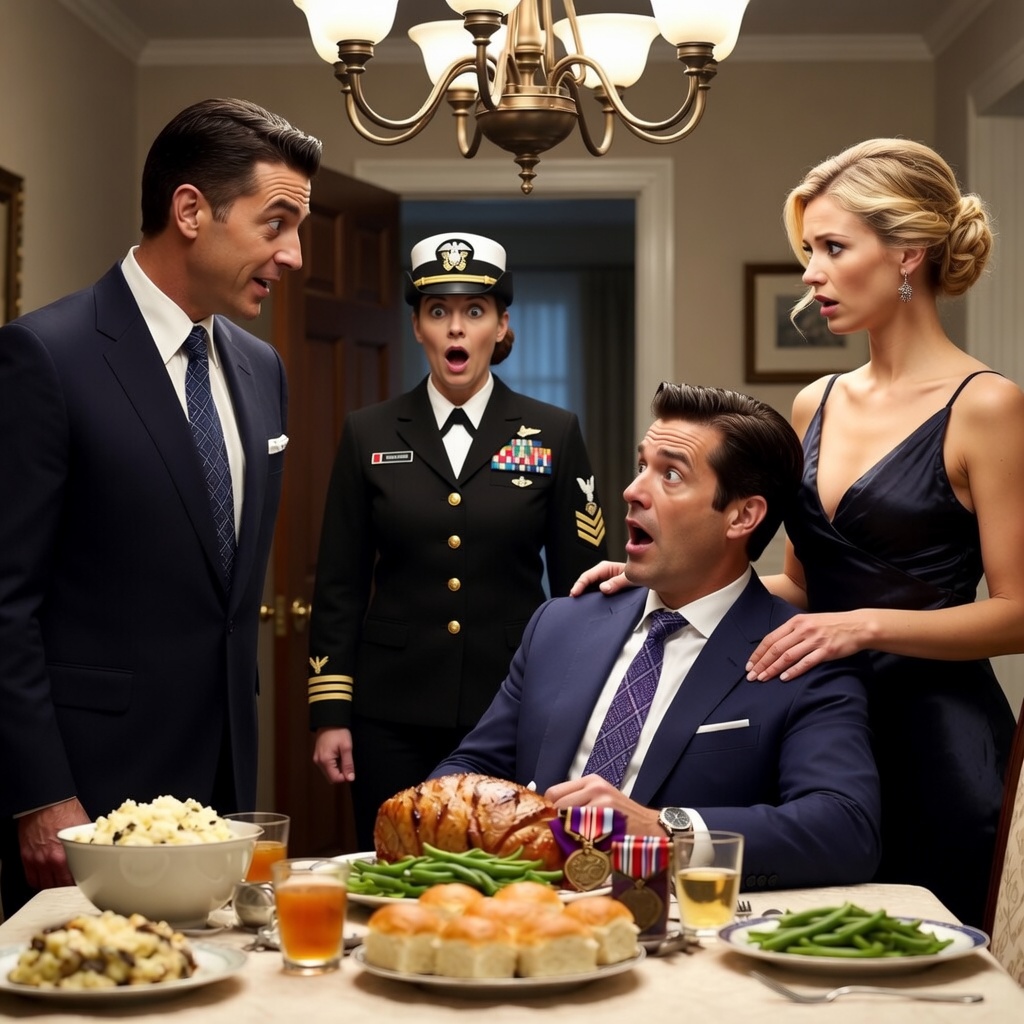
My brother tossed my Purple Heart into the trash can between the mashed potatoes and the green beans.
The medal hit the plastic liner with a dull, ugly sound that somehow felt louder than Sierra’s laugh, louder than Preston’s smug little champagne toast, louder than the grandfather clock in the hallway that had measured every Sunday dinner in my father’s house for twenty-five years. The whole room seemed to stop around that one sound.
Then Preston grinned.
“Oops,” he said, like he had knocked over a salt shaker instead of the only thing in that room my father had ever looked at with pride.
I stood at the end of the dining table with a serving spoon still in my hand, staring at the trash can near the kitchen island. Steam rose off the roast. Butter glistened on the dinner rolls. My father’s old oak hutch reflected the chandelier light in a warm golden blur that made the whole scene look normal from a distance.
Up close, it wasn’t normal at all.
It was the kind of family moment people lied about for years.
Preston leaned back in my father’s chair at the head of the table, broad shoulders relaxed, expensive watch flashing when he lifted his glass. He had taken over that chair six months after Dad’s funeral and never once asked if it bothered me. Sierra stood beside him in a dark silk dress, one manicured hand resting on his shoulder like she was presenting a prize bull at auction. They had already finished telling me—twice—about the defense contract Preston’s company was supposedly about to win.
Fourteen million dollars.
Twenty thousand tactical vests.
A direct local-base supply deal.
The whole thing had been delivered with the same oily arrogance Preston had been practicing since high school whenever he wanted the room to understand that he believed he was the smartest man in it.
“You know what Dad never understood?” he had said five minutes earlier, topping off his own glass but not mine. “Patriotism doesn’t create wealth. Contracts do.”
Sierra had smiled at that. “Some people are built to serve,” she said, glancing at me. “Some people are built to lead.”
I hadn’t answered. I had spent most of my adult life learning that silence made insecure people talk longer, and when people talked longer, they showed you who they were.
Now my medals were in the trash.
There were potato peels on top of them.
A cracked eggshell.
Coffee grounds.
The red-white-and-blue ribbon of the Purple Heart looked filthy against the plastic liner, and something in my chest went cold and still.
Not hot. Not furious.
Cold.
Preston saw the look on my face and smiled wider, mistaking restraint for weakness the way he always had.
“Oh, come on, Abby,” he said. “Don’t tell me you’re going to cry over scrap metal.”
Sierra laughed again, softer this time. “We can rinse them off.”
I set the serving spoon down very carefully on the tablecloth.
The dining room was still arranged the way my father used to keep it: cream walls, framed black-and-white family photos, the flag case from Dad’s funeral on the sideboard, the polished wooden display box he had bought me after my second deployment. He used to dust it himself. He used to straighten the medals when they tilted. He used to say, in that quiet way of his, that honor should never look neglected.
Preston had shoved his leather briefcase onto the glass shelf above that display box when he came in. I had told him to move it. He had rolled his eyes. Then he had shoved it harder, clipping the box and sending the medals straight into the kitchen trash.
He thought that was the insult.
It wasn’t.
When the briefcase shifted, the latch sprang open for half a second.
That was long enough.
Long enough for me to see a procurement form clipped inside.
Long enough to see a military inventory code.
Long enough to see a security authorization block.
My authorization block.
My name.
My clearance.
My signature.
Except I had never signed it.
I walked to the trash can without a word.
Behind me, Preston kept talking because men like him hated a quiet room.
“Those medals didn’t build anything,” he said. “They didn’t make money. They don’t matter in the real world.”
I reached into the trash and picked up the Purple Heart first. Grease streaked the ribbon. I wiped it with my thumb.
“Real value,” Preston went on, tapping a finger against his chest, “looks like fourteen million dollars.”
I picked up the commendation medal next.
Then the ribbons.
Then the bronze unit citation Dad had been prouder of than I ever was.
Sierra shifted her weight. “Honestly, Abby, you’re making this dramatic.”
I straightened slowly and looked at Preston for the first time since the medals fell.
He was still smiling.
My brother had always mistaken composure for surrender.
“Are you done?” he asked.
I held his gaze.
“Yeah,” I said. “I think you are.”
He chuckled, not understanding me at all.
That was the last easy moment he would have for a very long time.
I rinsed the medals in the sink one by one while Preston answered a phone call in the next room and Sierra started talking excitedly about profit margins, delivery schedules, investor confidence, and how quickly everything would scale once the base signed final approval. I listened to none of it and all of it.
Because suddenly every detail mattered.
The water ran cool over the Purple Heart.
My reflection looked warped in the stainless steel sink.
And somewhere behind me, on the kitchen counter, Preston’s half-open briefcase held proof that my brother hadn’t just crossed a line.
He had walked into federal fraud using my name.
By the time I left my father’s house, the medals were wrapped in a clean dish towel on the passenger seat beside me, and Preston was still convinced he had won the evening.
The roads back to Fort Harlow were almost empty.
I drove without music.
Without the heater.
Without letting myself touch the anger.
People liked to imagine that revenge started with rage, but in my experience that wasn’t true. Rage was loud. Rage was messy. Rage made people miss what mattered.
What started in me that night was simpler and far more dangerous.
Clarity.
Fort Harlow looked the way it always looked after 2300—floodlights cutting hard white lines across the perimeter, guard towers lit like watchful eyes, the hush of a place that never truly slept but knew how to move quietly. I flashed my ID at the gate, drove through, and parked near the logistics operations building.
The medals stayed in the car.
I didn’t want them near what came next.
Inside, the building smelled like machine oil, toner, and recycled air. Everything familiar. Everything controlled. My footsteps echoed down the corridor as I passed through the layered access points—badge, PIN, fingerprint, retinal scan. The system accepted me with the same cool indifference it accepted everyone who belonged there.
That was the thing Preston never understood about institutions like this.
They didn’t care about charm.
They cared about validation.
My office was small, clean, and cold enough that people complained when they visited. I preferred it that way. A locked file cabinet, a narrow bookshelf, a steel desk, one framed photograph of my father in work clothes standing on the porch he built himself. No clutter. No softness I couldn’t afford.
I powered up my secure terminal and opened the audit interface.
First, I ran my own authorization history.
Every procurement action tied to my credentials for the past ninety days appeared in sequence across the screen. Standard approvals. Inventory transfers. Emergency repair clearances. A dozen routine actions I could identify on sight.
Then the forged one surfaced.
Tactical vest acquisition request.
Quantity: 20,000.
Destination: Fort Harlow regional supply chain.
Vendor: Redstone Strategic Solutions.
Status: Pending final release.
Authorized by: Major Abigail Mercer.
I stared at my own name on the screen until the letters looked foreign.
My father had named me Abigail after his mother. Preston had once told me it sounded too serious for a girl. He preferred easy things. I had spent a lifetime becoming the kind of woman who could survive serious ones.
I opened the signature file.
At a glance, it was good. Better than most forgeries. Correct angle. Correct pressure pattern. Correct end stroke.
But the timing metadata didn’t match my login history, and the secondary verification layer showed an override routed through a credential mirror—sophisticated enough to evade a casual review, sloppy enough to fail under a real audit.
That meant two things immediately.
First, Preston had help.
Second, whoever helped him didn’t understand military procurement as well as they thought they did.
I dug deeper.
Redstone Strategic Solutions looked legitimate for the first twelve seconds. A registered corporate shell, domestic mailing address, clean branding, a short polished history page. Then the deeper database link opened, and the illusion fell apart.
No approved defense manufacturing certifications.
No verified ballistic testing chain.
No domestic plant.
No inspection history.
Instead, an affiliated foreign supplier appeared under a different name—one already flagged in three separate defense procurement databases for falsified compliance documents, substandard materials, and failed ballistic performance. The kind of company that sold protection to people who would never test it until bullets did.
I opened the submitted testing data.
Numbers.
Charts.
Claims.
And buried beneath the formatting, impossibilities.
Material densities that didn’t align with the listed weight.
Stopping power claims unsupported by plate thickness.
Stress-test results copied from a separate product line three years old.
I cross-referenced the standards.
Then I sat back in my chair.
If those vests went out, soldiers would wear them believing they were protected.
Some of them would not come home because they trusted equipment that existed only to maximize someone else’s margin.
The room felt smaller.
I looked again at the financial breakdown.
Certified equivalent contract value: $14.2 million.
Actual supplier cost for the defective units: just over $8 million.
Projected internal profit skim: nearly $6 million.
Six million dollars.
That was the number beneath Preston’s little toast. That was the number under Sierra’s bright smile and polished nails and designer dress.
Six million dollars bought by gambling with military lives.
I should have felt sick.
Instead, I felt precise.
I opened the property records next.
What I found there chilled me more than the vest fraud.
continue 👇
My father’s house had been used as collateral for an emergency liquidity loan tied to Redstone’s fulfillment financing. The property file showed joint ownership—Preston and me, exactly as the will established. It also showed a signed consent packet authorizing the collateralization of the full value.
My consent packet.
My signature again.
Another forgery.
The submission had been routed through a civilian banking network Sierra knew how to navigate from her years in corporate finance. It was cleaner than Preston’s paperwork—better disguised, better timed, layered under enough legitimate supporting documentation to pass first review. If I had signed the final release they were planning to shove in front of me, they could have locked me into the debt structure and buried me under my own inherited house.
I closed my eyes for one slow breath.
Dad had built that house with overtime shifts, callused hands, and the kind of pride men from his generation never spoke aloud. Every hinge he installed sat straight. Every shelf he cut lined up flush. The porch swing was his retirement project. The garden wall still had a brick loose near the hydrangeas because he always said he’d fix it “next weekend.”
Preston and Sierra had turned all of that into leverage.
Not memory.
Not legacy.
Leverage.
I opened a secure incident file and began building the case.
Unauthorized use of military credentials.
Forgery of procurement approval.
Attempted insertion of unsafe ballistic gear into an active military supply chain.
Fraudulent collateralization of jointly owned civilian property.
Potential wire fraud.
Potential conspiracy.
Potential endangerment of service members.
I attached records, timestamps, signature comparisons, supplier alerts, banking logs.
No dramatics.
No assumptions.
Just facts.
At 0140, I sent the first secure notification up the chain.
At 0217, my office phone rang.
“Major Mercer,” I answered.
A woman’s voice came through, low and formal. “Do not leave the building.”
I recognized the office code before she said her name.
“Inspector General Eleanor Brooks will be on-site at 0600,” the voice continued. “You are to preserve all records, make no external contact regarding this matter, and wait for direct instruction. Do you understand?”
I looked at the evidence on my screen.
“Yes,” I said.
The line went dead.
I didn’t sleep.
At 0558, I was standing in the command conference room with a folder in my hands and stale coffee in my stomach when Base Inspector General Eleanor Brooks walked in.
She was not what most people expected when they heard the title. She wasn’t tall. She didn’t enter with theater. She wore a dark civilian suit instead of a uniform, carried a slim leather portfolio, and had the kind of face that revealed absolutely nothing unless she wanted it to. Her silver hair was pinned neatly back. No wasted motion. No wasted expression.
Two investigators came in behind her, followed by Colonel Nathan Vance, the base commander, and a legal officer I knew by sight but not well enough to trust.
Brooks took the seat at the head of the table and looked at me.
“Major Mercer,” she said. “You submitted an allegation at 0140 describing procurement fraud, credential compromise, and deliberate endangerment tied to a civilian vendor connected to your brother.”
“Yes, ma’am.”
“Your brother threw your military decorations into the trash before you found the forged authorization?”
The question caught me slightly off guard.
“Yes, ma’am.”
She nodded once, as if filing away not the insult but the psychology behind it.
“Good,” she said.
I blinked. “Good?”
“It tells me he mistakes humiliation for control. People like that overextend.” Her eyes shifted to the folder in my hands. “Walk me through everything.”
So I did.
For nearly two hours I laid out the sequence from beginning to end. Sunday dinner. The briefcase. The forged authorization. The supplier shell. The blacklisted manufacturer. The ballistic failures. The collateral loan against my father’s house. The banking structure. The likely role of Sierra Cole in the financing and documentation layers.
No one interrupted until I finished.
Then Brooks asked for the supplier testing sheet.
Then the property packet.
Then the signature comparisons.
Then she stood, moved to the screen herself, and reviewed the procurement chain in silence.
Colonel Vance swore under his breath when he saw the failed plate data.
The legal officer paled at the collateral records.
One of Brooks’s investigators began typing so fast his laptop keys sounded like rain.
Finally Brooks turned back toward me.
“Major,” she said, “did your brother or his associates indicate when they intended to move from pending approval to active execution?”
“Soon,” I said. “He and Sierra are already behaving as if the contract is theirs. They think all they need is my final cooperation.”
Brooks studied me for a moment. “Will they push for another signature?”
“Yes, ma’am.”
“Will they rush you?”
“Yes.”
“Good.”
Again, that word.
My silence must have shown because for the first time, something almost like dry humor touched her face.
“When arrogant people believe they are close to money,” she said, “they compress time. Compression creates mistakes. We can use that.”
She laid out the first phase before anyone else spoke.
I would return to the house if summoned.
I would not accuse.
I would not confront.
If they presented documents, I would sign in a way the system could later flag as nonstandard and compelled without tipping them off. The banking networks tied to federal defense risk markers would do the rest.
Meanwhile, the Inspector General’s office would quietly lock every relevant record, monitor the vendor communication channels, and prepare a broader containment action.
“What if they try to move the inventory anyway?” Colonel Vance asked.
Brooks looked at me. “Will they?”
I thought of Preston’s face at the dinner table—glassy with greed, bright with contempt, utterly convinced he was smarter than consequence.
“Yes,” I said. “If money starts slipping away, he’ll panic. And when he panics, he’ll grab.”
Brooks nodded. “Then we let him reach.”
The call from Sierra came the next evening, right on schedule.
“Come by the house,” she said, voice sugary and rushed. “There’s paperwork we need to handle together. Routine stuff.”
I drove over at dusk.
Dad’s porch light was already on. It always made the house look softer than it was.
Inside, Preston stood in the kitchen with his jacket off and his sleeves rolled up, performing ease. Sierra had spread a packet of documents across the table where Dad used to do crossword puzzles. There was wine breathing on the counter. They had set the stage for normalcy.
Predators loved normal rooms.
“Perfect,” Sierra said when she saw me. “We just need five minutes.”
I set my keys beside the fruit bowl and stayed standing.
Preston tapped the papers. “Bank release. House maintenance reserve. We’re refinancing some old structural work and need your sign-off because of the estate split.”
He said it too casually.
People only used that tone when they wanted you to ignore the knife inside the envelope.
I pulled out a chair and sat.
Sierra slid the documents toward me with a sympathetic smile she had never once offered when no one else was watching. “I know forms bore you,” she said. “But this is straightforward.”
I scanned the first page.
Clean bank letterhead.
Proper formatting.
Reasonable summary language.
Then I turned the page.
There it was.
Collateral reinforcement clause.
Expanded personal liability language.
Consent to accelerated liquidation in event of defense contract default.
If I signed it cleanly, they would lock my half of the house into the fraud structure and insulate themselves for one more move.
Preston drummed his fingers on the table.
“We don’t have all night.”
I kept reading.
“What?” he said after a moment. “You waiting for subtitles?”
Sierra shot him a quick look. “Preston.”
He leaned back against the counter, annoyed. “She doesn’t understand half of it anyway.”
That was the thing about contempt.
It made people lazy.
I lifted my eyes to Sierra. “Why is defense contract language in a house maintenance reserve packet?”
A tiny pause.
Then she smiled too fast. “Because the same lender is handling multiple instruments. It’s standard.”
“It isn’t,” I said.
Preston pushed off the counter and came closer. “You know what? We’re done explaining. Sign it.”
I held his gaze for a beat.
Then I lowered my eyes to the page again.
Pressure. Urgency. Dismissal.
Exactly what Brooks predicted.
I picked up the pen.
My signature lived in enough systems that even small variations mattered under forensic review. Years earlier, during a credential security seminar, I had learned how compelled or compromised signings sometimes revealed themselves under layered analysis—pressure distortion, interrupted stroke order, inconsistent cross placement. Not magic. Not a secret code. Just pattern recognition.
So I gave them a signature that looked right to the greedy eye and wrong to the trained one.
I omitted one cross stroke.
I altered the pressure at the tail end.
And when I set the pen down, I let it press just hard enough that the imprint bit into the wood beneath the paper.
Sierra exhaled in relief and snatched the packet up before I could change my mind.
Preston grinned. “There we go. See? Wasn’t so hard.”
He folded the papers and slipped them into his jacket like he was pocketing a winning lottery ticket.
I stood.
“That all?” I asked.
Sierra was already tapping out a text. “That’s all.”
Preston walked me to the door, not from politeness but dominance. At the threshold he smiled down at me.
“For once,” he said, “you made the smart choice.”
I looked at him.
He still had no idea he was bleeding out through systems he didn’t even know existed.
“Maybe,” I said. “We’ll see.”
By 0812 the next morning, Sierra was screaming into my phone.
“What did you do?”
I was in my on-base apartment drinking coffee by the window.
I let the question hang.
“Good morning to you too,” I said.
“Don’t do that.” Her breathing was sharp and ragged. “Everything is frozen. The account, the transfer channel, every damn cent. We tried to move the supplier reserve and it got flagged. Flagged, Abby. By a federal fraud hold.”
I took another sip.
“I’m just a logistics officer,” I said. “How would I control your accounts?”
“Stop lying.”
She was near tears now.
I could picture her pacing in Dad’s kitchen, one hand in her hair, the other white-knuckled around the phone, finally realizing that people she dismissed as boring often knew where the real switches were.
“This says defense fraud suspicion,” she said. “That doesn’t just happen.”
“No,” I said. “It usually doesn’t.”
Silence.
Then, quieter: “What do you know?”
I looked out at the parking lot below, where two airmen were arguing over a toolbox and a maintenance cart.
“Enough,” I said.
I hung up before she could answer.
Three minutes later, Preston called.
I declined.
He called again.
Then again.
Then he sent a text.
Fix this.
I showed it to Inspector General Brooks at 0910.
She read it once and slid the phone back across the table.
“He’s entering the anger phase early,” she said. “That means he’s more frightened than he sounds.”
By late afternoon, her office had already locked the supplier channels, flagged the vendor distribution routes, and coordinated with base security. Then the next alert landed.
Unauthorized credential probe.
Sector 4 logistics storage.
Scheduled for overnight.
My forged access profile again.
Brooks read the alert and did not look surprised.
“Your brother is trying to recover the inventory,” she said.
Colonel Vance folded his arms. “We intercept at the gate.”
Brooks shook her head.
“No. We document.”
Vance looked at me, then back at her. “If we let him onto federal property—”
“We let him fully commit,” Brooks said. “Attempt invites argument. Completion buries it.”
Then she turned to me.
“Major Mercer,” she said, “are you capable of watching him walk deeper into this without trying to stop him too soon?”
I thought of my father’s house leveraged under forged ink. I thought of the Purple Heart lying in garbage beside potato peels. I thought of soldiers wearing useless plates because Preston wanted a bigger house, a brighter watch, a louder life.
“Yes,” I said.
Brooks nodded. “Then we proceed.”
The control room was dim enough that the screens looked suspended in darkness.
I stood beside Colonel Vance and Inspector General Brooks at 0015 while the live feeds mapped the perimeter in green and gray. Gate 4 waited under hard floodlight. The forged credential packet sat in the system queue, ready to be tested by whoever believed they were clever.
“Remember,” Brooks said quietly, “we are not helping him succeed. We are helping him reveal.”
At 0017, the first truck appeared.
No company logos.
No plates.
A dark box truck easing toward Gate 4 like it belonged there.
A second truck rolled in behind it.
Vance muttered, “He brought backup.”
Brooks didn’t answer.
The scanner pinged.
My cloned credentials populated on the screen.
Surface checks passed exactly as we expected. The deeper trap layers remained silent by design. Gate 4 opened.
The first truck entered.
Then the second.
Smooth. Clean. Quiet.
On the thermal feed, two figures sat in the cab of the lead truck. One broad-shouldered. One leaner.
Preston and hired muscle.
The trucks moved through the route our analysts predicted and turned toward Sector 4.
“Confident,” Vance said.
“Desperate,” I replied.
Inspector General Brooks glanced at me once, approving the distinction.
Inside the storage facility, the cameras picked them up in low light—Preston in a black jacket and work gloves, the second man hooded and anonymous. They didn’t search. They moved straight to the pallet row holding the seized vests.
That meant Preston had more than a forged signature.
He had layout knowledge.
Which meant the investigation would not stop with him.
He pried open the first crate with a crowbar.
Pulled out a vest.
Checked only the label.
Then nodded and started loading.
No reverence.
No hesitation.
No thought for what the equipment was supposed to do.
To him it was just product.
To me, it was the difference between a mother getting a folded flag or a living son.
The second man moved fast, hauling crates toward the truck in clumsy bursts. Preston kept glancing toward the entrance, not because he was cautious by nature but because fear was finally in the room with him.
Good.
Fear made sloppy men leave evidence.
The internal microphones picked up fragments.
“Move.”
“Faster.”
“No, take all of it.”
“Forget the paperwork.”
Inspector General Brooks watched the feed with her hands folded lightly in front of her.
“Listen to the language,” she said. “Possession is already assumed. He’s not retrieving disputed inventory. He’s reclaiming profit.”
One truck filled.
Then the second.
Preston wiped his forehead with the back of his glove and laughed. I could hear it faintly over the audio feed, breathless and relieved.
It was the laugh of a man who thought survival meant victory.
He was wrong.
They drove out through Gate 4 at 0041.
No alarms.
No chase.
No resistance.
Just two trucks leaving a military installation loaded with fraudulent ballistic gear and enough surveillance evidence to destroy every excuse Preston would later invent.
Vance exhaled slowly. “We take him now?”
Brooks shook her head. “Not yet.”
She looked at the schedule for the next night’s annual defense partnership gala—the room where contractors, officers, investors, regional officials, and procurement-adjacent civilians gathered to smile at one another over expensive glasses and pretend everyone’s motives were patriotic.
“He will appear there,” she said.
“Yes,” I said. “He’ll perform.”
Brooks nodded. “Then we will let him.”
The gala was held in the Grand Meridian Ballroom downtown, a place built to flatter money. Marble columns, brass fixtures, chandeliers the size of helicopters, staff who floated instead of walked. I had been twice before in plain dress uniform, usually to endure speeches and watch civilians congratulate themselves for supporting service members from a safe distance.
This time I arrived in full Class A.
Every ribbon aligned.
Shoes mirror-shined.
Hair secured tight.
I wanted the room to understand what it was looking at before anyone said a word.
Inside, the air smelled like perfume, polished wood, and dry white wine. Sierra moved through the crowd in midnight-blue silk, smiling with the hungry brightness of a woman who believed visibility was power. Preston stood near the bar in a tailored black suit, laughing too loudly with two men I recognized from regional investment groups.
He looked excellent.
That was the grotesque thing about certain people: the closer they got to ruin, the more carefully they adjusted the knot of their tie.
I hadn’t taken five steps inside when Sierra saw me.
Her smile faltered.
Then she recovered and walked toward me with practiced elegance that dissolved the second she reached conversational distance.
“What are you doing here?” she hissed.
“Attending.”
She glanced at my uniform like it was a stain. “This is a civilian partnership event.”
“It’s a defense event,” I said. “I’m defense.”
She lowered her voice further. “You are embarrassing us.”
Us.
The nerve of that word almost made me laugh.
Before I could answer, Preston drifted over with a champagne glass in one hand and his investor smile still half-fastened.
“Well,” he said, looking me up and down, “if it isn’t Fort Harlow’s most dedicated box-mover.”
“Preston,” Sierra murmured. “Not now.”
He ignored her. His eyes went to my ribbons. “Still wearing those little trophies?”
The room around us continued humming with soft conversation and silverware and string music. Nobody nearby knew they were standing next to a federal criminal. Not yet.
“I like the suit,” I said.
His smile sharpened. “Custom.”
“Must have cost a lot.”
He leaned in. “Worth it.”
I held his gaze.
“Your millions are parked outside, Preston,” I said quietly. “Hope nobody checks the lot.”
His expression changed almost imperceptibly.
Not panic.
Not yet.
Just a hitch. A tiny fracture.
Sierra’s eyes darted between us. “What does that mean?”
I smoothed the cuff of my jacket.
“You’ll find out.”
Then I stepped around them and moved deeper into the ballroom.
At the far side of the room, near a curtained service corridor, Inspector General Brooks stood in a dark formal suit speaking to a retired general who had no idea his evening was about to turn historic. She did not look at me, but one finger against her glass stem gave a small measured tap.
Ready.
I took my place near the center aisle.
Onstage, the host began introducing sponsors. Laughter rippled politely. Waiters moved. Crystal flashed under the chandeliers. The whole room glowed with the expensive illusion that power belonged to the people best dressed for it.
Then the lights went out.
Not a flicker.
A full cut.
Gasps in the dark.
A woman laughed nervously.
Someone near the stage said, “Generator?”
Then one bank of overhead lights came back—but only above the stage.
The rest of the ballroom stayed dim.
A feedback tone sliced the silence.
And Inspector General Eleanor Brooks walked into the spotlight.
She did not hurry.
She did not smile.
She stepped to the microphone, adjusted it once, and let the room settle around her until even the waitstaff stood still.
“Good evening,” she said.
No title given.
No apology.
No soft opening.
“Before this event continues,” she said, “there is a matter of immediate federal concern that must be addressed.”
The giant screen behind her shifted from sponsor graphics to black.
Then the first image appeared.
Thermal footage.
A timestamp.
Two men entering Sector 4 logistics storage at Fort Harlow just after midnight.
At first the room was confused. People craned their necks, squinted, tried to place the setting. Then the feed sharpened, Preston’s face turned toward camera, and the confusion collapsed into recognition.
Whispers rolled outward in concentric waves.
On-screen, Preston forced open a crate and began hauling tactical vests toward the truck.
The second camera angle showed him scanning a forged credential badge at the interior door.
The third showed the plate labels.
The fourth showed the crate manifests tied to Redstone Strategic Solutions.
A woman near the front covered her mouth.
One of Preston’s investors slowly lowered his drink.
Nobody laughed now.
The footage cut to document scans.
Vendor registration history.
Blacklisted supplier warnings.
Ballistic failure reports.
Comparative plate thickness measurements.
Projected profit skim.
Then came the signature analysis.
My name beside a forged authorization.
Then the bank records tying the fraudulent procurement structure to a collateral instrument secured against my father’s house.
The ballroom went dead still.
No clinking glasses.
No rustle of programs.
No performative murmurs.
Just the horrible vacuum that opened when wealthy people realized that what they were watching was not scandal gossip but evidence.
Inspector General Brooks let the silence deepen before she spoke again.
“The equipment shown in these files,” she said, “was represented for use by active service personnel. It failed required ballistic standards. Approval documents were forged. Federal credentials were compromised. Civilian property was fraudulently leveraged. And at 0017 hours last night, an attempt was made to remove the evidence from secured military custody.”
Her voice never rose.
It didn’t need to.
A good blade didn’t have to be swung wildly to cut.
She looked out across the room.
“Those responsible are present tonight.”
That did it.
The room physically shifted.
Distance opened around Preston like he had burst into flame. One investor stepped away from him immediately. Another pretended to study the stage while sliding sideways. Sierra’s face had gone sheet white beneath her makeup.
Preston himself stood frozen with the empty smile of a man whose body still hadn’t informed his ego that the world had changed.
Then Brooks said the line I would remember for the rest of my life.
“The attempted insertion of defective life-saving equipment into a military supply chain is not a paperwork violation,” she said. “It is a decision to profit from the death risk of American service members.”
There were people in that room who had spent careers turning war into contracts and contracts into summer homes. Even they looked sick.
Brooks stepped back from the microphone.
“Major Abigail Mercer,” she said, “please join me.”
Every spotlight in the room swung.
Not slowly.
Immediately.
White heat found me at the center aisle, uniform blazing, ribbons bright, shoulders squared. I could feel hundreds of eyes snap toward me, and behind me, somewhere near the bar, I heard glass shatter.
Sierra.
I didn’t turn.
I walked to the stage one measured step at a time.
Brooks met me halfway and spoke just loudly enough for the room.
“Major Mercer identified the credential compromise, preserved the evidence, and prevented defective equipment from reaching service members. Her discipline and restraint protected lives.”
No applause came at first.
The room was too stunned.
Then it began—tentative, then firmer, then full.
I barely heard it.
Because over the applause, something else had started.
Boots.
Heavy.
Rhythmic.
Approaching from every exit.
Military police entered first, then federal agents from the Inspector General’s investigative unit, then two CID officers in dark suits. The ballroom sealed almost elegantly, each doorway occupied, each hallway closed.
Preston finally moved.
One backward step.
Then another.
An MP reached him before the third.
“Sir, place your hands where I can see them.”
“What is this?” Preston snapped, voice cracking between outrage and panic. “This is insane. I have lawyers. I have—”
The agent took his arm.
Another took the other.
Preston jerked, not quite resisting, not quite cooperating, too shocked to choose. His champagne glass hit the floor and rolled under a table.
Sierra made a sound I had never heard from her before—thin, animal, stripped of polish.
“No,” she said. “No, no, no, no.”
She pushed through the crowd toward me, mascara starting to break under her eyes.
“Abby,” she said, grabbing at my sleeve. “Abby, tell them this is wrong. Tell them this is some misunderstanding.”
I looked down at her hand on my uniform.
The last time those fingers touched my life, they were arranging forged collateral documents against my father’s house.
“We’re family,” she said, voice cracking. “Please.”
That word again.
Family.
A word people loved to use when they wanted access without accountability.
I removed her hand gently, one finger at a time.
“No,” I said.
It was not loud.
It was final.
Behind her, Preston’s voice rose as the cuffs came out.
“You can’t do this to me!”
The first metal click sounded almost delicate in the vast ballroom.
Then the second.
That sound carried farther than any shout.
He twisted hard once, pure reflex, and an MP forced him forward onto a linen-covered table. Silverware jumped. Crystal toppled. The centerpiece tipped sideways, spraying white roses across the cloth.
The room watched.
No one intervened.
No one defended him.
Not a single investor who had laughed with him ten minutes earlier stepped forward now.
That was the nature of purchased loyalty. It dissolved the second the bill came due.
They hauled him upright.
His face had lost all color.
When his eyes found mine, the arrogance was gone. Not reduced. Gone. In its place was the slow, sick understanding of a man realizing he had mocked the only person in the room who actually knew how the system worked.
I stepped down from the stage and stopped in front of him.
He was breathing hard, wrists bound, suit jacket twisted, hair falling loose at the temple. He looked smaller than I had ever seen him.
“You said my medals were just cheap pieces of metal,” I said.
No one in that room missed the line.
His jaw moved, but no words came out.
I lowered my eyes to the cuffs around his wrists.
“Let’s see how much value those carry.”
For one second—just one—something flashed across his face that might have been shame.
Then the agents turned him away.
Sierra tried one last time to reach me, tears streaking down her cheeks. “Abby, please—”
I didn’t answer.
They took her too, though not in cuffs that night. She was escorted with investigators, separated for questioning, every ounce of social shine stripped off her by fluorescent rooms and recorded interviews before dawn.
The ballroom doors closed behind them.
And just like that, the performance ended.
The next week blew apart faster than most lives do in ten years.
Federal fraud charges were filed.
Defense endangerment counts followed.
Wire fraud. Conspiracy. Credential theft. False statements. Attempted removal of secured government evidence. Financial fraud tied to the collateral loan on my father’s house. Seizure orders hit Redstone Strategic Solutions and every related account before the company could dissolve itself into smoke.
The press got hold of part of the story by Tuesday.
By Wednesday, every photo of Preston from charity galas and golf tournaments was running beside phrases like fraud scheme, defective military gear, and forged authorization.
Sierra lasted thirty-six hours before she asked for counsel separate from his.
By Friday, she was talking.
It turned out she had done more than I knew.
She hadn’t just shaped the banking paperwork. She had built the offshore routing structure, coached Preston on which investors to flatter, helped obtain a former contractor’s credential templates, and drafted alternate distribution plans in case the base procurement route failed. She had emails. She had spreadsheets. She had voice messages.
Greed made people keep records when they wanted credit.
The property issue resolved faster than I expected once federal authorities entered the chain. The bank rescinded the collateral instrument, voided the forged consent packet, and restored the title status on the house. An apologetic vice president from the lending institution called me personally, his tone trembling with the kind of corporate fear that only appears when federal investigators start requesting internal compliance notes.
I accepted the correction.
I did not soften for him.
Dad’s house stayed ours—though by then “ours” meant something very different.
For a while I thought I would sell my half, leave the memories where they stood, and let the wood and brick and porch boards belong to history instead of blood. But the first time I walked back in after the legal freeze lifted, I knew I couldn’t do that.
The house still smelled faintly like lemon oil and old books.
Dad’s cap still hung on the peg by the laundry room.
The loose brick was still loose.
And on the kitchen shelf, in the exact place Preston had treated like storage for his ego, the polished wooden box waited for me.
I set it down on the table and opened it.
The medals lay exactly where I had placed them after the gala, cleaned and restored. Purple Heart. Meritorious commendation. Unit ribbon. Each one carrying the strange burden that military decorations carried: not glory, not really, but memory made tangible. Good people lost. Bad nights survived. Decisions no one should ever have to make and some of us made anyway.
Dad had understood that better than I did.
To him, the medals were proof that suffering had not turned into waste.
I stood there in the late afternoon light and remembered the first time he saw me wear the Purple Heart ribbon after I came home injured. He hadn’t said much. He just looked at it for a long moment, then looked at me, and his voice had gone rough when he said, “You came back. That counts for everything.”
For weeks after the arrests, I moved through layers of aftermath.
Interviews.
Evidence reviews.
Chain-of-custody sessions.
A closed-door hearing on procurement vulnerabilities.
Another with congressional staff.
One with a committee that wanted to understand how a civilian-linked vendor had gotten close enough to the system to pose the threat in the first place.
Every room had men who sounded very serious and women who took very careful notes and coffee that always tasted burned.
Inspector General Brooks sat in most of those meetings.
She never wasted a word.
The first time we were alone after the initial storm, she stood with me outside an administrative annex while rain hit the concrete in silver streaks.
“You handled yourself well,” she said.
“Thank you, ma’am.”
She studied me. “Do you know why your brother targeted your credentials?”
“Because he underestimated me.”
“Yes,” she said. “But also because he needed legitimacy. He knew your name meant something in a system his never would.”
That sat with me.
All my life Preston had treated my service as something smaller than his ambition, something dutiful and gray and financially unimpressive. But when he needed a doorway into real power, he stole the shape of my work and tried to wear it.
Even in contempt, he had understood its value.
That was its own ugly lesson.
The criminal process took nearly a year.
Sierra accepted a plea first.
She testified to conspiracy, fraud, and financial manipulation in exchange for a reduced sentence and permanent debarment from defense-adjacent contracting. She cried on the stand once. Not when they showed the forged banking packets. Not when they described the shell accounts. She cried when the prosecutor played a recorded call in which Preston said, “Abby’s good for signatures and silence. That’s all.”
I watched her hear herself laugh in the background.
I didn’t feel satisfaction.
I felt confirmation.
Preston refused every plea offer until the trial was already closing around his throat. He believed, right up to the last week, that confidence could still outrun documentation. Men like him sometimes confused the number of times they had escaped consequences with proof that consequences were fictional.
On the stand, he tried three versions of himself.
First: the visionary businessman misled by technical advisors.
Then: the overburdened entrepreneur who trusted the wrong people.
Finally: the betrayed brother who had only ever tried to “build something for the family.”
That last one almost made me laugh out loud.
When my turn came, I testified for six hours.
I described the procurement chain.
The signature mismatch.
The blacklisted supplier.
The ballistic failure data.
The falsified authorization.
The house collateral fraud.
The attempted retrieval from Sector 4.
The gala.
The medals.
The prosecutor hadn’t planned to use that detail at first. Brooks had told him not to lead with emotion when structure would do. But during cross-examination, Preston’s attorney tried to imply that I was motivated by personal resentment, that sibling rivalry had colored my interpretation of routine business confusion.
Routine business confusion.
That phrase still makes my teeth ache when I think about it.
So the prosecutor came back on redirect and asked one simple question.
“Major Mercer, when did you first realize your brother’s conduct might be criminal?”
I looked across the courtroom at Preston in his tailored suit and the expensive haircut his lawyers still arranged for him.
“The moment he threw my military medals into the trash,” I said.
The courtroom went very still.
“Why then?” the prosecutor asked.
“Because that was the moment I understood he no longer recognized any boundary as real. Not service. Not family. Not the dead. Men who believe nothing is sacred will eventually treat laws the same way.”
I saw one juror blink hard.
Another looked down and wrote something.
It wasn’t sentiment that convicted him, in the end. It was evidence. Brooks was right about that. Records. Footage. Financial trails. Expert testimony. Fraud layers. Supplier failures. The trucks. The fake credentials.
But the medals helped the jury understand the man inside the paperwork.
And people mattered, even in systems.
The verdict came back guilty on the major counts.
Not every count. Trials were never as tidy as stories. But enough. More than enough.
He was sentenced to federal prison.
Long enough that his hair would gray inside.
Long enough that trends would pass him by and the men he chased approval from would forget his name.
Long enough for silence to finally catch up with him.
After sentencing, he tried to speak to me in the corridor outside the courtroom.
The marshals were moving him, wrists chained low, ankles linked just enough to alter his stride. He saw me standing near the exit and slowed.
“Abby.”
I kept my face neutral.
He swallowed. For the first time in my life, he looked uncertain without disguising it as anger.
“I never thought you’d go this far,” he said.
That might have been the most honest thing he ever said to me.
“No,” I answered. “You never thought at all.”
He flinched like the words hit harder than he expected.
Then the marshals moved him on.
Sierra wrote once from the correctional facility where she served her reduced sentence. Six pages. Tight handwriting. Apologies wrapped around explanations. Childhood insecurity. Fear of being irrelevant. The momentum of bad decisions. Preston’s influence. Market pressure. The belief that everybody cut corners and they were simply doing it better.
I read every line.
Then I folded the letter, put it back in the envelope, and locked it away without replying.
Forgiveness wasn’t a performance I owed anyone on schedule.
Fort Harlow changed after the case.
Not overnight.
Not dramatically.
But in all the places that mattered.
Credential mirroring vulnerabilities were patched across the command network.
Procurement sign-offs gained additional dual-path confirmation requirements.
Civilian vendor access audits expanded.
A fraud-prevention workshop I helped design became mandatory for everyone touching sensitive logistics approvals at the base.
The first time I taught it, a young lieutenant asked me if the new protocols existed because “one greedy idiot tried something stupid.”
“No,” I said. “Because systems are built for the day someone inevitably does.”
Inspector General Brooks had a way of turning aftermath into doctrine. It was one of the reasons she was so effective. Nothing in her mind stayed personal for long; it became pattern, then lesson, then policy.
A few months after the sentencing, she called me into her office.
No drama. No buildup. Just a file folder on her desk and a thin line of winter sunlight crossing the carpet.
“I’m recommending you for a joint oversight task group,” she said.
I took the seat across from her. “Ma’am?”
“Procurement integrity. Cross-installation review. Temporary assignment at first.”
I looked at the folder but didn’t touch it.
“That sounds,” I said carefully, “like politics.”
“It is,” she said. “The useful kind.”
I almost smiled.
Brooks folded her hands. “Major Mercer, people think strength is loud because loudness is easier to notice. But institutions survive because of people who can hold a line without announcing themselves. We need more of those.”
Coming from her, it felt like a medal I actually understood.
I accepted.
The new work took me across bases, depots, and regional contracting hubs where I met the same pattern wearing different faces: urgency used as pressure, paperwork used as camouflage, familiarity used as a weapon. Every case was different. None of them were new.
A widow in Texas nearly lost her land because her brother-in-law “just needed a temporary co-sign” for a transport business that existed only on paper.
A National Guard supply sergeant in Ohio noticed duplicate serial ranges that led to a counterfeit equipment ring.
A civilian analyst in Virginia caught a consultant recycling a dead contractor’s approval code.
The details shifted.
The mechanism didn’t.
Access.
Assumption.
Contempt.
Pressure.
Silence.
Then damage.
Everywhere I went, I carried the lessons from my own house.
Not as speeches.
As instincts.
Slow down the room.
Read the second page.
Follow the metadata.
Watch who gets irritated when you ask ordinary questions.
The loudest person in a negotiation is usually the one most afraid of scrutiny.
And if someone keeps telling you to trust them while blocking your view, they are not asking for trust.
They are asking for surrender.
A year after the trial, I finally fixed the loose brick in Dad’s garden wall.
I don’t know why that became the task that undid me.
Maybe because it was small.
Maybe because Dad had meant to do it himself.
Maybe because grief sometimes waited politely in a side room until all the large disasters were handled, then walked in carrying something tiny and ordinary and impossible.
I knelt in the dirt behind the hydrangeas with mortar on my gloves and tears on my face, laughing at myself through it because the brick was ridiculous and the tears were worse and there was no one there to see either except the birds and the old fence and the memory of a man who had never once made me feel like my worth needed proving.
When I went inside, I washed my hands and stood in the quiet kitchen.
The house felt different now.
Not lighter, exactly.
More honest.
It had survived being used as collateral, survived arrogance, survived staged dinners and false signatures and expensive lies. Wood remembered pressure, but it also held shape if the structure beneath it was sound.
I made coffee.
I opened the wooden medal box.
And I sat at the same table where Preston once expected my silence to be automatic.
That was the real ending of the story, if there was one.
Not the gala.
Not the handcuffs.
Not the verdict.
The real ending was me in that kitchen, alone, unhurried, no pressure in the room except the kind I chose for myself.
Control didn’t come back all at once.
It returned in quiet pieces.
In the decision to keep the house.
In the refusal to answer Sierra’s letter before I was ready.
In the habit of reading every page of every document set down in front of me.
In the first night I slept without dreaming about the ballroom lights.
In the first Sunday dinner I hosted for a few people I trusted—two friends from base, one retired neighbor who used to bring Dad tomatoes from his garden, no champagne toasts, no performances, just roast chicken and too much pie and the simple miracle of a table where nobody had to guard their own name.
Before everyone left that evening, the retired neighbor paused by the shelf and looked at the medal box.
“Your father loved those,” he said.
I nodded.
“He loved you more,” he added, and left before I could answer.
I stood there a long time after the door closed.
Then I reached up, touched the edge of the box, and smiled for the first time in months without feeling like I was forcing the shape.
Some stories end with revenge.
Mine didn’t.
Mine ended with recognition.
My brother believed respect could be bought, manipulated, or humiliated into submission. He believed status came from money, that institutions existed to be outsmarted, that family meant permanent access, that quiet people were weak, and that symbols only mattered if they increased your market value.
He was wrong about every one of those things.
The medals in that box were never valuable because of the metal.
They were valuable because of the choices behind them.
Because of who came home carrying them.
Because of who didn’t.
Because of the line between service and exploitation.
Because some things in this life still mean what they are supposed to mean, no matter how often greedy people try to price them.
The last time Inspector General Brooks and I spoke before she rotated to Washington, we met on the flight line at sunrise. The sky was pale gold, the wind sharp enough to sting, and transport aircraft were beginning to wake the morning with their engines.
She looked out across the tarmac and said, “You know what saved you?”
I thought she meant the evidence, the protocols, the secure systems.
Instead she said, “You never let your anger outrun your discipline.”
I considered that.
“Some days it wanted to,” I admitted.
“Yes,” she said. “That’s what made it discipline.”
Then she turned, shook my hand once, and left.
I watched her car disappear past the maintenance hangars and thought about how strange it was that one of the most important people in this entire story arrived only after the first damage was done. Not to save me. Not to rescue me. Not to tell me who I was.
She arrived to help me do what I had already chosen to do.
That mattered.
Because most turning points in life didn’t begin when help walked through the door.
They began the moment you decided not to be used anymore.
For me, that moment happened in my father’s kitchen.
It happened with garbage at my feet and grease on my fingers and my Purple Heart buried under coffee grounds.
It happened when I saw the forged signature in Preston’s briefcase and understood, with a clarity so sharp it almost felt merciful, that the next move could not be emotional.
It had to be exact.
He thought throwing my medals in the trash made me smaller.
What it actually did was show me the full shape of the man standing in front of me.
And once you truly see the shape of a threat, you can stop negotiating with it.
You can build a case.
You can hold the line.
You can wait.
And when the time comes, you can let the right door open.
Then you can watch them walk through it on their own.