
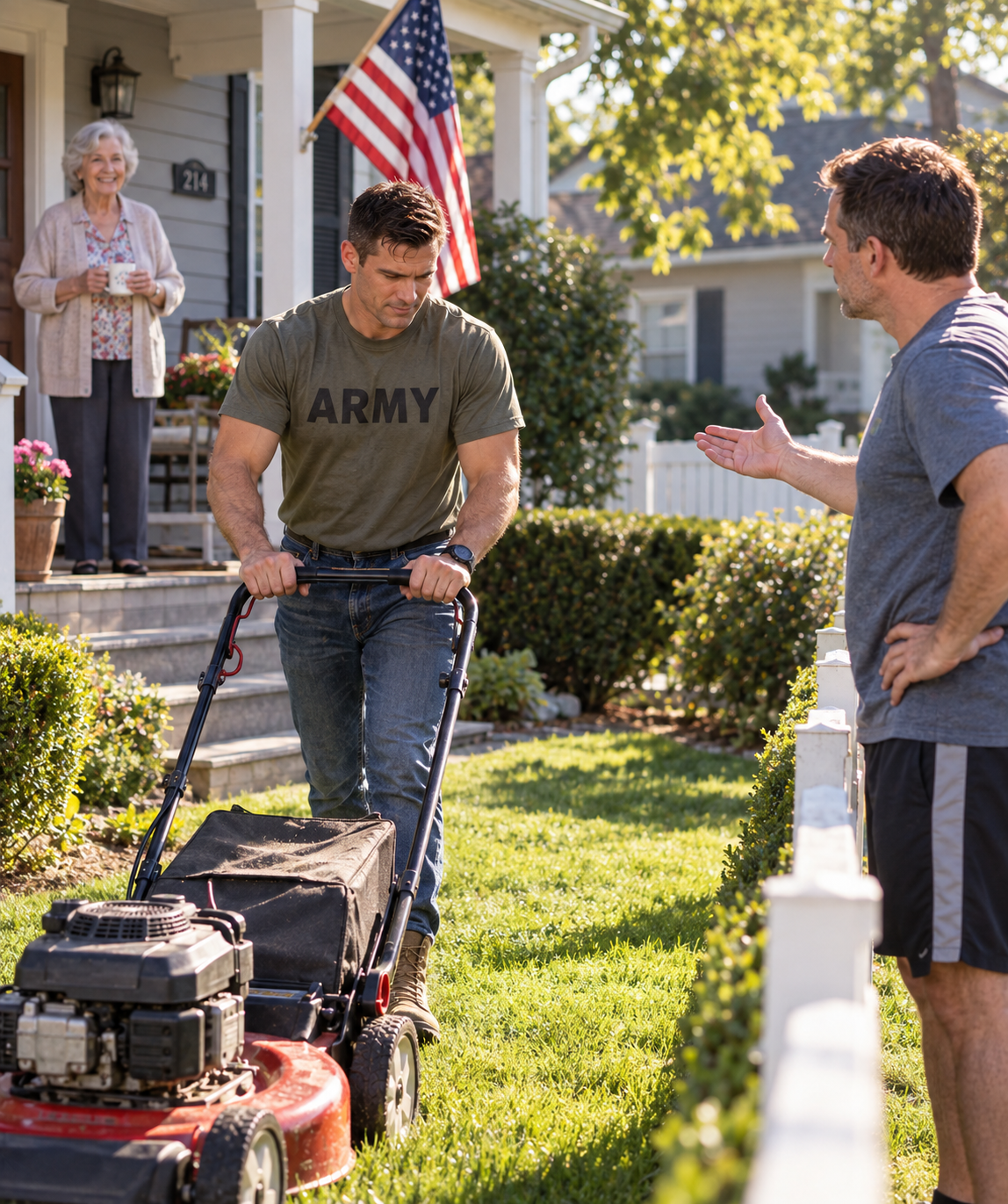
PART 2: WHAT FRANK DID FIRST
Brian’s anger disappeared.
Mason looked uncomfortable.
“Evelyn, you don’t have to—”
“I know.”
She pointed toward the porch.
“Coffee. Both of you.”
Ten minutes later, the mower sat silent beside the driveway.
Evelyn placed three mugs on the table.
Then she began telling Brian about her husband.
Frank Dawson had served in the Army when he was younger.
By the time Mason met him, Frank had been retired for years.
Mason was seventeen.
His father had just died.
The loss changed everything inside the Reed house.
Mason’s mother was trying to keep the family functioning.
Mason responded differently.
He became angry.
Stopped talking.
Stopped caring about school.
He spent long evenings sitting alone on the front steps.
Frank lived three houses away.
He never gave Mason a speech about grief.
He simply started finding reasons to need help.
“Reed!”
Frank would shout across the street.
“Hold this ladder.”
The next week:
“Help me move this table.”
Then:
“My mower’s making a weird noise.”
Most of those jobs, Evelyn admitted, Frank could have done himself.
Mason hadn’t realized that at seventeen.
“He was giving you somewhere to be,” Brian said.
Mason nodded.
“And something to do.”
Frank paid him occasionally.
Other times Evelyn made sandwiches.
Sometimes Mason stayed for dinner.
Eventually Frank started talking about his own years after military service.
Not glamorous stories.
Stories about responsibility.
Marriage.
Mistakes.
Getting up the next morning when the previous day had been terrible.
One afternoon Mason finally asked:
“How long does it take before you stop missing somebody?”
Frank didn’t answer immediately.
Then he said:
“I don’t think that’s the job.”
Mason frowned.
Frank continued:
“The job is learning how to keep living while you miss them.”
Mason never forgot it.
Months later, he finished high school.
Eventually, he joined the Army.
His life moved forward.
But whenever he came home, he visited Frank and Evelyn.
Years passed.
Frank got older.
His knees began giving him trouble.
Mowing the lawn became difficult.
One summer afternoon Mason came over and found him halfway through the yard, leaning against the mower.
“Give me that.”
Frank protested.
“I can mow my own lawn.”
“You’ve been mowing the same ten feet for twenty minutes.”
“I’m being thorough.”
Mason took over.
After that, whenever he was home and available, he cut the grass.
Then Frank became seriously ill.
Three weeks before he died, Mason visited him.
Frank was sitting on the porch.
The lawn needed mowing.
Mason pointed toward it.
“I’ll get it Sunday.”
Frank smiled.
“Figured you would.”
They sat quietly.
Then Frank said:
“Evelyn hates asking people for things.”
Mason looked at him.
Frank didn’t need to explain further.
“I’ve got it.”
Frank nodded.
That was the entire conversation.
No dramatic promise.
No handshake.
No final speech.
Just:
I’ve got it.
Frank died three weeks later.
And the following Sunday, Mason arrived with the mower.
Then the Sunday after that.
And the one after that.
Evelyn never asked.
Mason never announced why.
For nearly two years, the arrangement remained almost invisible.
Until Brian Keller moved across the street.
Brian stared into his coffee.
“I thought you were just obsessed with everybody’s lawns.”
Mason smiled.
“I don’t even like mowing my own.”
Evelyn laughed.
Brian looked embarrassed.
“Captain, I’m sorry.”
“Mason.”
“What?”
“I’m holding a lawn mower, Brian. You can call me Mason.”
Brian smiled.
Then he looked at Evelyn.
“I am sorry about this morning.”
She waved him off.
“You were defending an old lady from an aggressive landscaper.”
Mason nearly choked on his coffee.
The next Sunday, Mason arrived at 7:00.
Before he could unload the mower, Brian walked across the street.
He was carrying another mower.
Mason stared at him.
“What are you doing?”
Brian shrugged.
“My side of the yard.”
“You don’t have a side.”
“I do now.”
Mason laughed.
They compromised on a later start time.
Evelyn approved.
Within months, Sunday mornings became something else.
Sometimes Brian’s wife brought coffee.
Sometimes their little boy sat on Evelyn’s porch with juice.
Sometimes Mason stayed afterward to repair something small.
Nobody called it charity.
Nobody needed to.
Then military life did what it often does.
Mason received orders that would eventually take him away from the area.
The evening before he left, he walked to Evelyn’s house.
She was waiting on the porch.
“I suppose I’ll have to hire somebody,” she said.
Mason smiled.
“You won’t.”
A mower started across the street.
Brian raised one hand.
Evelyn looked at Mason.
“You arranged that?”
“No.”
For once, Mason truly hadn’t.
Brian had simply decided to continue.
Evelyn’s eyes filled.
“Frank would’ve liked that.”
Mason looked toward the lawn.
“Yeah.”
Then Evelyn handed him an old photograph.
Frank stood beside a teenage Mason.
Both were covered in grass clippings.
Mason laughed.
“I’ve never seen this.”
“He kept it.”
Mason turned it over.
Frank had written something on the back years earlier:
KEEP SHOWING UP.
Mason stared at the words.
Suddenly he understood.
For years, he’d believed he was repaying Frank.
One lawn.
One Sunday.
One promise at a time.
But kindness didn’t work like a debt.
Frank had shown up for Mason.
Mason showed up for Evelyn.
And now Brian would show up after Mason left.
Nobody was settling an account.
They were passing something forward.
Mason put the photograph carefully into his pocket.
The next morning, he drove away from Willow Creek Drive.
In his mirror, he could see Brian already outside.
Evelyn stood on the porch holding coffee.
And Mason finally understood why Frank’s smallest lesson had stayed with him longer than almost anything else:
You don’t always need the perfect words when somebody is carrying something heavy.
Sometimes you just keep showing up.