
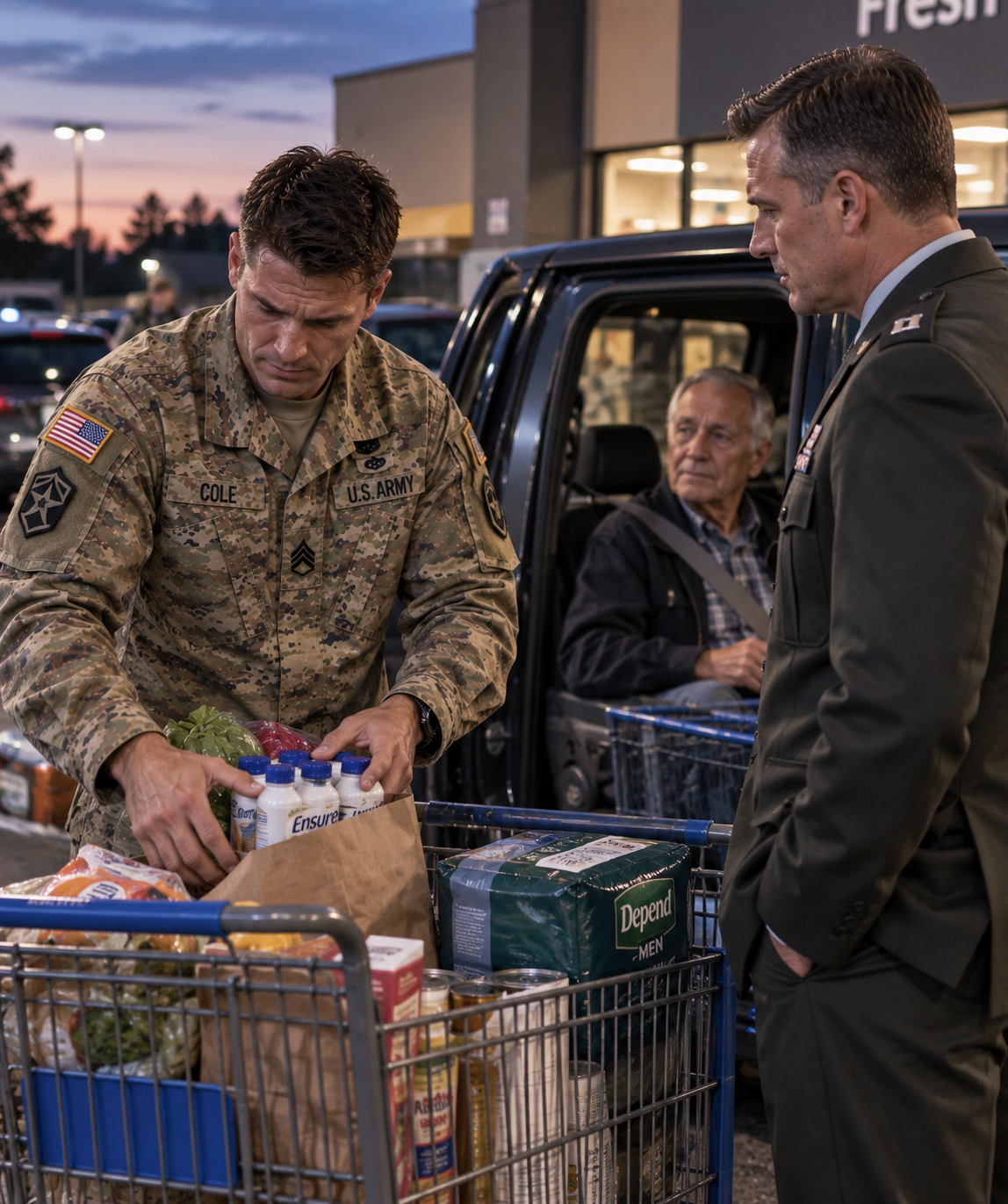
PART 2: NOT SPECIAL TREATMENT
Ryan arrived at Captain Reed’s office the next morning expecting a lecture.
Instead, Reed pointed at the chair.
“Sit.”
Ryan remained standing.
“Sir, my personal life has never interfered with my duties.”
Reed raised an eyebrow.
“I’ve found you asleep in your truck twice.”
Ryan sat.
For several seconds, neither spoke.
Then Reed asked:
“How long?”
“Seven months.”
Ryan’s father, Michael Cole, was seventy-four.
He had always been fiercely independent.
After Ryan’s mother died, Michael remained in the same small house where Ryan had grown up.
At first, he managed fine.
Then ordinary tasks became harder.
Driving.
Cooking.
Remembering medications.
Getting groceries upstairs.
Ryan started visiting twice a week.
Then four times.
Eventually almost every evening.
“Why doesn’t he move closer?” Reed asked.
“He won’t.”
“Have you discussed other support?”
“Yes.”
“And?”
Ryan smiled tiredly.
“My father considers accepting help a character flaw.”
Reed almost laughed.
“Wonder where you got it.”
Ryan looked away.
There was another reason he’d kept quiet.
Years earlier, Ryan had watched another soldier deal with a difficult family situation.
Schedules were occasionally adjusted when circumstances permitted.
Other soldiers helped cover.
Most people had been supportive.
But Ryan remembered hearing one man complain:
“Must be nice getting special treatment.”
That sentence stayed with him.
Ryan never wanted anyone saying it about him.
So he said nothing.
He drove forty miles after work.
Bought groceries.
Prepared his father’s dinner.
Sorted household necessities.
Checked what needed attention.
Then drove forty miles back.
Sometimes he arrived home after 10:00 p.m.
A few hours later, his alarm went off.
“You think asking us to understand the situation means asking us to lower the standard?” Reed said.
Ryan nodded.
“Yes, sir.”
“Those are two different things.”
Reed didn’t promise Ryan easier duty.
He didn’t erase responsibilities.
And he certainly didn’t tell him he could simply leave whenever he wanted.
Instead, they looked at what could realistically change within unit requirements.
Ryan’s schedule had several late days followed immediately by early starts.
Some could be rearranged without reducing coverage.
A Sergeant in another section preferred earlier hours because of his own family routine.
They were able to coordinate certain shifts through proper channels.
Reed also pointed Ryan toward available support resources so he could learn what options existed for his father rather than trying to solve everything alone.
“This isn’t permanent,” Reed said.
“I understand.”
“And operational requirements still come first when they have to.”
“I understand.”
Reed leaned forward.
“Then stop calling reasonable planning a favor.”
Ryan didn’t answer.
The new arrangement didn’t make life easy.
He still drove.
Still bought groceries.
Still spent evenings helping his father.
But he wasn’t routinely stacking the worst possible work hours on top of those responsibilities simply because he was afraid someone might judge him.
Two weeks later, Staff Sergeant Ethan Brooks approached him.
“Hey.”
Ryan looked up.
“Heard you switched some shifts.”
Ryan immediately became defensive.
“Captain approved it.”
“I know.”
“Coverage isn’t affected.”
“I know.”
Ryan frowned.
“Then what?”
Ethan held up his truck keys.
“My mom lives thirty miles in the same direction.”
Ryan waited.
“I go out there Thursdays.”
“So?”
“So if your dad needs groceries Thursday, give me the list.”
Ryan shook his head.
“No.”
“Why?”
“Because he’s my father.”
Ethan stared at him.
“And?”
Ryan had no answer.
Ethan tossed his keys once.
“Think about it.”
The following Thursday, Ryan handed him a short grocery list.
No speech.
No gratitude ceremony.
Just a list.
Ethan returned that evening with two bags.
Michael Cole was suspicious.
“Who’s this?”
Ryan smiled.
“A guy from work.”
Michael looked at Ethan.
“My son making you run errands?”
Ethan answered immediately.
“No, sir. I’m going to see my mother anyway.”
Michael considered that.
Then nodded.
“Fine.”
He took the bags.
Five minutes later, he was making Ethan coffee.
Over the next several months, Ryan’s father slowly accepted more help.
Not because Ryan forced him.
Because Ryan finally stopped presenting every form of assistance as evidence that Michael could no longer take care of himself.
Some things Michael still did independently.
Some things Ryan handled.
Some things professionals helped with.
And occasionally, somebody simply picked up groceries.
One evening, Ryan and Michael sat on the porch.
His father looked toward Ryan’s truck.
“You driving all the way back tonight?”
“Yeah.”
Michael shook his head.
“Eighty miles round trip just to check on an old man.”
Ryan smiled.
“You checked on me for about eighteen years.”
“More than eighteen.”
“Then I’m still behind.”
Michael laughed.
A year later, a young soldier named Private Lucas Bennett began refusing weekend plans.
Ryan noticed.
Then Lucas started looking tired.
One afternoon, Ryan found him eating alone.
“Everything okay?”
“Yes, Sergeant.”
Ryan recognized the answer immediately.
“Family?”
Lucas hesitated.
“My wife just started working nights. We’ve got a baby.”
“You getting any sleep?”
“Enough.”
That meant no.
Lucas quickly added:
“I’m not asking for anything.”
Ryan pulled out a chair.
“Good.”
Lucas looked confused.
“Then we’re just having a conversation.”
Ryan explained something Captain Reed had taught him.
There was a difference between avoiding responsibility and managing responsibility.
A difference between lowering standards and building a schedule that allowed people to meet them.
Most importantly, there was a difference between favoritism and leadership knowing enough about its people to plan intelligently.
Lucas listened.
Ryan finished with the sentence he’d once hated hearing:
“You don’t have to pretend the rest of your life disappears when you put on the uniform.”
Years later, Ryan barely remembered the jokes about his imaginary girlfriend.
But he never forgot the night Captain Reed saw that grocery cart.
Ryan had spent months believing strength meant carrying every responsibility without letting anyone see the weight.
He eventually learned something harder.
Sometimes strength was admitting the weight existed.
His commander hadn’t rescued him.
Hadn’t lowered the standard.
Hadn’t given him a free pass.
He had simply helped Ryan build a life where being a good soldier and being a good son didn’t have to destroy each other.