
PART 2: THE EMPTY CHAIR
Nobody sat down.
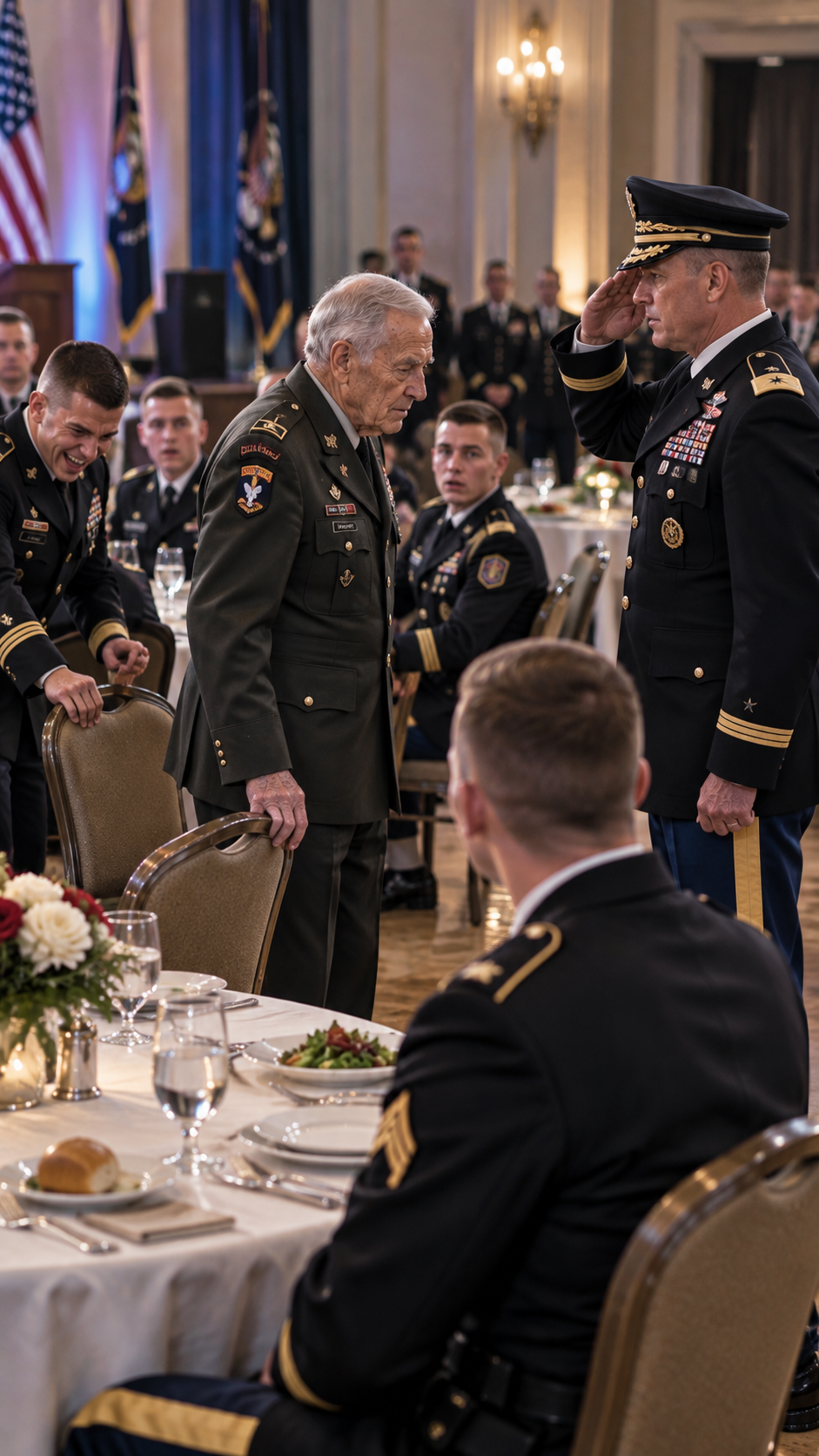
General Hayes remained beside James Donovan.
Tyler Grant stared at the floor.
Hayes turned toward the assembled soldiers.
“Twenty-nine years ago, this battalion nearly lost an entire team during an evacuation after severe weather cut off their planned route.”
James quietly interrupted.
“Robert.”
Hayes looked at him.
“You don’t have to do this.”
“Yes, sir,” Hayes replied. “I do.”
That word changed the room.
Sir.
The general had just called the old man sir.
Hayes continued.
“At the time, Colonel Donovan was the officer responsible for getting those soldiers home.”
The room became completely silent.
The operation had become part of the battalion’s history.
Most of the younger soldiers knew the story.
What they didn’t know was the name of the man standing against the wall.
Communications had failed.
The planned route became unusable.
Donovan reorganized the withdrawal, coordinated the scattered teams and refused to leave until every person under his responsibility had been accounted for.
No mythical one-man heroics.
No Hollywood miracle.
Just hours of calm decisions while everything around his unit was going wrong.
Every soldier eventually returned.
Hayes paused.
“My father was one of them.”
Tyler slowly raised his eyes.
Hayes looked at James.
“The reason I grew up with a father was partly because this man refused to treat anyone under his command as a number on a roster.”
James looked uncomfortable with the attention.
“I had good people.”
Hayes smiled.
“That’s exactly what my father always said you’d say.”
A few older officers nodded.
Some had finally recognized Donovan.
Tyler looked toward the table where James had originally tried to sit.
His face burned with embarrassment.
He stepped forward.
“Colonel Donovan…”
James turned.
Tyler swallowed.
“I owe you an apology.”
James waited.
“I judged you by your uniform. I embarrassed you in front of everyone. And I had no right to do that.”
James looked at him for several seconds.
Then he asked:
“Would it have been acceptable if I hadn’t been a colonel?”
Tyler froze.
That question hit harder than anger would have.
“No, sir.”
“What if I really had been somebody’s father wearing an old uniform?”
“No, sir.”
“What if I had been a janitor?”
Tyler lowered his head.
“No, sir.”
James nodded.
“Then you’ve understood the important part.”
He didn’t demand punishment.
He didn’t humiliate Tyler in return.
Instead, he walked back toward the original table.
Tyler immediately reached for the chair.
But James stopped him.
“Leave it.”
Everyone looked confused.
James picked up another empty chair from the next table and placed it beside his own.
Then he looked toward an elderly civilian standing alone near the rear entrance.
The man had arrived with one of the veterans but hadn’t been assigned a seat.
James waved him over.
“Come sit with us.”
The civilian hesitated.
James smiled.
“There’s room.”
General Hayes watched quietly.
That became the real lesson of the evening.
Not Donovan’s former rank.
Not the old operation.
Not even the general’s salute.
It was what James did after being humiliated.
He could have used his history to make the young soldiers feel small.
Instead, he used it to make the table larger.
Before dinner ended, Tyler approached him again.
“Colonel, can I ask you something?”
James nodded.
“Why didn’t you tell us who you were?”
James glanced at the faded sleeve of his old uniform.
“Because respect that only appears after you learn someone’s rank isn’t respect.”
Tyler said nothing.
Years later, after Tyler became a platoon sergeant himself, soldiers noticed something unusual about his unit dinners.
There was always one extra chair at his table.
Nobody reserved it for generals.
Nobody reserved it for decorated veterans.
It was simply there for whoever had nowhere else to sit.
And whenever a young soldier asked why, Tyler gave the same answer.
He never mentioned the embarrassing night.
He never mentioned Colonel Donovan.
He simply touched the empty chair and said:
“Nobody earns the right to make another person feel too small to sit beside them.”