
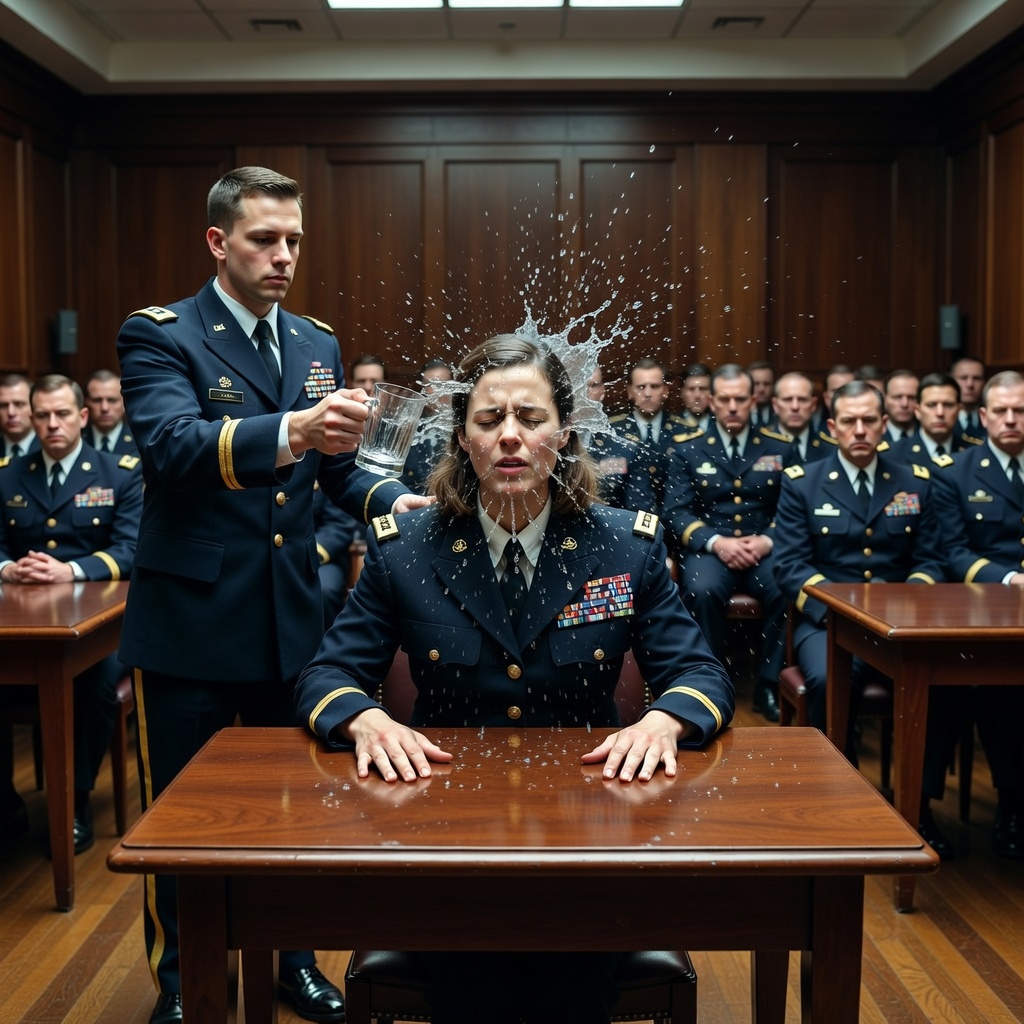
The water was ice-cold.
It hit the side of my face with a sharp, stinging slap, the sudden kinetic force of it startling the heavy, stagnant air of the courtroom before soaking instantly into the frayed collar of my faded grey sweater.
For a fraction of a second, the vast, wood-paneled room went entirely dead silent.
The kind of silence that precedes a detonation.
Then, the laughter started.
It wasn’t a roar, not an outright guffaw, but a low, murmuring sneer that rippled like a noxious gas through the gallery of pristine dress uniforms seated behind me.
I did not blink.
I did not raise my hand to wipe away the heavy drops sliding down my cheek, tracing the sharp line of my jaw before falling onto the polished mahogany of the defense table.
I just sat there, perfectly still.
My heart rate rested comfortably at forty-two beats per minute.
You do not survive three classified deployments in the suffocating, dust-choked mountains of the Korengal Valley by losing your temper over a spilled drink.
“Wake up, Ms. Miller,” Commander Hayes said, his voice dripping with a theatrical, condescending pity that made the gallery murmur in approval.
He stood precisely three feet away from my table, the empty glass still dangling casually from his manicured, uncalloused fingers.
He was a Judge Advocate General officer who had likely never seen sand outside of an officer’s club golf course bunker.
His uniform was immaculate, a terrifyingly crisp display of bureaucratic excellence, adorned with commendation ribbons for paperwork and peacetime administration.
He looked at me not as a fellow soldier, but as a smudge on his pristine floor.
A delusional civilian who had wandered into his sacred halls to play pretend.
I looked down at my clothes.
Faded denim jeans, soft at the knees from years of wear.
A plain, oversized wool sweater I had bought from a thrift store in Seattle because the cold never quite seemed to leave my bones after the last tour.
I wore civilian clothes because I had no uniform to wear.
When you operate in the shadows, when you are recruited into a Department of Defense black project so deeply buried that your own government doesn’t acknowledge your existence, you do not get to keep your brass.
You do not get a shadowbox.
You do not get a DD-214 that tells the truth.
When my unit was disbanded, my official service record was aggressively sanitized, leaving only a ghostly trail of a supply clerk who had served a remarkably unremarkable four years.
I was here because I had filed a claim with the Department of Veterans Affairs.
My hearing is nearly gone in my left ear—the permanent, ringing consequence of firing a MACMillan TAC-50 anti-materiel rifle from enclosed, echoing spaces over a hundred times.
I have tremors in my hands when I try to sleep, and I wake up tasting copper and cordite.
The system flagged my medical claims.
They ran my name, found the sanitized file, and concluded that Sarah Miller, supply clerk, was committing fraud.
Stolen valor.
The military takes stolen valor very seriously.
They pulled me into this preliminary tribunal to make an example of me.
“I asked you a question, Ms. Miller,” Hayes continued, his polished black shoes tapping rhythmically against the hardwood floor.
He paced back and forth, playing entirely to the audience of junior officers behind me.
“You expect this tribunal to believe the fairy tale you wrote on your medical forms?
You expect us to sit here, in a court of military justice, and swallow the delusion that a twenty-six-year-old female supply clerk was secretly a tier-one combat sniper?
You claim you sat on a ridge for seventy-two hours without moving.
You claim you provided overwatch for Joint Special Operations Command.
Yet, your commanding officer from 2014 says you spent the entire deployment organizing inventory in Bagram.
There are no files.
There are no witnesses.
There is only you, your faded jeans, and a very disrespectful attitude toward the uniform you falsely claim to have worn.”
He wanted me to break.
He wanted me to scream, to cry, to slam my hands on the table and demand respect.
He wanted me to act like the hysterical fraud he believed I was.
That was why he threw the water.
It was a calculated insult, a physical shock meant to shatter my composure.
But Commander Hayes did not understand the nature of stillness.
He did not know what it felt like to control your breathing while a hostile patrol walked thirty feet below your concealed position.
He did not know the supreme, agonizing discipline of holding a crosshair over a target for six hours, waiting for the wind to die down to a whisper.
To him, this courtroom was a battlefield.
To me, it was just a room full of loud, soft men.
I inhaled slowly through my nose.
Four seconds in.
Hold for four seconds.
Exhale for four seconds.
The sniper’s breath.
It grounded me.
The water dripped from the end of my nose.
The cold dampness of my sweater pressed against my collarbone.
“My records are classified under Executive Order 13526,” I said, my voice quiet, even, and entirely devoid of emotion.
“If you had the clearance to read them, Commander, we would not be having this conversation.”
The gallery erupted into a louder, harsher wave of scoffs.
Hayes chuckled, a dry, venomous sound.
He leaned over the table, placing both hands flat on the mahogany, bringing his face so close to mine I could smell the sharp peppermint on his breath.
“That is the oldest lie in the book, Ms. Miller. ‘My files are classified.’ It’s what every fake hero says when they are backed into a corner.
You are a civilian wearing the stolen ghosts of better men.
And we are going to ensure you never see a dime of veteran benefits, and that you face federal charges for this insult.”
I didn’t lean back.
I held his gaze.
My eyes were completely dead, locking onto his pupils with a predator’s hollow focus.
For a fleeting second, I saw his confident smirk falter.
He saw something in my eyes that didn’t belong in a civilian supply clerk.
He saw the void.
He blinked, stepping back slightly, subconsciously disturbed by the sheer lack of fear radiating from my side of the table.
“The presiding judge will be here momentarily,” Hayes said, his voice a fraction louder, trying to recover his theatrical dominance.
“And when he arrives, I am going to ask him to hold you in contempt for your behavior today.
I suggest you wipe your face.
You look pathetic.”
I didn’t move a muscle.
The heavy, oppressive tension in the room thickened.
The junior officers in the gallery were whispering now, pointing at the puddle of water on my table.
I felt a profound, crushing exhaustion wash over me.
This was the country I had bled for.
These were the men I had provided overwatch for, the men whose convoys I had saved from ambushes they never even knew were coming.
I had traded my youth, my peace of mind, and my hearing to keep them safe, and here they were, laughing at my wet hair and civilian clothes.
The injustice of it didn’t burn; it just felt incredibly heavy.
Then, the massive oak doors at the back of the courtroom swung open with a heavy, resonating thud that echoed off the high ceiling.
The sound was so sudden and violent that the whispers in the gallery died instantly.
“Ten-hut!” the Bailiff roared, his voice cracking with sudden, unexpected panic.
Every uniform in the room scrambled violently to stand.
Chairs scraped loudly against the hardwood.
Heels clicked together with frantic precision.
Commander Hayes snapped his spine straight, his arms pinned to his sides, his chin raised proudly.
I remained seated for a moment longer, turning my head slowly to look over my shoulder.
Stepping through the heavy oak doors was Admiral Thomas Vance.
He was not supposed to be here.
The docket had listed a low-level military judge, a Captain who handled administrative fraud cases.
But there stood Vance, three stars gleaming on his collar, the ribbons on his chest a heavy, undeniable tapestry of actual, brutal wars.
He was an older man now, his hair completely silver, his face weathered into deep canyons of stress and authority.
But I knew that face.
I knew it from the static-filled screens of command tents.
I knew his voice from the secure earpiece buried in my ear during the darkest, longest nights of my life.
In 2014, Admiral Vance was the theater commander of Joint Special Operations Command.
He was the man who had personally signed the orders that sent me into the shadows.
He was the man who had authorized the sanitization of my file to protect the black ops program.
Vance’s eyes swept the room.
They were cold, calculating, and utterly terrifying.
He did not look at the flags.
He did not look at the Bailiff.
He looked at the gallery of junior officers, who were practically trembling at the sudden presence of a three-star admiral in a minor administrative hearing.
Then, his eyes locked onto Commander Hayes.
Hayes was beaming, a smug, victorious smile twitching at the corner of his lips.
He thought Vance was here to drop the ultimate hammer, to personally crush the civilian who dared insult the Navy.
Finally, Vance’s eyes found me.
He saw the faded grey sweater.
He saw the dampness clinging to my hair.
He saw the water dripping from my chin, the puddle on the defense table, and the empty glass resting near Hayes’s hand.
The temperature in the room seemed to plummet twenty degrees.
The silence was no longer heavy; it was a vacuum, suffocating and lethal.
Admiral Vance began to walk down the center aisle.
His footsteps were slow, measured, and agonizingly loud in the dead quiet of the courtroom.
He didn’t look at the prosecution table.
He didn’t acknowledge Commander Hayes’s crisp salute.
He walked right past the JAG officer as if Hayes were nothing more than a piece of uninteresting furniture.
The smug smile on Hayes’s face melted into a mask of pure, unadulterated confusion, his arm still rigidly holding a salute that the Admiral completely ignored.
Vance stopped directly in front of my table.
He stood there for a long moment, his weathered eyes taking in my civilian clothes, the water on my face, the absolute stillness in my posture.
I slowly pushed my chair back.
The wood groaned softly.
I stood up, keeping my hands straight at my sides, my chin parallel to the floor.
I did not salute.
I had no uniform, and my existence as a soldier was technically a federal secret.
Vance looked deeply into my eyes.
He saw the hollow exhaustion.
He saw the tremors I was fighting so desperately to hide in my fingers.
A muscle feathered in the Admiral’s jaw.
The cold fury radiating from him wasn’t directed at me; it was directed at the room, at the men who had dared to mock a ghost who had kept them alive.
Slowly, deliberately, Admiral Vance brought his hand up.
His fingers were perfectly straight, his wrist rigid.
He snapped a salute that was crisp, perfect, and laden with a profound, shattering respect.
He held it.
The highest-ranking officer in the room, a three-star Admiral, was saluting a drenched woman in a thrift-store sweater.
The gallery stopped breathing.
Commander Hayes lowered his arm, his face draining of all color, his eyes wide with a sudden, horrifying realization of what he had just done.
CHAPTER II
The silence in the courtroom wasn’t empty. It was a physical weight, thick and suffocating, the kind of silence that precedes the collapse of a mountain. Admiral Thomas Vance remained locked in that salute, his hand a rigid blade against his brow, his eyes fixed on mine with a terrifying, paternal clarity. I didn’t move. I couldn’t. My sniper training, the years of Pavlovian conditioning to remain a statue in the tall grass, was the only thing keeping my knees from buckling.
Behind me, I could hear the wet, rhythmic sound of Commander Hayes’s breathing. It had become ragged, a sharp contrast to the arrogant, metronomic cadence he’d used while mocking my civilian clothes ten minutes ago. I could still feel the cold trail of the water he’d thrown in my face—a drop was clinging to my chin, heavy and irritating. I didn’t wipe it away. To move now would be to break the spell, to acknowledge that I was a person and not a ghost returned to haunt this sterile, fluorescent-lit room.
“Admiral,” Hayes finally stammered. His voice had jumped an octave, losing its predatory edge. “Sir, I don’t… this is a closed hearing regarding civilian fraud. The defendant is…”
“The defendant is Sergeant Sarah Miller,” Vance’s voice cut through the air like a serrated edge. He didn’t lower his hand. He didn’t look at Hayes. “But in the spaces where the world is actually kept spinning, Commander, she is known by a different name. One you aren’t cleared to whisper, let alone prosecute.”
Vance slowly lowered his hand, the motion so deliberate it felt like a sentence being passed. He finally turned his gaze toward Hayes. The Commander looked small. In his crisp whites, under the shadow of a four-star Admiral who had spent forty years in the dirt and the dark, Hayes looked like a child playing dress-up in his father’s closet.
“You threw water on her,” Vance said, his voice dropping to a low, dangerous rumble. It wasn’t a question. He had seen the dampness on my shirt, the puddle on the floor. “You mocked her lack of medals. You called her a parasite on the VA system because her records showed ‘administrative service’ in a desk job in Virginia.”
“Sir, the records provided by the Department of Defense explicitly state—”
“The records provided to you were a lie,” Vance interrupted. He reached into the inner pocket of his tunic and pulled out a sleek, black encrypted drive. He didn’t hand it to Hayes. He walked toward the court stenographer’s station, ignoring the judge, who was sitting paralyzed behind the bench. “They were a lie because the truth of what Sarah Miller did would cause a diplomatic crisis in three different hemispheres if it ever reached a Sunday morning talk show. They were a lie because I ordered them to be. But today, the lie ends. I have the unsealing authorization from the Secretary of Defense. The ‘administrative clerk’ is dead. We are here to talk about the Wraith.”
At the mention of that name, a cold shiver traced the path of my old wound—the jagged scar running from my left hip to the small of my back. It was a souvenir from a valley in the Hindu Kush that didn’t exist on any map provided to the public. That wound was my secret, the physical manifestation of a debt the government refused to acknowledge. For three years, I had lived in a cramped apartment, working two jobs, my body failing me because the VA told me my injuries were ‘non-service related.’ I had carried that silence like a stone in my mouth, knowing that to speak the truth was to violate a dozen non-disclosure agreements that carried the threat of Leavenworth.
I looked at the gallery. The people who had been laughing moments ago—the retired officers, the local reporters, the curious civilians—were leaning forward. The mockery had vanished, replaced by a voyeuristic hunger. They wanted the blood. They wanted the story. And for the first time, I realized that the truth wouldn’t set me free. It would only change the shape of my cage.
Hayes tried to regain his footing. “Admiral, with all due respect, this is highly irregular. There are protocols for unsealing classified—”
“Protocol?” Vance laughed, a dry, joyless sound. “You want to talk about protocol, Commander? You are currently attempting to imprison a woman for fraud because she claimed disability for a lung condition caused by a chemical fire in a facility that, officially, was a grain silo. You called her a liar because she couldn’t prove she was there. I was there. I watched her drag three men out of that ‘grain silo’ while her skin was blistering. I watched her stay behind with a long rifle to hold a bridge while the rest of us evacuated. Protocol says I should have given her the Silver Star that day. Politics said I had to give her a discharge and a gag order.”
Vance plugged the drive into the court’s media console. “The judge will now review the unredacted files. And because you decided to make this a public spectacle, Commander, because you invited the press to witness the ‘humiliation of a fraud,’ the unsealing will be public. You wanted a show? Here it is.”
The screen behind the judge flickered to life. It wasn’t just text. It was body-cam footage—grainy, green-tinted night vision. The sound of heavy breathing and the rhythmic thud of a helicopter rotor filled the room.
I closed my eyes. I didn’t need to see the screen. I lived in that footage every time I tried to sleep. I saw the flash of the muzzle, felt the kick of the .300 Win Mag against my shoulder, heard the frantic voice of my spotter, Elias, as he bled out in the dirt beside me. Elias. His name wasn’t in any of the fraud documents. He didn’t exist either. He had been buried in a civilian cemetery under a false history, his mother told he died in a car accident in Germany.
The courtroom was silent as the footage played. It showed a woman—thin, ghost-like in the infrared—moving through a compound with a terrifying, predatory grace. This wasn’t a clerk. This was a weapon. The footage showed the ‘grain silo’ explosion. It showed the woman, her uniform melting into her skin, refusing to drop her rifle. It showed her face as she looked into the camera during a brief moment of extraction. It was me, three years younger, with eyes that looked like they had already seen the end of the world.
I looked at Hayes. He was gray. Literally gray. The color had drained from his face, leaving behind a pasty, sickly hue. He knew. He knew that this wasn’t just about my exoneration. This was the end of him. He had built a career on being a ‘tough’ prosecutor, on ‘cleaning up’ the veteran rolls. He had used me as a stepping stone, a high-profile case to prove his vigilance. Now, he was the man who had publicly spat on a hero whose shadow he wasn’t fit to walk in.
But as I watched him tremble, I felt no triumph. Only a crushing, hollow exhaustion. To prove my innocence, Vance was tearing down the veil that kept the world safe—or at least, kept it ignorant.
“This is…” the Judge whispered, his eyes glued to the screen as a mission log scrolled by. *Project Nightfall. Operation Broken Arrow. Seventeen confirmed high-value targets.* “Commander Hayes, did you perform any due diligence regarding the defendant’s true assignment?”
“I… I followed the official personnel file, Your Honor,” Hayes said, his voice a pathetic squeak. “The records were verified by the Pentagon liaison.”
“The liaison who is currently being detained for questioning regarding the intentional suppression of service records,” Vance added coolly. “You see, Commander, you weren’t just a prosecutor. You were a tool. Someone wanted Sarah Miller silenced because she started asking for the medical benefits she was promised. She became a liability. So they fed you a false file, and you, in your infinite ambition, didn’t bother to ask why a ‘clerk’ had the combat reflexes of a tier-one operator.”
A moral dilemma began to coil in my chest, tighter than the scars on my back. By standing here, by letting Vance unseal these records, I was destroying more than just Hayes. I was exposing the names of the men still in that unit. I saw the faces of the operatives in the background of the footage—men who had families, who were still under deep cover.
I looked at Vance. He knew the cost. He was a man of the old guard, a man who believed in the mission above all else. Why was he doing this? Why was he burning it all down for me?
“Admiral,” I said, my voice cracking. It was the first time I’d spoken since the hearing began. “Stop. This is enough.”
Vance turned to me. His expression softened, just for a second. “No, Sarah. It isn’t. It’s not enough to just win. We have to make them understand what they’ve been doing. Not just to you, but to all the ghosts.”
He turned back to the court. “The records show that Sergeant Miller was denied treatment for toxic exposure, shrapnel removal, and PTSD-related neurological damage. She was denied because the government claimed she wasn’t there. Well, she was there. And while she was there, she saved the lives of two Senators’ sons who were on a ‘fact-finding mission’ that went south. One of those Senators is currently sitting on the Appropriations Committee. I wonder how he’ll feel when he finds out the woman who saved his child has been living on food stamps because of a ‘clerk’ error.”
A collective gasp went through the room. This was the triggering event. This was the irreversible moment. It wasn’t just a trial anymore; it was a political earthquake. The media in the back were already typing furiously, their thumbs flying over their phones. By tonight, the story of the ‘Ghost Sniper’ and the ‘JAG Bully’ would be the only thing on the news.
Hayes collapsed back into his chair. He looked at the water he’d thrown on me—it was still a dark stain on my shirt. He reached out as if to apologize, his hand trembling, but he caught my eye and stopped. He saw the same thing the enemies saw through my scope. I didn’t hate him. That would require an emotional investment I no longer possessed. I simply looked through him, as if he were nothing more than windage to be calculated.
“This court is adjourned,” the Judge said, his voice shaking. “Pending a full investigation into the conduct of the prosecution and the validity of the sealed evidence. Sergeant Miller… you are released on your own recognizance. Effective immediately.”
I didn’t move. The gallery was in an uproar. People were standing, some cheering, some shouting questions. Vance walked over to me. He stood between me and the crowd, a human shield.
“Let’s go, Sarah,” he whispered. “The car is outside.”
“You shouldn’t have done it, Admiral,” I said, my voice barely audible over the chaos. “You burned the unit. You burned the protocols. For what? For one sniper?”
Vance looked at me, and for the first time, I saw the true weight he carried. It wasn’t just the stars on his shoulders; it was the ghosts in his head. “I didn’t do it for the sniper, Sarah. I did it for the woman who has been dead for three years. I’m tired of burying people who are still breathing.”
As we walked out of the courtroom, the flashes of the cameras were like muzzle flares. The crowd pressed in, their faces a blur of false sympathy and excitement. They didn’t see me. They saw a story. They saw a ‘hero.’ They saw a way to feel good about themselves by being angry at Hayes.
I felt a hand on my arm. It was a woman, an older veteran with a tattered ‘Vietnam Vets’ cap. Her eyes were wet. “Thank you,” she whispered. “Thank you for making them see us.”
I wanted to tell her that I wasn’t her hero. I wanted to tell her that I was a killer who had been discarded and only brought back into the light because an Admiral felt guilty. I wanted to tell her that the truth was a weapon that always had recoil.
We reached the black SUV waiting at the curb. The air outside was hot and heavy, smelling of rain and exhaust. As I stepped into the vehicle, I looked back at the courthouse. Hayes was being led out a side door, flanked by security. He was shielding his face from the cameras. His career was a smoldering ruin. His life, as he knew it, was over. He had tried to drown me in a glass of water, and instead, he had been swept away by a tidal wave he never saw coming.
But as the door closed and the city began to slide past the tinted windows, the old wound in my back began to throb with a new, sharp intensity. I was no longer a ghost. I was a person again, with a name and a history and a target on my back. The Secret was out. The bridge was burned. And as Vance sat silently beside me, staring out at the passing buildings, I realized the hardest part wasn’t the trial.
The hardest part was going to be surviving the peace that followed.
I looked at my hands. They were steady. Too steady. I had spent so long being a weapon that I didn’t know how to be anything else. The military had discarded me, and then the Admiral had ‘saved’ me, but in doing so, he had stripped away the only thing I had left: my invisibility.
“Where are we going?” I asked.
Vance didn’t look at me. “To a safe house. You think this ends with a court dismissal? You just embarrassed some very powerful people, Sarah. People who liked you much better when you were a ‘fraudulent clerk’ no one believed.”
I leaned my head against the cool glass. The moral dilemma shifted again. By choosing to save my reputation, Vance had put a clock on my life. He had traded my obscurity for my survival, and I wasn’t sure it was a fair trade. I thought of the men in the valley. I thought of Elias. I wondered if they were watching from wherever ghosts go, and if they were laughing or crying.
I was Sarah Miller. I was the Wraith. And for the first time in my life, I was terrified of the light.
CHAPTER III. The air in the safe house tasted like dust and old copper. It was a sterile, two-story house somewhere in the Virginia woods, provided by what Admiral Vance called a neutral third party. But in my world, there is no such thing as neutral. There is only the side that wants you dead and the side that hasn’t decided yet. I sat by the window, not looking through the glass but at the reflection in it. My own face looked like a stranger’s. The trial was over. Commander Hayes was a ghost, a disgraced man whose career had been vaporized by the truth. But truth is a heavy thing to carry. It doesn’t make you light; it makes you a target. I could hear the hum of the refrigerator in the kitchen and the distant, rhythmic tap of a branch against the siding. It sounded like a heartbeat. Elias’s heartbeat. He was there, standing in the corner of my eye, a shadow among shadows. He didn’t speak. He never spoke anymore. He just watched, his phantom eyes weighing my soul. I was supposed to be safe. Vance had unsealed the records, the world knew I was ‘Wraith,’ and the public was currently drowning in the scandal of a government that tried to erase its own heroes. But as I watched a black SUV crawl up the gravel driveway without its headlights on, I realized the ‘liaisons’ weren’t here to protect me. They were the cleanup crew. The records were out, which meant I was the only piece of evidence left that could testify to the names behind the orders. They didn’t want the truth; they wanted the silence that comes after it. Phase One: The realization. I moved before the SUV even stopped. My body remembered the rhythm of the hunt better than the rhythm of peace. I didn’t go for the front door. I went for the floorboards I’d loosened earlier that afternoon. Underneath lay the only thing that felt real anymore—my custom-built reach-bolt rifle, the one the military claimed didn’t exist. It felt cold and honest in my hands. I heard the soft click of a car door closing. Not a slam. A click. These were professionals. They weren’t soldiers following a code; they were contractors, men who sold their morality by the hour. I slipped into the crawlspace, my heart slowing down to that combat pace where time starts to stretch. I could hear their breathing now. Three men. They moved with a synchronized efficiency that told me they had done this a hundred times. They weren’t looking for a conversation. They were looking for a corpse. I felt a surge of cold fury. I had given everything to a country that was now sending hitmen to my bedroom. The hypocrisy was a physical weight in my chest. I crawled toward the back of the house, my mind racing through the tactical layout of the woods. I knew these trees. I had spent six hours mapping them from the window. I knew where the shadows pooled and where the ground was soft enough to swallow a footstep. I wasn’t Sarah Miller anymore. I was the Ghost. I was the monster they had spent millions of dollars to create, and now they were going to find out why you never try to kill your own creation. Phase Two: The discovery. As I reached the tree line, I saw him. Not one of the hitmen, but Jax. Jackson ‘Jax’ Thorne, the man who had pulled me out of a burning humvee in Fallujah. He was standing near a secondary vehicle a few hundred yards down the road, his hands zip-tied behind his back. He looked broken. His face was a map of bruises, and his eyes were hollow. They weren’t just here for me. They were rounding up the survivors of Project Nightfall. They were burning the ledger. My breath hitched. Jax was a father. He had three girls and a wife who sent him letters in scented envelopes. He was the kind of man who deserved a quiet life, a porch, and a beer. Seeing him there, treated like a piece of refuse, snapped something inside me. The ‘fatal error’ wasn’t my decision to fight; it was the government’s decision to think I would ever let them touch one of my own. I pulled the rifle to my shoulder. The wood of the stock pressed against my cheek like a familiar kiss. Through the scope, the world turned green and sharp. I saw the man standing over Jax—a suit, not a uniform. He held a suppressed pistol to the back of Jax’s head. He was checking his watch. He was waiting for the signal from the house. They were going to execute him as soon as they confirmed I was dead. I had a choice. I could disappear into the woods. I could run and let the legend of Wraith vanish into the mist. Or I could take the shot that would change everything. If I pulled this trigger, I wasn’t just defending myself. I was engaging in an act of war against the people who signed my paychecks. I would be a murderer in the eyes of the law, regardless of the truth. Phase Three: The shot. I didn’t hesitate. I couldn’t. The world slowed down to the space between heartbeats. I factored for the wind, a light cross-breeze from the east. I factored for the drop. I focused on the suit’s temple. I didn’t see a human being; I saw a threat to a brother. I squeezed the trigger. The suppressed rifle let out a cough, a dull ‘thud’ that the woods swallowed instantly. Through the glass, I saw the suit collapse. He didn’t even have time to be surprised. Jax scrambled, his eyes wide, looking for the source. I didn’t wait for him to find me. I shifted my aim. The second man, the one by the SUV, was turning toward the sound of the body hitting the gravel. I took him in the chest. One. Two. The rhythm was hypnotic. It was the only language I knew how to speak perfectly. But then, the ‘fatal error’ manifested. As I lined up the third man, the leader of the liaison team, a floodlight hit the area. It wasn’t from the hitmen. It was from above. A news helicopter, alerted by an anonymous tip—likely Vance’s last insurance policy—roared over the trees. And behind them, a convoy of State Police and a black limousine with government plates. The timing was catastrophic. The world saw Sarah Miller, the celebrated hero of the morning’s trial, standing in the woods with a high-caliber rifle, surrounded by dead bodies. To the cameras, I wasn’t a veteran defending a friend. I was a loose cannon, a broken weapon that had finally snapped. I saw the leader of the contractors put his hands up, a smirk playing on his lips even as he knelt. He knew. He had won. He had forced me to become the monster the media could fear. Phase Four: The twist and the intervention. The limousine door opened. I expected more soldiers. I expected the Director of the CIA or a shadowy general. Instead, out stepped Julian Vane. The man I had saved from a spider-hole in the desert ten years ago. The son of the most powerful Senator in the country. He walked right into the line of fire, his face pale but determined. He didn’t look at the dead bodies. He looked at the trees where he knew I was hiding. ‘Sarah!’ he screamed over the roar of the helicopter blades. ‘Don’t do it! We have the files! We have the names!’ But it was too late. The intervention wasn’t to save me from the hitmen; it was to save the government from me. Julian wasn’t there as a friend; he was there as a shield for the very people who wanted me gone. He was the face of the ‘good’ side of the corruption, the one that uses gratitude as a leash. Behind him, the State Police were moving in, their weapons drawn. They didn’t see a hero. They saw a sniper who had just executed two men on camera. The power shifted in an instant. The moral authority I had gained in the courtroom bled out into the Virginia soil. I looked at Jax, who was being hauled away by the police, his eyes filled with a mix of terror and pity. He knew what I had just done. I had traded my freedom for his life, and in doing so, I had confirmed every lie they ever told about me. I was a killer. I was unstable. I was a threat to the peace. I lowered the rifle. The weight of it felt like a mountain. The silence that followed the helicopter’s departure was the loudest thing I’d ever heard. I had won the battle in the morning and lost the war by midnight. My secret was gone, my hands were stained, and the very boy I had saved was now the man who would sign my arrest warrant. The truth hadn’t set me free. It had just built a bigger cage. I stood up and walked out of the shadows, my hands empty, my heart hollow. The red and blue lights danced across the trees, a kaleidoscope of failure. Elias was gone. Even my ghosts didn’t want to stay for this part.
CHAPTER IV
The holding cell was bright. Too bright. Fluorescent lights hummed a constant, irritating song that burrowed into my skull. After the night vision, the gunfire, the adrenaline… this felt like torture. They’d stripped me of everything: boots, belt, laces, even the damn dog tags I’d worn since… well, since before I was a ghost. Now, I was just another Jane Doe in an orange jumpsuit.
The silence was worse. No shouted orders, no whispered threats, just the dull throb of the building’s ventilation system. I sat on the edge of the steel cot, the cold seeping through the thin fabric. Jax was alive. That was the mantra I clung to, the only anchor in this swirling vortex of shit.
But at what cost? I’d traded my soul for his life, and the world was already lining up to collect.
**Phase 1: The Echo Chamber**
The news reports started subtly. At first, they focused on the ‘heroic rescue’ of Jax Thorne, framing it as a hostage situation gone wrong. Then came the questions: “Unstable Veteran?” “PTSD Trigger?” “Was Excessive Force Justified?” The footage from the news helicopter played on a loop: me, rifle raised, silhouetted against the burning wreckage of the safe house. Every angle, every freeze-frame, designed to paint me as a monster.
The online comments were a cesspool. “Traitor.” “Psycho Sniper.” “Lock her up and throw away the key.” The same people who’d lauded me as a hero weeks ago were now baying for my blood. The fickle nature of public opinion was a lesson I’d learned long ago, but this felt different. This felt personal. The hate was a physical presence, a suffocating blanket that smothered any hope of reason.
My lawyer, a public defender named Ms. Davies, visited me that afternoon. She was young, earnest, and clearly overwhelmed. “Ms. Miller,” she said, her voice barely a whisper, “the charges are… extensive. Assault with a deadly weapon, aggravated assault on federal officers, destruction of government property…”
I cut her off. “Treason?”
She winced. “It hasn’t been formally filed, but… the possibility is there.”
I nodded. Treason. It had a nice ring to it, didn’t it? After everything I’d done for this country, I was now its enemy. “What about Jax?” I asked.
“He’s… cooperating with the investigation. He’s being treated for his injuries.”
Cooperating. Of course, he was. He always was the good soldier. I didn’t blame him, not really. Survival instincts are a powerful thing. But the thought of him, safe and sound, while I rotted in this cell… it stung.
Ms. Davies cleared her throat. “There’s been… a development. Senator Vane has issued a statement.”
Julian. My stomach clenched. “What did he say?”
She hesitated. “He expressed his… deep concern about the incident. He called for a thorough investigation and… and he mentioned your previous… assistance to his son.”
“He threw me under the bus,” I said, the words flat and emotionless.
She didn’t deny it. “He said he was ‘shocked and saddened’ by your actions.”
Shocked and saddened. The weasel. He owed me his son’s life, and this was how he repaid me. But that was politics, wasn’t it? Use people, then discard them when they become inconvenient.
As Ms. Davies left, she turned back to me. “Ms. Miller,” she said, her eyes filled with a strange mixture of pity and fear, “I don’t know what happened out there, but… the world has already made up its mind.”
And she was right. The world had. I was guilty until proven innocent, and in this kangaroo court, innocence was a luxury I couldn’t afford.
**Phase 2: The Vance Gambit**
The only visitor I wanted to see was Admiral Vance. He arrived two days later, his face grim. The usual twinkle in his eyes was gone, replaced by a haunted look I recognized all too well.
“Sarah,” he said, his voice low, “this is a mess.”
“No shit, Admiral,” I replied. “You set me up.”
He flinched. “That’s not true, and you know it.”
“Then explain it to me,” I challenged. “Explain why the people ‘protecting’ me were actually trying to kill me. Explain why Jax was a target. Explain why the whole damn world thinks I’m a terrorist.”
He sighed, running a hand through his thinning hair. “Project Nightfall… it stirred up some powerful people. People who don’t want their secrets exposed. They saw you as a threat, and they took steps to eliminate you.”
“And you let them,” I accused. “You used me as bait.”
“I tried to protect you,” he insisted. “But they have resources I can’t match. They control the narrative, Sarah. They control the truth.”
“So, what now?” I asked. “Am I just supposed to roll over and die?”
He shook his head. “No. I have a plan.”
My hopes flickered, just for a moment. “What kind of plan?”
“I can get you out of here,” he said. “I can arrange for you to disappear. New identity, new life. You’ll have to leave everything behind, but it’s the only way.”
Disappear. Start over. The same offer they’d made me years ago, when they erased Sarah Miller and created Wraith. But this time, it felt different. This time, it felt like a final surrender.
“What’s the catch?” I asked, already knowing the answer.
He hesitated. “There are… conditions. You’ll have to agree to remain silent. No interviews, no memoirs, no seeking revenge. You’ll have to disappear completely and never look back.”
“And if I don’t agree?”
He looked away. “Then I can’t help you. You’ll face trial, and you’ll be convicted. They’ll make sure of it.”
Silence stretched between us, thick and suffocating. He was offering me a way out, but it came at the cost of my voice, my identity, my very existence. Was I willing to pay that price?
“There’s something else, isn’t there?” I said, my eyes narrowed. “Something you’re not telling me.”
He hesitated, then nodded slowly. “Senator Vane… he’s using this situation to his advantage. He’s pushing through a new piece of legislation, the ‘National Security Enhancement Act.’ It would grant the government unprecedented surveillance powers, all in the name of preventing future ‘incidents’ like yours.”
My blood ran cold. It all made sense now. The smear campaign, the public outcry, the rushed legislation… it was all orchestrated. I was just a pawn in their game, a convenient scapegoat to justify their power grab.
“You knew about this, didn’t you?” I accused. “You knew what Vane was planning.”
He didn’t deny it. “I suspected. But I couldn’t prove it.”
“So you let me take the fall,” I said, my voice trembling with rage. “You sacrificed me to expose Vane’s scheme.”
“I gave you a choice, Sarah,” he said, his voice pleading. “I gave you a way out.”
But there was no choice, not really. I was trapped, caught between the machinations of powerful men who saw me as nothing more than a tool. And in the end, I was the one who would pay the price.
**Phase 3: The Thorne Betrayal**
Three days after Vance’s visit, Jax came. He looked… different. Cleaner, healthier, almost… relieved. He sat across from me, the steel table a cold barrier between us.
“Sarah,” he said, his voice hesitant, “I… I wanted to thank you.”
“Thank me?” I asked, my voice dripping with sarcasm. “For what? For saving your life and ruining mine?”
He flinched. “I know things look bad, but…”
“But what, Jax?” I challenged. “But you’re safe? But you’re going home? But everything’s going to be okay?”
He looked down at his hands. “I had to tell them what happened, Sarah. I had to tell them everything.”
“Everything?” I repeated. “So you told them about Nightfall? About Elias? About all the things we did together?”
He nodded slowly. “It was the only way to clear my name. They said I was being investigated as a possible accomplice.”
Accomplice. He’d thrown me under the bus to save his own skin. And I’d risked everything for him.
“Did you tell them about Vance?” I asked, my voice dangerously low.
He hesitated. “I… I mentioned that he was involved.”
“Mentioned?” I scoffed. “Or did you paint him as the mastermind behind the whole thing?”
He didn’t answer. His silence was all the confirmation I needed.
“You betrayed me, Jax,” I said, the words heavy with pain. “You sold me out to save yourself.”
“I didn’t have a choice,” he pleaded. “They threatened to take everything away from me. My pension, my benefits, my reputation…”
“And what about me, Jax?” I asked. “What about everything I lost?”
He looked at me, his eyes filled with a strange mixture of guilt and resentment. “You made your own choices, Sarah. You didn’t have to do what you did.”
Those words hit me like a physical blow. He was right. I didn’t have to. I could have let him die. I could have walked away. But I didn’t. I made a choice, and now I had to live with the consequences.
As he stood to leave, he turned back to me. “I’m sorry, Sarah,” he said, his voice barely audible. “I truly am.”
But his apology was hollow, meaningless. The bond between us was broken, shattered beyond repair. I was alone, utterly and completely alone.
**Phase 4: The Wraith Unbound**
Days blurred into weeks. I refused to cooperate with the investigation. I refused to speak to the media. I refused to play their game.
Ms. Davies informed me that the trial date was set. The prosecution was confident. The evidence was overwhelming. My chances were slim to none.
Admiral Vance visited me one last time. He looked defeated, his shoulders slumped, his eyes filled with a weary resignation.
“It’s over, Sarah,” he said. “Vane’s bill passed. The public is clamoring for your head. There’s nothing I can do.”
“Then do nothing,” I said, my voice flat. “I don’t want your help.”
He looked at me, confused. “But… I thought you wanted to get out of here.”
“I did,” I said. “But not on your terms.”
I’d spent my entire life being a weapon, a tool for others to use. I’d been molded, shaped, and controlled by forces beyond my comprehension. But no more. I was done being a pawn.
“What are you going to do?” he asked.
I looked him in the eye, and for the first time in a long time, I felt a sense of peace. “I’m going to let them win,” I said.
He stared at me, bewildered. “But why?”
“Because I’m tired, Admiral,” I said. “Tired of fighting, tired of running, tired of being someone I’m not.”
I closed my eyes, and I saw her: Sarah Miller, the girl I used to be. Before the missions, before the kills, before the lies. She was still there, buried deep beneath layers of trauma and regret. And she was ready to rest.
The trial was a formality. The outcome was predetermined. I sat silently as they paraded witnesses before me, each one painting a more damning picture of my character. I didn’t defend myself. I didn’t argue. I simply listened.
The jury deliberated for less than an hour. The verdict: guilty on all counts.
As the judge read the sentence – life without parole – I felt a strange sense of liberation. The weight of the world lifted from my shoulders. I was free.
They took me to a maximum-security prison, a concrete fortress surrounded by razor wire and armed guards. I was assigned a cell, a small, sterile box that would be my home for the rest of my days.
As the steel door clanged shut behind me, I smiled. Wraith was dead. And Sarah Miller was finally home.
CHAPTER V
The fluorescent lights of the high-security prison hummed, a constant, irritating drone that had become the soundtrack to my life. Cell 218, D Block. Four walls, a steel bed, a toilet, and a sink. My world. Once, I navigated the shadows of nations, a whisper in the dark. Now, I was just another number, another face swallowed by the system. Sarah Miller, prisoner #84729. The Wraith was dead.
Days bled into weeks, weeks into months. The rhythm of prison life was monotonous: the clanging of metal doors, the shuffling of feet, the echoing shouts in the yard. I ate, I slept, I exercised in the small, enclosed space allotted to me. I received no mail, no visitors. I was a ghost even here, isolated by my past, my notoriety, and the government’s desire to keep me buried.
I found myself thinking about Elias often. About the day he died, the look on his face. The guilt was a heavy weight, but it no longer crushed me. It was simply… there. Part of the landscape of my mind. I had done what I thought was necessary, what I was ordered to do. And it had led me here. To this.
The dreams were less frequent now. The nightmares, the flashbacks of missions gone wrong, the faces of those I had killed. They still came, but they were fainter, like echoes in a distant cave. I was learning to live with them, to acknowledge them without being consumed.
I spent hours staring at the wall, letting my mind wander. I thought about my mother, about the life I could have had if I hadn’t joined the military. About the choices I had made, the paths I had taken. There were no regrets, not really. Only acceptance. This was my destiny. My end.
Weeks later. I was reading when a guard stopped at my cell. “You have a visitor,” he said, his voice flat and devoid of emotion.
I looked up, surprised. “Who is it?”
“Admiral Vance.”
A wave of conflicting emotions washed over me: shock, anger, resentment, and a strange sense of… pity. I had expected never to see him again. He had done what he could, but in the end, he couldn’t save me.
I followed the guard to the small, sterile visitation room. Vance was already there, sitting at the metal table, his face etched with weariness and regret. He looked older, more defeated than I had ever seen him.
He stood as I entered, a flicker of hope in his eyes that quickly died as he saw my own expression.
“Sarah,” he said, his voice low. “I… I wanted to see you.”
I sat down opposite him, the cold metal of the chair a stark contrast to the warmth of his gaze.
“Why?” I asked, my voice flat. “There’s nothing left to say.”
“I know,” he said. “But I needed to tell you… I’m sorry. I failed you.”
“You didn’t fail me, Admiral,” I said. “The system did. You were just a part of it.”
He shook his head. “I could have done more. I should have done more.”
“It doesn’t matter now,” I said. “It’s over.”
We sat in silence for a long moment, the weight of our shared history hanging heavy between us. I saw the guilt in his eyes, the burden he carried for the things he had done, the things he had allowed to happen.
“How are you?” he asked finally, his voice barely a whisper.
“I’m… at peace,” I said, surprised by the truth of my own words. “I’ve accepted my fate.”
He looked at me, a hint of disbelief in his eyes. “You don’t hate me?”
“No,” I said. “I don’t hate you. I pity you. You’re still trapped in the game, still fighting battles that can’t be won. I’m free.”
He didn’t respond, his gaze fixed on the table. I could see the pain in his eyes, the realization that he had lost, not just me, but a part of himself.
“I brought you something,” he said, reaching into his coat pocket. He pulled out a small, worn photograph and slid it across the table.
I picked it up, my heart skipping a beat. It was a picture of me, taken years ago, before the war, before the training, before I became the Wraith. I was smiling, my eyes full of hope and innocence. A lifetime ago.
I looked at the picture, then back at Vance. “Why?”
“I wanted you to remember who you were,” he said. “Before all this.”
I smiled, a faint, sad smile. “That person is gone, Admiral. She died a long time ago.”
“Maybe not,” he said. “Maybe she’s still in there, buried beneath the layers of pain and regret.”
I shook my head. “The ghost is gone, Admiral. Only Sarah Miller remains.”
He didn’t say anything, but I saw a glimmer of understanding in his eyes. He knew that I was right. The Wraith was dead, and Sarah Miller was finally free, even in this cage.
The guard came to take Vance away. As he stood, he looked at me one last time, his eyes filled with a mixture of sadness and respect.
“Goodbye, Sarah,” he said.
“Goodbye, Admiral,” I replied.
He turned and walked away, leaving me alone with the photograph. I stared at it for a long time, tracing the lines of my younger face with my finger. It was a reminder of a life I had lost, a life that could never be recovered. But it was also a reminder that I was still here, that I had survived, that I had found a way to make peace with my past.
I closed my eyes, and for the first time in a long time, I felt a sense of… serenity. I was no longer the Wraith, the weapon, the ghost. I was just Sarah Miller, a woman who had lived, who had loved, who had lost, and who had finally found her way home.
Years passed. The prison became my world, my sanctuary. I learned to live within its walls, to find meaning in its monotony. I read, I wrote, I meditated. I helped other inmates, offering them comfort and guidance.
The world outside continued to spin, oblivious to my existence. The government changed, policies shifted, and new enemies emerged. But none of it mattered to me anymore. I was no longer a part of that world. I was free from its grip, its demands, its betrayals.
Sometimes, I would think about Jax. About his betrayal, his lies. But the anger had faded, replaced by a quiet understanding. He had done what he thought was necessary to survive. He was a survivor, just like me.
I never saw Vance again. I heard rumors that he had retired, that he was living a quiet life somewhere. I hoped that he had found peace, that he had been able to reconcile himself with the things he had done.
I kept the photograph of myself, the one Vance had given me, tucked away in a small box under my bed. It was a reminder of who I was, of who I could have been. But it was also a symbol of hope, a reminder that even in the darkest of times, the light of humanity can still shine through.
One day, I was sitting in my cell, reading a book, when I felt a presence behind me. I looked up and saw a new guard standing at the door. He was young, fresh out of training, his eyes wide with a mixture of fear and curiosity.
“Miller,” he said, his voice trembling slightly. “There’s someone here to see you.”
I frowned. “Who is it?”
He hesitated for a moment, then said, “She wouldn’t give her name. But she said you would know her.”
I stood up, my heart pounding in my chest. Could it be?
I followed the guard to the visitation room, my mind racing with possibilities. As I entered, I saw her. A woman, standing by the window, her back to me. She was older, her hair streaked with gray, but I recognized her instantly.
“Mother?” I whispered.
She turned around, her eyes filled with tears. “Sarah,” she said, her voice choked with emotion. “My Sarah.”
We rushed towards each other, embracing tightly. It had been so long, so many years since I had last seen her. I had thought she was dead, that I had lost her forever.
We sat down at the table, holding hands, our eyes locked on each other’s faces. We talked for hours, catching up on lost time, sharing stories of our lives.
She told me about my sister, about my nieces and nephews, about the life I had missed. I told her about my time in the military, about the missions, about the betrayals. I didn’t sugarcoat anything, I told her the truth, the whole truth.
She listened patiently, her eyes filled with sadness and understanding. She didn’t judge me, she didn’t condemn me. She just loved me, unconditionally.
As the visit came to an end, she looked at me, her eyes filled with a deep, abiding love.
“I’m so proud of you, Sarah,” she said. “You’ve been through so much, but you’ve never given up. You’re a survivor.”
I smiled, tears streaming down my face. “I learned from the best,” I said.
We hugged again, tightly, and then she was gone, leaving me alone in the visitation room.
I walked back to my cell, my heart filled with a sense of peace and gratitude. I had lost so much in my life, but I had also gained so much. I had found strength, resilience, and a connection to something larger than myself.
I sat down on my bed, took out the photograph of myself, and stared at it for a long time. The girl in the picture was gone, but her spirit lived on, in me. I was Sarah Miller, and I was finally home.
The sun set beyond the walls, casting long shadows across the yard. The prison fell silent, the only sound the gentle hum of the fluorescent lights. I closed my eyes, took a deep breath, and smiled.
The ghost is gone. Only the silence remains.
END.