
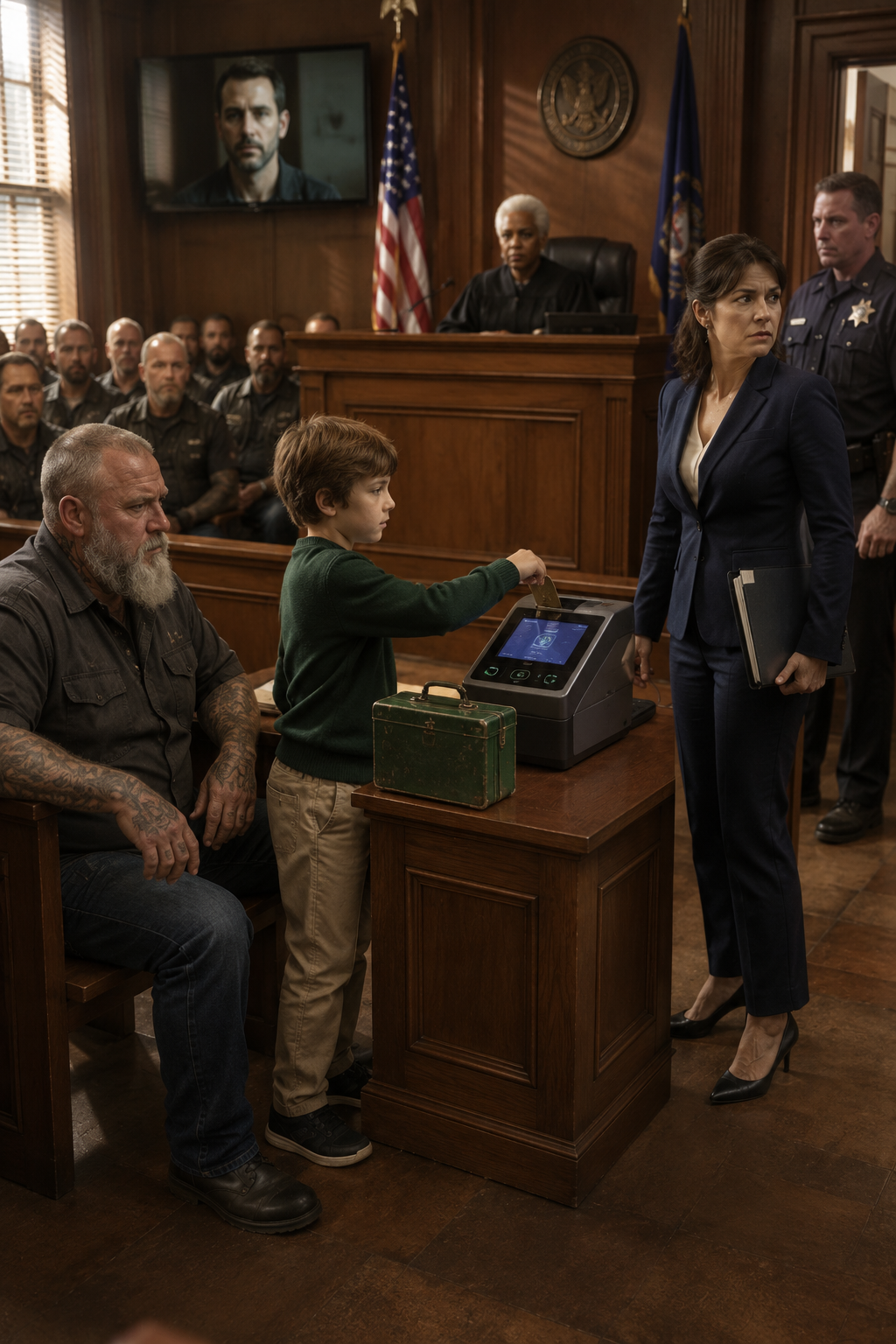
Ms. Vale reached the courtroom door before the bailiff caught it.
She did not run.
She stopped with one hand on the brass handle and turned back toward the judge as though leaving had been an administrative misunderstanding.
“That recording has no evidentiary foundation,” she said.
The judge looked at the screen, where Michael Turner’s face remained frozen above the words of his sealed petition.
“You were asked about a death certificate.”
“I am an adoption attorney, Your Honor. I do not issue death certificates.”
“But you signed this one,” I said.
The document had appeared beneath Michael’s video. Ms. Vale’s electronic signature sat beside a county medical examiner’s seal.
Her expression barely changed.
“That image could have been inserted.”
Amos remained seated in the rear gallery.
The other riders had not unfolded their vests or moved closer. Thirty-seven large adults sat in complete silence while the woman who had called them dangerous tried to leave the room.
Eli looked at Amos.
“Did Dad know she would be here?”
Amos answered carefully.
“He knew she handled children nobody expected anyone to fight for.”
The agency attorney beside Eli closed the folder on her lap.
She was younger than Ms. Vale and had spent the morning explaining that moving Eli out of Kentucky would give him stability.
Now she shifted her chair away from him.
The judge noticed.
“So there are two agency attorneys present?”
The younger woman swallowed.
“Ms. Vale supervises regional placements.”
“Then why is she not listed in the case file?”
Nobody answered.
The judge ordered the courtroom secured and asked the bailiff to contact the county attorney’s office. Ms. Vale released the door handle but remained standing beside it.
The court evidence scanner began processing the remaining brass timecards automatically.
One after another, names appeared in the emergency-care registry.
Some riders had been approved for weekend respite care. Others had completed first-aid training, foster-placement classes, home inspections or transportation certification.
They had not prepared to take Eli together.
Michael had built layers around him.
If Amos was unavailable, there was Preacher.
If Preacher was sick, there was Ruth.
If Eli needed a quiet house, Daniel and Sam had no children living at home.
If he needed help at school, two riders were retired teachers.
The final card did not contain a rider’s name.
It opened a warehouse inspection report.
Michael had submitted it six weeks before the fire.
The report described blocked emergency exits, altered sprinkler valves and boxes of confidential foster records stored inside a building licensed only for machine parts.
The warehouse belonged to the same holding company that owned Ms. Vale’s agency office.
She finally moved away from the door.
“That proves nothing about the boy’s placement.”
Amos looked at her for the first time.
“It proves Michael found your files.”
The room became still.
Ms. Vale’s voice hardened.
“Mr. Reed, you have a criminal record.”
“So did Michael.”
“You belong to a motorcycle club investigated for organized violence.”
“Then investigate us.”
“You expect this court to believe thirty-seven bikers independently completed foster requirements out of kindness?”
“No.”
Amos leaned forward, resting his tattooed hands on the bench ahead of him.
“We did it because Michael asked before he died.”
Eli turned sharply.
“You knew he was going to die?”
Amos’s shoulders tightened.
“No.”
The answer came too slowly.
Eli heard it.
“So you knew something.”
Amos did not look away from him.
“Your dad knew the warehouse wasn’t safe. He thought someone might try to take you if he kept asking questions.”
“Why didn’t he tell me?”
“Because you were seven.”
“That’s not an answer.”
Amos lowered his eyes.
It was the first time the large man looked uncertain.
“No,” he said. “It isn’t.”
The judge asked me to open Michael’s complete petition.
The file required a second authorization.
The system requested a physical guardian key.
Amos reached beneath his shirt and removed a thin steel tag on a chain. It looked like an old machine-shop label, scratched nearly smooth from years of wear.
Eli recognised it.
“That was Dad’s.”
“He gave it to me the night before the fire.”
“You said you didn’t know.”
“I said I didn’t know he would die.”
Amos placed the tag against the scanner.
A sealed audio file opened.
Michael’s voice came through the speakers without video.
He sounded tired.
“Harbor, if you’re hearing this in court, I didn’t make it back.”
Eli’s hands closed around the lunchbox.
Michael continued.
“Do not let them tell Eli the riders are strangers. They were the only people willing to put their names on paper before I had proof.”
The recording paused.
A faint metal bang sounded in the background.
Michael lowered his voice.
“The agency has been creating emergency removals before parents die. They prepare the child’s transfer, then wait for the adult to lose housing, get arrested, disappear or stop breathing.”
The younger agency attorney began crying silently.
Ms. Vale looked at her.
Not with concern.
With warning.
The judge saw that too.
Michael said he had found intake files for sixteen children whose guardians were still alive when their post-death placements were approved.
His own name appeared on a casualty form dated three days before the warehouse fire.
Eli’s interstate transfer had been scheduled the same morning.
The judge asked Ms. Vale whether she wished to respond.
She sat down.
“No.”
It was not surrender.
It sounded like calculation.
A county prosecutor arrived with two investigators. They collected the scanner files and asked that Ms. Vale remain inside the courtroom.
The younger attorney raised her hand.
“I need protection.”
Ms. Vale turned toward her.
The young woman began shaking.
She said the agency did not select children randomly. It targeted children whose parents worked temporary jobs, had old convictions, lacked nearby relatives or could be discredited after death.
The emergency-care registry threatened that system.
Michael had created thirty-seven legally approved adults who could challenge an interstate transfer immediately.
“That is why the fire happened,” she whispered.
Eli looked at Amos.
“You said Dad died in an accident.”
Amos’s face went flat with grief.
“That was what the report said.”
“You believed it?”
“No.”
The younger attorney opened her folder and removed a plain white envelope.
She had received it that morning with instructions to hand it to Ms. Vale only after Eli crossed the state line.
The prosecutor opened it instead.
Inside was a new birth certificate for Eli.
Michael Turner was no longer listed as his father.
The father’s space carried another man’s name.
Amos Reed.
Every rider looked toward Amos.
Eli stared at him.
“You’re my father?”
Amos stood so quickly that the bench struck the wall behind him.
“No.”
Ms. Vale smiled for the first time since the recording began.
“That is what Michael never understood,” she said. “We did not need to remove Eli from his family.”
She looked directly at Amos.
“We only needed to rewrite who his family was.”
The courtroom computer chimed.
A second sealed petition had just been filed under Amos’s identity.
It requested immediate custody of Eli.
The filing time was 8:14 that morning.
Amos had been riding beside Eli’s school bus at 8:14.
The judge opened the digital signature record.
The signature was valid.
The biometric verification matched.
Then the courthouse security monitor switched automatically to a camera outside the building.
A man wearing Amos’s leather vest was walking up the courthouse steps.
He had Amos’s face.