
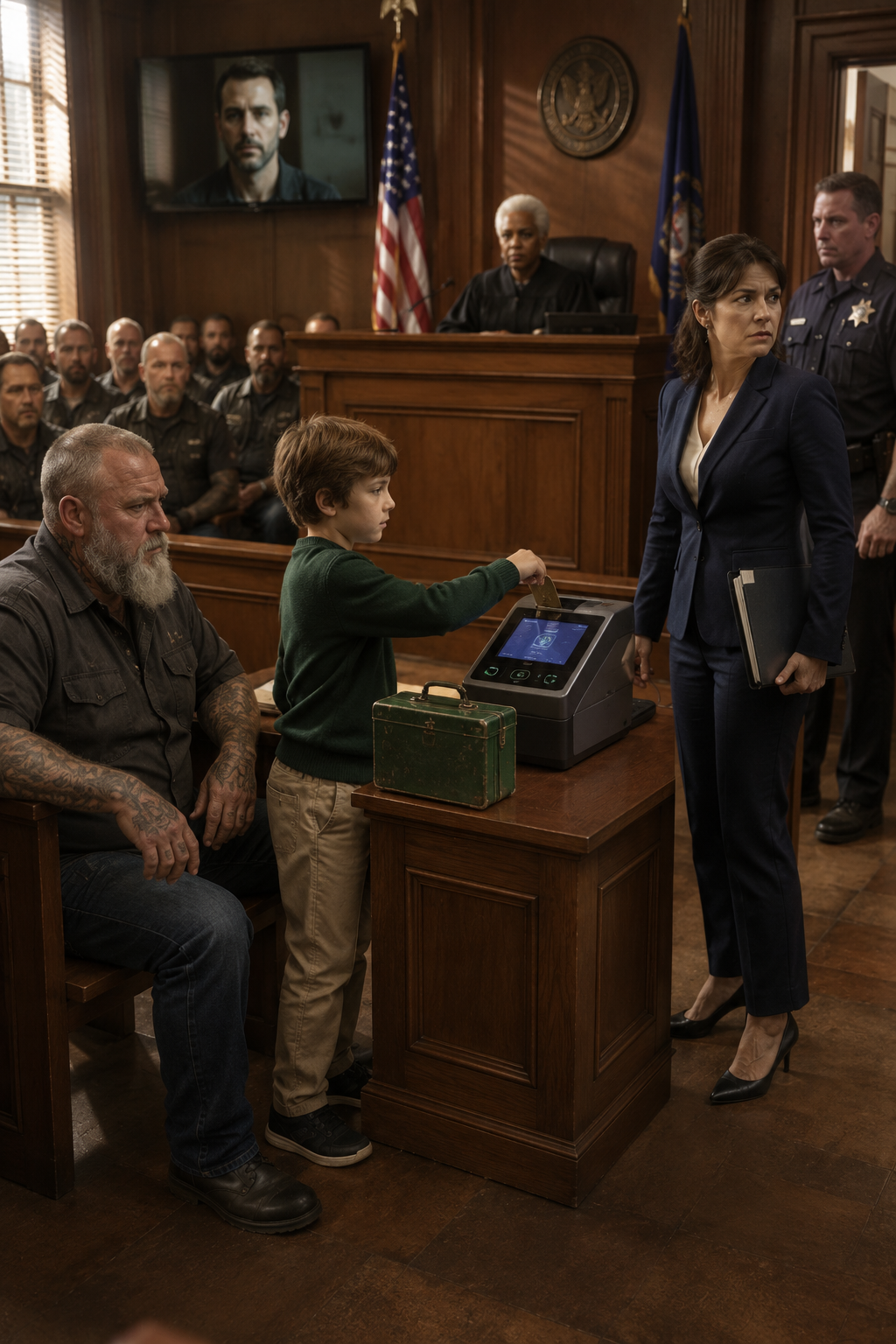
The man on the courthouse steps looked like Amos only from the security camera.
Up close, the differences appeared.
His beard was attached with theatrical adhesive. The scar above his left eyebrow ended too neatly. Amos’s prison tattoo had been copied onto a transparent neck sleeve, but one letter faced the wrong direction.
The bailiff stopped him inside the metal detector.
He identified himself as Amos Reed and produced a valid Kentucky driver’s licence.
The photograph matched the disguise.
The fingerprints did not.
His real name was Carl Danner, a private investigator employed by Ms. Vale’s foster agency. In his case were silicone facial pieces, a duplicate leather vest, Michael Turner’s stolen machine-shop records and a portable biometric reader containing Amos’s fingerprints.
Years earlier, Amos had submitted those prints during foster certification and after an arrest. The agency had access to both databases through a county contractor.
They did not forge his identity from nothing.
They assembled it from records the government had already collected.
The false custody petition was meant to survive only long enough for Eli to cross state lines. Once the boy disappeared into a contracted facility, Amos would appear to have requested the transfer himself.
If he objected, his criminal history would make the denial sound convenient.
Ms. Vale stopped smiling when Carl was brought into the courtroom.
He asked for a lawyer.
The younger agency attorney did not.
She gave investigators the address of an off-site records warehouse and explained that Michael had discovered children’s identities being reassigned to approved foster adults without their knowledge. The agency used those manufactured family links to bypass relatives, schools and local judges.
Michael’s warehouse fire had begun fifteen minutes after he copied the files.
The sprinkler valves had been closed deliberately.
Carl admitted placing Michael’s body near the machinery after the smoke overcame him. He had been told the death would be treated as an industrial accident.
Amos listened without moving.
Eli did not.
He stood beside the clerk’s desk with the green lunchbox pressed against his chest.
“You knew Dad was scared,” he said.
Amos nodded.
“And you let him work that night?”
“I offered to stay.”
“But you didn’t.”
“Michael told me to take you to Ruth’s house.”
Eli’s eyes filled.
“You always do what dead people tell you?”
The question landed harder than anger.
Amos lowered his head.
“Too often.”
The judge suspended the interstate transfer and placed Eli temporarily with Ruth Bell, a retired teacher whose approval was among the thirty-seven timecards. Amos’s compromised identity had to be cleared before he could legally petition for guardianship.
He accepted the decision.
For once, protection meant allowing someone else to stand closer.
Ms. Vale, Carl and three county contractors were charged with identity fraud, conspiracy, child trafficking and offences connected to Michael’s death. Investigators reopened sixteen placement cases. Eleven children were returned to surviving relatives. Five chose to remain with foster families who had not known how the placements were created.
Months later, a judge asked Eli where he wanted to live.
He looked at Ruth.
Then at Amos, seated alone behind the rail without his leather vest.
“With Harbor,” Eli said. “But Ruth gets a key.”
The judge almost smiled.
Amos became his guardian, not his replacement father.
Michael’s photographs stayed on the walls. His birthday remained a family day. When Eli became angry, Amos did not tell him grief made him unreasonable.
He listened.
The thirty-seven brass timecards were mounted inside Michael’s repaired lunchbox. On Eli’s first day at a new school, Amos walked him to the entrance while the other riders waited across the street.
No engines.
No formation.
No spectacle.
Eli stopped at the door.
“Dad planned all of you, didn’t he?”
Amos looked toward the riders.
“He planned options.”
Eli considered that.
Then he handed Amos the lunchbox.
“Carry this until I come out.”
Amos held it against his chest.
Some families begin with blood.
Others begin when frightened people put their names on paper before they know whether anyone will ever need them.
Michael had not found thirty-seven replacements for himself.
He had made certain his son would never again be easy to erase.