
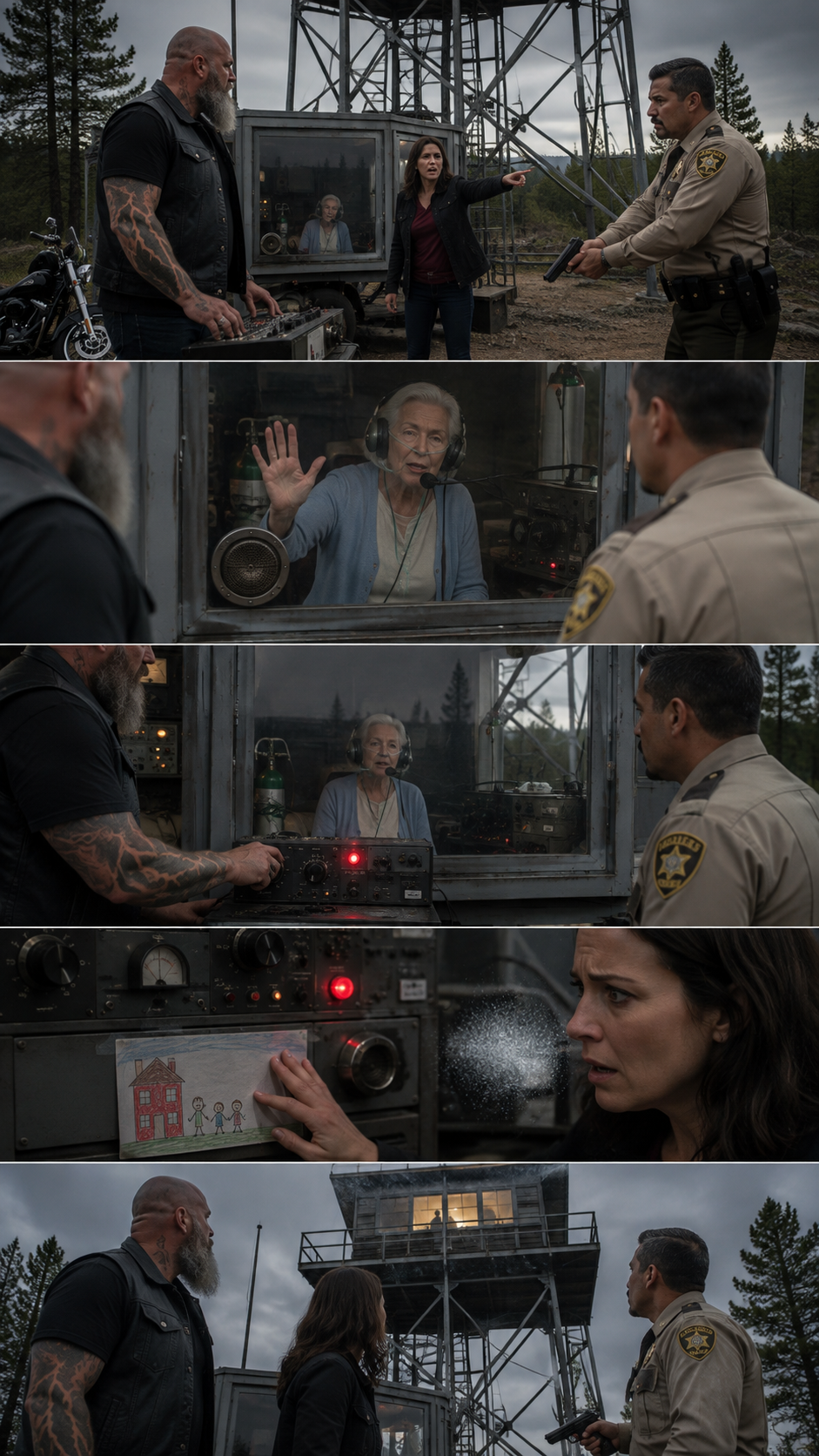
Static switched off the external speaker.
The man’s voice vanished beneath a burst of white noise.
My mother pressed both palms against the booth glass.
“Bring it back.”
Static did not touch the dial.
“Not until we know who turned on that light.”
The fire lookout stood eighty feet above us on steel supports. Its windows had been boarded after lightning damaged the electrical system three years earlier. The Forest Service listed it as unsafe and empty.
Now a pale figure moved behind the highest window.
The deputy raised his radio and requested backup.
Mom tore off her headset.
“No police at the tower.”
“You heard Eli,” I said. “He told us not to send anyone up there.”
“He said not to send them.”
I looked at Static.
“Who are ‘them’?”
He opened a weatherproof case beneath the transmitter. Inside were old frequency maps, handwritten call logs, and a cassette recorder wrapped in a child’s red scarf.
Mom’s face changed when she saw it.
“That belonged to Eli.”
Static nodded.
He had found the scarf seven months earlier inside a sealed radio cabinet purchased at a county surplus auction. The cabinet had come from the emergency command post used during the Schultz Pass wildfire.
Behind its false back panel were sixteen tapes.
Most contained routine evacuation traffic.
One contained my mother’s voice.
Static inserted the cassette into a portable player.
The recording began with wind, static, and men shouting coordinates.
Then Mom said, “The boy is at Marker Seven. Keep the light on until I reach him.”
A dispatcher answered.
“Negative. Marker Seven is already inside the burn zone.”
My mother’s recorded voice became sharper.
“He has a radio. He can see the tower.”
Another voice entered the channel.
Male. Calm. Official.
“Terminate that transmission. We cannot redirect crews for an unconfirmed civilian.”
Static stopped the tape.
I stared through the booth glass.
“You knew Eli was alive after he disappeared.”
Mom looked down.
“For forty-three minutes.”
She had been a volunteer emergency radio operator during the fire. Eli had followed our father to the command site, then wandered away after hearing that a trapped family needed help near the ridge.
He carried Dad’s spare handheld radio.
When the wind shifted, Eli became stranded beyond the evacuation line.
Mom maintained contact with him until a supervisor named Gordon Vale ordered the channel cleared. Vale claimed the boy’s signal was interfering with aircraft coordination.
It was a lie.
The emergency frequency had enough capacity.
Vale wanted the channel silent because Eli had reported seeing two county trucks near a locked utility building inside the forest.
The trucks were not fighting the fire.
They were removing metal drums before flames reached the site.
“What was in them?” I asked.
Static answered.
“Industrial solvent.”
A private company had buried hazardous waste on leased federal land. Vale had accepted payments to conceal it. The wildfire threatened to expose the containers, so he sent county workers to remove them before inspectors arrived.
Eli saw their license plates.
Vale could not allow rescue crews to reach him.
Mom kept transmitting on a backup frequency after Vale shut down the main channel. She heard Eli describe the tower light blinking through the smoke.
Then someone entered the radio room and struck her from behind.
When she woke, the tapes were gone.
Vale told our family Eli had never made radio contact and was presumed dead in the fire.
My father believed him.
Mom did not.
“Why didn’t you tell me?” I asked.
“Because Vale came to our house.”
Her eyes lifted to mine through the glass.
“He showed me a photograph of you walking home from school.”
I remembered the months after Eli disappeared: Mom checking locks, changing our route, refusing to let me answer the telephone.
I had thought grief made her controlling.
She had been frightened.
Static returned the receiver to the abandoned frequency.
The red signal light was still blinking.
He handed me the microphone.
“Eli may not be transmitting from the tower.”
“What does that mean?”
“The voice is passing through a repeater.”
The lookout light flashed twice.
Static studied the timing.
Two flashes. Pause. Three flashes. Pause. One.
Mom began crying before he finished writing the numbers.
“They’re map coordinates,” she said.
The deputy compared them with the old frequency maps.
The location was six miles north, near Marker Seven.
Static raised the microphone.
“Eli, confirm your position.”
White noise filled the speaker.
Then my brother’s voice returned.
“I can’t leave until she wakes up.”
A second sound came through the channel.
A woman coughing.
Mom stood so quickly that her oxygen line pulled tight.
Static enlarged an old photograph from the case. It showed Gordon Vale beside the fire command trailer.
Next to him stood a young female dispatcher.
My mother touched the glass.
“That’s Rebecca Vale.”
Gordon’s daughter had disappeared three days after Eli.
The official report said she ran away.
The transmission crackled again.
Eli whispered, “Cricket, Gordon is coming back.”
Headlights appeared between the trees below the access road.
A dark county truck was climbing toward us with its emergency lights turned off.
The deputy reached for his weapon.
Static looked at the welded booth door.
Then at my mother.
“There’s something she still hasn’t told you.”
Mom pressed the microphone button.
Her voice trembled.
“Claire, Eli wasn’t the child Gordon took from that mountain.”