
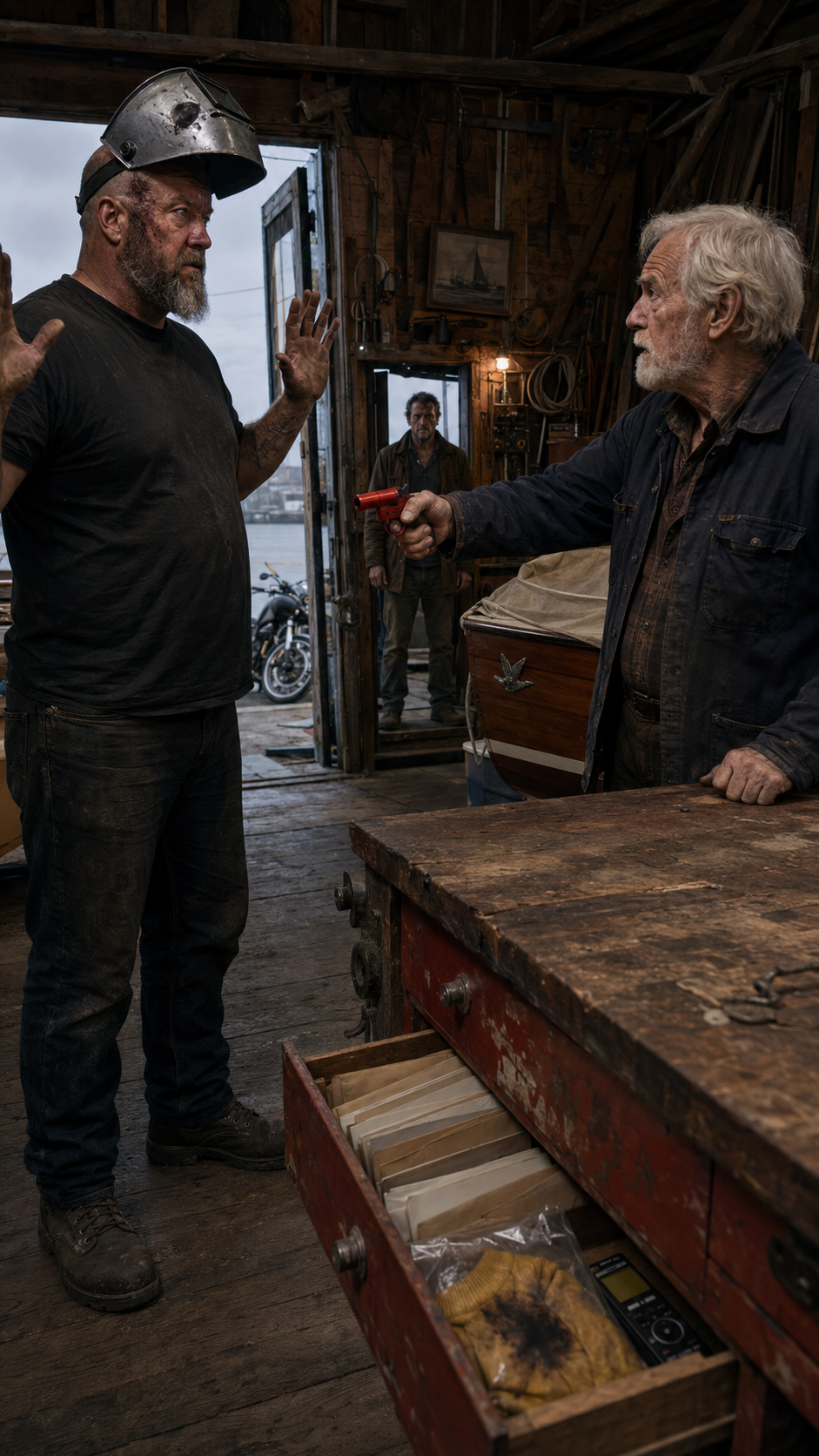
The flare gun fired from behind the nearest hull.
Its red light struck the ceiling, showering sparks across the rafters and revealing a man crouched beside the paint cabinets.
Peter Vale.
He had his father’s narrow face and the same damaged right hand Mae described in the recording. Two fingers were fused from an old burn.
Owen moved first.
He kicked the flare gun beneath a workbench before Peter could reload it. I pulled Silas behind an overturned boat while sparks died harmlessly across the damp concrete.
Peter did not fight after that.
He only stared at the ledger in my hand.
“You have no idea what that book will destroy.”
Silas stepped out from behind the hull.
“My daughter’s life is already gone.”
Sirens approached from the harbour road.
Mae had planned further ahead than any of us understood. The recorder inside her mask contained a second transmitter. When I activated her final message, it sent a location signal and copies of the recordings to a state investigator she had contacted before the crash.
The black pickup outside belonged to a private investigator working for Peter.
He tried to leave before police arrived.
Owen stopped him at the gate.
Peter was arrested for attempted arson, conspiracy, insurance fraud and involvement in the crash that injured Mae. Investigators later connected his company to seven staged marine losses across three states.
The old ledger proved Edwin Vale had begun the scheme decades earlier.
Silas’s careless signatures had helped make it possible.
He was not charged, but the truth left him with no place to hide from what his trust had cost.
When the workshop became quiet again, Owen placed Mae’s sealed envelope on the bench.
Silas opened it slowly.
There was no long confession inside.
Only a photograph.
Mae and Owen stood beside a small unfinished boat. They were older than Silas remembered them, but young enough that Mae still wore her hair in two uneven braids.
On the back, she had written:
WE WAITED FOR YOU TO COME LOOKING.
Silas sat down.
“I did look.”
Owen’s voice remained calm.
“You looked for bodies. You didn’t look for children who believed you had chosen someone else.”
Silas covered his face.
The sound he made was not dramatic.
It was the thin, exhausted sound of a man discovering that grief had not excused him from responsibility.
Owen did not forgive him that day.
He stayed long enough to hear the rest of Mae’s recordings, then left before dark.
But he returned the following week.
After that, he came every Sunday.
Sometimes they worked on boats.
Sometimes they argued.
Sometimes Owen left after ten minutes.
Silas never locked the door.
The boatyard reopened under a new name and became a training workshop for teenagers leaving foster care. The first project was a narrow cedar skiff based on one of Mae’s unfinished designs.
They mounted her silver welding mask above the main workbench.
The scorch mark remained.
So did the small metal swallows she had placed on every hull.
Months later, Silas asked me why Mae had trusted a stranger to carry the mask home.
I told him she had not trusted a stranger.
Years earlier, after my own life had collapsed, Mae found me sleeping inside a damaged ambulance at the veterans’ garage. She handed me a welding torch and told me to repair one broken hinge before deciding I was useless.
One hinge became a week.
A week became years.
Mae had understood that people rarely return through grand gestures.
They return through small work repeated until shame no longer controls the door.
Silas looked toward Owen, who was teaching a quiet boy how to smooth cedar without splitting the grain.
“My daughter saved both of you,” he said.
I shook my head.
“She gave us tools.”
Outside, the harbour fog lifted from the water.
For the first time in thirty-two years, the workshop doors stood open at both ends.
Nothing was hidden behind them.
Nothing needed to burn for the truth to be seen.