
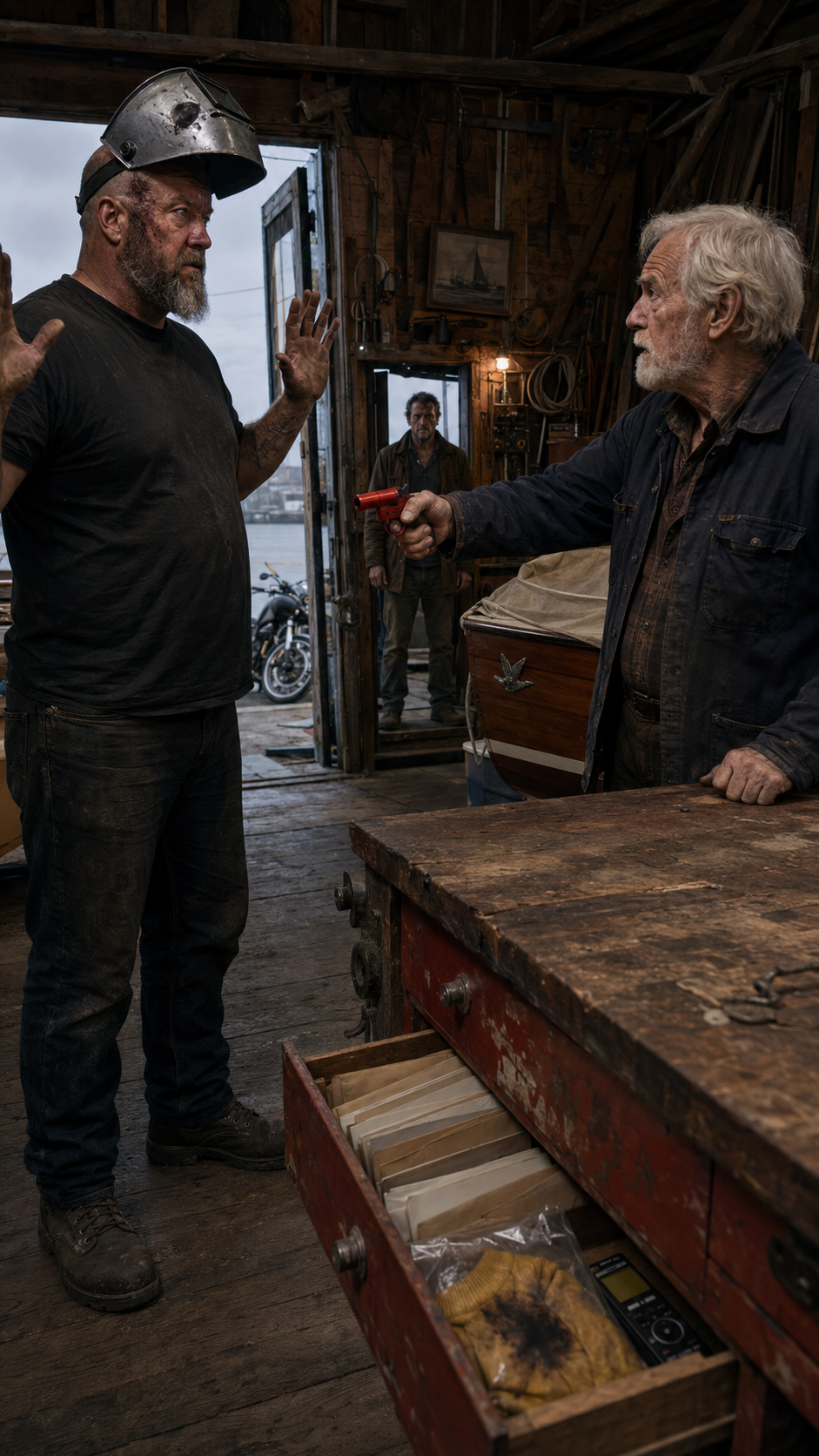
The man closed the workshop door behind him.
He was in his late forties, broad through the shoulders, with dark hair gone gray at the temples. Shiny scar tissue pulled at his left cheek and disappeared beneath the collar of his canvas coat.
Silas stared at him as if the dead had entered without knocking.
“Owen?”
The man nodded once.
Silas gripped the edge of the workbench.
“You were six.”
“I was seven.”
“No. Mae was seven. You were six.”
Owen’s mouth tightened.
That small correction seemed to wound Silas more than the scars.
He had remembered the wrong child’s age for thirty-two years.
Owen did not move closer.
He looked at the welding mask in my hands, then at the recorder hidden behind its dark glass.
“She said you would bring that.”
I asked why Mae had allowed her father to believe both children were gone.
Owen glanced toward the unfinished boats.
“Because he wasn’t the person she was hiding me from.”
Silas straightened.
The official story said an electrical fault had started the fire after midnight. Mae escaped through a workshop window. Owen disappeared inside. Investigators assumed his body had been destroyed when the fuel drums exploded.
That was the story Silas repeated.
It was not the story in Mae’s recording.
Her voice came weakly through the mask.
“The fire began near the paint room. I saw Mr. Vale carrying the red can.”
Silas closed his eyes.
Edwin Vale had been his business partner.
He managed the accounts, negotiated contracts, and convinced Silas to insure the boatyard for three times its value.
According to Mae, she had woken because Owen was crying. Smoke had already filled the upstairs rooms. She pulled him through a laundry chute into the workshop, where they saw Vale pouring fuel beside the completed boats.
Vale saw them.
He caught Owen near the side door and struck him with a metal hook. Mae attacked Vale with a welding torch, burning his hand badly enough to make him release the boy.
She dragged Owen beneath an overturned hull while Vale searched the building.
Then the fuel ignited.
A volunteer firefighter named Caleb Price found both children behind the collapsed hull. Owen was unconscious and badly burned. Mae was awake.
She heard Vale telling Silas that she had caused the fire while playing with equipment.
Before Silas reached the children, Caleb removed them through the rear gate.
He believed Vale would kill Owen if he learned the boy had survived.
Silas shook his head.
“Caleb told me there was nothing left.”
“He was trying to protect us,” Owen said.
“He let me bury an empty coffin.”
“He thought you were helping Vale.”
The words struck the room flat.
Silas turned toward the workbench.
Years earlier, he had signed insurance forms, transfer papers and statements that Vale placed before him. He said he never read them carefully because he trusted his partner.
One document identified Mae as a disturbed child who had confessed to setting the fire.
Another gave Vale control of the insurance payout.
Mae saw Silas’s signature and believed he had chosen money over her.
Caleb moved the children to a church shelter in Vermont. Owen spent months in hospitals under another name. Mae stayed with him, refusing every attempt to contact home.
When Caleb died unexpectedly, the records connecting them to Rockland disappeared.
Owen grew up believing Silas had helped cover up the fire.
Silas grew old believing Mae had run away after killing her brother.
Neither version was true.
I opened the red drawer fully.
Beneath the returned letters was a narrow ledger wrapped in oilcloth. It contained dates, boat identification numbers and payments made to shell companies controlled by Edwin Vale.
The final entry was only eight months old.
Silas frowned.
“Vale died twelve years ago.”
Owen looked at me.
“Edwin did.”
There was another Vale.
His son, Peter, had taken over the marine supply company and purchased several properties around the old boatyard. Mae discovered he was still collecting insurance settlements on boats deliberately damaged or destroyed.
She planned to expose him.
Then someone ran her van off a mountain road.
The crash left her unable to walk and was recorded as an accident.
Silas sank onto a stool.
“All these years, she thought I betrayed her.”
Owen answered softly.
“She found out the truth before she died.”
He removed a sealed envelope from inside his coat.
Mae had written Silas’s name across it.
Silas reached for it, but Owen held it back.
“She said you had to hear the final recording first.”
I pressed the switch inside the welding mask.
Mae’s voice returned.
“Dad, Peter knows Owen is alive. He knows about the ledger. And if the man wearing my mask reached you, Peter will already be watching the boatyard.”
Outside, gravel shifted beneath a vehicle.
All three of us turned toward the front windows.
A black pickup had stopped beyond the gate.
The driver did not get out.
Then the lights inside the workshop died.
From somewhere among the unfinished boats came the unmistakable sound of a flare gun being cocked.