
Mara was running before the radio stopped crackling.
The north cove lay beyond a stand of pines and a narrow service path slick with rain. The deputy followed, but Mara reached the shoreline first.
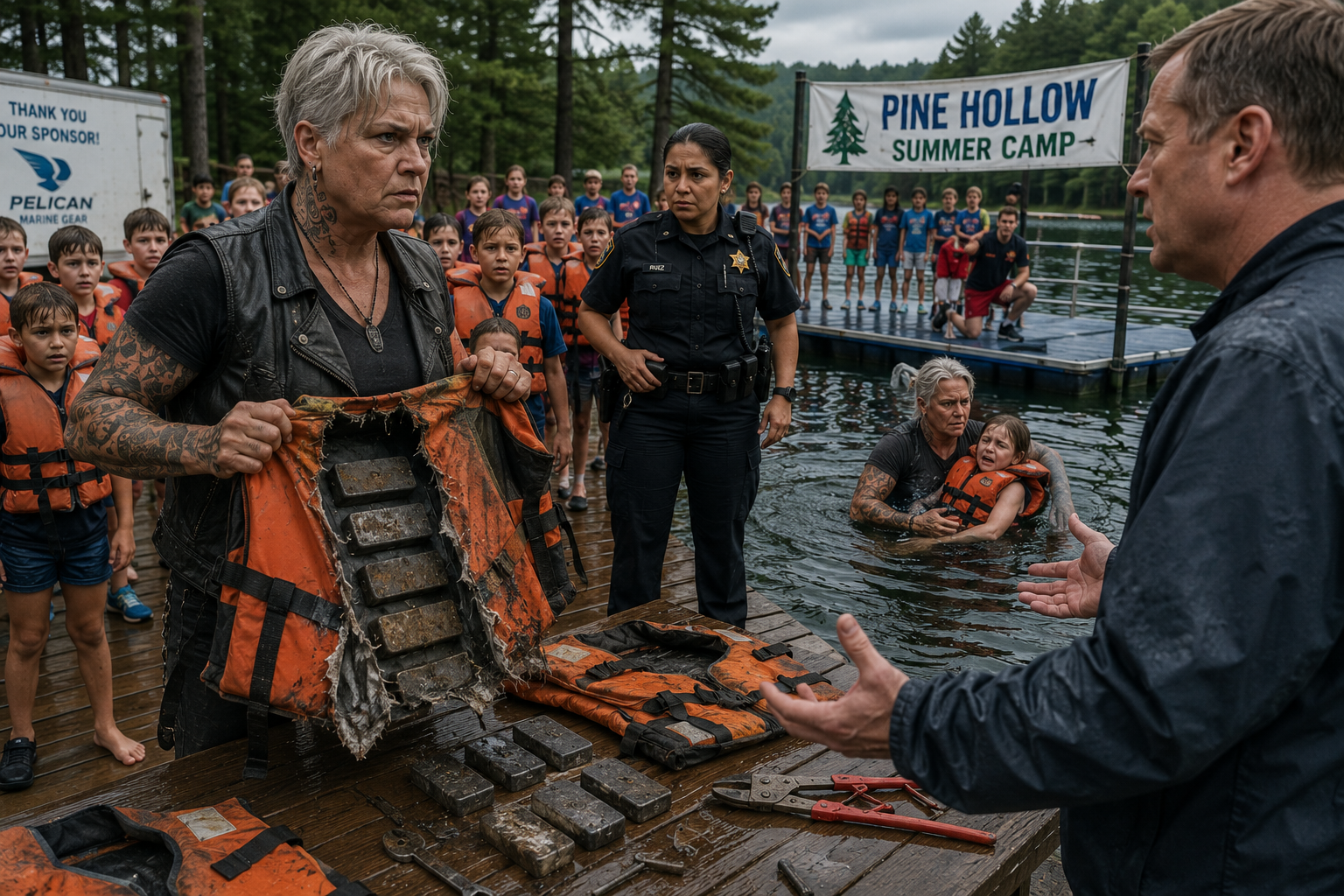
Emma was twenty yards from the bank.
Only the top of her head showed above the water.
A young counsellor had entered after her and was trying to hold the girl upright, but the weighted vest dragged both of them downward. Each time he pulled, the straps tightened beneath Emma’s arms.
Mara kicked off her boots and went in.
The water reached her chest before she could feel the drop beneath her feet. She kept one hand on the floating platform and moved slowly enough not to push Emma farther away.
“Don’t lift her,” Mara told the counsellor. “Hold her face up.”
She found the vest’s lower seam beneath the water.
There was no release handle.
Mara pulled the rescue shears from her belt and cut one side strap, then the other. The orange shell slipped from Emma’s body and vanished immediately beneath the surface.
Without the weight, the girl rose so quickly that she coughed against Mara’s shoulder.
They carried her to shore.
Emma was conscious. Frightened, cold and vomiting lake water, but alive.
The paramedics wrapped her in blankets while her mother knelt beside her. Grant Hollis stood several yards away with the deputy. He did not attempt to explain himself again.
The missing vest was recovered by divers later that afternoon.
It contained eight steel plates.
More than twice the weight found in Caleb’s vest.
Investigators traced the shipment to a sporting-equipment company owned by the same investors who had purchased Pelican Marine’s remaining assets after its closure. They had relabelled the recalled equipment and sold it through charitable sponsorship programmes, knowing camps and youth organisations were unlikely to pay for independent testing.
Grant had seen the warning.
He had chosen the money.
That choice ended his career.
He pleaded guilty to reckless endangerment, evidence tampering and falsifying safety records. The company executives faced fraud and product-safety charges after similar vests were found at two other camps before anyone used them in the water.
Pine Hollow closed for the rest of the summer.
The families received refunds, medical evaluations and written copies of the investigation. No one called the event a miracle. Too many adults had been given enough information to prevent it.
Caleb kept the piece of orange fabric bearing the sailboat his father painted.
Mara repaired the torn edges and mounted it in a plain frame. She did not include the steel plates or the photograph of Lena.
Those belonged to a different grief.
Weeks later, Emma visited Mara’s workshop with her mother. She stood near the open garage door, watching sparks fall from a welding table.
“Were you scared in the lake?” she asked.
“Yes.”
Emma seemed surprised.
“But you came anyway.”
Mara set down her welding mask.
“Being afraid doesn’t tell you what to do. It only tells you something matters.”
The girl thought about that, then nodded.
Mara eventually received Lena’s recovered vest from the evidence department. She removed the corroded weights, cleaned the serial plate and kept the jammed release cable exactly as it was.
She placed it beside the photograph from Caleb’s vest.
For fourteen years, she had believed Lena’s death came from one defective piece of equipment.
The investigation proved it had also come from warnings dismissed, costs avoided and adults who assumed children would carry the consequences quietly.
Mara could not change that day.
She could only make sure the same machinery did not reach another child.
At the rebuilt camp dock the following summer, every flotation vest was tested in the water before a child wore it.
Mara watched from the shore.
When Emma stepped onto the platform, she looked back once.
Mara raised one hand.
The girl jumped.
This time, the vest carried her upward.