
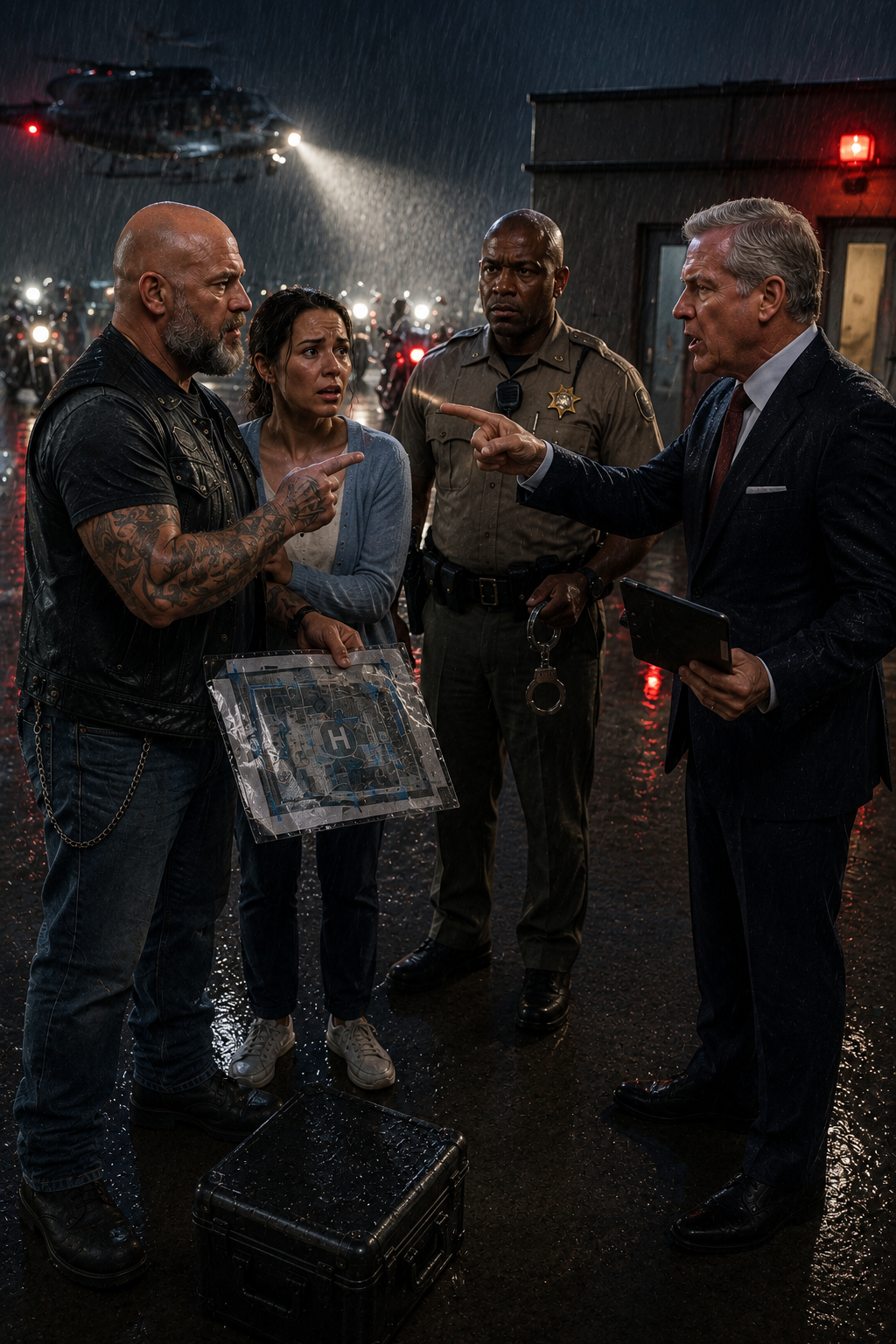
Owen’s voice continued through the red-lit rooftop.
“The second file is the donor transport authorization. If it still shows a different hospital, someone will try to remove the heart before surgery is complete.”
The nurse ran back to the access panel, but the doors would not release.
The pilot used his radio to contact dispatch while one deputy called the operating floor from his mobile. Silas remained beside the metal case, his hands open and still. He had spent years repairing machines, and he understood that panic often damaged more than the original fault.
The intercom clicked again.
Owen said he had discovered the altered records while testing the helipad relay. Cole had been redirecting emergency flights and transplant transfers toward a private hospital owned by a company in which his brother held a financial interest. Most delays had been explained as technical faults or weather diversions.
Mateo’s case was different.
His donor heart was unusually well matched, and another child at the private hospital had been placed behind him on the regional list.
Cole had changed the helipad status, then altered Mateo’s blood type so the surgical team would reject the organ after arrival.
The heart would then be offered to the next compatible patient.
No one on the roof spoke.
The meaning settled slowly because it was too ugly to accept quickly.
Owen had copied the override logs, but Cole discovered him before he could report them. Owen was suspended, threatened with prosecution for theft, and told that his pension and medical insurance would disappear if he contacted investigators.
He left the burned controller at Silas’s garage because they had served together in the National Guard years earlier. The date on the note was the night Owen believed Cole would make his final attempt.
The deputy forced the access door using the manual release behind the alarm housing.
By the time we reached the surgical corridor, two hospital transport employees were standing outside the operating suite with a refrigerated case and paperwork authorizing the heart’s removal.
The transplant surgeon refused to open the doors.
Cole arrived several minutes later under escort.
He tried to say the authorization had been generated automatically.
The memory module said otherwise.
It contained his administrator code, the exact time the helipad was closed, and every alteration made to Mateo’s medical record. The pilot’s dispatch log confirmed the false diversion. Owen’s recording provided the rest.
Cole was taken away before dawn.
The surgery continued for nearly seven hours.
I sat beneath a vending machine light with Silas and three of the riders. Their jackets steamed slowly as the rain dried. Nobody spoke about heroism. One man slept with his helmet in his lap. Another brought me coffee and forgot to add sugar.
When the surgeon finally appeared, there was blood on the edge of his shoe and exhaustion in his face.
“The heart is working,” he said.
My legs would not hold me.
Silas caught my elbow, then released it immediately, as though he did not want even gratitude to feel like a debt.
Mateo remained in intensive care for sixteen days.
Owen returned during the second week. He looked thinner than his recorded voice had sounded. He apologised for not coming forward sooner.
I told him fear had delayed him, but it had not stopped him.
The state investigation later uncovered six improperly redirected emergency transfers. Cole was convicted of fraud, tampering with medical records and reckless endangerment. The hospital replaced its board, rebuilt the helipad system and placed all transplant record changes under independent review.
Silas and the riders never formed an official rescue organisation.
They simply kept reflective record changes under independent review.
Silas and the riders never formed emergency covers in their saddlebags.
A year later, Mateo stood beside me at the hospital’s reopened rooftop garden. His scar showed above his collar, pale and clean.
Twelve motorcycles waited in the parking lot below.
Mateo waved.
Every rider looked up.
For a few seconds, their headlights flashed together—not to guide an aircraft, not to stop traffic, but to answer a boy whose heart was still beating.