
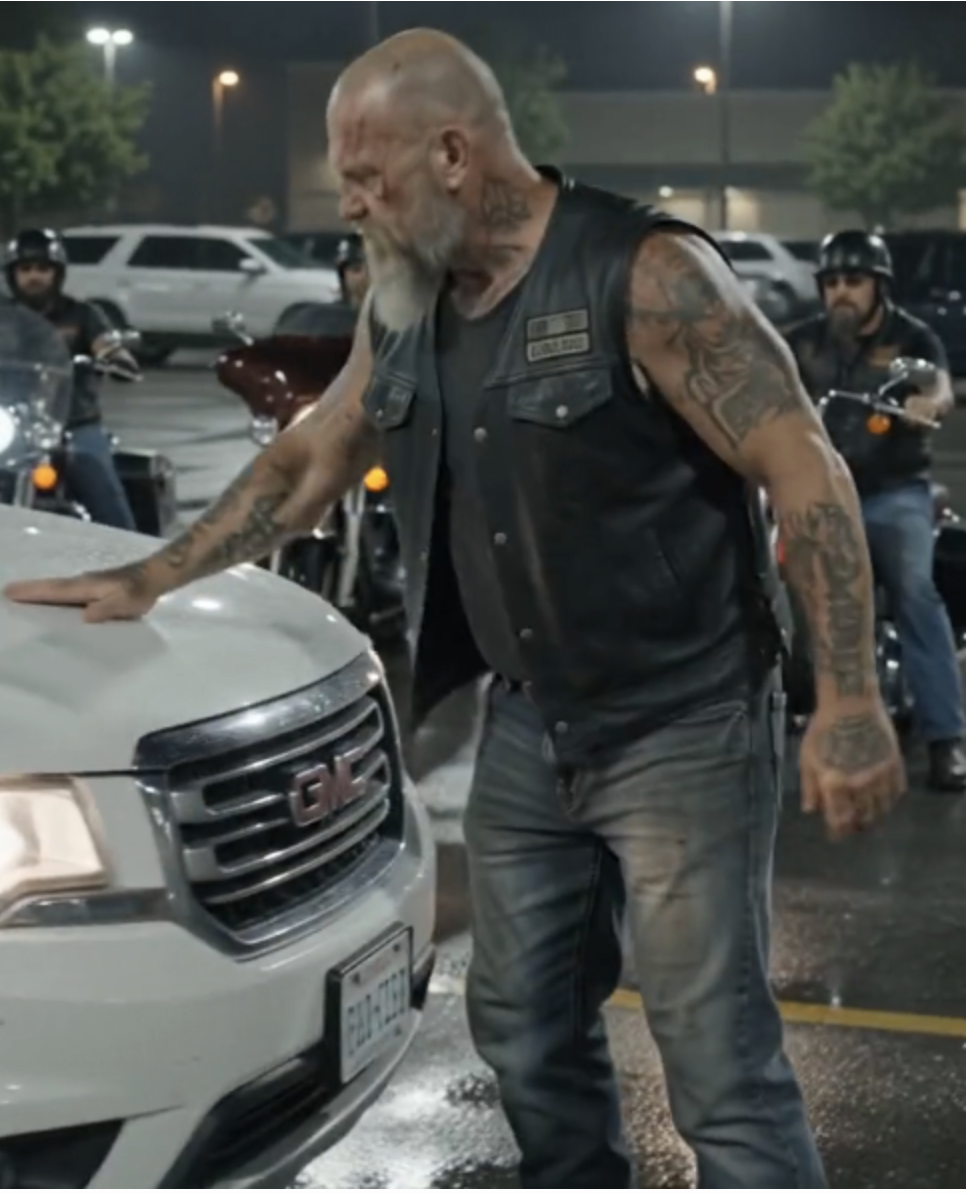
Eleven tattooed bikers surrounded my SUV before I could start the engine, and when their leader pressed one scarred hand against my window, I locked every door and prepared to drive straight through them.
My name is Emily Carter. I was thirty-nine then, an emergency-room nurse in Tulsa, Oklahoma, and I had just finished a fourteen-hour Saturday shift at St. Catherine’s Medical Center. It was 12:43 in the morning. Half the lights in the east parking lot were dead, rain had left the asphalt shining black, and my white SUV sat alone near a concrete drainage wall because I had arrived too late to find anything closer.
I had barely placed my purse on the passenger seat when motorcycles entered from both ends of the aisle.
The sound came first—a low V-twin rumble rolling between parked cars, deep enough to vibrate through my steering wheel. Then the headlights separated. Two Harleys stopped behind me, three angled across the lane ahead, and the others spread along both sides of my vehicle with the precision of men who had done this before.
They did not speak.
That frightened me more.
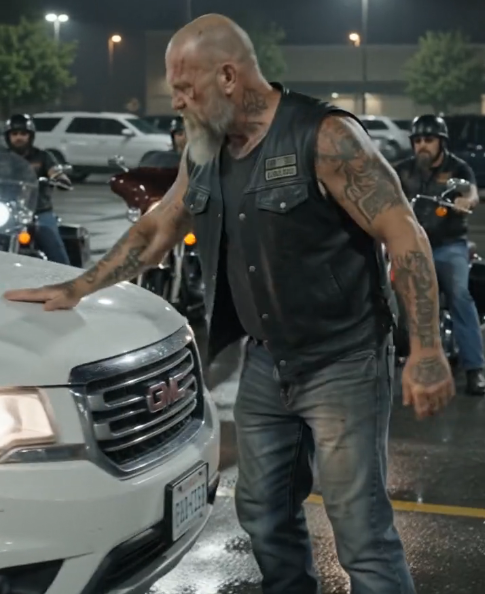
The largest rider dismounted from a black Road King. He was at least six-foot-four, close to 280 pounds, with a shaved head, a gray beard hanging over his chest, and tattooed forearms exposed beneath a rain-darkened leather cut. The patches on his vest meant nothing to me. I only saw a skull, heavy boots and scarred hands.
He walked directly to my driver’s window.
I grabbed my phone and called 911.
“Eleven men are surrounding my car,” I whispered. “They’re bikers. Please hurry.”
The dispatcher asked whether I could drive away. I shifted into reverse, but the big biker slapped his palm against the glass so hard that I screamed.
“Don’t move the car,” he said.
Another rider hurried behind my SUV and parked his Harley across the space, trapping me completely. A younger man crouched near my front bumper. Someone else switched off his motorcycle, and the sudden silence left only rain ticking against my roof.
“Ma’am,” the dispatcher said, “stay locked inside.”
The biker leaned closer. A pale scar crossed his left eyebrow, and the letters on his knuckles disappeared when he closed his fist. His face looked tense, almost angry, but he kept glancing down instead of looking at me.
“Put both feet on the passenger seat,” he ordered.
I stared at him.
“What?”
“Get your feet off the floor.”
I thought he wanted me helpless. I thought the men were preparing to break the window, pull me out and steal the SUV—or do something worse before the police could reach the hospital.
I leaned on the horn.
The sound tore through the lot. Two orderlies leaving the building stopped beneath the entrance canopy. One raised his phone to record. A security cart turned toward us, its amber light spinning, while the bikers held their positions around me.
The large man did not flinch.
He pointed down.
“Feet up. Now.”
Something in his voice made me obey. I dragged my legs across the center console and curled them against the passenger seat, still holding the phone against my ear. My pulse beat so hard behind my eyes that the windshield seemed to move.
Then I heard it.
A scrape beneath me.
Not from the engine. Not from the rain.
Something touched the metal directly below my left foot.
I stopped breathing.
The biker saw my face change. He slowly lowered himself onto one knee beside my driver’s door, but he did not reach under the SUV. Instead, he placed both hands where I could see them and spoke to someone hidden below me.
“Stay where you are.”
The younger biker near my bumper took one step forward. The leader snapped his head toward him.
“Nobody touches him, Jace.”
Him.
The word turned the blood in my hands cold.
Police cruisers entered the lot seconds later, blue lights breaking across chrome, wet leather and my locked windows. Officers jumped out with weapons lowered but ready, and the bikers immediately raised their hands.
For one terrible moment, the circle opened.
Something beneath my SUV moved toward the driver’s side.
The big biker stepped between it and my door, lifted both hands higher, and shouted the sentence I would remember long after the arrest, the court hearings and the discovery of what had been found inside a backpack near the drainage wall.
“We surrounded her car,” he said. “There’s a man underneath it. We surrounded her so he couldn’t make his move.”
An officer dropped to the pavement and aimed a flashlight beneath my door.
His face changed.
Then he ordered me not to unlock anything—because the man below my seat was holding something in one gloved hand, and the biker outside my window had recognized my SUV for a reason he had kept secret for fourteen years.
Part 2 — The Men Everyone Watched
Before that night, I believed danger had a recognizable face. Eight years in an emergency room had taught me otherwise, but grief can make a person cling to simple rules: stay in bright areas, hold your keys between your fingers, look over your shoulder, distrust anyone who looks as if he could overpower you.
My husband, Daniel, had taught me better. He had been a Tulsa police officer for sixteen years and spent most of our marriage telling me that appearance was weak evidence. Watch the hands, he would say. Watch who controls the exit. Notice who keeps looking at the room instead of the person speaking.
Daniel had been dead four years when the bikers surrounded my car.
He was killed while responding to a domestic-disturbance call on the north side. There was no dramatic final conversation between us. Our last argument concerned a leaking dishwasher. His final text asked whether I needed milk.
For months after the funeral, I left the porch light burning until dawn. I knew he was not coming home, but some part of me believed darkness became permanent once I switched it off. Eventually our daughter, Sophie, asked why the bugs deserved a light more than we did, so I began turning it off again.
Sophie was twelve on the night in the parking lot. She was sleeping at my sister’s house because I had picked up an extra shift. Her asthma medication had become expensive, the refrigerator was making a grinding sound, and a storm earlier that week had loosened shingles above her bedroom.
That was why I was exhausted enough to ignore the first warning.
At 10:16 that evening, a respiratory therapist named Kayla told me she had seen a man wandering near the east lot. Security checked the main walkway but found nobody. One guard offered to walk me out after my shift, yet an ambulance arrived with three crash victims, and by the time I finished my paperwork, the guard had been called to the psychiatric wing.
I told myself I was thirty-nine, not nine.
I walked alone.
The bikers had been at Rourke’s Diner across Route 66, where they gathered on the last Saturday of each month after delivering groceries to older veterans. Their club called itself the Ash Creek Riders. The name sounded menacing to people who never met them, although the group included two mechanics, a roofing contractor, a retired math teacher, an electrician and one man who repaired commercial ovens.
Their president was Elijah “Gravel” Mercer.
Gravel had earned his road name because his voice sounded like tires turning across broken stone. He was fifty-eight, six-foot-four and broad enough that restaurant booths forced him to sit sideways. A coal-black raven covered the left side of his neck. Chains, flames and dates wrapped both forearms. The letters HOLD FAST crossed his knuckles.
He had also spent eighteen months in an Oklahoma prison when he was thirty-two.
Most people knew that part.
Almost nobody knew the rest.
Gravel had been convicted of aggravated assault after beating a man outside a convenience store. The victim suffered a broken jaw and three fractured ribs. Gravel pleaded guilty, refused to explain what started the fight and lost his towing business while incarcerated.
Years later, court records connected that man to two assaults on young women. One was Gravel’s nineteen-year-old daughter, Hannah.
She survived.
Gravel never forgave himself for reaching her too late.
Prison changed him, but not in the clean way newspapers like to describe. He did not walk out gentle. He walked out controlled. There was a difference. He still had a temper; he simply built walls around it and placed rules at every door.
No weapons at club meetings. No riding drunk. No touching a suspect after the danger stopped. No surrounding a weaker person unless the circle protected that person from something worse.
Those rules mattered that night.
According to security footage, the Ash Creek Riders left Rourke’s at 12:36. Rain had weakened to a mist. Gravel was leading them toward the highway when Owen “Mouse” Dalca, a thirty-four-year-old Latino electrician riding near the rear, noticed a shopping cart moving in the hospital lot.
There was almost no wind.
Mouse looked again and saw a man in a green hooded jacket crouched between two vehicles. The stranger flattened himself when the motorcycles passed, then crawled behind my SUV.
Mouse flashed his headlight twice.
The riders turned around.
What happened next lasted less than nine minutes, but every choice divided the men. Jace Holloway, the youngest prospect, wanted to confront the stranger immediately. His sister had survived an assault in a college garage, and he carried that memory like gasoline.
Gravel stopped him.
“If we reach under there, he gets her door,” he said. “Circle first.”
Mouse called 911 while they were still moving. Another rider, Preacher Webb, went toward the hospital entrance to find security. Two riders blocked the lane behind my SUV. Three closed the front. The others sealed the spaces beside me so the hidden man could not slide out unseen.
They looked like hunters.
They were building a cage.
As Gravel dismounted, his headlight swept across my rear window. Hanging beneath the mirror was Daniel’s old silver police badge charm, the small replica Sophie had given me after his funeral. On the tailgate was a faded memorial decal bearing his name.
Gravel saw both.
For fourteen years, he had carried Daniel Carter’s name inside his vest.
Now his widow was sitting above a hidden man in a dark parking lot, reaching for the gearshift.
Gravel did not have time to explain.
He only had time to stop me.