
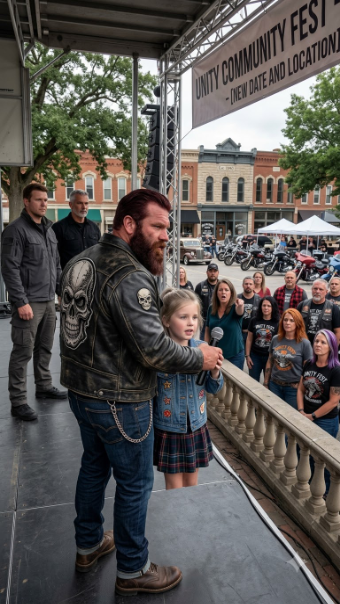
Part 2: The Name on the Brass Tag
Ray never answered Lucy.
He simply folded her tiny fingers over the brass tag and looked toward the collapsed lighting truss.
For a moment, nobody moved.
The sirens had already reached the fairgrounds, yet the only sound beneath them was the soft ping of cooling steel.
Then Ray whispered four words.
“He’s here again.”
I heard him.
No one else seemed to.
The firefighters rushed past us, checking for trapped victims beneath the twisted framework.
Paramedics insisted Ray sit on the ambulance bumper while they stitched the cut above his ear.
He refused.
“Count the kids first.”
One by one they counted.
Twenty-three performers.
Six volunteers.
Forty-eight children from the choir.
Every one alive.
Only then did Ray allow anyone to touch the blood running down his neck.
Lucy refused to leave his side.
She still held the brass tag.
“What does this mean?” she asked.
Ray looked at her mother instead.
Her mother had gone completely pale.
She recognized the name.
Not because she had ever met the man—
—but because she had attended his funeral.
Twenty-three years earlier.
Detective Alan Brooks arrived before the state inspectors.
Unlike everyone else, he did not begin by questioning Ray.
He looked at the photographs.
Three images.
5:16 a.m.
5:18 a.m.
5:21 a.m.
Every photograph showed the same locking shackle slowly separating.
The final picture contained a handwritten sentence.
It will fail before sunset if nobody listens.
Brooks frowned.
“Who wrote this?”
Ray answered quietly.
“I don’t know.”
“Who gave you the envelope?”
Ray hesitated.
“It was waiting on my motorcycle.”
That answer made everyone stare.
The envelope had contained no fingerprints.
No return address.
Only the photographs.
And the warning.
Ray had driven nearly three hundred miles because of it.
Not because he knew Lucy.
Not because he knew the festival.
Because twenty-three years earlier…
someone had ignored an almost identical warning.
And twelve people had died.
The detective flipped over the brass tag.
There was another engraving on the back.
Almost invisible beneath decades of scratches.
Three letters.
M.R.C.
Ray immediately reached for it.
Too late.
The detective had already seen.
“So it was his.”
Ray’s jaw tightened.
“He should still be alive.”
Nobody understood what he meant.
Meanwhile, investigators climbed the damaged lighting tower.
Within minutes one of them shouted down.
“Detective!”
Brooks looked up.
“What?”
The investigator held something between two gloved fingers.
It wasn’t the missing locking pin.
It wasn’t broken hardware.
It was a brand-new cotter pin…
still sealed inside its manufacturer’s plastic packet.
The replacement part had been brought to the tower.
But it had never been installed.
Someone had climbed thirty feet into the rig…
seen the failing connection…
and walked away.
The festival director insisted it proved nothing.
“It could have been left there weeks ago.”
The investigator shook his head.
“The packaging was dry.”
Everyone looked toward the dark clouds gathering overhead.
It had rained hard the previous night.
Anything left on that tower before sunrise should have been soaked.
This package wasn’t.
Someone had been on that tower…
after the storm.
Ray slowly stood.
His eyes never left the festival director.
“I told you this morning.”
The director’s face tightened.
“You don’t have proof.”
Ray reached into another pocket.
Everyone assumed he had nothing left.
Instead…
he pulled out a small digital voice recorder.
The red light was still blinking.
“I recorded our conversation at 5:32 this morning.”
The entire command tent fell silent.
The detective slowly reached for the recorder.
Before he could press play…
a sheriff’s deputy ran into the tent holding a muddy backpack recovered beneath the stage.
Inside…
was another envelope.
This one was addressed to Ray Dawson.
In thick black marker, only six words were written across the front:
“You were only the beginning.”