
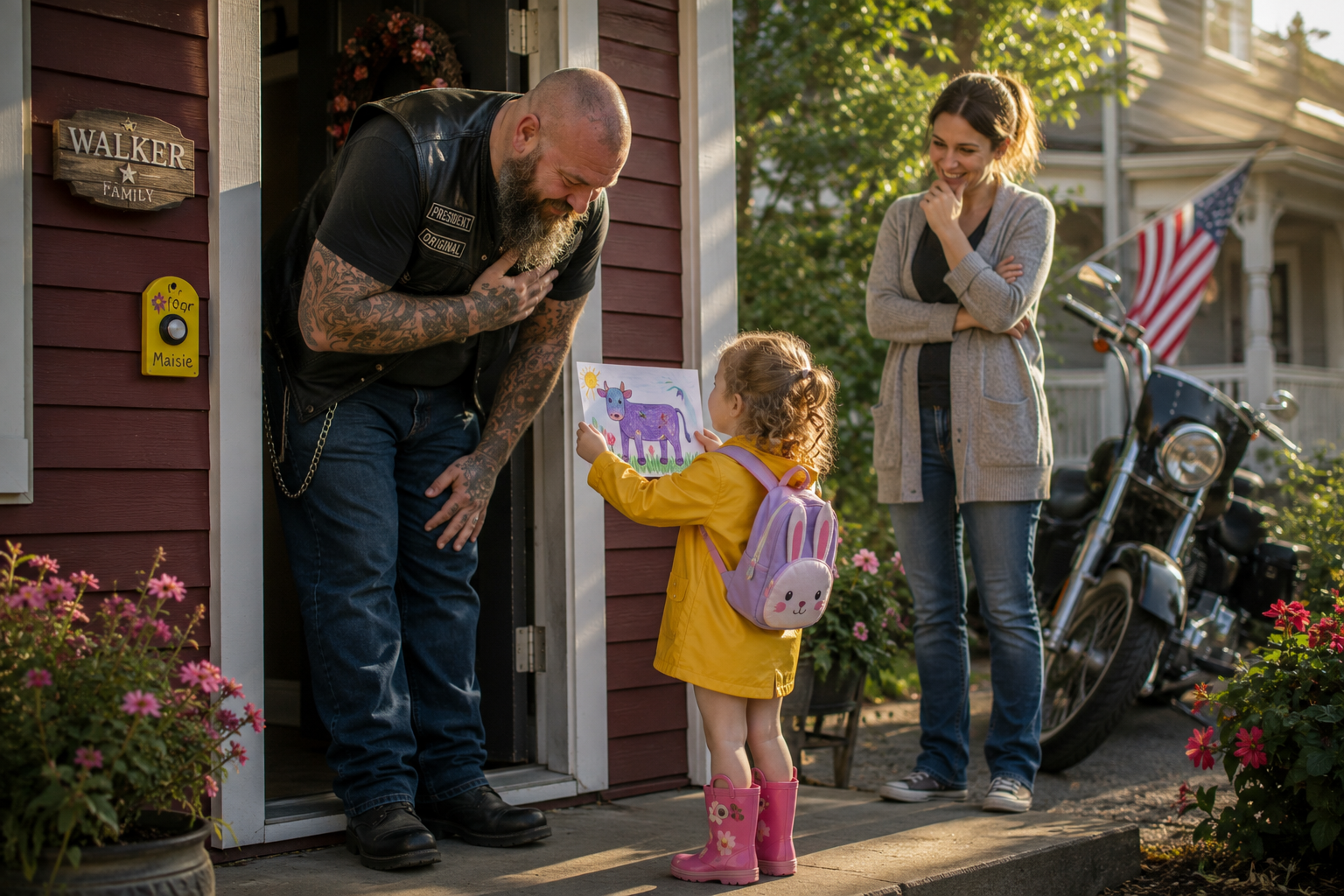
THE LITTLE GREEN BELL
Part Three
Moose did not chase the dark sedan.
That was the first decision that saved everything.
The old version of him might have run to his Harley, followed the car through Knoxville and dragged the driver out at the next light.
Instead, he looked down at Poppy.
She was staring at the two empty screw holes beside the door.
“Is the house not happy anymore?”
Moose closed his hand around the broken green button.
Then he crouched.
“The house didn’t break it.”
“Who did?”
“I don’t know yet.”
“Was it because of me?”
“No.”
The answer came immediately.
Poppy looked at him through her round glasses.
“Then why did they write that?”
Moose glanced at the note.
SHE DOESN’T BELONG HERE.
“Because some grown-up wanted you to believe something untrue.”
“Why?”
He swallowed.
“Because hurting little people is how cowards try to control big people.”
Hannah knelt beside them.
Poppy leaned into her.
Moose stood and called the police.
No threats.
No chase.
No touching the note without gloves.
By the time an officer arrived, I had written down the sedan’s description.
Dark blue.
Older model.
Partial plate.
Tennessee registration.
The porch camera had captured the driver entering the yard twelve minutes before we returned.
The image was grainy, but the person was clearly a woman.
Mid-fifties.
Short hair.
Light jacket.
She used a key to open the side gate.
That detail changed the investigation.
A stranger could climb a fence.
Someone with a key had been trusted.
Hannah looked at Moose.
“Who has one?”
He listed them.
Me.
Hannah’s sister.
Their social worker.
The emergency respite provider.
And Dr. Vance.
“No,” Hannah said. “He never had a house key.”
Moose stared at the footage.
“Not officially.”
The officer enlarged the image.
The woman turned just enough for her face to appear.
I recognized her first.
“Elaine.”
Moose looked at me.
“Who?”
“Dr. Vance’s wife.”
I had met Elaine Vance once at a county fundraiser.
She ran New Horizons Child Restoration.
She had shaken my hand, praised foster parents and spoken about “repairing biological bonds” as though families were machines that could be returned to factory settings.
Police located her three hours later.
She denied entering the yard.
Then officers found green paint on the heel of her shoe.
Fragments of yellow plastic in her car.
And eleven duplicate keys labeled only with children’s initials.
Poppy’s was marked:
P.W.
The search of the Vance home uncovered far more than a broken bell.
Case files.
Foster addresses.
School schedules.
Photographs taken from public streets.
Notes rating families by “pressure vulnerability.”
One category read:
APPEARANCE-BASED NARRATIVE VALUE.
Beside Moose’s name:
High. Male subject visually intimidating. Prior arrest record. Motorcycle affiliation. Potential public concern regarding household safety.
They had not simply found his appearance useful.
They had selected him because of it.
Dr. Vance knew a camera could transform a father bowing to his daughter into a threatening man requiring a child to request entry.
Elaine knew neighbors would remember the Harley before they remembered Moose loosening Poppy’s hearing-aid battery cover so she could manage it herself.
They had built their cases from cropped moments, loaded language and the public’s willingness to trust clean offices over scarred hands.
Kendra had been useful too.
Biological mother.
Recent sobriety.
Guilt.
Hope.
Easy to persuade that she was fighting strangers who had stolen her child instead of confronting the choices that had led to removal.
The scheme had started as ideology.
Then it became a business.
New Horizons collected donations by promising to “restore separated families.”
Dr. Vance used his clinical access to identify emotionally vulnerable parents.
Elaine funded their legal petitions, then charged consulting and advocacy fees through related organizations.
Sometimes reunification was appropriate.
Sometimes it was not.
The distinction mattered less than whether the case could produce attention, donations and influence.
Poppy’s case was especially valuable.
A small child.
A biker foster father.
A strange-looking ritual.
A biological mother who could be presented as recovered and courageous.
The story practically wrote itself.
Only the truth complicated it.
Kendra came to the house the following morning.
This time, she parked at the end of the street and waited.
She called Hannah first.
“May I come closer?”
Hannah looked at Moose.
Then at Poppy, who was coloring at the kitchen table.
“Not inside.”
Kendra accepted that.
We met her on the sidewalk.
She looked exhausted.
“I didn’t break the bell.”
“We know,” Moose said.
“I gave Elaine information.”
Hannah’s face tightened.
“What information?”
“Your routines. Court dates. When you usually left for preschool.”
Moose said nothing.
Kendra began crying.
“She told me it was for case preparation.”
“You gave her our address.”
“Yes.”
“You gave her access to Poppy.”
“I didn’t know she had a key.”
Hannah stepped forward.
“You knew she was photographing my child.”
Kendra lowered her eyes.
“Yes.”
“That should have been enough.”
“I know.”
Moose looked at her.
“Do something with it.”
The same words he had used at court.
This time, Kendra did.
She gave police every email.
Every message.
Every recording.
She admitted Dr. Vance had rehearsed testimony with her.
Admitted Elaine told her which phrases to use:
conditional belonging
coercive ritual
intimidating male environment
Words chosen not because Poppy used them, but because judges might.
Kendra also revealed something else.
Dr. Vance had not contacted her randomly.
He had treated her years earlier in a county rehabilitation program.
He knew her history.
Her guilt.
Her fear that Poppy would forget her.
He had told her adoption would erase her permanently.
Not legally.
Emotionally.
“He said if she called them Mom and Dad long enough, I’d become nothing.”
Moose’s face softened, though only slightly.
“So you tried to make us nothing first.”
Kendra nodded.
“Yes.”
No excuse.
Just yes.
That honesty was the first useful thing she gave them.
The independent adoption review lasted four months.
Four months of interviews.
Home visits.
New psychological evaluations.
Background checks.
Poppy was asked the same questions in different forms by adults trained to detect coaching.
Where do you live?
Who opens the door?
Can you enter without ringing?
What happens if you do not press the bell?
Who makes the rules?
Poppy became increasingly irritated.
Finally, during one interview, she said:
“The bell is not a rule. It is a hello.”
That sentence appeared in the final report.
So did another.
When asked what made a place home, Poppy answered:
“Home is where they know which cup is mine.”
Not the bell.
Not the bow.
Not even the people.
The cup.
A yellow plastic cup with a crack near the handle that Hannah kept replacing and Poppy kept retrieving from the recycling.
Belonging had become ordinary enough to hide in kitchen cabinets.
The review recommended adoption.
It also recommended carefully structured contact with Kendra, but only if Poppy wanted it and only under independent supervision.
Moose resisted.
Not loudly.
But completely.
“She used my daughter.”
Hannah corrected him.
“Our daughter.”
He looked at her.
Then nodded.
“Our daughter.”
Kendra had manipulated the case.
Allowed surveillance.
Helped threaten the stability Poppy depended on.
Moose believed that should end everything.
Hannah asked him one question.
“Are you deciding from what Poppy needs, or from what you need never to feel again?”
He hated the question.
Because he knew the answer.
The first supervised meeting lasted twelve minutes.
Poppy brought her stuffed fox.
Kendra brought nothing.
No gift.
No promises.
No argument over names.
She sat across from Poppy and said:
“I am the mother who gave birth to you.”
Poppy nodded.
“I know.”
“I was not safe for you.”
Poppy held the fox tighter.
“I know.”
“I am trying to become safer.”
Poppy studied her.
“Are you going to take me?”
Kendra’s face broke.
“No.”
“Promise?”
Kendra looked toward the supervisor.
Then back at Poppy.
“I promise I will not ask you to leave your home.”
Poppy relaxed slightly.
Not completely.
Trust did not return because an adult finally chose the correct sentence.
But a beginning existed.
The adoption hearing took place on a rainy Monday in November.
Moose wore a suit.
The jacket was too tight across his shoulders.
His beard had been trimmed unevenly because Poppy insisted on helping.
Hannah wore green.
Poppy wore her red raincoat indoors because she said courtrooms looked cold.
Judge Porter asked whether she understood what adoption meant.
Poppy nodded.
“It means they stop asking if I live there.”
The judge smiled.
“That is one way to say it.”
Then she asked:
“Do you want Hannah and Jackson Walker to become your legal parents?”
Poppy looked at Moose.
“His name is Moose.”
The courtroom laughed.
Even the judge.
“Do you want Hannah and Moose to become your legal parents?”
Poppy nodded.
“They already are.”
The order was signed at 10:42 a.m.
Penelope Grace Walker.
Moose stared at the paper for a long time.
Then Poppy pulled his sleeve.
“Can we go home now?”
He lifted her.
“Yeah, Lady Penelope.”
“Do I still ring?”
“If you want.”
She thought.
“I want.”
The new bell was waiting when we returned.
Moose had made it himself.
Not plastic this time.
A small green metal plate mounted at Poppy’s height.
A yellow button in the center.
Around it, Hannah had painted a white daisy.
Poppy climbed the porch steps.
Everyone stayed at the sidewalk.
Neighbors.
Social worker.
Her teacher.
Even Kendra, standing at a respectful distance with the supervisor.
Poppy faced the door.
Then stopped.
She looked back at Moose.
“You’re outside.”
He had forgotten.
Everyone laughed.
Moose climbed the steps and entered through the side door.
A moment later, Poppy pressed the yellow button.
The chime rang inside.
The front door opened.
Moose stood in the doorway wearing his black leather vest over the court suit.
He bowed.
Deep.
Formal.
“Lady Penelope Grace Walker,” he announced, “this house has been waiting for you.”
Poppy smiled.
Then walked inside.
Not carefully.
Not like a guest.
She kicked off her rain boots in the hallway, dropped the stuffed fox on the floor and shouted:
“Where’s my yellow cup?”
Moose looked at us.
“Royalty has standards.”
Years passed.
The bell remained.
Poppy grew tall enough to press the regular doorbell.
Then tall enough to see through the front window.
By eight, she sometimes forgot the ritual entirely and ran inside through the garage.
Moose never reminded her.
That mattered.
The bell belonged to her.
She did not belong to it.
At ten, she asked why they had installed it.
They told her the whole story in language she could carry.
The motels.
The waiting.
The feeling that doors opened for everyone else.
The court case.
The people who tried to turn welcome into control.
Poppy listened.
Then asked:
“Did I really say I wanted to be important like people?”
Hannah nodded.
Poppy looked embarrassed.
“That sounds dramatic.”
Moose stared at her.
“You once declared war because your banana broke.”
“I was four.”
“Historic facts remain facts.”
She rolled her eyes.
Then went outside and pressed the bell.
Moose opened the door.
He no longer bowed every time.
His knees objected.
But that day he did.
Poppy looked at him.
“Why do you still do this?”
He leaned against the frame.
“Because you still came home.”
“That happens every day.”
“Exactly.”
The little green bell had never meant that Poppy needed permission to enter.
It meant her arrival was worth noticing.
That was the truth Dr. Vance had tried to distort.
A ritual could become coercion.
A home could become conditional.
Protection could become control.
Those risks were real.
But context mattered.
Choice mattered.
Whether the child could walk past the bell without consequence mattered.
Whether the door opened in anger or joy mattered.
Most of all, the person at the door mattered.
Moose looked like the kind of man who might install a warning system.
In a way, he had.
The little bell warned the entire house that someone important had returned.
And every time it rang, the largest man on Sycamore Lane stopped whatever he was doing—
because Poppy had come home.