
PART 3
Gabriel read the final sentence twice.
If Emma made a list, she already found the pattern I spent thirteen years trying to prove.
Then he looked at his daughter.
Emma was sitting beside me with both hands wrapped around the old photograph of Caroline.
Ten years old.
Hair uneven where someone had cut it three days earlier.
Eyes red from crying.
Still watching every adult in the room as though one of us might change the story again.
Gabriel said:
“What pattern?”
Detective Vega turned the page.
The next sheet was a chart.
Twelve children.
Twelve families.
Twelve connections to the old Ridge Kings.
Some parents had ridden with the club.
Some worked at businesses used during charity events.
One had handled bookkeeping.
Another had been a warehouse security guard.
Tyler Jensen’s grandfather had driven trucks for Thomas Bell’s construction company.
Mia Torres’s mother had once worked at the bank where the veterans’ relief account was held.
Jordan Pike’s uncle had been the young club member who backed Thomas’s version of the warehouse assault thirteen years earlier.
Emma’s name sat at the center.
I looked at Gabriel.
“These children weren’t selected because of who they are.”
“No.”
His voice went flat.
“They were selected because of who their families are.”
Detective Vega nodded.
“That’s what Caroline believed.”
Principal Maddox looked sick.
“You’re saying Mr. Bell allowed children to be bullied because their parents knew something about his old club?”
Vega corrected him.
“We don’t know yet whether he directed the bullying.”
Good.
That mattered.
“We know he appears to have discouraged reporting. We know he had photographs of these children. We know this list links their families to people connected to an old financial investigation.”
Gabriel stared at Thomas’s volunteer office through the glass.
“Same thing he did back then.”
“What?”
I asked.
“Make people feel alone before they compare notes.”
The school suspended Thomas’s volunteer access immediately.
Police seized the phone, cabinet contents, and records.
Parents were contacted individually.
Nobody told twelve families to meet in a parking lot and accuse somebody.
Nobody needed another mob.
Statements were taken separately.
That was how the old story began to crack.
Mia’s mother remembered something from fourteen years earlier.
A banking customer named Thomas Bell repeatedly deposited checks from several charities into contractor accounts.
The amounts were small enough individually to avoid attention.
She flagged them internally.
Her supervisor told her the accounts were legitimate.
Tyler’s grandfather remembered hauling sealed crates from the Ridge Kings warehouse late at night.
He was told they contained donated motorcycle parts.
Jordan’s uncle admitted he lied to police after the warehouse incident.
Not about Gabriel hitting Thomas.
That happened.
He lied about Caroline.
Thomas had told everyone Caroline attacked him first.
She had not.
“Why lie?” Vega asked.
Jordan’s uncle looked ashamed.
“Because Bell had photographs.”
“What photographs?”
“Us moving crates.”
“Illegal goods?”
He nodded.
“What kind?”
That was when the case changed.
Not drugs.
Not weapons.
Medical equipment.
Wheelchairs.
Prosthetic components.
Mobility devices.
Items donated through charity drives for injured veterans.
Thomas had been diverting some of them.
Reselling them through private contractors.
The money missing from the veterans’ fund was only one layer.
The stolen equipment was worth far more.
Gabriel stared at the transcript.
“Caroline found this.”
“Yes.”
“And Thomas thought she had evidence.”
“Yes.”
“That’s why he went after her.”
“Likely.”
Gabriel shook his head.
“For thirteen years I thought this was about money.”
Vega looked at him.
“It was.”
He frowned.
“Just more of it.”
Diane Bell finally spoke.
Thomas’s wife.
She came to the police station voluntarily two days later with an attorney.
Gabriel did not attend.
He wanted to.
Emma asked him not to.
“Stay with me.”
So he did.
Diane admitted she took baby Emma to Kentucky.
Caroline had contacted her from a motel outside Nashville.
She was frightened.
Injured.
Pregnant.
And convinced Thomas would find her if she went home.
Diane had known more about her husband’s business than she admitted.
Not everything.
Enough.
She helped Caroline deliver under an alternate last name.
Then, months later, transported baby Emma to the hospital that contacted Gabriel’s sister.
“Why not go to police?” Vega asked.
Diane answered:
“I tried.”
She had called an officer she knew through Thomas.
The next afternoon, Thomas knew.
That ended it.
She believed the local system was compromised.
So she did what frightened people often do.
She chose secrecy over process.
Sometimes correctly.
Sometimes disastrously.
Caroline disappeared again.
Diane lost contact for almost eight years.
Then letters started arriving.
No return address.
Always asking about Emma.
Never asking to take her.
Just:
Was she healthy?
Was Gabriel out?
Was Thomas still near the family?
Diane answered through a postal box.
Then Thomas discovered the correspondence.
Four years earlier.
He took the letters.
Threatened Diane.
She stopped responding.
Caroline likely believed everyone had abandoned her.
Gabriel listened to that part of Diane’s statement alone later that night.
Then punched nothing.
Not a wall.
Not a person.
He simply sat in his truck and cried.
The newest letter contained one clue to Caroline’s location.
A receipt stapled inside.
Grocery store.
Lexington, Kentucky.
Four months old.
Police traced the loyalty-account number.
Fake name.
But security footage matched Caroline.
Then another purchase.
Pharmacy.
Then a library card.
Different surname.
Same woman.
She had been living under the name Caroline Shaw.
Not hiding from Gabriel anymore.
Hiding from Thomas.
Police contacted her through an attorney.
She refused to return to Tennessee immediately.
But she agreed to a video call.
Gabriel asked Emma what she wanted.
“I want to see her.”
“You sure?”
“No.”
That answer sounded exactly like him.
The call happened on a Thursday afternoon in my office.
Same room where Gabriel had admitted the lie.
Emma sat close to him.
Not holding his shirt now.
Holding his hand.
The screen connected.
Caroline appeared.
Older than the photograph.
Hair shoulder-length.
Thin.
Nervous.
She looked first at Gabriel.
Then at Emma.
Her hand covered her mouth.
Nobody spoke.
Finally Emma said:
“Are you my mom?”
Caroline started crying.
“Yes.”
“Why didn’t you come back?”
Gabriel looked away.
Caroline answered carefully.
“Because I was scared.”
“For thirteen years?”
“Yes.”
“Of Mr. Bell?”
“Mostly.”
Emma frowned.
“Mostly?”
Caroline looked at Gabriel.
“Of what coming back would do.”
Emma did not understand.
I did.
Caroline had built a survival story too.
If she returned, Gabriel might be accused again.
Thomas might retaliate.
Emma might be pulled into court fights.
After enough years, fear becomes habit.
Emma asked:
“Did you want me?”
Caroline’s face collapsed.
“Yes.”
“Then why did you give me away?”
“I didn’t give you away.”
She wiped her eyes.
“I sent you to your father because he was the safest person I knew.”
Emma looked at Gabriel.
He broke then.
Not loudly.
Just lowered his head.
Caroline continued.
“I thought I would follow.”
“What happened?”
“I got scared again.”
Emma stared.
“That was wrong.”
Caroline nodded.
“Yes.”
That mattered.
No heroic excuse.
No pretending fear erased responsibility.
“I’m sorry.”
Emma looked down.
Then:
“Dad lied too.”
Gabriel nodded.
“Yes.”
Caroline almost smiled.
“He always was terrible at complicated plans.”
Gabriel looked at the screen.
“You vanished.”
“You confessed.”
“You told me to.”
“I was panicking.”
“I was twenty-eight and stupid.”
“You were thirty-eight.”
He paused.
“Still stupid.”
Emma laughed.
Tiny.
First one in days.
Caroline returned to Tennessee three weeks later.
Not to reclaim Emma.
Not to move into Gabriel’s house.
Not to repair thirteen years in a weekend.
She rented a small apartment.
Attended therapy.
Met Emma in supervised family sessions at first.
Gabriel hated the word supervised.
Emma liked it.
“It means everybody behaves.”
Fair.
Their first in-person meeting lasted twenty-seven minutes.
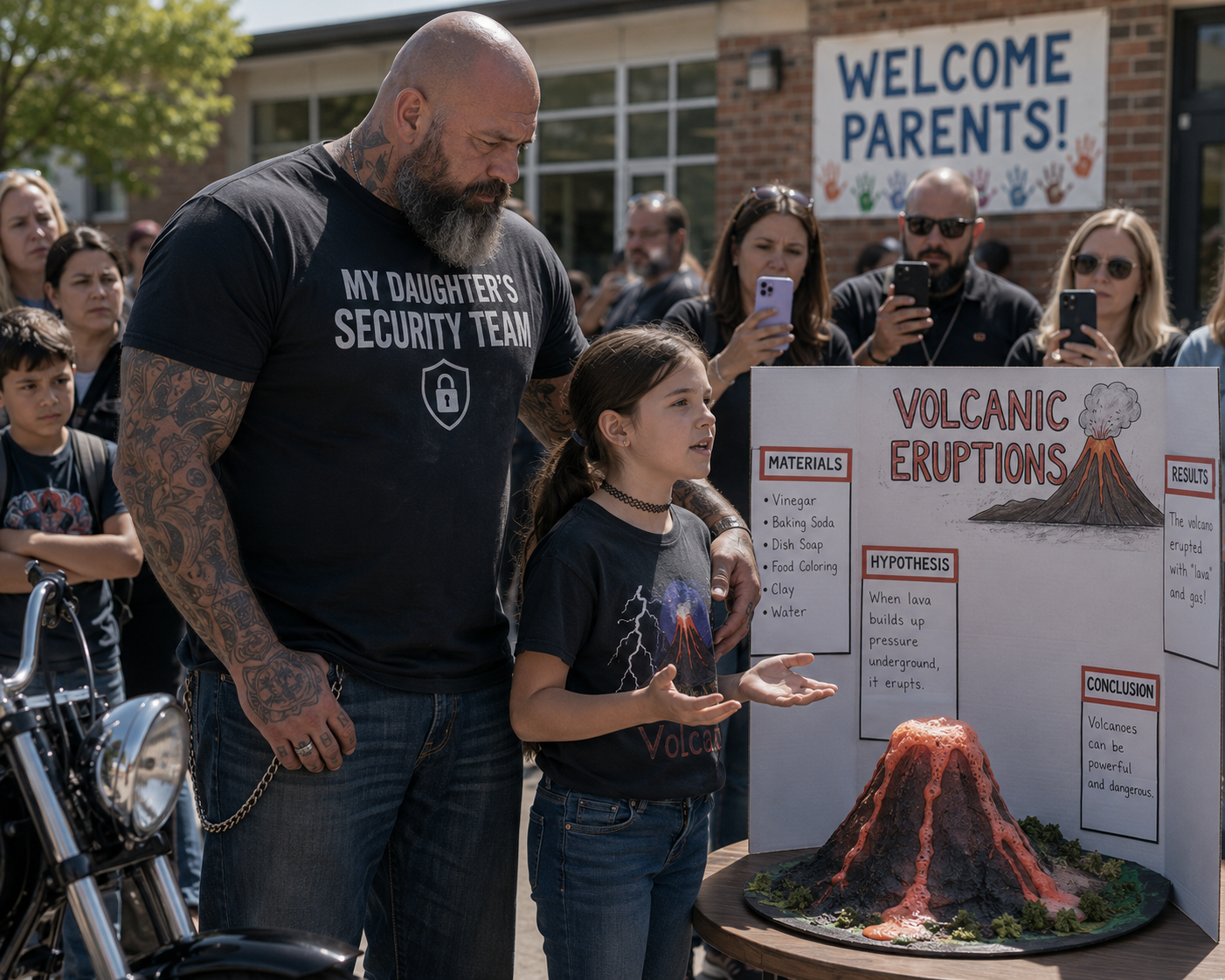
Emma brought the science project.
The volcano.
Caroline stared at it.
“You made this?”
“Yes.”
“Does it work?”
“It explodes.”
Gabriel said:
“Foams.”
Emma glared at him.
“Explodes emotionally.”
Caroline laughed.
Same laugh Emma had.
Gabriel heard it.
Turned away.
Some grief is too private even in a room full of people.
Thomas Bell’s case took months.
Investigators uncovered records connecting his companies to resale of donated mobility equipment.
False invoices.
Charity fund transfers.
Witness intimidation.
Evidence tampering.
The old warehouse case was reopened.
Gabriel’s conviction could not simply disappear because Thomas was corrupt.
Gabriel had actually assaulted him.
He admitted that.
But records were amended to reflect suppressed context and new evidence related to the underlying confrontation.
Gabriel cared less about clearing his name than people expected.
“I hit him.”
He told me that once.
“I shouldn’t have.”
“But he was hurting Caroline.”
“I still hit him because I wanted to.”
He shrugged.
“Two things can be true.”
That was probably the healthiest sentence he had ever said.
Thomas also faced charges tied to the present-day investigation.
The children’s cases were handled separately.
No child was forced to testify publicly before necessary protections were considered.
The school district launched an independent review.
Volunteer screening changed.
Recess complaints required written documentation.
Parents could no longer have concerns dismissed as “horseplay” without review.
Principal Maddox apologized publicly.
Not for failing to predict everything.
For minimizing what students had already told adults.
That distinction mattered.
The twelve children met once.
Not to discuss Thomas.
To redesign recess.
Emma suggested a buddy system.
Tyler wanted cameras near the equipment shed.
Mia wanted one adult whose only job was listening.
Jordan said:
“No hiding places.”
I asked what he meant.
He pointed at Emma’s old list.
“We shouldn’t need them.”
So we stopped treating the list as evidence alone.
We treated it as a blueprint of where adults had failed.
The broken bathroom stall was repaired.
The west stairwell got better supervision.
The music storage room stopped being Emma’s safe place.
Eventually, it became just a room again.
Three months later, Madison Creek held another family event.
Gabriel came.
Same boots.
Same tattoos.
Different shirt.
Emma had made it.
Across the chest:
NOT SECURITY. JUST DAD.
Parents still looked.
Some always would.
One man approached Gabriel near the art display.
The same father who had asked security to remove him months earlier.
“I owe you an apology.”
Gabriel looked at him.
“For?”
“I judged you.”
Gabriel shrugged.
“You were looking at what was easiest to see.”
The man nodded.
“Still wrong.”
Gabriel considered that.
“Yeah.”
Then shook his hand.
No speech.
No inspirational moment.
Just done.
Emma stood nearby talking with Caroline.
Still awkward.
Still cautious.
But talking.
That was enough.
Later, I asked Emma whether she still worried people thought her father was dangerous.
She looked across the courtyard.
Gabriel was helping a first grader untangle kite string.
A man built like a demolition machine arguing with pink nylon thread.
Emma shrugged.
“Sometimes.”
“Does it bother you?”
“Not really.”
“Why?”
She thought.
Then said:
“Because I know what he does when he gets mad.”
I remembered.
Fists closing.
Her hand touching his wrist.
Hands opening.
“What does he do?”
“He stays.”
That was the real story.
Gabriel had spent thirteen years believing protection meant carrying secrets alone.
Caroline believed protection meant disappearing.
Diane believed protection meant silence.
Thomas used that silence because isolated people are easier to control.
Emma understood something none of them had understood soon enough.
Protection is not making everyone afraid of you.
It is not taking every burden yourself.
It is not deciding someone else cannot survive the truth.
Sometimes it is simpler.
Tell the counselor.
Write the names down.
Stand beside the child.
Open your hands.
And when someone asks whether you want to leave—
stay.