
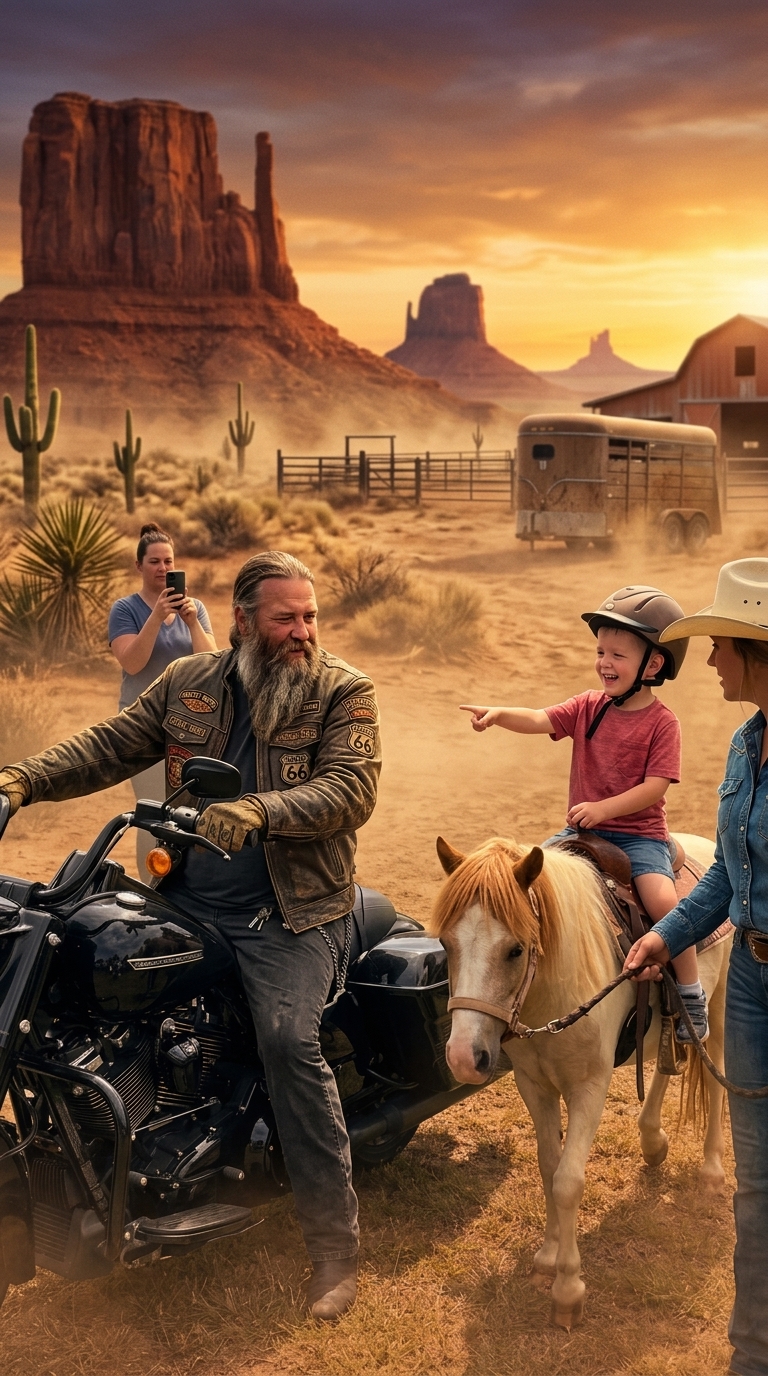
Part 2 — The Man Behind the Garage Door
My name is Mara Bennett. I was thirty-four that summer, worked mornings at a dental office in Tulsa, and spent most afternoons negotiating with a six-year-old who considered shoes optional and every stranger a future friend.
Noah and I moved to Broken Arrow after his father and I separated. The small rental house on East Canton Street was all I could afford within driving distance of my job and Noah’s school. The fence leaned toward Wade’s property, the air conditioner complained through July, and the kitchen window faced the open door of his detached garage.
I knew him first by sound.
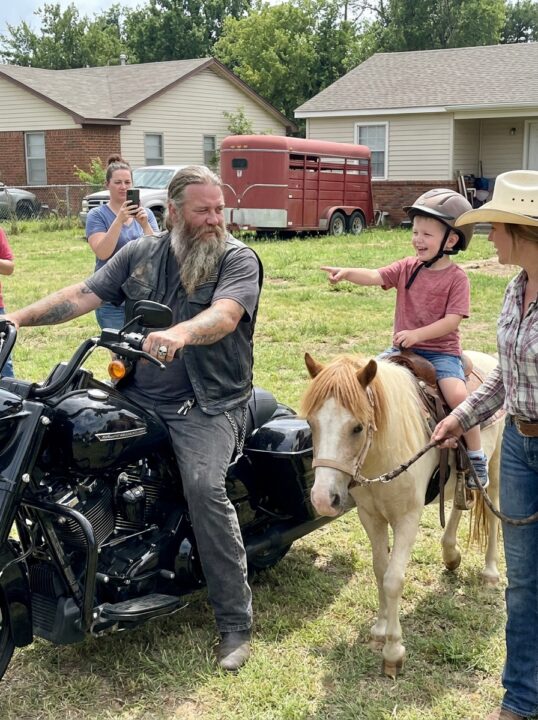
At 6:10 every weekday morning, his garage door rolled upward. Tools clicked against a metal tray. A radio played old Red Dirt songs beneath the rough pulse of an idling Harley, and by 6:30 Wade was headed toward Mercer Cycle Works, the small repair shop he owned beside Highway 51.
He came home after dark smelling of motor oil and road dust. Sometimes four or five riders followed him. They looked like the kind of men a cautious mother noticed—thick beards, tattooed arms, leather cuts, heavy motorcycles—and yet they never drank in his driveway, never shouted after ten, and never left trash near the curb.
The first time Noah kicked a soccer ball beneath Wade’s half-open garage door, I expected trouble.
Wade picked up the ball, examined the scuffed surface, and asked, “This thing got brakes?”
“No.”
“Poor engineering.”
He returned it with one slow underhand toss.
Two days later, a small wooden stop sign appeared beside our driveway so Noah would remember not to chase the ball into the street. Wade claimed he had found it behind his shop. I later discovered fresh sawdust in his trash bin and red paint beneath one thumbnail.
That was how he did kindness.
Sideways.
Wade did not speak about family. He owned no framed photographs that I could see, received no holiday visitors, and spent Christmas morning changing the battery in an elderly widow’s car. Yet odd traces of another life remained around him.
A dented silver belt buckle hung above his workbench. A pair of unused spurs rested in a coffee tin. An old saddle sat beneath a canvas sheet in the deepest corner of his garage, though dust had gathered thickly around it.
And then there was the horsehair braid.
It was perhaps eight inches long, dark brown with a narrow streak of gold, tied to his mirror with a piece of red leather. It moved whenever the Harley idled, brushing against the chrome stalk like a small tail keeping time with the engine.
Noah noticed everything.
“Did that come from a horse?”
“Yes.”
“Was it your horse?”
“No.”
“Whose horse?”
Wade looked at me over Noah’s head.
“Your mom needs help with those groceries.”
He took both bags from my arms and ended the conversation.
The other bikers knew the subject was closed. Earl “Rivet” Cole, a retired welder with a white mustache and hands burned smooth across the fingertips, once caught me looking at the saddle.
“Dusty rode before he walked,” Earl said.
“Why did he stop?”
The old man glanced toward Wade, who was tightening a primary chain on the far side of the shop.
“Ask him if you want him quiet for a month.”
I did not ask again.
What I learned came in fragments. Wade had grown up outside Claremore on a cattle operation owned by his grandfather. He competed in junior rodeo, broke ranch horses, and spent twelve years working across Oklahoma and northern Texas as a ranch hand, horse trainer, and occasional pickup rider.
His nickname had existed long before the motorcycle.
He married at twenty-four. His wife, Jenny, taught third grade. Their daughter, Annie, arrived two years later and apparently inherited her father’s complete lack of caution around animals.
That was all anyone would say.
When Wade was thirty-three, he left the ranch, sold his pickup, and bought a used Harley-Davidson Electra Glide from Earl for less money than Earl should have accepted. He taught himself motorcycle repair, stopped attending rodeos, and never again entered a barn unless someone’s life depended on it.
The Harley was not rebellion.
It was replacement.
A horse moved beneath you with warmth, breath, intention, and memory. A motorcycle responded to fuel, spark, pressure, and steel. If an engine failed, Wade could open it, identify the broken part, and replace what was gone.
People were harder.
That Friday, when Noah said horses were softer, he did not know he had placed one small hand against the locked door Wade had spent seventeen years reinforcing.
I did not know either.
But Lila Grant did.
After Noah and I went inside, Wade called her ranch for the first time in nearly eleven years. Lila answered on the fourth ring, heard his voice, and said nothing for so long that Wade nearly hung up.
Finally, she asked, “Who died?”
“Nobody.”
“Then who needs help?”
Wade watched Noah through our kitchen window, galloping around the table on a broom.
“A kid next door.”
Lila laughed once. “That sounds worse.”
“I need a pony for an hour.”
“Do you?”
“The boy does.”
She let the lie sit between them.
Lila still owned Biscuit, though the pony had gray around her muzzle and had retired from regular lessons. Biscuit was gentle with children, accustomed to loud farm equipment, and one of the few horses Lila trusted near a motorcycle.
More importantly, Biscuit had once belonged to Annie.
When Wade asked to borrow her, Lila understood what he was actually requesting.
Not a pony.
Permission to return.