
In the collective imagination of sports fans, the championship victory is the ultimate coda. It is the confetti rain, the hoisting of the trophy, the moment of pure, unadulterated ecstasy where the athlete finally exhales. We assume that for the giants of history—the men who conquered the world stage—that moment is the harvest of their toil. We assume they enjoy it.
We were wrong.
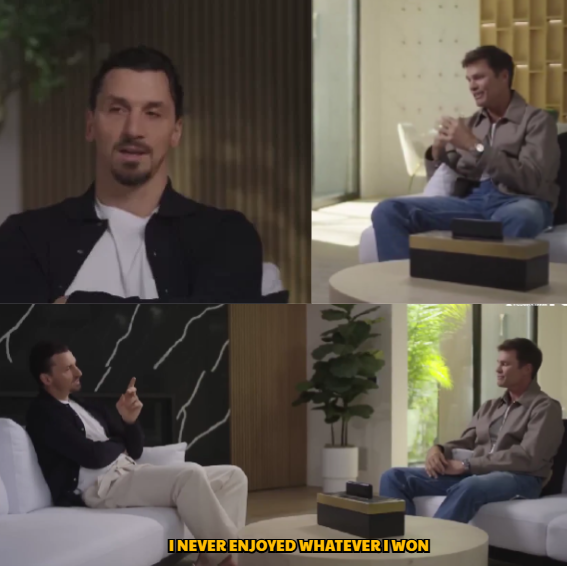
In a recent, startling exchange between two of the most iconic figures in modern athletics—football’s Tom Brady and soccer’s Zlatan Ibrahimović—a curtain was pulled back on the internal reality of the elite. When Zlatan, a man whose career was defined by audacious swagger and a trophy cabinet that spans three decades, asked the seven-time Super Bowl champion if he ever truly enjoyed his achievements while active, the answer was a flat, chilling “No.”
Zlatan’s response was immediate and resonant: “Same thing. I never enjoyed whatever I won. I always wanted more. Even now as a person, if I look back, yes I did what I did, but still I’m not satisfied. I cannot really enjoy it because I want more. And I’m not even playing.”
This is not a story of professional tragedy, but rather a forensic look at the psychology of the “Alpha.” For those who reach the absolute pinnacle of human potential, satisfaction is not the destination—it is the enemy.
The “Big Johnny” Philosophy
To understand this mindset, we must look to the bedrock of Brady’s philosophy. During the same exchange, Brady shared an anecdote from his collegiate days at the University of Michigan. It involved an equipment manager named “Big Johnny.”
“People would ask him, ‘Big Johnny, what’s your favorite ring?'” Brady recounted. “He would always say, ‘The next one.'”
It is a simple, pithy statement, but it contains the DNA of greatness. It is the antithesis of the “celebratory mindset.” If you view your achievements as a collection of historical artifacts to be cherished, you are, in the eyes of an elite competitor, looking backward. And if you are looking backward, you are not looking at the competition.
For athletes like Brady and Zlatan, the “next one” is not just a goal; it is a psychological shield against the stagnation of success. Success is often described as a “disease”—a state of comfort that makes the winner soft, complacent, and vulnerable. By refusing to enjoy the current victory, these athletes effectively delete the dopamine hit that tells the brain to rest. They stay in a perpetual state of hunger.
The Hedonic Treadmill of the Elite
Psychologists often refer to the “hedonic treadmill”—the tendency of humans to quickly return to a relatively stable level of happiness despite major positive or negative events or life changes. For the average person, winning a championship might bring a surge of joy that lasts for weeks. For the elite athlete, that surge is measured in seconds.
The moment the final whistle blows, the vacuum of “What now?” begins to gnaw at them.
Zlatan’s admission—that he is “not even playing” yet still cannot enjoy his past—suggests that this is not a tactical decision; it is a fundamental personality trait. This is the neurology of the obsession. These individuals do not play for the joy of the game; they play for the validation that they are the best, and the moment that validation is achieved, it loses its currency. The market price of their ego demands a new, higher acquisition.
The Cost of the “Never Satisfied” Mindset
If there is a dark side to this relentless drive, it is the inability to find peace. The irony of the “Greatest of All Time” label is that it is a title bestowed by others. The athletes themselves are rarely satisfied with their own internal narrative.
Consider the physical and emotional toll this takes. To never enjoy a win is to live in a state of constant, low-grade suffering. Every training session, every game, and every championship is merely fuel for the fire. It begs the question: What are they running toward? And more importantly, what are they running from?
For Zlatan, his career was a series of challenges—moving to new leagues, dominating new environments, and proving his worth against skeptics. For Brady, it was the relentless pursuit of perfection in a system (the NFL) designed to ensure parity and failure. Their careers were not joyous romps; they were high-stakes warfare where the only acceptable outcome was total dominance.
The cost, as they have admitted, is the forfeiture of the present moment. They never stood on the mountain top to admire the view; they stood there only long enough to map out the next climb.
The Distinction Between “Playing” and “Winning”
There is a vital distinction to be made here. These men did not say they didn’t love the sport. They said they didn’t enjoy winning.
There is a difference between the “flow state” of competition—the moment of execution, the perfect pass, the impossible goal—and the “satisfaction” of the result. It is possible that for these men, the only time they felt any semblance of peace was during the game. In the chaos of the match, the noise of their own ambition is drowned out by the necessity of action.
Once the game is over, and the result is in the record books, the noise returns. The “next one” begins to call.
The Legacy of the Unquenchable
Is this mindset necessary for greatness? It is a question that defines modern sports science and psychology. Can you be the best in the world while also being a person who is capable of sitting back, sipping a glass of wine, and saying, “I am enough”?
Perhaps not.
The greatest achievers in history—the Einsteins, the Musks, the Jordans—rarely seem to be men at peace. They are driven by a void that they spend their entire lives trying to fill with medals, money, or monuments.
Zlatan and Brady have done us a service by shattering the myth of the “happy champion.” By admitting that they were never satisfied, they validate the experience of millions of high-achievers who also feel that nagging sense of emptiness after a big win. They prove that the drive to be the best is not a gift; it is a burden.
The Final Whistle
As the sun sets on their active careers, we are left with a strange paradox. We worship them because they won everything. They are unhappy because they had to win everything.
Maybe the lesson is not that we should emulate their inability to enjoy success, but rather that we should understand the price of total dominance. To be the best, you must be willing to sacrifice the present. You must be willing to sacrifice contentment.
As for “Big Johnny,” perhaps he was right. Maybe the only thing that matters, in the end, is the next one. But as we watch these titans navigate their post-career lives, we are left wondering: What happens when there is no next one?
When the rings are all collected, and the records are all broken, and the “next one” no longer exists, perhaps then—and only then—will they finally find the peace they were always running away from.
Until then, they stand as the ultimate testament to the human capacity for hunger. They are the kings of the mountain, but they are the only ones who never felt the majesty of the view from the peak.