
Part 2
For one impossible second, the whole room forgot how to breathe.
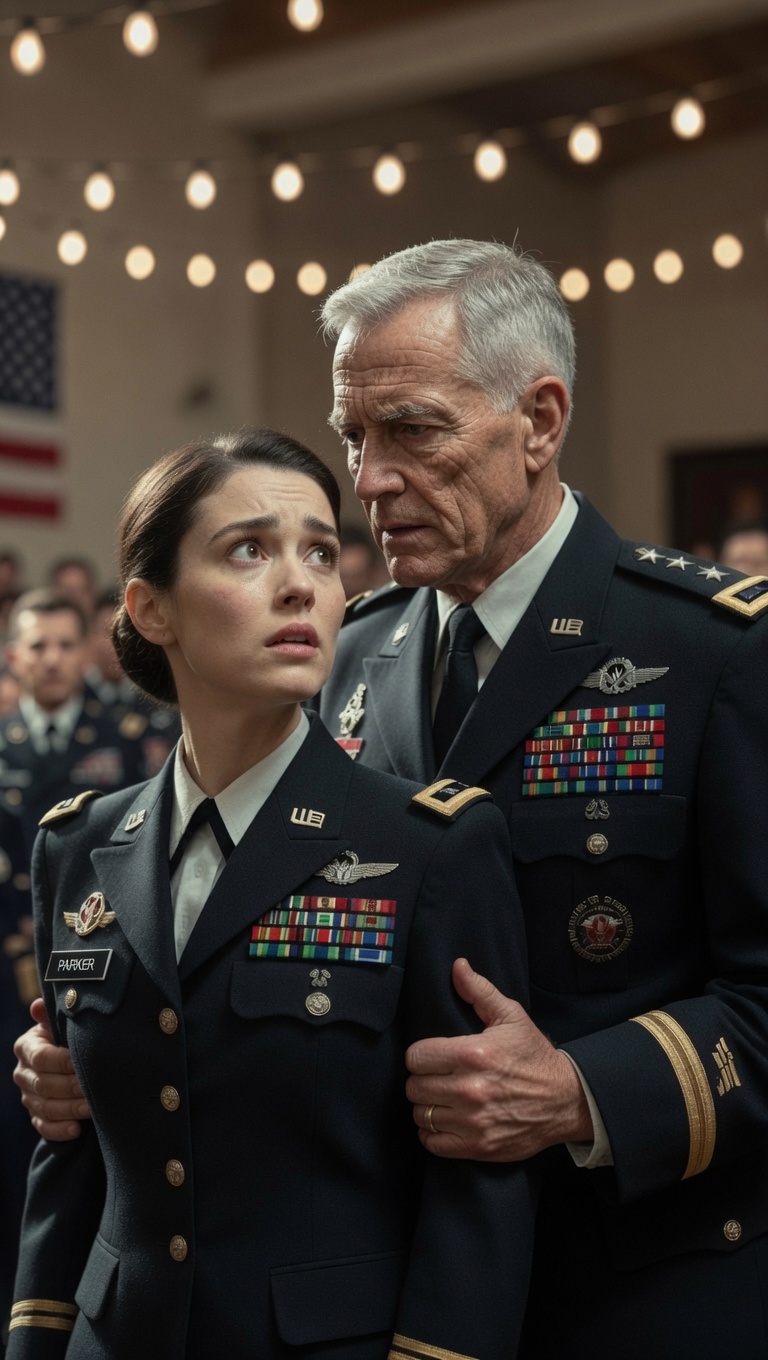
The four-star general stood with his gloved hand lightly touching my sleeve, as if he had stopped me not from leaving a birthday party, but from walking away from history itself.
My father stared at him.
Everyone stared at him.
And I stood there, feeling the old wooden floor beneath my polished shoes, hearing the faint buzz of the fluorescent lights overhead, wishing—more than anything—that the general had let me go.
“General Whitaker,” I said quietly.
His eyes softened when he looked at me.
“Colonel Parker,” he replied.
That single word struck the room like thunder.
Colonel.
Someone gasped.
Paula at the guest table lifted both hands to her mouth. The mayor straightened so fast his chair scraped the floor. Coach Reynolds, who had laughed into his coffee moments earlier, froze with the cup halfway to his lips.
My father blinked.
“No,” he said.
It was barely a word.
General Thomas Whitaker turned toward the crowd.
“I apologize for interrupting Mr. Parker’s celebration,” he said. “But I will not stand by while one of the finest officers I have ever served beside is publicly humiliated.”
My pulse thudded hard.
“Sir,” I said under my breath, “this isn’t necessary.”
He did not look away from the room.
“It became necessary when silence started protecting the wrong people.”
My father took one step forward.
“Officer?” he said, forcing a laugh that fooled no one. “Rachel works logistics. Paperwork. Supplies. She’s always made it sound bigger than it is.”
The general’s jaw tightened.
“Mr. Parker,” he said, “your daughter is not a clerk.”
I closed my eyes for half a second.
There it was.
The door I had kept locked for years.
Opening.
“Your daughter,” General Whitaker continued, “served as commander of a classified joint recovery unit overseas. She led missions most people in this room will never read about. She has saved American lives, allied lives, and civilian lives. She has stood in rooms with presidents, defense ministers, and foreign commanders.”
A low murmur spread through the hall.
My father looked from him to me, then back again.
“That’s not possible,” he said.
General Whitaker reached into the inside pocket of his uniform and removed a small black case. He opened it.
Inside was a medal.
Not the kind handed out for showing up.
Not the kind people wore casually in parades.
The silver star caught the light and sent it scattering across the room.
“Colonel Rachel Anne Parker,” he said, “was awarded the Silver Star for gallantry in action three years ago. The ceremony was private due to operational security.”
My father’s face drained of color.
The mayor whispered, “Silver Star?”
Paula began crying.
I looked at the medal and felt the desert heat again.
Not the hall.
Not Lancaster.
Not Dad’s birthday banner.
A road outside Kandahar.
Smoke twisting into a sky too bright to be real.
The radio screaming.
A convoy split in half by an explosion.
A young lieutenant trapped inside a burning vehicle, pounding against twisted metal until his hands bled.
I remembered running.
I remembered ignoring the order to wait.
I remembered the blast wave hitting my back as I dragged him out by his vest.
I remembered thinking, absurdly, that Mom would have scolded me for tearing my sleeve.
General Whitaker closed the case.
“Colonel Parker requested that this remain quiet,” he said. “She did not want attention. She did not want ceremonies. She did not even want the local paper to know.”
Then he turned to my father.
“She only wanted to come home.”
The room was silent enough to hear the ice machine cough in the corner.
My father swallowed.
His pride fought his shock. I could see it happening. I had watched him struggle the same way when Mom’s diagnosis came, when bills piled up, when the farm lost money, when age began stealing strength from his hands.
He was a man who did not know how to lose face.
So he reached for anger.
“Well,” he said, louder than necessary, “if all that’s true, why didn’t she tell her own father?”
The question landed harder than I expected.
Because beneath the accusation, there was something else.
Hurt.
Small, bitter, wounded hurt.
I looked at him.
“You never asked,” I said.
The words were quiet, but everyone heard them.
My father flinched.
General Whitaker stepped back slightly, giving me the room. He had opened the door, but he would not push me through it.
I could still leave.
I should have left.
But then my eyes moved to the crooked banner above the stage.
VIPS ONLY.
I thought of Mom’s quilt folded in the backseat of my truck. I thought of her hands smoothing fabric across the kitchen table. I thought of the way she had always tried to build bridges between two people who only knew how to stand on opposite shores.
And I stayed.
“I didn’t tell you,” I said, “because every time I came home, you reminded me exactly where you thought I belonged.”
Dad’s mouth opened.
No words came out.
“You told people I answered phones. You told Aunt Susan I joined the Army because college was too hard. You told Mr. Jenkins at the feed store I was still trying to figure out my life.”
I smiled faintly, though there was no humor in it.
“I was thirty-eight years old when you said that.”
A few people looked away.
The truth had weight, and no one wanted to be seen holding it.
My father’s eyes reddened.
“I didn’t understand what you did,” he said.
“No,” I answered. “You didn’t want to.”
General Whitaker’s voice came again, lower this time.
“Colonel Parker’s mother understood.”
The room shifted.
My father turned sharply.
“What did you say?”
The general looked at me.
I felt the coin under my jacket, resting against my heart.
The challenge coin.
The one my father had asked about that afternoon.
The one Mom gave me before my final deployment.
I reached inside my uniform and took it out.
It was old now, worn at the edges from years of being carried. One side bore the emblem of my unit. The other side had three words engraved in small letters.
COME HOME STANDING.
My father stared at it.
“I thought that was just some Army thing,” he said.
“It was,” I replied. “At first.”
General Whitaker’s voice softened.
“Mrs. Parker wrote to me before she passed.”
The hall seemed to tilt.
Dad gripped the back of a chair.
“What?”
“She knew more than you thought,” the general said. “Colonel Parker could not tell her details, but mothers have a way of reading silence. Your wife contacted my office through military family channels. She asked one question.”
He paused.
I already knew the question.
I had read it in the letter after the funeral.
General Whitaker said it aloud.
“She asked, ‘Is my daughter alone?’”
A sound escaped my father.
Not a sob.
Not yet.
Something smaller.
Something breaking in the walls.
“I told her no,” the general said. “I told her Rachel had earned the trust of everyone around her. I told her she was respected. I told her, without violating classified matters, that her daughter had become someone extraordinary.”
My hands tightened around the coin.
“She never told me,” Dad whispered.
“No,” I said. “She was waiting for you to want to know.”
Those words did what all the medals and titles had not.
They found him.
William Parker, who had spent seventy years building himself into stone, suddenly looked old.
The mayor cleared his throat awkwardly.
“Bill,” he said, “maybe we should—”
My father raised one hand.
The mayor stopped.
For once, Dad did not want help from important people.
He looked at me, really looked at me, and his eyes moved over my uniform as if seeing it for the first time. Not costume. Not vanity. Not proof that his daughter had chosen a life he could not control.
Service.
Sacrifice.
Distance.
Loneliness.
All the things hidden beneath pressed seams and polished brass.
“What did you do?” he asked.
I knew what he meant.
Not the official version.
Not the version in citations.
The real one.
I looked around the room.
“This isn’t the place.”
General Whitaker glanced toward the stage.
“Actually,” he said, “it may be exactly the place.”
Then the double doors opened.
Two soldiers entered.
Behind them came a man using a cane.
He was young—early thirties—but moved like someone twice that age. His left leg was stiff. Burn scars climbed the side of his neck and disappeared beneath his collar.
I knew him immediately.
My breath caught.
“Ethan?”
Lieutenant Ethan Morales stopped just inside the door.
His face changed when he saw me.
Not surprise.
Relief.
The kind that crosses years in a second.
“Ma’am,” he said.
I shook my head.
“No. Don’t.”
But he smiled.
Then, slowly, with effort, he came forward.
The room parted for him.
Every eye followed.
When he reached me, he did not salute. Instead, he held out his hand. I took it.
His grip trembled.
“You left before I woke up,” he said.
“I had orders.”
“You always had orders.”
“You always ignored medical advice.”
He laughed once, then wiped his eyes with the back of his hand.
My father watched us.
General Whitaker turned toward him.
“This is the officer your daughter pulled from a burning vehicle under enemy fire.”
Ethan looked at Dad.
“No, sir,” he said. “She didn’t pull me out.”
Dad frowned.
Ethan’s voice shook.
“She went back twice.”
A woman near the cake table began to cry openly.
Ethan leaned harder on his cane.
“The first time, she got me halfway out before the second blast knocked us both down. I remember screaming. I remember telling her to leave me.”
He looked at me.
“She said, ‘Not today.’”
My throat tightened.
“She went back again,” Ethan continued. “Cut my belt loose with a knife because the buckle had melted. Her gloves caught fire. She beat the flames out on the ground, dragged me to a ditch, then used her own body to shield me when the shooting started again.”
Dad stared at me as if I were a stranger wearing his daughter’s face.
Ethan reached into his jacket and removed a folded photograph.
He handed it to my father.
Dad took it slowly.
The photo showed a hospital room. Ethan in bed, bandaged from shoulder to foot. Beside him stood his wife holding a newborn baby wrapped in a blue blanket.
“My son,” Ethan said. “He’s three now. His name is Daniel Rachel Morales.”
The room erupted into murmurs.
My father stared at the photograph.
His hands began to shake.
Ethan said, “Your daughter is the reason I met him.”
That was when my father sat down.
Not dramatically.
Not fainting.
He simply folded into the nearest chair as if his bones had forgotten their purpose.
For the first time in my life, I saw him without armor.
No sarcasm.
No raised voice.
No hard look that could make me feel twelve years old again.
Just a man holding a photograph of a life his daughter had saved.
“I didn’t know,” he said.
I almost answered, “You didn’t ask.”
But I had already said it once.
And once was enough.
General Whitaker stepped toward the center of the hall.
“There is another reason I came tonight,” he said.
My head turned sharply.
“Sir?”
His expression changed.
The softness vanished.
The general was back.
Something cold slipped into my stomach.
“What reason?” I asked.
He did not answer immediately.
Instead, he looked at my father.
“Mr. Parker, your daughter’s service did not end when she returned to Ohio.”
Dad wiped his face quickly, embarrassed by his own tears.
“What does that mean?”
I looked at Whitaker.
“General.”
He met my eyes.
“I’m sorry, Rachel. This can no longer remain contained.”
Contained.
The word struck like a warning siren.
I lowered my voice.
“Not here.”
“Yes,” he said. “Here.”
The soldiers near the door straightened.
The air in the hall shifted again, but this time it was different.
Before, the room had been full of embarrassment and awe.
Now there was fear.
General Whitaker reached into his breast pocket and removed another envelope. This one was sealed in red.
My blood turned cold.
Only a handful of people knew what a red-sealed military courier envelope meant.
Urgent.
Classified.
Operational.
He held it out.
“Colonel Parker, by order of the Secretary of Defense, you are being recalled to active command effective immediately.”
The room blurred for half a second.
I did not take the envelope.
My father stood.
“No,” he said.
The word surprised everyone, including me.
He stepped toward the general.
“She just got home.”
General Whitaker looked at him with something close to sympathy.
“I know.”
“No,” Dad repeated. “You can’t walk into my birthday party and tell my daughter she has to go back to whatever hell you people dragged her through.”
A strange silence followed.
For seventy years, William Parker had dismissed my life.
Now, ten minutes after learning its cost, he was trying to defend it.
I didn’t know what to do with that.
So I did what soldiers do when emotions become too heavy.
I reached for procedure.
I took the envelope.
The seal broke beneath my thumb.
Inside was a single page.
I read the first line.
Then the second.
Then I stopped breathing.
General Whitaker watched my face carefully.
“You understand now,” he said.
I read the name again.
Operation Night Orchard.
A name buried so deep I had not spoken it aloud in years.
My father moved closer.
“Rachel?”
I folded the paper.
“Someone from my old unit is alive.”
Ethan’s face changed.
“Who?”
I looked at General Whitaker.
He gave the smallest nod.
My voice came out barely above a whisper.
“Captain Daniel Mercer.”
Ethan went pale.
“That’s impossible.”
“Yes,” I said.
But the paper in my hand disagreed.
Captain Daniel Mercer had been my second-in-command.
Brilliant. Reckless. Loyal in the terrifying way that made men follow him into fire without checking for exits.
He had died six years earlier.
At least, that was what I had been told.
A collapsed safe house near the Syrian border.
No recoverable remains.
A folded flag.
A memorial with an empty coffin.
I had written the letter to his sister myself.
Dad looked between us.
“Who is Daniel Mercer?”
No one answered.
Not at first.
Because some names carry ghosts into rooms.
General Whitaker finally said, “A soldier who knew secrets powerful people wanted buried.”
I stared at him.
“That was not in the file.”
“No,” he said. “It wasn’t.”
The sheet cake sat untouched beneath the birthday banner. Coffee steamed in paper cups. The jukebox in the corner blinked silently, ready to play some old country song no one would choose now.
Everything ordinary had become absurd.
My father’s birthday party had turned into a classified briefing.
And every person in that room knew they were witnessing something they would spend the rest of their lives trying to explain.
General Whitaker lowered his voice.
“Mercer surfaced forty-eight hours ago in Prague.”
“Prague?” I said.
“He walked into the U.S. Embassy under an alias. He was wounded. He asked for you.”
My pulse hammered.
“For me?”
The general nodded.
“By name.”
Ethan gripped his cane.
“What did he say?”
General Whitaker looked at the civilians around us.
Then at my father.
Then back to me.
“He said Lancaster was compromised.”
For a moment, I thought I had misheard.
“Lancaster?”
My father frowned.
“Our Lancaster?”
General Whitaker did not blink.
“Yes.”
Outside, through the Legion Hall windows, red and blue lights flashed across the parking lot.
Not party decorations.
Emergency lights.
The soldiers at the door turned immediately.
One of them pressed a hand to his earpiece.
General Whitaker’s face hardened.
“What is it?”
The soldier listened.
Then looked directly at me.
“Sir,” he said, “local police just found an abandoned vehicle two blocks away. Maryland plates. Military-grade communications equipment inside.”
The hall went utterly still.
Then Paula whispered, “Oh my God.”
The soldier continued.
“There was also a photograph on the passenger seat.”
General Whitaker’s eyes narrowed.
“Of whom?”
The soldier hesitated.
Then he looked at me.
“Colonel Parker.”
My father stepped in front of me before he seemed to realize he had moved.
The gesture was clumsy.
Late.
Almost useless.
But it was real.
I looked at his back, broad and stiff beneath his plaid shirt, and something inside me twisted painfully.
For years, I had wanted him to stand up for me.
Now he was standing between me and a threat he did not understand.
“Dad,” I said softly.
He did not move.
“No,” he said. “Not this time.”
General Whitaker gave orders with quiet speed.
“Lock the doors. No one leaves. Contact state police. Sweep the building. Colonel Parker, with me.”
The civilians began to panic.
The mayor demanded to know what was happening.
Coach Reynolds pushed away from his table.
Someone dropped a plate.
The crash made three people scream.
I reached for my father’s arm.
“You need to sit down.”
He turned on me, eyes wet and furious.
“I told you you weren’t important enough to attend my birthday party.”
His voice broke.
“And now men with guns are outside because you’re too important.”
I had no answer.
He looked smaller than he ever had.
“I wasted so much time,” he said.
Those six words hurt worse than the insult.
Because they were true.
General Whitaker called my name.
I stepped away.
My father caught my wrist.
Not roughly.
Desperately.
“Rachel.”
I looked back.
He swallowed hard.
“I still have your mother’s letters.”
My heart stopped.
“What letters?”
His eyes flicked toward the stage, toward the old canvas duffel bag sitting beneath the gift table. I had noticed it earlier but thought it belonged to one of the Legion members.
“I brought them tonight,” he said. “I was going to give them to you after everyone left.”
I stared at him.
“Why?”
His mouth trembled.
“Because today I turned seventy, and I finally got scared there wouldn’t be enough time to say I was wrong.”
The noise in the room faded.
For one strange second, there was only my father and me.
All the years between us.
All the things said.
All the things not said.
Then the soldier at the door shouted.
“Movement outside!”
The windows exploded inward.
Glass burst across the floor like thrown diamonds.
People screamed and dropped.
The lights went out.
In the dark, training took over.
I grabbed my father by the collar and pulled him down behind a table.
General Whitaker’s voice cut through the chaos.
“Everybody down!”
A smoke canister rolled across the floor, hissing.
White fog swallowed the room.
Through it came three sharp pops.
Not gunfire.
Flash charges.
Someone wanted confusion, not casualties.
Not yet.
I crawled toward the stage.
The duffel bag.
Mom’s letters.
My father grabbed my sleeve.
“Rachel, don’t!”
But I had already seen the shadow moving through the smoke.
A man in black.
Face covered.
Heading straight for the gift table.
Not for the general.
Not for me.
For the duffel bag.
My mother’s letters.
The red envelope in my hand suddenly felt connected to everything.
Mercer.
Lancaster.
The photograph.
The letters.
My mother.
I launched forward and slammed into the intruder at knee level.
We hit the floor hard.
He grunted.
His elbow caught my cheek.
Pain flashed white behind my eyes.
I twisted, trapped his wrist, and drove my shoulder into his ribs.
He was strong.
Too strong for a random thief.
He rolled, kicked free, and reached for the bag.
I caught the strap first.
For one second we both held it.
Through the smoke, his eyes met mine.
Gray eyes.
Familiar eyes.
My blood froze.
He whispered one word.
“Orchard.”
Then he let go.
Before I could stop him, he vanished through the shattered side door into the night.
The emergency lights flickered back on.
People were crying.
Soldiers were shouting.
General Whitaker crossed the room toward me.
“Are you hit?”
“No.”
My father stumbled to my side.
His hands hovered over me, afraid to touch, afraid not to.
“You’re bleeding.”
“It’s nothing.”
The duffel bag lay between us.
Old.
Dusty.
Ordinary.
I unzipped it.
Inside were bundles of letters tied with blue ribbon.
My mother’s handwriting covered every envelope.
But beneath them was something else.
A metal case.
Military issue.
Locked.
I looked at General Whitaker.
He looked as stunned as I felt.
My father whispered, “That wasn’t in there before.”
I lifted the case out.
On its lid, scratched into the black paint with something sharp, were three words.
COME HOME STANDING.
The same words on my coin.
My mother’s words.
But that was impossible.
Then I saw the small folded note taped beneath the handle.
I pulled it free.
The handwriting was not my mother’s.
It was Daniel Mercer’s.
Rachel,
If you are reading this, they have already found Lancaster.
Your mother knew.
Your father was never the target.
You were.
And the general standing beside you is not the man you think he is.
I slowly looked up.
General Whitaker stood three feet away.
His face had gone perfectly still.
The hall seemed to drop beneath me.
Outside, sirens wailed closer.
My father whispered my name.
And General Whitaker reached for his sidearm.
THE END OF PART 2 – LIKE, SHARE AND COMMENT “FULL STORY” IF YOU WANT TO READ FULL STORY.