
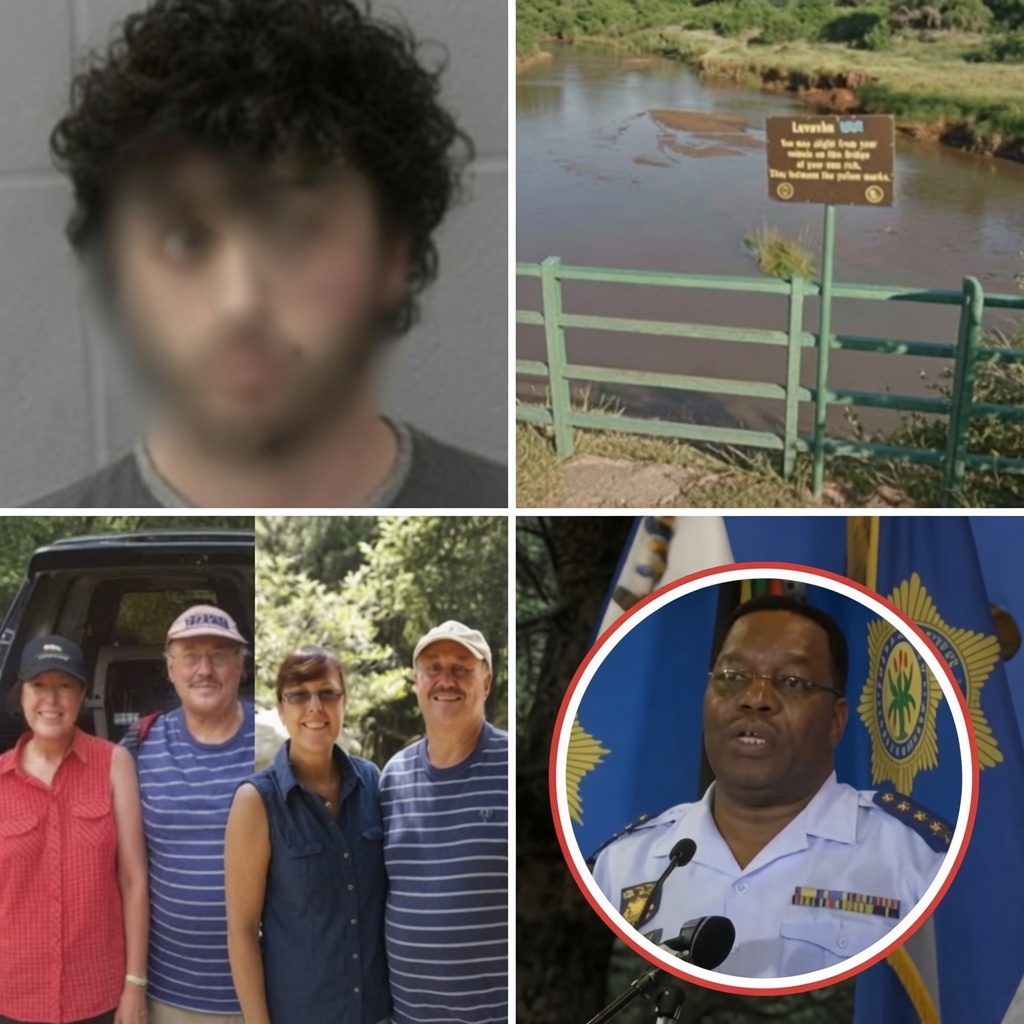
The sun sets over the Kruger National Park with a silence that is usually profound, a stillness that suggests the raw, untamed majesty of the African wilderness. For decades, it has been a sanctuary for those seeking to reconnect with the natural world—a place where the cycle of life and death plays out in its most primal, beautiful form. But for the family of Ernst and Dina Marais, that silence has been shattered by a violence that did not come from the bush, but from within their own kin.
In a development that has sent shockwaves across South Africa and beyond, the investigation into the brutal murder of the Marais couple has taken a devastating, tectonic shift. Authorities have confirmed that the investigation, which began as a hunt for faceless poachers or opportunistic criminals, has now pivoted toward a much more intimate, and perhaps more horrifying, reality. The couple’s own son, long considered a grieving survivor in the eyes of the public, has been detained by law enforcement as the investigation’s primary focus.
For those who have followed the “Kruger Horror” since the bodies were discovered during their final safari journey, this is not merely a legal update. It is a fundamental shattering of the narrative—a transition from a tragedy of circumstance to a tragedy of betrayal.
The Tragedy at the Park
To understand the magnitude of this week’s developments, one must revisit the sheer brutality of the original crime. Ernst and Dina Marais were not merely tourists; they were seasoned safari-goers, familiar with the dangers and the rhythms of the Kruger. Their disappearance, and subsequent discovery, sparked a frantic, nationwide effort that gripped the media for weeks.
When their vehicle was found, abandoned and vandalized in a remote sector of the park, the initial assessment was that they had fallen victim to a high-risk criminal element—perhaps poachers who feared witnesses, or a gang operating outside the park’s perimeter. The scene was chaotic. There were no signs of a struggle that suggested a random carjacking; instead, the precision of the violence suggested something more targeted, more personal.
As police forensic units swept the area, they were met with an eerie lack of evidence—no DNA, no footprints, no stray casings. It was as if the attackers knew exactly how to evade the sophisticated surveillance systems that define modern park security. For weeks, lead investigators searched for a motive. Why were the Marais couple, people of relative anonymity and quiet lives, singled out for such an execution-style end?
The Pivot: A Son in the Crosshairs
The investigation’s trajectory changed permanently this past Tuesday. Sources close to the police operation have revealed that a breakthrough came not from the bush, but from the digital ether—the analysis of financial records, communication logs, and internal family disputes that had previously been dismissed as irrelevant.
The focus, according to senior investigators, tightened around the couple’s son, whose identity has been withheld pending formal charges, but who has been the subject of intensive, round-the-clock questioning. The decision to detain him was described by one official as “the most difficult and, simultaneously, the most necessary step taken in the history of this inquiry.”
The detention was not a result of a singular “smoking gun,” but rather the culmination of an expanding web of evidence that allegedly links the son to individuals who, until now, had been considered peripheral or entirely unconnected to the case.
The Disturbing Development: A Question of Motive
What surfaced during the first forty-eight hours of intense interrogation has reportedly stunned even the most veteran investigators. We are accustomed to motives in high-profile crimes: money, revenge, political tension. But the information leaking from the closed-door proceedings suggests a motive that is far more complex and, frankly, chilling.
Preliminary reports indicate that the target was not the “tourist experience” of the Marais couple, but something deeply rooted in their personal legacy. Investigators are now exploring claims that the couple’s safari journey was not a spontaneous holiday, but an event that had been carefully monitored.
The “disturbing development” mentioned by law enforcement relates to the nature of the couple’s financial estate and the pressure that had been mounting regarding their family’s holdings. It is alleged that the motive was not simply inheritance, but a preemptive strike to cover up a trail of financial instability that threatened the son’s standing and future.
“We are looking at a level of premeditation that is frankly difficult to comprehend,” one source close to the investigation said. “When you investigate a crime, you look for the ‘who.’ But in this case, the ‘why’ is what will haunt the jury. It changes the nature of the crime from an act of malice to an act of calculated erasure.”
The “Tiger Factor”: A Comparison
In the broader context of high-profile crimes, investigators are drawing uncomfortable parallels. Just as in the most complex, high-stakes investigations, the Marais case is becoming a study in the “insider” dynamic. When the perpetrators are known to the victims—when they have access to the victims’ schedules, habits, and deepest vulnerabilities—the investigation becomes exponentially more difficult.
The “Tiger Factor”—a term coined by investigators to describe the sheer, shocking audacity of a crime committed by someone the victims trusted—is now the centerpiece of the prosecution’s theory. The couple was not singled out by chance; they were, it is alleged, steered into a “kill zone” that was effectively a cage of their own making.
The Public and Psychological Fallout
The public reaction to the news has been one of collective grief and disbelief. In a country where the Kruger National Park is a symbol of national pride, the idea that it could be used as a backdrop for a familial execution is a profound violation of the sanctity of the space.
Sociologists and criminal psychologists are already weighing in, noting that crimes of this nature leave a particular kind of scar on the public psyche. Unlike random violence, which we can fear but partially rationalize as “bad luck,” this type of betrayal strikes at the foundation of the family unit.
“If the allegations are true,” says Dr. Aris Thorne, a forensic analyst, “we are looking at a classic case of cognitive dissonance in the public consciousness. We want to believe that the predator is a stranger in the dark. We do not want to believe that the danger was sitting at the dinner table. It forces everyone to re-evaluate their own relationships, their own sense of safety.”
A Legal Mountain to Climb
As the authorities prepare their case, the road ahead is fraught with legal complexity. The son’s legal team has maintained his innocence, labeling the detention a result of “desperate investigative overreach” and citing a lack of direct physical evidence.
The prosecution, however, appears to be betting on the cumulative weight of the digital trail—the text messages, the encrypted communications, and the financial anomalies that, when taken together, paint a narrative of intent that is difficult to ignore.
The coming weeks will be critical. The investigation is expected to expand, likely looking into the financial ties that may have motivated the alleged accomplices. The courtrooms will be a theater of scrutiny, and for the family and friends who have been mourning the loss of Ernst and Dina, the trial promises to be an agonizingly public reopening of their wounds.
The Echoes of a Silent Savanna
As this story continues to develop, the tragedy of the Marais family serves as a somber reminder of the limitations of justice. Even if a conviction is secured, even if the motive is fully uncovered, the silence that now surrounds the Marais name is permanent.
The Kruger National Park will reopen its gates. The tourists will return to witness the lions, the elephants, and the quiet, rhythmic beauty of the dawn. But for those who know the truth of what transpired on that safari, the landscape will never be the same.
The “Kruger Horror” is no longer just a crime story; it is a profound testament to the darkness that can exist within the human heart—a reminder that sometimes, the most dangerous animal in the wild is the one that smiles at you across the breakfast table.
As the authorities tighten their grip on the final pieces of this devastating puzzle, one thing is clear: the final chapter of the Marais tragedy is far from written. It is, perhaps, only now beginning.