
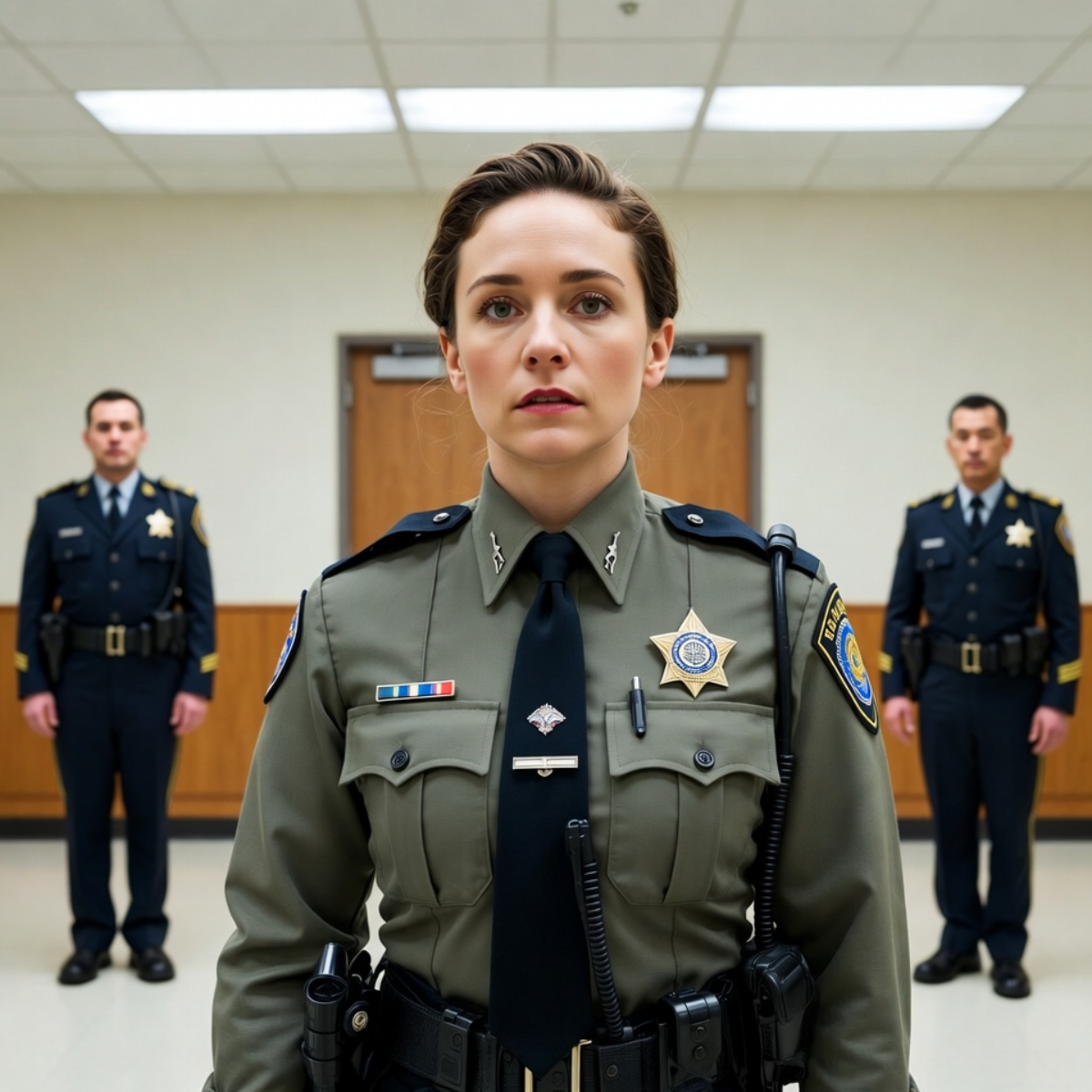
“Aw, look,” my dad snorted, the sound echoing off the high, water-stained ceiling of the county courthouse. He didn’t bother to whisper. He wanted the gallery to hear. He wanted the court reporter to hear. “She finally showed up in a costume.”
My mom, Elaine, didn’t look embarrassed. She never did. Shame was an emotion reserved for people who couldn’t afford to buy their way out of it. She just offered that tight, pinched smile she usually reserved for stray dogs that wandered too close to her manicured azaleas.
“At least she’s clean, Grant,” she murmured, loud enough to carry. “Though I suppose we’ll be paying for the dry cleaning eventually.”
I kept my face blank. Stone. Granite. That’s what training does to you. It turns your nervous system into a circuit board that you can switch off at will.
But inside?
Inside, something old, ugly, and jagged cracked wide open. It was the part of me that was still twelve years old, waiting on the front porch for a birthday party they forgot to attend because a golf tournament ran late.
The courthouse smelled like cheap coffee, lemon floor cleaner, and the distinct, dusty scent of desperation. It was the smell of people trying to scrub the truth right out of the tiles.
People whispered behind manila folders. A young couple in the back row argued under their breath about custody schedules. A kid kicked the metal bench, the rhythmic clang-clang-clang sounding like a countdown.
Then I pushed through the heavy oak swinging doors.
And the room changed.
It wasn’t because I was loud. I didn’t stomp. It wasn’t because I was dramatic. I didn’t slam the doors. It was because the uniform makes people look twice… once they realize it isn’t a game.
My boots hit the polished terrazzo floor—sharp, steady, rhythmic.
Clack. Clack. Clack.
I felt every eye slide over me like a TSA scanner. Down to the knife-edge crease of my trousers. Up to the heavy rack of ribbons stacked like a colorful brick wall on my chest. To the Combat Infantryman Badge. To the silver bars on my collar. To the stiff set of my shoulders that wasn’t posture; it was survival.
My dad’s chuckle died halfway through his throat. He choked on it. He didn’t know what he was looking at. To Grant Holloway, the military was something poor kids did to pay for college, or something delinquents did to avoid jail. He didn’t know the language of the cloth.
He only knew it wasn’t the failure he’d been telling his golfing buddies about for the last decade.
My mom’s pearls clicked softly as she turned her head. She always wore pearls when she wanted to feel superior. They were her armor. She touched them now, her fingers fluttering nervously, though she tried to hide it.
I didn’t look at them yet. I refused to give them that satisfaction.
I looked straight ahead.
Because the last time I looked at my father when he was disappointed in me, I was nineteen, standing in the kitchen with a duffel bag packed, my eyes red from crying.
He’d said, “So you’re gonna go play hero and come crawling back when you realize you’re not built for it. You’re soft, Riley. You always have been.”
My mother had added, her voice soft and surgical, slicing right between the ribs, “Don’t embarrass us. If you wash out, don’t call home.”
Like my life belonged to their reputation. Like my breath was something I leased from them.
Now?
Now I was walking into a courtroom where they were trying to take the only thing that had ever been mine.
Again.
The Honorable Judge Harlan Vance was halfway into his high-backed leather chair when he saw me. He was an older man, balding, with the kind of face that looked like it had been carved out of oak and left in the sun too long.
I watched his whole face lock up.
Not confusion. Not irritation. Recognition.
His eyes caught on my chest. Specifically, they caught on the blue ribbon with the white stars at the top of the stack. His throat bobbed like he swallowed a piece of glass. His hand gripped the edge of the bench so hard his knuckles turned the color of parchment.
The entire room went quieter, like somebody turned down the volume on reality. The ambient hum of the air conditioner seemed to vanish.
“My… God,” he whispered.
He didn’t even mean to say it out loud. The microphone on his bench picked it up, amplifying the tremor in his voice.
He stared at me like he’d just seen a ghost walk in wearing government-issue fabric.
“Is that really… you?”
Just like that, the man with the power to decide my financial future sounded like he couldn’t believe the room was big enough to hold me.
My father sat up straighter, his neck reddening. He hated being ignored. He hated confusion. My mother blinked rapidly like she’d missed a page in the script.
For the first time in my life, they didn’t know what to say.
And I didn’t give them anything. I didn’t salute. I didn’t smirk. I just walked.
My left knee ached. It always did when the air got thick and heavy. Alabama humidity turns old shrapnel injuries into a barometer. But my stride didn’t show it. Years of learning how to move through pain like it’s just background noise—like traffic or wind—will do that to you.
Left. Right. Left.
Like a metronome. Like a promise.
I reached the defense table and stopped. I placed my cover—my hat—on the table with precise, practiced movement.
My father leaned toward his high-priced attorney, a man named Sterling who looked like he slept in a tanning bed. Grant whispered loud enough that I caught the end of it.
“This is ridiculous. She thinks she can intimidate us with a Halloween costume. Tell the judge to make her take that off.”
He didn’t finish.
Judge Vance’s voice cut through the room like a KA-BAR blade.
“Mr. and Mrs. Holloway.”
The tone wasn’t warm. It wasn’t the “good ol’ boy” tone my father was used to hearing at the rotary club. It was cold. It was steel.
He looked right at me again, his eyes glossy. And then he looked back at my parents with an expression that bordered on disgust.
“Before we proceed,” the Judge said slowly, “I need to ask… do you have any idea who you’ve dragged into my courtroom today?”
CHAPTER TWO: THE SUMMONS
Two days earlier, the world had been smaller. Simpler.
I’d been in my tiny rental on the edge of Harborview, Alabama. It was the kind of neighborhood where everybody’s porch light is slightly crooked, and you learn which dogs bark but don’t bite. It was the kind of place my parents wouldn’t drive through without locking their doors.
I’d been outside in a faded gray work shirt and sun-bleached jeans, scraping weeds out of a sad little flower bed that I kept pretending I could bring back to life.
The heat was nasty—a wet, suffocating blanket that sticks to your skin like a bad memory. Somebody down the block was blasting old Waylon Jennings. A chain-link gate squealed every time a neighbor came and went.
My mutt, Diesel—half German Shepherd, half “found on the side of I-65”—was sprawled on the concrete porch like a tired bouncer. He watched me with one amber eye open, panting in the heat.
I barely noticed the mail van until it rolled past too slow. The driver honked once, more of a warning than a greeting.
By the time I got to the mailbox, sweat had dried in salty streaks down my neck. I wiped my forehead with the back of a dirt-stained glove and flipped through the usual junk.
A bright postcard trying to sell me a timeshare in Florida. A final notice for a gym membership I canceled three years ago. A flyer for a pizza place that had burned down last month.
Then I saw it.
A thick envelope. Not white—almost ivory. Textured. Heavy. It looked like the kind of paper rich people use to wrap cruelty in respectability.
There was a raised seal stamped on the back. County Court.
My stomach dropped so fast I swear I felt it in the soles of my boots. That feeling—the adrenaline dump—was familiar. It was the feeling of a patrol going wrong. The feeling of silence before the explosion.
I’d seen that seal before. On my grandmother’s deed. On tax papers. On the letter that showed up right after Nana Rose’s funeral, the one that said the little place out on Cypress Hollow Lane—her land, her tired little farmhouse and the forty acres of timber behind it—was left to me.
Not my parents. Me.
Because Nana Rose had watched them treat me like a mistake for thirty years. Because she’d seen who showed up to fix her roof when it leaked. She saw who drove her to chemotherapy when Grant and Elaine were “too busy with the gala.”
I stood there in the heat with Diesel’s ears perked up. He let out a low “wuff,” sensing the shift in my pheromones. He knew this envelope was a threat.
I told myself to breathe. In for four, hold for four, out for four. I told myself it could be nothing. I told myself a lot of lies.
Then I tore it open with my thumb.
Case No. 9176D. Holloway v. Holloway. Petition for Property Division and Annulment of Testamentary Gift. Plaintiffs: Grant Holloway and Elaine Holloway. Defendant: Riley Holloway.
My eyes reread it so many times the words started to swim.
Plaintiffs. My parents. Defendant. Me.
I actually laughed once, sharp and ugly, startling a crow off the powerline above me. What else do you do when your own blood tries to legally strip you?
Diesel trotted down the steps and leaned his weight against my leg. “We got a problem, Boss?”
“Yeah, buddy,” I whispered, scratching behind his ears. “We got a problem.”
It wasn’t just land. It was the last thing my grandmother had ever protected for me. It was the only place on earth where I didn’t have to look over my shoulder.
The petition was full of legal language dressed up like it wasn’t personal.
“Improper transfer.” “Undue influence.” “Incapacity.”
They were claiming Nana Rose was senile. They were claiming I had manipulated a confused old woman into cutting out her only son. They were rewriting history to fit their greed.
And the part that made my hands go cold? The part that made the scar tissue on my shoulder ache?
They weren’t just asking the court to review it. They were demanding immediate injunctions. They wanted me off the property. They wanted to sell it to a developer who planned to turn Cypress Hollow into a strip mall and condos.
I went inside, sat at my tiny kitchen table, and spread the pages out like a tactical map.
The air conditioner rattled, working overtime to keep my life from boiling over. My fingers shook—just a tremor—when I scrolled my phone.
I had numbers I could call. I had a buddy in the Pentagon who owed me his life. I had a JAG officer in D.C. who would fly down here on a red-eye if I asked.
But I didn’t want to call in favors. I didn’t want to hide behind the brass.
I wanted justice. I wanted my parents to finally, finally understand that I wasn’t the weak link in their story. I was the steel reinforcement they never bothered to notice.
The court date was in forty-eight hours. And when I read the last line—“Appearance required”—my jaw clenched so hard a molar cracked.
They expected me to show up in my work boots. They expected me to stutter. They expected me to fold, to apologize, to take a settlement check and disappear back into the shadows.
I stared at the paper until the edges curled under my damp hands.
Then I stood up. I walked past the kitchen, down the narrow hallway, to the back of my closet. I pushed aside the flannel shirts and the denim jackets. I reached for the black garment bag in the back. The one I rarely touch. The one that still smells like starch, brass polish, and memory.
I unzipped it slowly. The dark blue fabric caught the light. The gold braid shone.
If they wanted a war, I would bring them the whole damn army.
CHAPTER THREE: THE BLACK SHEEP
To understand why my parents were suing me, you have to understand the Holloway name. In our town, “Holloway” meant old money. It meant the bank on Main Street. It meant the wing of the hospital named after my grandfather.
It meant perfection.
And then there was me.
I was the daughter who climbed trees instead of attending ballet. I was the teenager who got into fights defending the weird kids. I was the college dropout who left a full-ride scholarship to State University because I couldn’t breathe in the classrooms.
I enlisted two weeks after my nineteenth birthday.
My mother told the neighbors I was “taking a gap year to find myself in Europe.” She lied. I was in Fort Benning, crawling through mud under razor wire, learning how to kill things that wanted to kill me.
For twelve years, I missed Christmases. I missed birthdays. When I did come home, I was different. Quieter. Jumpier. My parents didn’t ask where I had been. They didn’t ask about the deployments. They only saw that I didn’t have a corporate job, a husband, or a country club membership.
To them, I was a drifter. A failure.
When Nana Rose died three months ago, the funeral was a pageant. My mother wore a hat that cost more than my truck. My father shook hands like he was running for mayor.
I stood in the back, wearing a simple black suit. I didn’t wear my uniform then. It wasn’t about me. It was about her.
But when the will was read, the mask slipped.
Nana Rose left the bulk of the estate—the stocks, the bonds, the big house in town—to Grant. But she left Cypress Hollow—her sanctuary—to me.
“To my granddaughter, Riley,” the will had read. “Because she is the only one who knows the value of dirt, and the only one brave enough to stand her ground.”
My father had turned purple. My mother had actually gasped. They didn’t care about the sentiment. They cared that Cypress Hollow sat on forty acres of prime real estate that a developer from Atlanta was offering three million dollars for.
They tried to bully me into selling the week after the funeral. “It’s for your own good, Riley,” my dad had said, swirling his scotch. “You can’t maintain that place. You have no income. You’re… unstable.”
I had just looked at him. “I’m keeping it.”
“Don’t be stupid,” he snapped. “We’re trying to help you. You’re going to run it into the ground, just like you ran your life into the ground.”
I walked out that day. And two days later, they filed the lawsuit.
CHAPTER FOUR: THE WITNESS STAND
Back in the courtroom, the silence was still ringing in my ears.
Judge Vance was staring at my parents. He took off his glasses and rubbed the bridge of his nose, as if trying to clear a headache that had suddenly onset.
“Mr. Sterling,” the Judge said to my parents’ lawyer. “You may begin your opening statement. But I advise you… tread carefully.”
Sterling, slick and oblivious, stood up. He buttoned his expensive Italian suit jacket. He didn’t look at me. He looked at the gallery.
“Your Honor,” Sterling began, his voice smooth as oil. “We are here today to rectify a mistake. A tragic mistake made by a woman in mental decline. Rose Holloway was a pillar of this community. But in her final years, she was vulnerable. Vulnerable to… undue influence.”
He gestured vaguely in my direction without making eye contact.
“The Defendant, Riley Holloway, has a history of instability. She has no steady employment history. She disappears for months, sometimes years, at a time. She lives in a rental property in a low-income area. She has no spouse, no children, no roots. She took advantage of her grandmother’s dementia to secure a property she has neither the means nor the mental capacity to manage.”
My mother nodded solemnly from the table, dabbing at a dry eye with a lace handkerchief.
“We simply ask,” Sterling concluded, “that the court return the asset to the rightful stewards of the family legacy, Grant and Elaine Holloway, who can ensure it is… properly developed.”
Judge Vance looked at me. “Ms. Holloway. You are representing yourself?”
I stood up. The medals on my chest chimed softly. “Yes, Your Honor.”
“Do you have an opening statement?”
“I do.”
I walked to the center of the room. I didn’t pace. I planted my feet. Shoulders back. Chin up.
“My grandmother wasn’t senile,” I said. My voice wasn’t loud, but it carried to the back of the room. It was the voice I used to brief teams before a night raid. “She was the sharpest person in this family. She knew exactly who she was leaving her home to. And as for my ‘instability’…”
I turned to my parents.
“My ‘disappearances’ were not vacations. And my lack of a corporate title is not a lack of employment.”
Sterling jumped up. “Objection! Relevance? The Defendant is trying to grandstand.”
“Overruled,” Vance barked. He leaned forward. “I want to hear this.”
Sterling called my father to the stand first.
Grant Holloway sat there, looking like the victim. He spun a tale of a wayward daughter, a “troubled soul” who couldn’t hold down a job, who mooched off her grandmother.
“It breaks my heart,” my dad said, looking at the jury box—even though there was no jury, just the Judge. “Riley has always been… broken. We just want to make sure the property isn’t squandered. She has no concept of responsibility. She’s never held a leadership role in her life.”
I saw Judge Vance’s eyebrows shoot up into his hairline.
When it was my turn to cross-examine, I walked up to the witness stand. My father looked down at me, sneering slightly at the uniform.
“Mr. Holloway,” I said. “You stated I have no employment history.”
“That’s right. You do odd jobs. Landscaping. Bartending.”
“And you stated I disappear for long periods.”
“Years. You ran off when you were nineteen.”
“Did you ever ask where I went?”
My father scoffed. “We assumed you were backpacking. Or in rehab.”
A ripple of laughter went through the back of the room. My mother smirked.
I reached into the folder on the defense table. I pulled out a single sheet of paper. It was a redacted service record.
“Your Honor, I’d like to submit Defense Exhibit A.”
I handed it to the bailiff, who handed it to the Judge. Vance looked at it. He nodded slowly.
“Mr. Holloway,” I continued, turning back to my father. “Are you aware that from 2012 to 2016, I was not ‘backpacking,’ but deployed to the Kunar Province of Afghanistan?”
My father blinked. “I… what?”
“Are you aware,” I pressed, stepping closer, “that the ‘odd jobs’ I do now are because I am medically retired? Do you know why I am medically retired?”
“I don’t see how this matters,” he spluttered.
“Answer the question!” I barked. The command voice slipped out. My father actually flinched back in his seat.
“No,” he whispered. “I don’t.”
“I am retired because I took a sniper round to the shoulder and shrapnel to the knee while pulling three men out of a burning Humvee in Syria. Men who are alive today because I didn’t ‘wash out.’”
The courtroom was dead silent. My mother had stopped fanning herself.
“You claim I have no leadership experience,” I said, my voice dropping to a dangerous calm. “You claim I am not ‘family business material.’”
I pointed to the silver star at the top of my rack.
“That is a Silver Star. Do you know what you have to do to get one of those, Dad?”
He stared at it, his mouth opening and closing like a fish.
“You have to lead. You have to make choices that cost blood. You have to be responsible for lives, not just stock portfolios.”
I turned to the Judge. “No further questions.”
CHAPTER FIVE: THE JUDGE’S SALUTE
My parents looked shell-shocked. Sterling was frantically shuffling papers, trying to regain control of the narrative.
“Your Honor,” Sterling stammered. “While the Defendant’s… service… is commendable, it doesn’t prove she is mentally competent to manage a three-million-dollar estate. In fact, PTSD would suggest she is less capable.”
That was the wrong thing to say.
Judge Vance stood up. He didn’t just stand; he rose like a thunderhead.
“Mr. Sterling,” Vance said, his voice shaking with suppressed rage. “Sit. Down.”
Sterling sat.
The Judge looked at me. His eyes were wet.
“Sergeant First Class Holloway,” he said.
My parents looked at each other. They had never heard my rank before.
“I was a JAG officer in the Marines for twenty years,” Vance said to the room. “I know what a Silver Star means. I know what a Purple Heart with an Oak Leaf Cluster means.”
He pointed a finger at my father.
“You come into my courtroom,” Vance said, his voice booming now, “and you tell me that a woman who has achieved the rank of Sergeant First Class in Special Operations Support is ‘unstable’? You tell me that a woman who has likely seen more responsibility in a single afternoon than you have seen in your entire life is ‘incapable’?”
My father shrank into his suit. “We… we didn’t know.”
“You didn’t ask!” Vance roared. “You were too busy judging the book by its cover to read the damn pages!”
The Judge took a deep breath. He looked at the file in front of him—the lawsuit.
“This petition alleges undue influence. It alleges that Rose Holloway was manipulated.”
Vance picked up the file. He held it up for everyone to see.
“I knew Rose,” Vance said quietly. “She was a sharp woman. And she told me, explicitly, why she changed her will.”
My mother gasped. “You… you knew?”
“She came to me six months ago,” Vance said. “She told me that her son and daughter-in-law were vultures waiting for her to die.”
The color drained from my mother’s face. It was almost impressive how fast she went pale.
“She told me,” Vance continued, looking at me with a softness I hadn’t expected, “that her granddaughter was the only one who never asked her for a dime. The only one who sent her letters from halfway across the world, describing the stars instead of complaining about the food. She told me she was leaving the land to you, Riley, because you were the only one strong enough to keep it.”
Vance dropped the file on his desk. It landed with a heavy thud.
“The petition is denied. With prejudice. That means don’t you dare bring this garbage into a courtroom ever again.”
He wasn’t done.
“Furthermore,” Vance said, glaring at Sterling, “I am ordering the Plaintiffs to pay all legal fees incurred by the estate. And I am ordering a forensic audit of the Holloway Family Trust to ensure you haven’t been dipping into funds that weren’t yours before Rose passed.”
My father looked like he was having a stroke. My mother looked like she was going to faint.
“Case dismissed,” Vance said.
He stepped down from the bench. Usually, the judge leaves through a back door. Not today.
Judge Vance walked around the bench. He walked past the stunned bailiff. He walked right up to the defense table where I was standing.
The room held its breath.
The Judge, a man of sixty, stood tall. He looked me in the eye. And then, slowly, crisply, he raised his right hand to his brow.
He saluted me.
It wasn’t a casual gesture. It was a sign of supreme respect. One warrior acknowledging another.
I snapped to attention. My heels clicked. I returned the salute, holding it until he dropped his hand.
“Welcome home, Sergeant,” he whispered.
“Thank you, Sir,” I managed to say, my throat tight.
CHAPTER SIX: THE DEPARTURE
The walk out of the courtroom was different than the walk in.
Nobody whispered. The couple in the back had stopped arguing. The kid had stopped kicking the bench. They watched me with wide eyes. Not with judgment. With awe.
I picked up my cover and tucked it under my arm.
My parents were still sitting at the plaintiff’s table. They looked small. Deflated. The air of superiority that had surrounded them for decades had popped like a cheap balloon.
My father looked up as I passed. “Riley,” he croaked. “I… we really didn’t know.”
I stopped. I looked down at him. “I know you didn’t,” I said. “That’s the problem.”
My mother reached out a hand, her fingers trembling. “Riley, wait. The audit… if they look at the books… we could lose the house. We could lose everything.”
She was asking for help. She was asking me to intervene. To save them.
I looked at her pearls. I looked at her expensive shoes. And then I thought about Nana Rose, alone in that big house while they went to parties. I thought about the nineteen-year-old girl they kicked out.
“You’re resilient,” I said, echoing the words they had used on me so many times. “You’ll figure it out. If not… well, I hear the landscaping crews are hiring.”
I turned my back on them.
I pushed through the heavy oak doors, out into the hallway, and then out into the blinding Alabama sun.
The heat hit me, but it felt different now. It didn’t feel heavy. It felt like a warm embrace.
I walked down the steps to the parking lot. My old truck was waiting. Diesel was in the passenger seat, his nose pressed against the glass, tail wagging.
I took off my dress jacket, folding it carefully over the seat. I loosened my tie. I took a deep breath of the humid air.
I had a farm to run. I had flowers to plant. And for the first time in a long time, the war was over.
[THE END]