
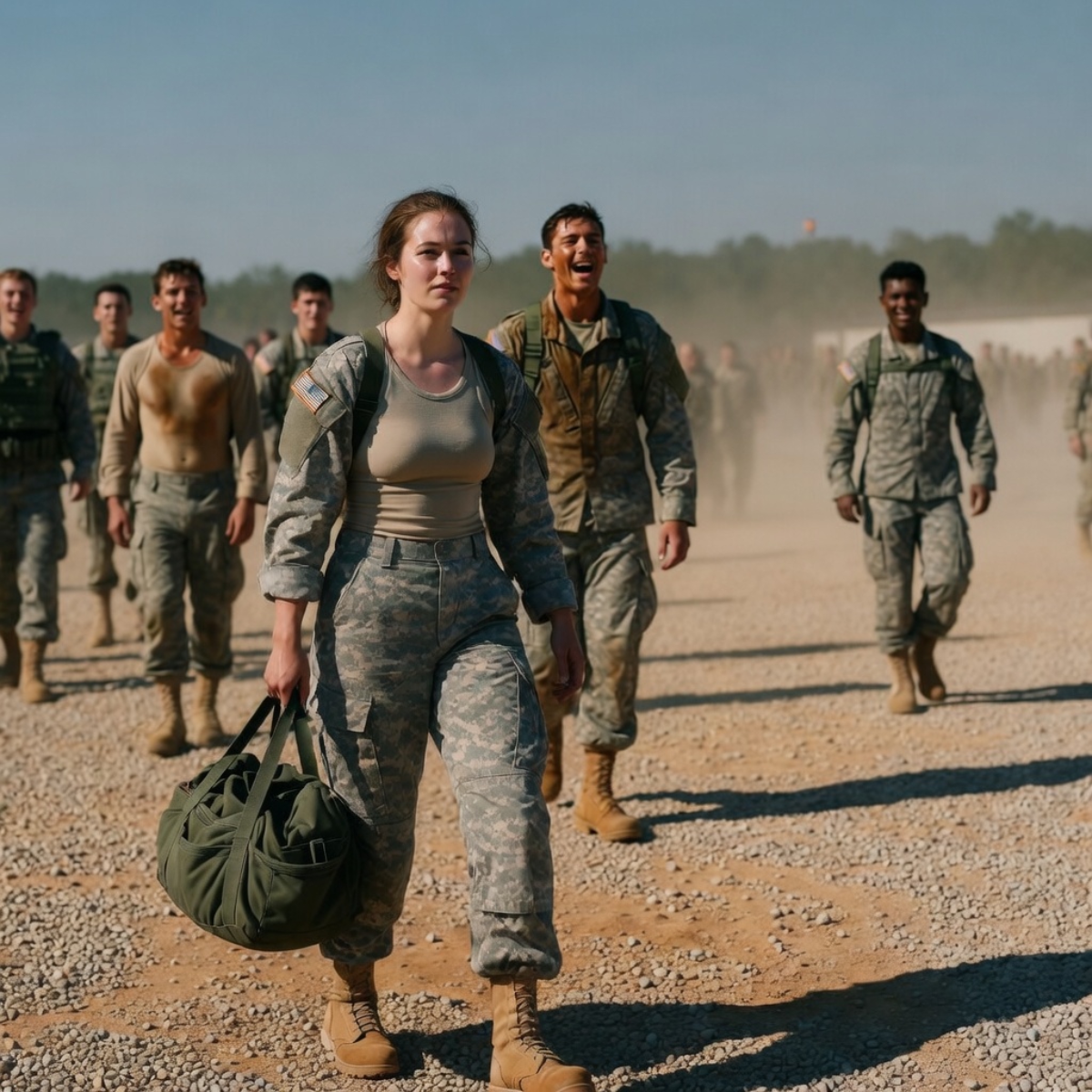
The dust of the North Carolina afternoon was still settling when I walked onto the main training yard.
Long shadows stretched across the military base, painting dark lines over the gravel.
It was my first day at this specific facility, but it was far from my first day in the dirt.
I was wearing standard issue fatigues. Unmarked. Unassuming.
I kept my head straight, my duffel bag slung over my shoulder, minding my own business.
I was here for a specific reason. A highly classified reason that nobody in the regular infantry needed to know about.
But of course, when you’re a twenty-something woman walking onto a heavily male-dominated proving ground, you don’t get to just blend in.
I saw them before they saw me. A group of about twelve guys from the 82nd Airborne, fresh off a drill, covered in sweat and full of that raw, unfiltered adrenaline.
They were loud. Boisterous. Showing off for each other.
Then, one of them caught sight of me.
His name tag read ‘Miller’. He was built like a brick wall, tall, broad, with a buzz cut and a sneer that told me he thought he owned the place.
He nudged the guy next to him. Then he pointed.
Within seconds, the entire group was staring at me.
“Hey! Are you lost?” Miller called out, his voice booming across the quiet yard.
I didn’t answer. I just kept walking toward the command center.
“I said, are you lost?” he yelled louder, stepping into my path.
The rest of his squad followed his lead, fanning out slightly so that they were blocking my way.
I stopped. I looked at Miller.
“No,” I said quietly. “I’m exactly where I need to be.”
That was all it took. The group erupted into laughter.
It wasn’t a friendly chuckle. It was the kind of deep, mocking laughter meant to make you feel small.
They looked at my size. They looked at my unmarked uniform. They made their assumptions.
“Look at her,” one of the guys in the back wheezed, wiping a tear from his eye. “She thinks she’s deploying.”
Miller took a step closer to me. He looked down, a condescending smirk plastered across his face.
“Listen, sweetheart,” Miller said, his tone dripping with fake sympathy. “The administrative offices are back that way. This is the training yard. People actually get hurt out here.”
I shifted my duffel bag on my shoulder. The heavy canvas strap dug into my collarbone, right over the hidden velcro patch on my uniform jacket.
“I’m aware of what a training yard is,” I replied, my voice steady.
More laughter. Loud, echoing, obnoxious.
“She’s feisty,” another soldier chimed in.
Miller shook his head, looking at me like I was a stubborn child.
“Go home, princess,” he said, the amusement fading into genuine irritation. “You’re holding up traffic. The real soldiers have work to do.”
I stood there for a moment.
I looked at Miller. I looked at the men laughing behind him.
I could have just walked around them. I could have gone to the command center, flashed my credentials to the base commander, and let it go.
But I was tired. I was jet-lagged. And I really, really hated being called a princess.
“You know,” I said, my voice dropping an octave, losing any trace of politeness. “In my experience, the guys who talk the loudest on the yard are the ones who cry the hardest in the mud.”
The laughter stopped instantly.
A tense silence fell over the group. The amusement in Miller’s eyes vanished, replaced by a flash of anger.
He stepped right up to me, invading my personal space. He towered over me.
“What did you just say to me?” he growled.
“I think you heard me, Specialist,” I said, catching a glimpse of his rank insignia.
His face turned red. “You have no idea who you’re talking to, little girl. You have no idea what we do.”
“You jump out of perfectly good airplanes and hope your parachute opens,” I said flatly. “It’s cute.”
Miller’s jaw clenched. He looked like he was about to explode.
“Who the hell are you?” he demanded. “Where is your unit? Where is your commanding officer?”
“My unit is classified,” I said softly. “And I don’t have a commanding officer on this base.”
Miller scoffed, a harsh, ugly sound. “Classified? Yeah, right. You’re probably a supply clerk who got lost looking for the mess hall.”
He reached out, as if to grab my shoulder and physically turn me around.
That was his first mistake.
Before his hand could even make contact, I shifted my weight, dropped my shoulder, and stepped inside his guard.
I didn’t strike him. I didn’t need to.
Instead, I reached up with my left hand, grabbed the heavy canvas flap that was secured tightly over my right shoulder, and ripped it back in one swift motion.
The harsh afternoon sunlight caught the intricate, gold-threaded embroidery on the black patch.
The eagle. The anchor. The trident.
And right below it, the undeniable, heavy weight of four stars.
It was an insignia that technically didn’t exist in the public military database. An insignia that only a handful of people in the entire armed forces had ever seen in person.
I watched Miller’s eyes track down to my shoulder.
I watched the exact moment his brain registered what he was looking at.
The blood drained from his face so fast he looked physically ill.
Chapter 2: The Sound of Silence
The silence that followed the tearing of that Velcro flap was more than just a lack of noise. It was a physical weight. It was the kind of silence that happens right before a massive explosion, or the second after a car crash when the world hasn’t figured out it’s supposed to be screaming yet.
Miller’s hand was still hanging in the air, frozen inches from my shoulder. His fingers were slightly curled, as if he’d been intending to shove me aside like a bothersome piece of luggage. Now, those fingers were trembling. Not a lot—he was an Airborne Ranger, after all—but enough that I could see the vibration.
His eyes were locked on the patch. The gold of the Trident shimmered, even in the dusty, filtered light of the North Carolina afternoon. But it wasn’t just the Trident. It was the four silver stars pinned beneath it.
Four stars. A full General. In the Navy, they’d call me an Admiral, but in the joint-task world of Tier 1 Special Operations, where I spent ninety percent of my life, I wore the stars of a General. And I wasn’t just any General. I was the ghost. The one the Pentagon didn’t talk about.
“Sir—” Miller started, his voice cracking. He caught himself immediately, his face flushing a deeper, more embarrassed shade of purple. “I mean… Ma’am… General… I…”
He didn’t know what to do with his hand. He eventually pulled it back as if the air around me had suddenly turned into a thousand-degree furnace. He snapped to attention so hard I thought I heard his heels click like a gunshot.
The guys behind him followed suit. It was like watching a row of dominos fall in reverse. One by one, the cocky, laughing soldiers turned into rigid statues of salt. The guy who had been wiping a tear from his eye now looked like he was trying to vibrate out of his own skin.
“At ease,” I said. My voice wasn’t loud. I didn’t need to yell. When you carry that much weight on your shoulders, you can whisper and people will still hear you in the next county.
None of them moved. They were too terrified to be ‘at ease.’
“I said, at ease,” I repeated, a bit sharper this time.
Miller slowly let his arms drop to his sides, but his chest was still puffed out so far he looked like a pigeon. He wouldn’t look me in the eye. He was staring at a point exactly six inches above my head, his jaw clenched so tight I could see the muscles pulsing in his neck.
“Specialist Miller, right?” I asked, reading his name tag again.
“Yes, General!” he barked.
“You were telling me to go home, Specialist. You were calling me ‘Princess.’ You seemed very concerned about my safety on this training yard.”
I took a slow step toward him. I’m five-foot-six. He was at least six-foot-three. But in that moment, I felt like the tallest person on the base. I walked around him, my boots crunching on the gravel, the only sound in the entire courtyard.
“Tell me, Miller,” I said, stopping behind him. “Do I look like I’m lost?”
“No, General! Deepest apologies, General! I didn’t see the—”
“You didn’t see the rank,” I finished for him. “That’s the problem, isn’t it? You only respect the rank. You don’t respect the person in the uniform unless they’re carrying enough metal to sink a boat.”
I walked back around to face him. The rest of the squad was watching out of the corners of their eyes, their faces pale. They knew they were witnessing a career-ending event. Or at least, a very, very painful afternoon.
“If I had been a private, or a civilian contractor, or a janitor, you would have been perfectly happy to keep mocking me. You would have kept calling me ‘princess’ until I felt small enough to disappear. Isn’t that right?”
Miller swallowed hard. “No, General. We were just… blowing off steam, Ma’am.”
“Blowing off steam,” I mused. “Interesting. In my unit, we blow off steam by running twenty miles with eighty-pound packs through freezing surf. We don’t do it by harassing women walking across a base.”
I leaned in closer. I could smell the stale sweat and the cheap tobacco on him. He didn’t flinch, but I could see the sweat beads forming on his forehead.
“Do you know why I’m here, Miller?”
“No, General.”
“I’m here because this base has a leak. I’m đây because someone in the 82nd thinks they’re smarter than the NSA. And I’m here because I was told the men on this base were the best of the best. The elite. The disciplined.”
I looked at the group of them.
“Right now, all I see is a bunch of schoolyard bullies who haven’t learned the first rule of warfare: never underestimate your target.”
Just then, the sound of a high-pitched engine roared from the far end of the yard. A blacked-out Chevy Suburban came tearing across the gravel, kicking up a massive cloud of dust. It screeched to a halt twenty feet away.
The doors flew open. Out stepped a man in a crisp ACU uniform with two stars on his collar. Major General Vance, the base commander. He looked like he’d just run a marathon in a suit—his face was flushed, and he was fumbling with his cover as he hurried toward us.
Behind him were four MPs, their hands hovering near their sidearms.
Vance saw me and practically skidded to a stop. He snapped a salute that was so crisp it was almost a work of art.
“General Thorne!” he shouted, his voice echoing. “I am so sorry, Ma’am! We weren’t expecting you for another hour. My deepest apologies for the lack of a proper escort.”
I didn’t salute back immediately. I let him hold it for a few seconds, letting the weight of the situation sink into the men surrounding me. If they had any doubt about whether my patch was real, seeing the base commander sweating through his shirt to greet me cleared it up.
“It’s alright, Vance,” I said, finally returning a casual salute. “I decided to walk. I wanted to see the ‘culture’ of your base firsthand.”
Vance’s eyes darted to Miller and the squad. He wasn’t an idiot. He saw the way they were standing. He saw the look on Miller’s face. He saw the uncovered patch on my shoulder.
His face went from red to a ghostly, sickly white.
“Is there a problem here, General?” Vance asked, his voice low and dangerous.
I looked at Miller. The Specialist looked like he was ready to accept a death sentence. He was waiting for me to drop the hammer. He was waiting for me to tell Vance to strip his rank and put him on latrine duty for the next decade.
I could have done it. One word from me, and Miller’s military career was over. He’d be lucky to get an honorable discharge.
I looked at the four stars on my shoulder. Then I looked at the fear in the eyes of a kid who probably hadn’t even seen his twenty-fifth birthday yet.
“No problem, Vance,” I said, my voice calm. “Specialist Miller here was just giving me directions. He was very… enthusiastic about making sure I didn’t get lost.”
Miller’s eyes widened. He flicked a glance at me, a look of pure, unadulterated shock. He knew what I’d just done. I’d given him a life jacket in the middle of a hurricane.
Vance didn’t look convinced. He looked at Miller like he wanted to throttle him. “Is that right, Specialist?”
“Yes, sir!” Miller yelled, his voice shaking. “I was just… assisting the General, sir!”
Vance turned back to me, his expression softening but still wary. “Well. My car is here. We have the briefing room secured. The representatives from the Pentagon are already waiting.”
“Lead the way, Vance,” I said.
I started toward the Suburban, but I stopped after a few steps. I turned back and looked at Miller.
“Specialist?”
“Yes, General?”
“The next time you see a ‘princess’ on your base, remember one thing.”
“What’s that, General?”
“Some princesses don’t live in castles. They live in the shadows. And they carry a much bigger sword than you do.”
I didn’t wait for a response. I climbed into the back of the Suburban, and the door clicked shut with a heavy, armored thud. As we pulled away, I looked out the tinted window.
Miller was still standing there, at a perfect salute, watching the car drive away. He didn’t move until we were out of sight.
“What did he do?” Vance asked as we sped toward the command center. “I can have him re-assigned to Alaska by dinner.”
“Forget it, Vance,” I said, leaning back into the leather seat. “He’s a good soldier. He’s just stupid. And I’ve dealt with enough stupid people in my life to know that sometimes, a good scare is better than a court-martial.”
Vance nodded, though he still looked nervous. “As you wish, Ma’am. But you have to understand… the situation here… it’s gotten complicated.”
“Complicated is why I’m here, Vance. Let’s get to the ‘Red Room’. I want to see exactly how bad this leak is.”
As the car wove through the sprawling military complex, I looked at my reflection in the dark glass. I looked young. Too young for four stars. I had the kind of face that made people think I belonged in a library or a coffee shop, not on the bridge of a carrier or in a HALO jump over hostile territory.
That had always been my greatest weapon.
In the world of special operations, being invisible is everything. If they don’t see you coming, they can’t stop you.
But today, I wasn’t just here to be invisible. I was here to be the hammer.
The leak at Fort Liberty wasn’t just some disgruntled private selling secrets for crypto. It was something much deeper. Something that touched the very heart of our domestic security.
And if I had to break a few egos like Miller’s to get to the truth, I was more than happy to do it.
The Suburban pulled up to a nondescript concrete building surrounded by three layers of razor wire. There were no signs. No windows. Just a single heavy steel door with a biometric scanner.
“We’re here,” Vance said, his voice tight.
I stepped out of the car. The heat was still oppressive, but as I walked toward the steel door, I felt a familiar coldness settling in my chest.
The ‘Princess’ was done playing nice.
It was time to go to work.
The interior of the building was a stark contrast to the dusty, chaotic training yard outside. Here, the air was chilled to a precise 65 degrees, humming with the sound of high-powered servers and the low murmur of men and women who spoke in codes and acronyms.
This was the JSOC (Joint Special Operations Command) auxiliary hub. This was where the real wars were fought—long before the first bullet was ever fired.
Vance led me through a series of checkpoints. Retinal scans, palm prints, voice recognition. By the time we reached the final door, I felt like I’d been through a digital car wash.
The “Red Room” was a large, circular chamber dominated by a massive digital map of the world. In the center was a polished mahogany table where six people were already seated.
They all stood as I entered.
There were two Colonels from Intelligence, a representative from the CIA who looked like he hadn’t slept since the 90s, and a woman in a sharp navy suit who I recognized as Sarah Jenkins from the Department of Justice.
“General Thorne,” Jenkins said, stepping forward to shake my hand. “Thank you for coming on such short notice.”
“Let’s skip the pleasantries, Sarah,” I said, taking my seat at the head of the table. “Vance tells me the leak is active. How active?”
The CIA man, whose name tag read ‘Holloway’, tapped a key on his laptop. The map on the wall shifted, zooming in on a series of coordinates in the Appalachian Mountains, not far from where we were sitting.
“Six hours ago, a high-frequency burst was detected originating from a dead-zone in the mountains,” Holloway said. “It was encrypted using a Tier 1 protocol. A protocol that only exists on three servers in the world. One of them is in this building.”
I felt a prickle of ice on the back of my neck. “You’re saying the leak isn’t just data. It’s a communication line.”
“A two-way line,” Jenkins added. “Someone on this base is talking to a Ghost Cell. And they’re not just talking. They’re coordinating.”
“Coordinating what?” I asked.
Holloway looked at the others, then back at me. “A strike, General. Within the next forty-eight hours. On American soil.”
The room went silent. The weight of the words hung in the air like smoke.
I looked at the map. The coordinates were blinking red.
“Who is the target?”
“We don’t know yet,” Vance said. “But the data bursts are referencing a ‘Project Nightingale’. We can’t find anything in the archives about it.”
I leaned back, my mind racing. Nightingale. I’d heard that name once before. Years ago. In a place I never wanted to think about again.
“It’s not in the archives because it’s a black-site project from the seventies,” I said quietly. “It was supposed to be buried.”
Everyone at the table looked at me.
“How do you know that, General?” Jenkins asked.
“Because,” I said, looking her straight in the eye, “I’m the one who buried it.”
I stood up and walked to the map. I traced the line of the mountains with my finger.
“Vance, I need a specialized team. I don’t want your regular infantry. I want the guys who can move without making a sound. The ones who don’t ask questions.”
Vance nodded. “I have a Tier 2 unit on standby. Captain Reed is—”
“No,” I interrupted. “I don’t want Reed. I saw a squad out there today. Lead by a Specialist named Miller.”
Vance blinked. “Miller? Ma’am, with all due respect, they’re 82nd. They’re good, but they’re not—”
“They’re exactly what I need,” I said. “They’re cocky, they’re loud, and they think they’ve seen it all. But more importantly, Miller owes me. And in this business, a debt is the strongest form of loyalty.”
I turned back to the group.
“Get Miller and his squad to the hangar in one hour. Tell them they’re going for a little hike.”
“And what should I tell them the mission is?” Vance asked.
I looked at the blinking red coordinates on the map.
“Tell them,” I said, “that the Princess is taking them to war.”
The hangar was a cavernous space, smelling of aviation fuel and cold metal.
Miller and his squad were there, standing in a neat line. They looked different than they had an hour ago. The cockiness was gone. In its place was a grim, nervous energy. They were wearing full combat gear, their faces streaked with cammo paint.
Miller saw me approaching and his entire body went rigid.
“General on deck!” he shouted.
The squad snapped to attention.
I walked up to Miller. I looked at his gear. His rifle was clean. His vest was tight. He was ready.
“At ease, Specialist,” I said.
They relaxed, but only slightly.
“I’m sure you’re wondering why you’re here,” I said, walking down the line. “I’m sure you’re wondering why a ‘Princess’ would choose a bunch of Airborne Rangers for a mission that technically doesn’t exist.”
I stopped in front of a young soldier with bright red hair. He looked like he was about eighteen years old.
“What’s your name, soldier?”
“PFC Henderson, Ma’am!”
“Are you afraid, Henderson?”
The kid hesitated. “A little bit, Ma’am.”
“Good,” I said. “Fear keeps you sharp. It’s the ones who aren’t afraid that I worry about. The ones who think they’re invincible.”
I looked back at Miller.
“Specialist, you’re in charge of this squad. If any of them breaks rank, if any of them makes a sound they shouldn’t, it’s on your head. Do you understand?”
“Crystal, General,” Miller said.
“We’re going into the mountains,” I said, my voice dropping. “We’re looking for a needle in a haystack. But this needle has the power to burn down half the state. We move at 0300. We don’t use lights. We don’t use radios unless it’s an emergency.”
I stepped closer to Miller, so close that only he could hear me.
“This is your chance, Miller. You wanted to see what a ‘real soldier’ does? You’re about to find out.”
Miller looked me in the eye for the first time. There was no mockery there. No condescension. Only a deep, burning respect—and a healthy amount of terror.
“I won’t let you down, General,” he whispered.
“See that you don’t,” I said. “Because if we fail, ‘Go home, princess’ is going to be the last thing any of us ever hears.”
I turned and walked toward the waiting transport helicopter. The rotors were already starting to spin, casting long, flickering shadows across the hangar floor.
The mission had begun.
And as I climbed into the cockpit, I knew one thing for certain.
By the time the sun came up, Miller and his men would never look at a woman in uniform the same way again.
And neither would the rest of the world.
The mountains were waiting. And they were hungry.
I checked my sidearm, chambered a round, and signaled the pilot.
“Let’s go,” I said.
The Black Hawk lifted off, disappearing into the dark, silent night.
The air in the cabin of the Black Hawk was thick with the smell of hydraulic fluid and the nervous sweat of the twelve men sitting across from me.
In the dim red light of the tactical lamps, their faces looked like carved stone. They were staring at their boots, at their rifles, at anything other than me.
To them, I was a ghost. A legend they’d heard stories about in the dark corners of the mess hall. The woman who had led the raid on the Somali warlord’s compound. The one who had single-handedly dismantled a sleeper cell in Chicago.
But seeing me in the flesh—seeing the four stars and the SEAL patch—it was a different reality.
Miller was sitting directly across from me. He was checking his magazine for the tenth time. His hands were steady now, but I could see the way he kept glancing at me when he thought I wasn’t looking.
I leaned forward, the noise of the rotors making conversation difficult.
“Check your seals, Miller!” I shouted over the roar. “The air is going to get thin where we’re going.”
He nodded, giving a thumbs up to his squad.
I looked out the window. The lights of Fort Liberty were fading behind us, replaced by the jagged, black silhouettes of the Appalachian range.
These mountains were old. They were full of caves, deep valleys, and secrets that had been buried for generations. It was the perfect place for someone to hide.
And the perfect place for someone to die.
“General?” Miller shouted, leaning toward me.
“Yeah?”
“Why us? I mean… there are Delta guys on base. There are Green Berets. Why did you pick a bunch of regular grunts?”
I looked at him. I looked at the raw determination in his eyes.
“Because,” I said, “Delta guys think like operators. Green Berets think like teachers. I don’t need thinkers tonight, Miller. I need hunters. I need people who are hungry to prove they belong in the room.”
I smiled, though there was no warmth in it.
“And I know you’re hungry, Specialist. You’ve been biting at the bit to prove you’re the toughest guy in the yard. Tonight, I’m giving you the chance to show me.”
Miller’s jaw set. He didn’t say anything else. He just leaned back and gripped his rifle a little tighter.
We were twenty minutes out from the drop zone.
I closed my eyes, trying to visualize the map of Project Nightingale.
It had been thirty years since the project was shut down. It was a Cold War relic—a series of underground bunkers designed to house a ‘shadow government’ in the event of a nuclear strike.
But it wasn’t just a bunker. It was a research facility. They were looking into ways to weaponize the very environment itself. Sound waves. Seismic triggers.
If someone had found a way to reactivate the tech inside Nightingale, they didn’t just have a hideout. They had a weapon that could level a city without firing a single shot.
The helicopter began to bank steeply.
“Two minutes to drop!” the pilot’s voice crackled in my headset.
I stood up, grabbing the overhead rail. The squad followed my lead, their movements synchronized and efficient.
“Fast rope!” I commanded. “Miller, you’re first out. Henderson, you’re tail. I’m in the middle.”
The side door of the Black Hawk slid open with a metallic crash. A wall of freezing mountain air rushed in, whipping our hair and stinging our eyes.
Below us was nothing but a void of black trees and jagged rocks.
“Go! Go! Go!”
Miller didn’t hesitate. He grabbed the rope and vanished into the darkness.
One by one, the soldiers followed.
When it was my turn, I took a deep breath of the cold air. I looked at the pilot, gave him a quick nod, and jumped.
The friction of the rope burned through my gloves. The ground rushed up to meet me—a blur of pine needles and granite.
I hit the ground, rolled, and was on my feet in a second, my rifle raised and scanning the perimeter.
The Black Hawk didn’t linger. It pulled up and away, its sound fading into the wind until there was nothing left but the rustle of the trees.
We were on our own.
“Status report,” I whispered into my comms.
“Squad accounted for, General,” Miller’s voice came back, crisp and low. “Perimeter secure. We’re at the base of the ridge.”
“Move out,” I said. “Single file. Maintain noise discipline.”
We began the climb.
The terrain was brutal. It wasn’t a trail; it was a vertical scramble over loose rock and tangled roots. Every step was a risk. One slip, one clatter of a stone, and we’d give away our position.
I watched the men. They were struggling, but they were pushing. Miller was at the front, setting a pace that was punishing but sustainable. He was checking his corners, watching the flanks. He was acting like a leader.
After an hour of climbing, we reached the crest of the ridge.
Below us, tucked into a deep, horseshoe-shaped valley, was a small industrial complex. It looked like an old mining operation—corrugated tin roofs, rusted machinery, and a single dirt track leading into the woods.
But through my night-vision goggles, I could see things that didn’t belong.
High-gain satellite dishes. Armed sentries in tactical gear. And a heavy steel door set into the side of the mountain that was glowing with the faint blue light of a high-end security system.
“There it is,” I whispered. “Project Nightingale.”
Miller crawled up beside me. He looked through his own optics.
“That’s a lot of heat for an old mine,” he muttered. “I count at least twenty shooters on the perimeter. And those aren’t local militia. Those guys move like professionals.”
“They are,” I said. “That’s the Ghost Cell. Former spec-ops from four different countries. They’re the best money can buy.”
Miller swallowed. “And there’s only twelve of us. Plus you, Ma’am.”
“Thirteen is a lucky number, Specialist,” I said, checking my watch. “We have three hours until dawn. We need to get inside that mountain, find the transmitter, and shut it down.”
“And the hostiles?”
“Neutralize any threat,” I said flatly. “But our priority is the tech. If that burst goes out again, we’ve lost.”
I looked at the squad. They were waiting for the word.
“Miller, take the left flank. Use the old conveyor belt for cover. Henderson, you’re with me. We’re going through the main vent.”
“Yes, General.”
“Wait for my signal,” I said. “When the lights go out, we move.”
I reached into my pack and pulled out a small, palm-sized device. It was an EMP burst-generator, a piece of tech that wasn’t supposed to exist for another ten years.
I keyed in the code and set the timer for sixty seconds.
“Get ready,” I whispered.
The countdown hit zero.
Suddenly, the valley was plunged into total, absolute darkness. The security lights flickered once and died. The hum of the generators vanished.
“Move!” I hissed.
We surged down the slope.
The ‘Princess’ was done waiting.
The hunt was on.
We hit the perimeter like a shadow.
The sentries were blinded, their high-end night-vision gear fried by the EMP pulse. I saw one of them fumbling with his goggles, his mouth open in a silent shout.
I didn’t give him a chance.
I moved with a fluid, lethal grace that comes from decades of muscle memory. Two suppressed shots. He went down before he even knew I was there.
On the left, I saw Miller’s team moving through the shadows of the conveyor belt. They were fast. Faster than I expected. Miller was leading from the front, taking down a guard with a quick, brutal knife strike.
He wasn’t the loud-mouthed kid from the training yard anymore. He was a weapon.
“Vent is clear,” Henderson whispered in my ear.
We reached the massive steel grating that led into the mountain’s interior. It was designed to withstand a bomb blast, but it wasn’t designed for a General with a blowtorch and a grudge.
I made quick work of the hinges. The metal groaned, but the sound was swallowed by the wind.
We slipped inside.
The air inside the mountain was different. It was stale. It smelled of ozone and ancient dust.
We were in a long, concrete tunnel that sloped downward. The emergency lights were dim, casting long, eerie shadows against the walls.
“Stay sharp,” I warned. “The EMP won’t have reached this deep. Their internal systems might still be up.”
As if on cue, a siren began to wail—a deep, booming sound that vibrated in my teeth.
“So much for the quiet approach,” Miller’s voice crackled in my comms. “We’ve got contact! Five hostiles in the corridor, heavy weapons!”
The sound of gunfire erupted from the lower levels. The sharp, rhythmic crack of M4s answering the heavy thud of AK-47s.
“Hold your ground, Miller!” I shouted. “Henderson, with me! We’re taking the service shaft!”
We scrambled up a vertical ladder, our boots clanging on the rungs. We reached a narrow maintenance catwalk that overlooked the main chamber.
I stopped, my heart hammering against my ribs.
The chamber was massive—a cathedral carved out of solid rock. In the center was a towering structure of steel and glass. It looked like a giant tuning fork, glowing with a pulsing, violet light.
“Project Nightingale,” I whispered.
At the base of the structure, a man in a white lab coat was frantically typing on a console. Surrounding him were a dozen soldiers in black gear, their weapons pointed at the entrances.
“That’s the transmitter,” Henderson said, his voice shaking. “General… what is that thing doing?”
The air in the room was starting to vibrate. My skin felt like it was crawling with electricity.
“It’s warming up,” I said. “They’re preparing the final burst.”
I looked down at the floor. Miller’s team was pinned down behind a row of crates, trading fire with the guards. They were outnumbered and outgunned.
“Miller! Status!”
“We’re stuck, General! We can’t get a line of sight on the console! Too much crossfire!”
I looked at the catwalk. It ran directly over the center of the structure.
“Henderson, give me your grenades,” I said.
“Ma’am?”
“Give them to me! And stay here. Lay down suppressive fire on my mark.”
He handed me the two M67 fragmentation grenades.
I took a deep breath.
“Miller! On three, I want everyone to duck! Do you hear me? Duck and cover!”
“Copy that, General! But what are you—”
“One!”
I climbed over the railing of the catwalk.
“Two!”
I looked down at the violet glow of the machine. It was beautiful. And it was deadly.
“Three!”
I jumped.
I didn’t have a parachute this time. I didn’t have a rope.
I fell through the air, the wind whistling past my ears. I pulled the pins on both grenades as I descended.
I hit the top of the glass structure with a sickening crunch. The glass shattered, sending shards flying in every direction.
I rolled, ignoring the pain in my shoulder, and shoved the grenades into the heart of the humming machinery.
Then I dove off the side, sliding across the concrete floor just as the world exploded.
The blast was deafening. A wave of heat and pressure slammed into me, throwing me against the far wall.
The violet light vanished, replaced by a plume of black smoke and orange flame. The vibration in the air stopped instantly.
For a moment, there was nothing but the ringing in my ears.
Then, the shouting started.
“General! General Thorne!”
I felt hands on my shoulders. I opened my eyes.
Miller was kneeling over me, his face covered in soot and blood. He looked terrified.
“I’m okay,” I coughed, pushing myself up. “Is the machine down?”
Miller looked at the twisted, burning wreckage of the transmitter. “It’s gone, Ma’am. It’s completely destroyed.”
I looked around the room. The guards were either dead or unconscious. Henderson was climbing down from the catwalk, his rifle held high.
The rest of the squad was moving through the room, securing the perimeter. They looked battered, tired, and bloody.
But they were all alive.
“We did it,” Miller whispered, a look of disbelief on his face. “We actually did it.”
I stood up, leaning on Miller for support. My uniform was torn. My four-star patch was covered in grime.
I looked at Miller.
“You did good, Specialist,” I said. “You did real good.”
Miller smiled—a genuine, tired smile. “Does this mean I still have to go to Alaska, Ma’am?”
I chuckled, despite the pain in my ribs. “We’ll see. But for now… let’s get out of this hole.”
As we walked out of the mountain and into the first light of dawn, I looked up at the sky.
The sun was rising over the Appalachians, painting the peaks in gold and crimson.
The world was safe. For now.
And as I looked at the twelve men walking beside me, I knew that the ‘Princess’ had found her army.
A group of regular grunts who had become something more.
They weren’t just soldiers anymore. They were legends in the making.
And as the extraction helicopter appeared on the horizon, I knew that this was just the beginning.
Because the shadows are always moving. And someone has to be there to meet them.
“Go home, Princess,” I whispered to myself, a small smile playing on my lips.
“Not today.”
Chapter 3: The Ghost in the Machine
The morning sun didn’t feel warm. It felt like a spotlight on a crime scene.
As we stood on that jagged ridge, watching the smoke billow from the ventilation shafts of the mountain, the adrenaline began to recede, leaving behind a cold, hollow ache in my bones. I could feel every bruise, every scrape, and the sharp, stabbing reminder of the ribs I’d likely cracked when I hit that machinery.
Beside me, Specialist Miller was a mess. His face was a mask of soot, dried blood, and sweat. His uniform, once crisp enough to satisfy a drill sergeant’s wet dream, was shredded at the knees and elbows. But his eyes—those were different. The arrogance was gone, replaced by a thousand-yard stare that usually took years of combat to earn.
Behind us, the rest of the squad was slumped on the rocks. Henderson was shaking, his hands vibrating as he tried to reload a fresh magazine into a rifle he no longer needed to fire. They were alive. All twelve of them. In my world, that was a miracle. In their world, it was the most terrifying night of their lives.
“General?” Miller’s voice was hoarse, barely a whisper against the mountain wind.
“Yeah, Miller?”
“That machine… Nightingale. You said you buried it thirty years ago.”
I looked at him. I saw the question he was too afraid to ask. If I had buried it, how was it back? And more importantly, who dug it up?
“Projects like that never truly stay buried, Miller,” I said, my voice flat. “They just wait for someone with enough clearance and enough greed to find the shovel.”
The sound of rotors began to thrum in the distance. Two Black Hawks, flying low and fast, hugging the contours of the terrain. The extraction was here. But as I watched them approach, I didn’t feel the relief I should have. I felt a tightening in my chest.
In the world of high-stakes intelligence, the moment you finish a mission is the moment you are most vulnerable. You think it’s over. You let your guard down.
And that’s when the real monsters come out.
“Listen to me, Miller,” I said, grabbing his tactical vest and pulling him close. “When we get back to Fort Liberty, you and your men say nothing. You don’t talk to the MPs. You don’t talk to the intelligence officers. You don’t even talk to General Vance unless I am standing in the room. Do you understand?”
Miller blinked, the confusion evident in his grime-streaked face. “Ma’am? We just saved—”
“We just destroyed a multi-billion dollar asset belonging to someone very powerful and very hidden,” I interrupted. “To the world, we’re heroes. To the people who funded Nightingale, we’re loose ends.”
I let go of him as the lead Black Hawk flared for landing, kicking up a storm of dust and dried pine needles. The side doors slid open, and a team of men in sterile, unmarked tactical gear jumped out. They weren’t wearing US Army patches. They were wearing ‘Contractor’ black.
“Who are they?” Henderson yelled over the noise, his hand drifting toward his sidearm.
“The clean-up crew,” I muttered.
I stepped forward, putting myself between the contractors and the squad. A man with a buzz cut and a jawline like a hatchet approached me. He didn’t salute. He just held out a hand for my credentials.
“General Thorne. We’ll take it from here,” he said. His voice was like grinding gravel.
“I’m sure you will,” I replied, not moving an inch. “But these men are under my protection. They fly with me.”
The contractor looked past me at Miller and the bedraggled squad. A flicker of something—disdain, perhaps—passed through his eyes. “Orders are to secure the site and debrief the primary asset. The infantry is to be processed through standard channels.”
“I am the primary asset,” I said, my voice dropping into that low, dangerous register that made even admirals flinch. “And my ‘standard channel’ involves me breaking the jaw of anyone who tries to separate me from my team. Now, get out of my way.”
The contractor hesitated. He looked at the four stars on my shoulder, then at the twelve heavily armed, very angry-looking Rangers standing behind me. He knew the math.
“The General’s bird is the second one,” he said, stepping aside.
We climbed into the second Black Hawk. As the floor lifted beneath us, I watched the contractors move toward the mountain entrance. They weren’t there to investigate. They were there to erase. By the time they were done, there wouldn’t be a single scrap of evidence that Project Nightingale had ever existed.
The flight back to Fort Liberty was silent. The squad was exhausted, most of them nodding off despite the turbulence. Miller sat opposite me, his eyes fixed on the floor. He was processing it—the shift from ‘princess’ to ‘general’, from training yard to a war he didn’t know existed.
When we landed, the atmosphere at the base had changed. The casual energy of a training facility was gone. There were humvees at every intersection. Armed guards on every rooftop.
General Vance was waiting on the tarmac. He looked like he hadn’t slept, his uniform rumpled, his face pale.
“Thorne,” he said as I hopped down from the chopper. “Thank God. The Pentagon has been calling every ten minutes. They want a full report.”
“They’ll get it when I’ve had a shower and a bottle of ibuprofen,” I said, walking past him. “Where’s Jenkins?”
“The DOJ representative? She’s in the secure briefing room. She’s… agitated.”
“Good,” I said. “I like her agitated.”
I turned back to Miller. The squad was being met by a group of medics.
“Miller! Take your men to the infirmary. Get checked out. Then go to the barracks and stay there. I want a guard on your door. Not to keep you in, but to keep everyone else out.”
Miller snapped a salute. This one wasn’t for the rank. It was for the woman who had jumped into a blowing machine for them. “Yes, General.”
I followed Vance toward the command center. My body was screaming for rest, but my mind was spinning. The “Second Signal” Holloway had mentioned back in the Red Room—it had bothered me throughout the mission. If Nightingale was a transmitter, it needed a receiver. And we had only found one end of the line.
We entered the briefing room. Sarah Jenkins was there, pacing the floor, her phone pressed to her ear. Holloway from the CIA was sitting at the table, staring at a laptop screen with an expression of pure dread.
“Tell me,” I said, slamming the door shut.
Jenkins hung up the phone. Her face was ashen. “We were wrong, Thorne. Nightingale wasn’t just a seismic weapon.”
“Then what was it?”
Holloway turned the laptop toward me. On the screen was a series of encrypted files we’d recovered from the mountain’s local server before the explosion.
“It was a key,” Holloway said. “A master key for the US power grid’s automated load-balancing system. The ‘Second Signal’ wasn’t a communication. It was a virus. And it’s already been sent.”
I felt a chill that had nothing to do with the air conditioning. “Sent where?”
“Everywhere,” Jenkins said. “In six hours, the virus will trigger a massive over-surge in every major substation on the East Coast. We’re talking a total blackout. Not for days. For months. The transformers will literally melt.”
“Can we stop it?” I asked.
“Not from here,” Holloway replied. “The kill-switch is located at a secondary site. A ‘shadow’ node. We thought it was in the mountains with the transmitter. We were wrong.”
“Where is it?”
Holloway hesitated. He looked at Vance, then at Jenkins.
“It’s in the heart of the city,” he whispered. “Underneath the old Federal Reserve building in Charlotte.”
I looked at my watch. 0800. The city would be waking up. Thousands of people going to work, oblivious to the fact that their world was about to be plunged into the Dark Ages.
“Why Charlotte?” Vance asked. “Why not DC?”
“Because Charlotte is the financial hub of the South,” Jenkins said. “You take out the power there, you take out the banking records. You wipe the slate clean. It’s not just a blackout; it’s a financial apocalypse.”
I stood up, ignoring the flare of pain in my side. “Vance, get my bird refueled. I need the squad.”
“Thorne, you can’t be serious,” Vance stammered. “Those men are exhausted. They’re injured. And Charlotte is a civilian center. We can’t just drop a Tier 1 unit into the middle of a skyscraper district.”
“We aren’t dropping them,” I said. “We’re driving.”
“And what if the people behind this are already there?” Jenkins asked. “You saw those contractors. This goes deep, General. Maybe all the way to the top.”
“I don’t care how deep it goes,” I said, grabbing my gear. “I’m the ‘Princess’, remember? And I’m going to reclaim my kingdom.”
I left the room before they could argue.
I didn’t go to my quarters. I went straight to the barracks.
I found Miller sitting on his bunk, staring at his hands. The rest of the men were scattered around, some sleeping, some staring blankly at the walls. When I walked in, they all stood up.
“Sit down,” I said.
I walked to the center of the room.
“The mission isn’t over,” I said, my voice cutting through the silence. “The thing we blew up in the mountain was just the fuse. The bomb is in Charlotte. And it’s about to go off.”
I looked at each of them.
“I’m going in. Unauthorized. Unofficial. If we get caught, there will be no medals. There will be no ‘thank you’ from the President. We will be treated as rogue elements. We will likely spend the rest of our lives in a black-site prison.”
I paused, letting the weight of it sink in.
“I won’t order you to come with me. This isn’t an Airborne mission. This isn’t about rank. This is about doing what’s right when everyone else is too afraid to look.”
Miller stood up. He didn’t hesitate. He didn’t even look at his squad.
“I’m in,” he said.
One by one, the others stood. Henderson was the last. He looked terrified, but he stood tall.
“Good,” I said. “We leave in ten minutes. Strip your uniforms. I want you in civilian clothes. Concealed carries only. We’re going to be ghosts.”
The drive to Charlotte took two hours. We were in three nondescript SUVs, weaving through the morning traffic.
I was in the lead car with Miller. He was driving, his knuckles white on the steering wheel. We were both wearing jeans and heavy jackets to hide our vests and sidearms. To anyone passing us, we looked like a group of friends on a road trip.
“You’re very quiet, General,” Miller said, his eyes on the road.
“I’m thinking,” I said.
“About the mission?”
“About the ‘why’. Projects like Nightingale don’t just happen. They’re built by people who think they know what’s best for the world. People who think that a little chaos is a fair price to pay for control.”
I looked out the window at the rolling hills of the Piedmont.
“I’ve spent twenty years fighting ‘terrorists’ in caves,” I said. “But the most dangerous people I’ve ever met were wearing three-piece suits in air-conditioned offices.”
Miller glanced at me. “Is that why you’re a ‘Ghost’? Why you stay off the grid?”
“The grid is a trap, Miller. If they can see you, they can own you. I prefer to be the thing they can’t see.”
We entered the outskirts of Charlotte. The skyline rose up before us—a forest of glass and steel reflecting the morning sun. It looked peaceful. It looked invincible.
“The Federal Reserve building is on South Tryon,” I said. “There’s a service entrance in the back. We need to get into the sub-basement.”
“How are we going to get past security?” Miller asked. “It’s one of the most guarded buildings in the state.”
I pulled a small black device from my pocket. “With this. It’s a master-key spoofer. It mimics the signal of a high-level security badge. I ‘borrowed’ the code from Vance’s office before I left.”
Miller chuckled. “You’re a regular criminal, aren’t you, Ma’am?”
“In this world, Miller, the line between a criminal and a hero is just a matter of who wins.”
We pulled into the alleyway behind the Federal Reserve. The SUVs lined up, and my team stepped out. They looked like a group of tech contractors—hoodies, backpacks, work boots.
I led the way to the heavy steel service door. I pressed the spoofer against the reader.
Click.
The lock disengaged.
“Go,” I hissed.
We slipped inside. The interior was a maze of concrete hallways and humming pipes. It felt like the mountain all over again, but colder. More clinical.
We moved with a practiced efficiency. Miller and Henderson took the lead, their suppressed pistols held low. We reached the elevator bank.
“The node is in Sub-Level 4,” I said. “It’s a restricted area. Not even the bank staff knows what’s down there.”
We took the stairs. Four flights of echoing concrete.
When we reached the door to Sub-Level 4, I felt that familiar prickle on my neck.
“Wait,” I whispered.
I peered through the small reinforced window in the door.
The room beyond was huge, filled with rows of server racks. But it wasn’t empty.
A dozen men in the same black contractor gear from the mountain were standing guard. And in the center of the room, standing over a console, was Sarah Jenkins.
Miller saw her and gasped. “The DOJ rep? What is she doing here?”
“She isn’t here to stop the virus,” I said, my heart sinking. “She’s here to make sure it launches.”
I realized then that the “Second Signal” wasn’t a mistake. It was the plan. Jenkins hadn’t been ‘agitated’ because she was worried. She was agitated because I was still alive and interfering with her timeline.
“Miller,” I said, my voice as cold as ice. “I’m going in. When the shooting starts, I want you to take out the guards on the left. Henderson, take the right. Do not—I repeat, do not—let her touch that ‘Enter’ key.”
“What about you, General?”
“I’m going to have a little talk with the Department of Justice.”
I kicked the door open.
The sound was like a thunderclap in the quiet server room. The contractors spun around, their rifles coming up.
“Sarah!” I shouted, my voice echoing off the concrete walls. “Step away from the console!”
Jenkins turned. She didn’t look surprised. She looked disappointed.
“I told them you were too smart for your own good, Thorne,” she said, her voice calm and chilling. “I told them you wouldn’t just sit in a hospital bed and take your medals.”
“Who is ‘them’, Sarah? Who is worth destroying the lives of millions of people?”
Jenkins smiled. It was a thin, joyless thing. “The people who understand that a system this broken needs to be reset. The people who are tired of watching this country crumble under its own weight. We aren’t destroying it, Thorne. We’re pruning it.”
“By killing thousands? By causing a total societal collapse?”
“A necessary sacrifice,” she said. She reached for the keyboard.
“Don’t do it!” I yelled.
One of the contractors fired.
The bullet whizzed past my ear, shattering a server rack behind me.
“Now!” I screamed.
The room erupted into chaos.
Miller and the squad poured through the doorway, their suppressed weapons spitting lead. It was a close-quarters nightmare. The sound of gunfire was muffled by the hum of the servers, but the violence was raw and immediate.
I dived behind a heavy metal cabinet, returning fire as I moved toward Jenkins.
She was frantic now, her fingers flying across the keys.
“It’s too late, Thorne!” she screamed over the noise. “The sequence is already locked! You can’t stop it!”
I saw a contractor leveling his rifle at me from my flank. I didn’t have time to aim. I threw my tactical knife.
The blade caught him in the throat. He slumped to the ground, his rifle firing a wild burst into the ceiling.
I reached the console just as Jenkins hit the final key.
“No!”
I tackled her, sending us both crashing to the floor. She was surprisingly strong, clawing at my face, her eyes wide with a fanatic’s light.
“You’ve failed!” she hissed, pinning me down. “The world is about to change!”
I saw the screen. A progress bar was at 98%.
“Not today,” I growled.
I reached up, grabbed the heavy gold chain around her neck, and twisted. She gagged, her grip loosening. I threw her off me and lunged for the console.
99%.
I didn’t have time to find the ‘cancel’ command. I didn’t have time to hack the system.
I pulled my sidearm and emptied the entire magazine into the server’s central processor.
The screen flickered. Sparks flew from the terminal. A plume of acrid smoke rose from the keyboard.
The progress bar froze. Then, the screen went black.
Silence fell over the room.
The gunfire had stopped. The contractors were either dead or disarmed.
Miller was standing over a wounded guard, his chest heaving. He looked at me, then at the smoking console.
“Is it over?” he asked.
I looked at Jenkins. She was slumped against a server rack, her face a mask of pure, unadulterated rage.
“You think you’ve won?” she spat. “This was just one node. There are others. You can’t stop the inevitable, Thorne. The ‘Princess’ can’t save everyone.”
“Maybe not,” I said, holstering my empty weapon. “But I can sure as hell make it expensive for you to try.”
I turned to Miller. “Secure her. And get the data from the backup drives. I want every name, every account, every ‘three-piece suit’ involved in this.”
“Yes, General,” Miller said. He looked at me with a newfound intensity. “What do we do now?”
I looked around at the broken servers, the dead men, and the twelve soldiers who had followed me into a personal hell.
“Now,” I said, “we go to the one place they’ll never expect us.”
“Where’s that?”
I smiled, and for the first time in a long time, it felt real.
“Washington. I think it’s time the ‘Princess’ had a word with the King.”
As we walked out of the Federal Reserve building, the city was still humming. The lights were still on. The people were still going about their lives, never knowing how close they had come to the edge.
But as I looked at the sky, I knew that the battle was far from over.
Project Nightingale was just the tip of the iceberg. The rot went all the way to the core.
And I was the only one with the knife long enough to cut it out.
“Miller?” I called out as we reached the SUVs.
“Yes, Ma’am?”
“You still want to go to Alaska?”
Miller looked at the Charlotte skyline, then back at me.
“No, Ma’am,” he said, a determined glint in his eye. “I think I’d rather stay in the shadows with you.”
“Good,” I said. “Because things are about to get very, very dark.”
We climbed into the cars and pulled away, disappearing into the morning traffic.
The Ghost was back. And she was bringing the storm with her.
The drive north toward D.C. was a tense, high-speed blur.
We stayed off the main highways, sticking to the backroads and state routes where we were less likely to be spotted by state troopers or automated license plate readers.
In the back of the lead SUV, I was hunched over a laptop, sifting through the data we’d pulled from the Charlotte node.
The names I was seeing… it was a ‘Who’s Who’ of the American elite. Senators. Defense contractors. Tech moguls. Even names from within the Joint Chiefs of Staff.
It wasn’t just a group of ‘rogue’ actors. It was a shadow government. An organization that called itself ‘The Aegis’.
Their goal wasn’t just power. It was ‘stability’. They believed that the only way to save the country was to break it and rebuild it in their image.
And Project Nightingale was their reset button.
“General?” Miller said, glancing at the laptop. “You’ve been staring at that screen for three hours. What are we looking at?”
“A map of the rot, Miller,” I said. “And it’s bigger than I ever imagined.”
“How big?”
“Big enough that if we just hand this over to the FBI or the CIA, it’ll be buried before we leave the building. We can’t trust anyone inside the system.”
“Then who do we trust?”
I closed the laptop and looked at the passing trees.
“We trust the one man who still believes in the oath he took. The one man who isn’t afraid to burn it all down if it means saving the truth.”
“Who’s that?”
“Admiral Marcus Reed. He’s the Chairman of the Joint Chiefs. And he’s the only person in D.C. who hasn’t tried to kill me yet.”
Miller nodded. “And how do we get to a four-star Admiral in the middle of a lockdown?”
I reached into my bag and pulled out a small, worn brass coin. On one side was the SEAL trident. On the other was a single word: Always.
“He gave me this when I graduated from BUD/S,” I said. “He told me that if I ever found myself in a fight I couldn’t win, to find him. And he’d bring the cavalry.”
I looked at the coin, the metal cold against my palm.
“Well,” I whispered. “I’m in the fight. I just hope he still has the cavalry.”
We reached the outskirts of Alexandria as the sun was beginning to set. The sky was a bruised purple, the air thick with the humidity of the Potomac.
“The Admiral’s private residence is in a gated community in Great Falls,” I told Miller. “It’ll be guarded. Heavily.”
“We can handle guards,” Miller said, his voice firm.
“These aren’t contractors, Miller. They’re US Marines. Our own people. I don’t want any casualties. We go in quiet. We get to Reed. We tell him the truth.”
“And if he’s part of it?”
I looked at Miller. The question hung in the air like a lead weight.
“If he’s part of it,” I said, “then I’ll be the last thing he ever sees.”
We pulled up to the perimeter of the Great Falls estate. It was a sprawling colonial mansion surrounded by a ten-foot stone wall.
“Henderson, take the drone,” I commanded. “I want a thermal map of the grounds.”
Henderson pulled a small, bird-like drone from his pack. Within seconds, we had a bird’s eye view of the property.
“I count six sentries on the lawn,” Henderson reported. “Two more on the balcony. And a K9 unit circling the perimeter.”
“Routine patrol,” I noted. “They aren’t expecting trouble.”
“How do we want to play this, General?” Miller asked.
I looked at the house. The lights were on in the study. Reed was home.
“We don’t play,” I said. “We just walk in.”
I stepped out of the SUV and straightened my jacket. I wasn’t wearing my four-star patch anymore. I was just a woman in a dark coat.
But I carried the weight of the stars in my eyes.
“Stay here,” I told the squad. “If I’m not back in fifteen minutes… you know what to do.”
“General—” Miller started.
“That’s an order, Specialist.”
I walked toward the main gate.
Two Marines stepped out of the guard shack, their rifles held at the low-ready.
“State your business,” the corporal said, his voice firm.
I didn’t stop. I walked right up to the gate.
“I’m here to see Admiral Reed,” I said.
“The Admiral isn’t receiving visitors, Ma’am. Please step back.”
I reached into my pocket and pulled out the brass coin. I held it up so the corporal could see it.
“Tell the Admiral that the ‘Ghost’ has come home. And she’s brought the bill.”
The corporal looked at the coin. Then he looked at me. He recognized the look in my eyes. It was the look of someone who had seen the end of the world and was still standing.
He keyed his radio. “Sir… there’s a woman at the gate. She has… she has the token.”
There was a long silence. Then, the gate began to slide open.
“The Admiral will see you in the study, Ma’am,” the corporal said, snapping a salute.
I walked up the long, gravel driveway. The air was still, the only sound the crunch of my boots.
I reached the front door. It opened before I could knock.
Admiral Marcus Reed was standing there. He looked older than I remembered. His hair was completely white, his face etched with the lines of forty years of command.
He looked at me, and for a moment, I saw a flash of genuine fear in his eyes.
“Cassie,” he whispered. “I thought you were dead.”
“Not yet, Marcus,” I said, stepping inside. “But a lot of people are trying to change that.”
He led me into his study. The room smelled of old leather and expensive scotch.
“I heard about the mountain,” he said, pouring me a drink. “And I heard about Charlotte. The reports say you’ve gone rogue. That you’re a domestic terrorist.”
“You know better than that,” I said, taking the glass.
“Do I? You’ve destroyed two multi-billion dollar government assets in twenty-four hours. You’ve killed twelve contractors. And you’re traveling with an unauthorized squad of Rangers.”
I leaned forward, my eyes locking onto his.
“The contractors were Aegis, Marcus. And Project Nightingale was a weapon designed to destroy this country from the inside out.”
Reed sighed, a long, weary sound. He sat down behind his mahogany desk.
“I know about Aegis, Cassie. I’ve known for a long time.”
“Then why didn’t you stop them?”
“Because they are everywhere. They are the system. You don’t ‘stop’ a cancer that has metastasized to the brain. You just try to manage the pain.”
“I’m not interested in managing pain,” I said, pulling the laptop from my bag and slamming it onto his desk. “I’m interested in the cure.”
I opened the files.
“Every name. Every plan. Every bank account. It’s all here, Marcus. We can end this tonight.”
Reed looked at the screen. He scrolled through the list of names. His hand began to shake.
“My God,” he whispered. “They’ve even got the Vice President.”
“It’s not just the VP, Marcus. It’s the whole damn Cabinet.”
I stood up. “We need to get this to the President. Now.”
Reed looked up at me. His expression was a mix of admiration and pity.
“The President is a good man, Cassie. But he’s a politician. He’ll look at this and he’ll see a scandal that will destroy his legacy. He’ll try to ‘negotiate’. He’ll try to find a middle ground.”
“There is no middle ground with these people!” I shouted.
“I know,” Reed said. “Which is why we aren’t going to the President.”
“Then where are we going?”
Reed stood up and walked to a safe in the corner of the room. He keyed in a code and pulled out a small, encrypted satellite phone.
“There is a protocol,” he said. “A ‘Doomsday’ protocol that was designed during the Cold War. It bypasses the executive branch. It bypasses the military. It goes straight to the ‘Guardians’.”
“The Guardians? Who are they?”
“A group of retired generals, judges, and intelligence officers who have sworn to protect the Constitution above all else. They are the fail-safe. And they’ve been waiting for someone like you to provide the evidence.”
Reed keyed a number into the phone.
“Tell them,” he said, handing me the device. “Tell them the ‘Princess’ has the keys to the kingdom.”
I took the phone. I felt a surge of hope, a glimmer of light at the end of a very long, very dark tunnel.
But as I raised the phone to my ear, I heard a sound from the hallway.
A heavy, rhythmic thud.
The sound of tactical boots.
I looked at Reed. His face had gone pale.
“Marcus?” I whispered.
The door to the study burst open.
A dozen men in black tactical gear stormed the room. But they weren’t Aegis contractors.
They were Secret Service.
And standing behind them was General Vance.
“I’m sorry, Cassie,” Vance said, his voice devoid of emotion. “But the Admiral was right. This goes all the way to the top.”
I looked at Reed. He was looking at the floor, his face a mask of shame.
“You?” I whispered. “You’re part of it?”
“I had to, Cassie,” Reed said, his voice cracking. “They have my family. They have my legacy. I couldn’t let you destroy everything I’ve worked for.”
I felt a coldness settle in my heart. A coldness deeper and more absolute than anything I’d ever felt before.
The man I had trusted most. The man who had given me the stars.
He was the one who had sold me out.
Vance stepped forward, his hand on his sidearm.
“General Thorne, you are under arrest for treason. Give me the laptop.”
I looked at the laptop. I looked at the satellite phone in my hand.
Then I looked at Vance.
“You want the truth, Vance?” I said, a slow, dangerous smile spreading across my face.
“You can have it.”
I dropped the satellite phone.
But I didn’t drop it on the floor. I dropped it into the glass of scotch on the desk.
The liquid short-circuited the device, sending a shower of blue sparks into the air.
At the same time, I reached for the ‘Enter’ key on the laptop.
“No!” Vance screamed.
I hit the key.
The file I had been preparing for the last three hours—the one that contained every shred of evidence I’d gathered—wasn’t sent to the Admiral.
It was sent to every major news outlet in the world.
The ‘Princess’ wasn’t going to negotiate.
She was going to burn the kingdom down.
“Kill her!” Vance yelled.
But before the Secret Service could fire, the windows of the study shattered.
Flash-bangs exploded in the room, filling it with blinding light and deafening sound.
“Go! Go! Go!”
Miller and the squad poured through the windows, their weapons roaring.
It was a bloodbath in the small study. The Secret Service agents were good, but they weren’t ready for a squad of Rangers who had nothing left to lose.
I dived behind the desk, grabbing the laptop and tucking it under my arm.
“Miller! Get us out of here!” I screamed.
Miller grabbed me by the arm and pulled me toward the window.
“We’ve got the extraction on the lawn!” he yelled.
We jumped from the balcony, hitting the grass and rolling as bullets whipped past our ears.
The SUVs were waiting, their engines roaring.
We scrambled inside, the tires screaming as we tore down the driveway.
I looked back at the house.
Admiral Reed was standing on the balcony, watching us go. He looked small. He looked broken.
“He sold us out,” Miller said, his voice thick with anger.
“I know,” I said, leaning back into the seat.
“What now, General? The truth is out. They’ll be hunting us from every corner of the globe.”
I looked at the laptop. The ‘Upload Complete’ message was glowing on the screen.
“Now,” I said, a cold, hard light in my eyes.
“Now we wait for the world to wake up.”
As we disappeared into the dark Alexandria night, I knew that the ‘Princess’ was gone.
The General was gone.
I was just a Ghost now.
And the Ghost was hungry.
Chapter 4: The Ghost’s Last Stand
The night did not end with the upload. It only grew teeth.
The three SUVs roared through the winding backroads of Northern Virginia, their headlights switched off, running on nothing but the pale, ghostly glow of the moon and the infrared sensors of our tactical gear. Every bridge we crossed felt like a trap; every passing car felt like a predator.
I sat in the back of the lead vehicle, the laptop still burning hot against my thighs. The ‘Upload Complete’ notification felt like a death warrant. I had just punched the most powerful people in the world in the mouth, and now I was waiting for them to hit back.
Beside me, Miller was cleaning a fresh magazine, his movements mechanical, his eyes fixed on the dark road ahead. He hadn’t said a word since we left the Admiral’s house. He didn’t need to. We both knew the score. We were no longer soldiers of the United States. We were the prey of the very country we had sworn to protect.
“General,” Miller said, his voice breaking the silence like a gunshot. “The news.”
I pulled up a secure satellite link on the laptop. The internet was a war zone.
#ProjectNightingale was trending globally. The documents I’d leaked—the blueprints for the seismic weapons, the financial ledgers of The Aegis, the list of names—were spreading faster than the government could delete them. But the counter-narrative had already begun.
I flipped to a major news network. The Vice President was standing at a podium, his face a mask of grave concern.
“…we are dealing with a highly sophisticated disinformation campaign,” the VP was saying. “General Cassandra Thorne, a once-decorated officer, has suffered a severe psychological break. The documents she has released are AI-generated forgeries, part of a rogue effort to destabilize our national security. We are currently pursuing her and her radicalized associates to ensure no further harm is done to the American people.”
I felt a cold laugh bubble up in my chest. Psychological break. AI-generated forgeries. It was a classic play. If you can’t hide the truth, make it look like a lie.
“They’re calling us terrorists, Ma’am,” Henderson said from the front seat, his voice trembling. “My parents… they’re going to see this on the news. They’re going to think I’ve betrayed everything.”
I reached forward and squeezed Henderson’s shoulder. “Your parents raised a hero, Henderson. Don’t you forget that. The truth is a heavy thing to carry, but it’s the only thing worth dying for.”
I turned back to Miller. “Where are we on the extraction?”
“Vance has blocked the airfields,” Miller reported. “Every Black Hawk and Chinook within five hundred miles is grounded or under his direct command. We can’t fly out.”
“Then we go to the water,” I said. “Miller, take us to the Outer Banks. There’s a decommissioned Naval Research Station near Ocracoke. It’s been off the books for fifteen years. If the ‘Ghost’ has a home, it’s there.”
The drive south was a descent into a specific kind of American madness. We bypassed the major cities, sticking to the rural arteries of North Carolina. We saw the lights of police cruisers at every major intersection. We heard the thump-thump-thump of search helicopters circling the urban centers.
The Aegis was closing the net.
As the sun began to peek over the Atlantic horizon, we reached the coast. The air was thick with salt and the smell of decaying marsh grass. We ditched the SUVs in a dense thicket of pines and moved on foot toward the research station.
It was a rusted, salt-crusted structure of concrete and steel, perched on the edge of a crumbling pier. To the world, it was an eyesore. To me, it was a fortress.
“Squad, listen up,” I said, as we huddled in the shadow of the main hangar.
They gathered around me, twelve men who had aged a decade in the last forty-eight hours. They were dirty, exhausted, and bleeding. But they were still standing.
“In a few hours, the most elite units in the world are going to descend on this position,” I told them. “Vance isn’t going to send regular infantry. He’s going to send the boys from the ‘Unit’. He’s going to send men who know every trick I know.”
I looked at Miller.
“I can’t ask you to stay. This isn’t your fight. You’ve done more than enough. If you head west now, through the marshes, you might have a chance to disappear. Go back to your families. Go back to your lives.”
The silence that followed was long and heavy. The only sound was the crashing of the waves against the pier.
Miller stepped forward. He looked at the four-star patch I had pinned back onto my uniform before we left the car.
“You called me a ‘princess’ in the training yard, General,” Miller said, a faint, sad smile on his lips. “And I called you one, too. I was a loud-mouthed idiot who thought he knew what a soldier was.”
He tightened the strap on his rifle.
“But I’ve seen more courage in your shadow than I’ve seen in my entire career. I’m not going anywhere. If the ‘Princess’ is going to war, she’s going with her Rangers.”
One by one, the others nodded. Henderson stepped up, then the rest of the squad.
“Rangers lead the way, Ma’am,” Henderson whispered.
I felt a lump in my throat that I had to fight to swallow. I had led thousands of men into battle. I had seen heroism on a grand scale. But this—this quiet, certain loyalty from men who had been my enemies only two days ago—was the greatest honor of my life.
“Alright then,” I said, my voice hardening. “Let’s show them why they should have left the Ghost in the shadows.”
The next six hours were a masterclass in defensive preparation. We used every scrap of material in the research station. We rigged the pier with C4. We set up sniper nests in the rusted observation towers. I used the station’s old emergency transmitter to create a localized ‘dead zone’ for electronics, a trick I’d learned in the Navy’s most classified labs.
If Vance wanted us, he was going to have to pay in blood.
At 1400 hours, the horizon changed.
Four sleek, gray naval vessels appeared on the water. Above them, six AH-64 Apache helicopters hovered like giant, angry insects.
They didn’t call for a surrender. They didn’t offer a parley.
They just opened fire.
The world dissolved into fire and noise. The Apaches unleashed a barrage of Hellfire missiles, the explosions rocking the concrete foundations of the station. The observation towers collapsed in a rain of twisted metal and glass.
“Contact! North side!” Henderson’s voice screamed over the comms.
I saw them through my optics. Combat rubber raiding crafts (CRRCs) were hitting the beach. Men in black tactical gear, moving with the terrifying precision of Tier 1 operators.
“Engage!” I commanded.
The Rangers opened up. The stuttering rhythm of the M4s filled the air, cutting through the roar of the surf. Miller was a demon on the left flank, his fire controlled and lethal. Every time a black-clad figure tried to move up the beach, Miller’s rifle sang, and the figure fell.
But for every one we hit, three more seemed to appear.
“They’re flanking us through the water!” I yelled, seeing a group of divers emerging from beneath the pier.
I dropped my rifle and pulled my sidearms—two customized Sig Sauers. I moved through the flooded basement of the station, the water up to my knees.
The first diver rose from the dark water, his knife gleaming. I didn’t hesitate. I fired two rounds into his chest before he could even register my presence. Another appeared behind him. I spun, the movement fluid and instinctual, and sent a bullet through his goggles.
I was no longer General Thorne. I was the Ghost. I was the thing that lived in the dark, the personification of the violence they had taught me to master.
I fought my way back to the main level. The station was a charnel house. Henderson was down, his leg shattered by shrapnel, but he was still firing, his teeth bared in a snarl.
“General! They’ve breached the upper deck!” Miller shouted.
I looked up. General Vance was there. He had landed in a command helicopter on the roof, surrounded by his personal security detail. He was wearing his dress blues, looking like a conqueror surveying his new domain.
I climbed the rusted staircase, my lungs burning, my vision blurring with sweat and blood. I reached the roof just as Vance was stepping out of the chopper.
“Thorne!” he yelled over the rotor wash. “It’s over! The data is being scrubbed as we speak! The world has already forgotten you!”
I stood my ground, my pistols raised. I was covered in dirt, my uniform was shredded, and I was bleeding from a dozen wounds.
“The truth doesn’t need to be remembered to be true, Vance!” I shouted back. “It just needs to exist!”
Vance pulled his own sidearm. “You’re a ghost, Cassie. And ghosts belong in the ground.”
He fired.
I felt the hot sting of the bullet graze my shoulder, but I didn’t flinch. I fired back, my round catching him in the shoulder, spinning him around.
His guards moved to intervene, but a sudden explosion from the deck below stopped them. Miller had detonated the final charges on the pier.
The entire structure groaned and tilted toward the sea.
“General!” Miller’s voice came over the radio, weak and strained. “Get out of there! The station is going down!”
I looked at Vance. He was crawling toward his helicopter, his face twisted in fear.
I could have finished him. I could have put a bullet in his head and ended the man who had betrayed his country.
But I looked at the horizon.
Dozens of small boats were appearing. Not military. Not Aegis.
Civilians.
Fishermen, weekend boaters, local residents. They had seen the smoke. They had seen the news. They had seen the truth I had leaked, and they had come to witness the ‘Princess’ make her stand.
Thousands of them, their cell phone cameras held high, streaming the entire battle to the world in real-time.
Vance saw them too. He saw the thousands of witnesses. He saw the end of his shadow government.
“You can’t kill a ghost, Vance,” I whispered, loud enough for his body mic to catch it. “But you can sure as hell expose a snake.”
I turned and ran for the edge of the roof.
“General, no!” Vance screamed.
I jumped.
The fall felt like an eternity. The cold Atlantic water rushed up to meet me. I hit the surface with a bone-jarring impact and let the darkness take me.
Epilogue
Six months later.
The world was different. The Aegis had been dismantled, its members fleeing to countries with no extradition treaties or facing the cold reality of a federal courtroom. The Vice President had resigned in disgrace. General Vance was awaiting trial for treason.
The “disinformation” campaign had failed. The truth, once out, was like a virus that no one could cure.
At a small, unmarked grave in Arlington National Cemetery, a group of men stood in silence.
Miller, now a Captain, stood at the head of the group. Beside him was Henderson, leaning on a cane, his chest adorned with a Silver Star. The rest of the squad was there, all of them in their dress uniforms.
They weren’t there for a funeral. There was no body in the ground.
“She’s still out there,” Miller whispered, looking at the stone that read only: A Friend of the Constitution.
“How do you know?” Henderson asked.
Miller reached into his pocket and pulled out a small brass coin. On one side was a trident. On the other, the word: Always.
“Because,” Miller said, a small smile playing on his lips. “I got a message this morning. From an untraceable server in the North Atlantic.”
“What did it say?”
Miller looked up at the bright Virginia sky.
“It just said… ‘Go home, Captain. The Princess has everything under control.’”
Far away, in a place where the shadows are long and the secrets are deep, a woman sat in a small cafe, her hair dyed dark, her eyes hidden behind sunglasses.
She watched the news on the television above the bar. She saw the faces of the people she had saved. She saw the world moving on, better than it had been before.
She took a sip of her coffee, adjusted the four-star patch she kept in her pocket, and disappeared into the crowd.
The Ghost was gone.
But the truth remained.
And as long as there was a shadow, she would be there.
Waiting.
THE END.