
PART ONE
The first thing Emily Carter learned at North Corps Military Academy was that fear had a sound.
It was not screaming. It was not crying. It was not even the barked commands that cracked across the concrete yard like rifle fire.
Fear was quieter than that.
It was the tiny scrape of polished boots shifting out of line. It was the held breath of fifty cadets standing beneath a merciless August sun. It was the silence that fell when Colonel Marcus Kane stepped through the iron gates and the entire courtyard seemed to forget how to breathe.
They called him “Hammer.”
Not to his face, never to his face, but in dormitories, shower rooms, whispered corners, and sleepless bunks, his name traveled like a curse. Hammer broke arrogance. Hammer broke weakness. Hammer broke anyone who looked like they still believed they owned their soul.
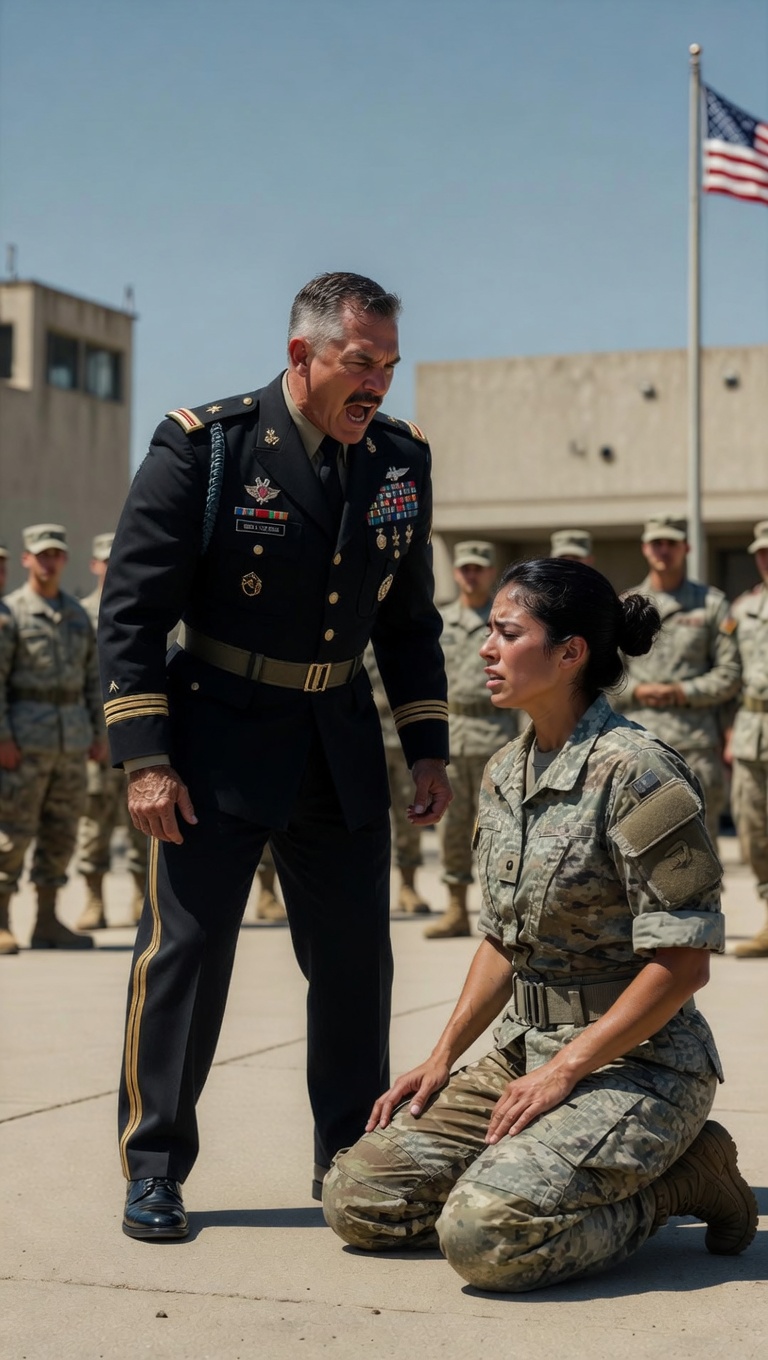
Emily stood at the end of the third row, her uniform too new, her boots too stiff, her dark hair pinned beneath her cap with painful precision. She was nineteen, slight, quiet, and completely still. Around her, boys twice her size stared straight ahead with pale faces and locked jaws.
Then Colonel Kane saw her.
His steps slowed.
The medals on his black dress uniform glinted like little blades.
He walked toward her with the calm pleasure of a man approaching something he had already decided to destroy. His gray buzz cut shone under the sun. His mustache framed a mouth that seemed unfamiliar with kindness. When he stopped in front of Emily, his shadow covered her face.
“Cadet,” he said, voice low. “Why are you staring at me?”
Emily kept her eyes level. “I’m standing at attention, sir.”
A ripple passed through the formation. Not movement exactly, but terror trying not to show itself.
Kane leaned closer. “That wasn’t my question.”
Emily’s throat was dry, but her voice remained steady. “No disrespect intended, sir.”
His expression hardened.
That calmness offended him more than defiance would have.
“Do you think you’re special?” he snapped, loud enough for the guard tower to hear. “Do you think because you passed some entrance exam and survived a few push-ups, you belong here?”
“No, sir.”
“Then why do you look at me like that?”
Emily said nothing.
Kane smiled.
It was not a smile meant for humor. It was the smile of a man who had found a handle on someone’s pain.
“On your knees.”
The courtyard froze.
A bird crossed the sky above them, small and distant, impossibly free.
Emily did not move at first.
Kane’s voice exploded. “On your knees, cadet! Now!”
Slowly, Emily lowered herself onto the concrete. Heat burned through the fabric of her pants. Her knees struck the ground with a dull sound that made several cadets flinch.
Kane circled her once.
“Look at that,” he said to the formation. “This is what happens when softness enters an institution built by men with discipline.”
No one laughed.
So he made them.
“I said, look at her.”
Dozens of eyes shifted toward Emily. Some were ashamed. Some frightened. A few desperate to appear loyal.
Kane stopped beside her and struck the brim of her cap. It flew from her head and landed near his boot.
A few nervous laughs broke out.
Emily stared forward.
Her cheeks were flushed from the heat, but her eyes remained strangely cold.
Kane bent down, his face inches from hers. “Now you know your place.”
Emily looked at him then.
Not upward like a victim.
Not downward like a defeated child.
She looked at him as if she had been waiting for this exact moment longer than he could imagine.
Something flickered in Kane’s eyes.
Not fear.
Not yet.
Recognition’s ghost.
“You have something to say?” he asked.
Emily’s right hand moved slowly toward her uniform pocket.
Kane scoffed. “What is it? A tissue? A letter from your mother? Something to remind you you’re loved?”
Emily’s fingers closed around cold metal.
She pulled it out.
A small silver military identification medal hung from a broken chain. Beneath it was an old black insignia, scratched, scorched at the edges, marked with a symbol that did not appear in any academy textbook.
Kane stopped breathing.
His face changed so quickly that everyone saw it.
The cruel smile vanished. His jaw loosened. His eyes widened by a fraction, then narrowed violently as if trying to force the object out of existence.
Emily held it up between them.
“Do you remember him?” she asked softly.
The entire courtyard heard her.
Kane’s lips moved, but no sound came.
For the first time in North Corps history, Hammer had been struck silent.
PART TWO
The medal swung gently from Emily’s fingers, catching sunlight, throwing broken flashes across Colonel Kane’s face.
No one understood what it was.
But everyone understood what it did.
The most feared man in the academy had stepped back.
Only half a step.
But enough.
Kane recovered quickly, or tried to. His eyes darted to the cadets, then to the guard tower, then back to Emily. His voice returned in a harsh whisper.
“Where did you get that?”
Emily rose slowly from her knees.
No one ordered her to stand.
No one dared tell her not to.
“My father gave it to me,” she said.
Kane’s nostrils flared. “Your father is dead.”
The courtyard seemed to tilt.
Emily’s expression did not change, but something deep behind her eyes tightened.
“Yes,” she said. “He is.”
Kane’s hand twitched near his sidearm, not to draw it, but from instinct, from panic dressed as discipline.
“What was his name?” he demanded.
Emily stepped closer.
The cadets behind her were no longer staring like spectators. They were witnesses now.
“Captain Daniel Carter.”
Kane’s face became stone.
A breeze moved through the yard, lifting dust from the concrete. Somewhere, the flag rope clanged against the pole, sharp and lonely.
For twenty years, Daniel Carter had been a dead hero in a sealed file.
To the army, he had died during a classified mountain extraction in hostile territory. To the public, he was a name on a memorial wall. To Emily, he had been a photograph on a nightstand, a voice on old recordings, and a father who had kissed her forehead once when she was too young to remember it.
But there had been another inheritance.
A locked metal box beneath her mother’s bed.
Inside were three things: the medal, a burned patch, and a letter Daniel Carter had written but never mailed.
Emily had read that letter at fifteen.
She had memorized it by sixteen.
By nineteen, she had built her entire life around the last line:
“If anything happens to me, find Marcus Kane. He knows why.”
Kane turned away from the formation and barked, “Inspection dismissed.”
Nobody moved.
He spun around. “Dismissed!”
The senior instructor hesitated, then shouted orders. Boots thundered. Cadets dispersed in ragged obedience, though nearly every pair of eyes tried to look back.
Emily stayed where she was.
Kane grabbed her arm and pulled her toward the side of the courtyard, beneath the narrow shade of a concrete archway.
His grip was hard enough to bruise.
“What do you want?” he hissed.
Emily looked down at his hand on her sleeve.
He released her.
“I want the truth,” she said.
Kane laughed once, ugly and breathless. “Truth? You came here for truth? You joined this academy, stood in my formation, let me put you on your knees, all for a ghost story?”
“My father wrote your name before he died.”
“Your father died a hero.”
“No,” Emily said. “He died betrayed.”
Kane’s eyes sharpened. “Careful.”
“I have been careful for four years.”
She reached into her pocket again.
This time Kane flinched.
Emily pulled out a folded photograph, cracked along the edges. She opened it and held it up.
Four soldiers stood in snow beside a downed helicopter. One was Daniel Carter. One was Marcus Kane, younger, leaner, smiling with his arm around Daniel’s shoulders. Behind them, half-hidden, was a third man Emily had only recently identified: General Arthur Voss, current commander of North Corps Military Academy.
Kane stared at the photograph like it was a loaded weapon.
“You don’t understand what you’re touching,” he said.
“Then explain it.”
His face twisted.
For a moment, the monster everyone feared looked old.
“The mission was illegal,” he said finally. “Not unofficial. Not risky. Illegal. Voss sent us over a border we were not authorized to cross to retrieve something he wanted buried.”
“What?”
Kane swallowed. “Evidence.”
Emily’s heartbeat hammered in her ears.
“What evidence?”
“Proof that Voss had been selling intelligence through private contractors. Your father found it. He wanted to report it. Voss ordered me to stop him.”
Emily’s fingers tightened around the medal chain.
“And did you?”
Kane looked away.
The silence answered first.
“I didn’t kill him,” Kane said. “But I left him.”
Emily’s face went pale.
The words hit harder than any slap.
Kane spoke faster now, as if the confession had cracked something and the rest was leaking out beyond his control. “We were ambushed. Carter had the drive. He was wounded. He told me to take it and run. I did. But when I reached extraction, Voss was waiting. He knew. He knew everything. He gave me a choice.”
Emily whispered, “Your career or his life.”
Kane closed his eyes.
“My career,” he said. “My reputation. My command. My family. He told me Carter was already dead.”
“But he wasn’t.”
Kane opened his eyes again, wet and furious. “No.”
Emily felt the world narrow until there was only his face and the medal between them.
“My father died alone?”
Kane’s voice broke at the edge. “No. He died on the radio. Calling your name.”
Emily staggered back as if struck.
The courtyard blurred.
For years she had imagined her father dying in silence, brave and distant, belonging to the country more than to her. But now she saw him bleeding in snow, clutching a transmitter, speaking to a daughter who could not hear him.
Kane rubbed a trembling hand over his mouth.
“I kept the drive,” he said.
Emily stared at him.
“What?”
“I kept it. Voss thought I destroyed it. I couldn’t save Daniel, but I couldn’t burn what he died for.”
“Where is it?”
Kane’s expression shifted again.
Fear returned.
Not of Emily.
Of someone behind her.
A slow clap echoed under the archway.
Emily turned.
General Arthur Voss stood at the edge of the shade, immaculate in his white summer uniform, silver hair perfectly combed, smile polite enough to be horrifying.
Beside him were two military police officers.
“How touching,” Voss said. “The daughter, the coward, and the dead man’s souvenir.”
Kane straightened instinctively.
Voss looked at Emily. “Cadet Carter, you have caused quite a disruption on your first week.”
Emily’s hand closed around the medal. “You murdered my father.”
Voss sighed. “No. War murdered your father. Ambition murdered many men. Memory simply makes widows dramatic and children reckless.”
Kane stepped in front of Emily.
Voss’s smile faded.
“Marcus,” he said softly, “do not embarrass yourself twice in one lifetime.”
Kane’s face hardened.
For twenty years, he had terrorized cadets because he could not punish the man who owned his shame. He had broken others because he had once been broken. He had become Hammer because the truth had made him hollow.
Now Emily stood behind him, her father’s eyes burning in her face.
Kane made a decision.
“Run,” he whispered.
Emily did not move.
“Run,” he said again, louder.
Voss lifted one hand.
The military police reached for their weapons.
Then the academy alarm screamed.
PART THREE
The sound tore across North Corps like the sky splitting open.
Cadets poured from buildings. Instructors shouted. Somewhere beyond the courtyard, metal gates began to close automatically.
Voss’s smile disappeared completely.
“What did you do?” he asked.
Kane looked at Emily.
But Emily was looking past all of them, toward the administration building, where every outdoor screen suddenly flickered to life.
The academy used those screens for schedules, announcements, patriotic ceremonies, and disciplinary rankings.
Now they showed a video.
Grainy. Blue-tinted. Old.
A younger Marcus Kane appeared on screen, helmet cracked, face streaked with blood.
Beside him, Captain Daniel Carter lay against snow, one hand pressed to his side, the other gripping a small black drive.
The entire courtyard went silent except for the alarm.
Daniel’s voice crackled through ancient audio.
“Marcus, listen to me. If I don’t make it, this goes public. Voss sold coordinates. He gave them our route. He wanted us dead.”
The camera shook.
Young Kane cursed, crying openly.
Daniel grabbed his sleeve.
“Don’t let my daughter grow up in a country that salutes liars.”
Emily stopped breathing.
Her father’s face filled the screen.
He was younger than she had ever seen him. Alive. Terrified. Brave.
Then Daniel looked directly into the camera.
“If Emily ever sees this…” His voice failed, then steadied. “Tell her I tried to come home.”
A sound escaped Emily before she could stop it.
Not a sob.
Something deeper.
Something that had been buried since childhood.
Voss lunged toward Kane. “You had it?”
Kane did not answer.
Emily did.
“No,” she said.
Everyone turned to her.
“My mother had it.”
Voss froze.
Emily reached into her pocket and pulled out one final object: a tiny transmitter sewn into the lining of her uniform patch.
“My mother didn’t die of grief,” Emily said. “She disappeared because your men came looking for this. She raised me under another name. She waited until I was old enough to finish what he started.”
Kane stared at her. “Your mother is alive?”
Emily’s lips trembled.
“She’s not just alive.”
At that moment, the academy’s main gates burst open.
Black vehicles rolled in.
Federal agents stepped out first.
Then a woman in a dark suit emerged from the lead vehicle, silver threaded through her black hair, posture straight as a blade.
Emily turned toward her.
For the first time all day, the cold mask on her face cracked.
“Mom,” she whispered.
Rebecca Carter, presumed dead for twelve years, walked into North Corps Military Academy with a federal warrant in one hand and twenty years of fury in her eyes.
Voss backed away.
“You have no jurisdiction here,” he snapped.
Rebecca smiled without warmth. “Actually, General, after your encrypted confession went live to federal command, congressional oversight, and every major military legal office five minutes ago, I have plenty.”
Voss looked at Kane.
Kane lifted his chin.
“I wore a wire,” he said.
Emily’s eyes widened.
Kane looked at her, shame and relief battling across his face. “The moment I saw the medal, I knew Daniel had found a way back.”
Voss’s face twisted with rage.
For one wild second, he moved toward Emily.
Kane intercepted him.
The old colonel slammed into the general, driving him backward. The two men crashed onto the concrete, medals scraping, officers shouting. Voss struck Kane across the jaw, but Kane did not let go.
“Get off me!” Voss roared.
Kane pinned him down with a forearm across his chest.
“This is me getting off my knees,” Kane said.
Federal agents swarmed them.
Voss was dragged upright, wrists locked behind him.
The cadets watched in stunned silence as the untouchable general was marched through the same courtyard where he had ruled like a king.
But the story was not over.
Not yet.
Rebecca reached Emily and pulled her into her arms.
Emily held on with both hands, suddenly nineteen again instead of a soldier shaped from grief.
“You were supposed to wait,” Rebecca whispered.
Emily laughed through tears. “You trained me badly.”
Rebecca pulled back and touched her daughter’s face. “No. Your father did.”
Across the yard, Kane stood with blood at the corner of his mouth. He looked smaller now, medals heavy on his chest, uniform dusty, legend ruined.
Emily walked to him.
For a long moment, neither spoke.
“I hated you,” she said.
“You should.”
“I still might.”
“You should.”
Her eyes glistened. “But you helped us.”
Kane looked toward the screen, where Daniel Carter’s frozen face remained. “Too late.”
Emily shook her head. “No. Late isn’t the same as never.”
Kane’s composure shattered.
He lowered himself slowly onto one knee before her.
The cadets gasped.
The feared Hammer, the man who had forced hundreds to kneel, bowed his head in front of the recruit he had humiliated.
“I am sorry,” he said. “For your father. For your mother. For every day I lived as a coward.”
Emily looked down at him, the medal still wrapped in her fist.
Then she did something no one expected.
She placed the medal in his hand.
Kane stared at it in horror. “I don’t deserve this.”
“No,” Emily said. “You don’t.”
She closed his fingers around it.
“But you’re going to carry it until every man involved is named.”
Kane looked up.
Emily’s voice sharpened, steady and commanding.
“And then you’re going to give it back to my father.”
The investigation that followed destroyed careers, reopened graves, and exposed a network of corruption older than Emily herself. General Voss died in custody before trial, officially from a stroke, though rumors would chase his name forever. Colonel Marcus Kane testified for seventeen days. He named names. He surrendered medals. He refused immunity.
North Corps changed after that.
The courtyard was renamed Carter Yard.
A bronze plaque was installed where Emily had been forced to kneel. It bore no speech, no slogan, only seven words from Daniel Carter’s final recording:
“Don’t let my daughter salute liars.”
Years later, when Captain Emily Carter returned to North Corps as an instructor, new cadets whispered about her the way they once whispered about Hammer.
But they did not fear her cruelty.
They feared her honesty.
On her first inspection day, a nervous recruit dropped his cap and began to shake.
Emily picked it up, dusted it off, and placed it back in his hands.
Then she looked across the yard, where an old man in a plain gray suit stood alone near the memorial wall.
Marcus Kane had been released from prison that morning.
He looked fragile, almost unrecognizable, but in his hand was the silver medal.
Emily walked to him.
Without a word, he gave it back.
“I kept my promise,” he said.
Emily looked at the medal, then at the wall where her father’s name had finally been corrected from casualty to whistleblower, from soldier to betrayed hero.
Then she did the last thing anyone expected.
She handed Kane a folded envelope.
He opened it with trembling fingers.
Inside was a photograph of Daniel Carter, Rebecca, and baby Emily.
On the back, in Rebecca’s handwriting, were four words:
He forgave you first.
Kane broke then.
Not loudly.
Not dramatically.
Just completely.
Emily stood beside him as the sun lowered over Carter Yard, turning the concrete gold.
And for the first time in twenty years, the man called Hammer did not look like a weapon.
He looked like a man who had finally heard the truth strike back.