
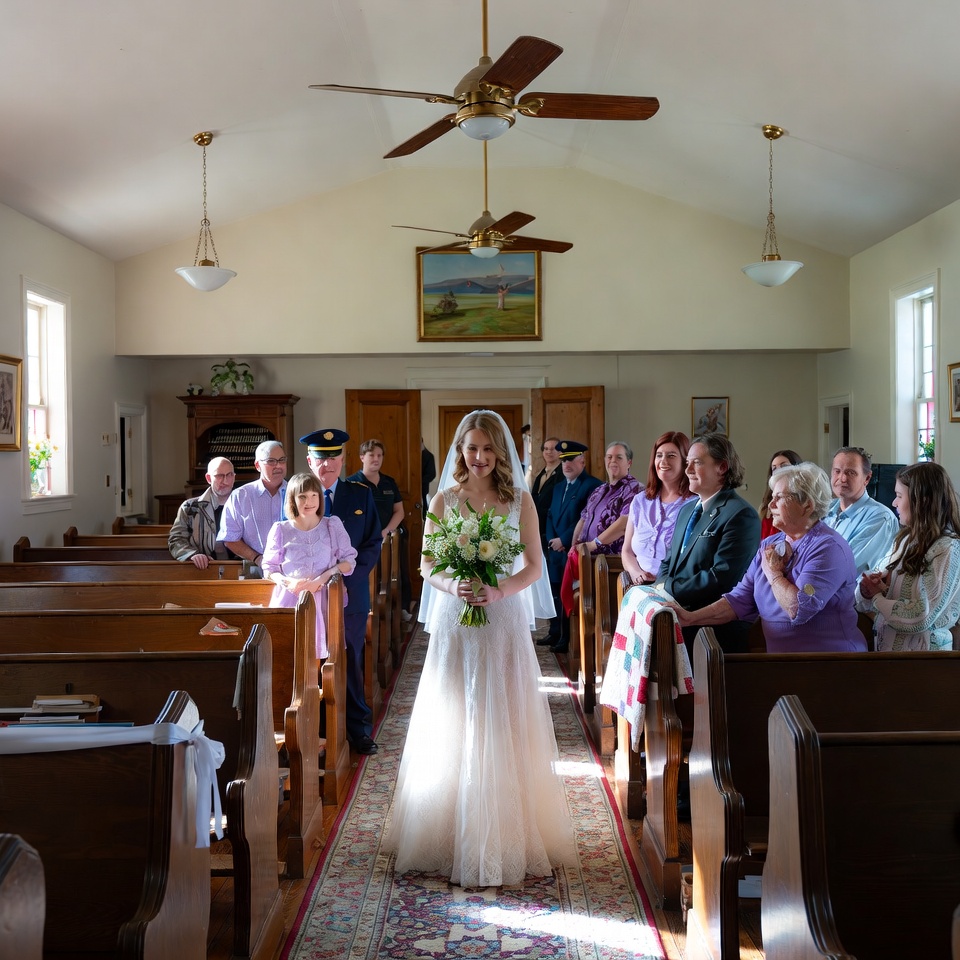
At The Wedding, My Dad Texted, “No Blessing.” My Mom Scoffed, “A Farmhand?” Their Empty Pews Mocked Me – Until Veterans Day, A Medalled Officer Announced, “Jason Miller Saved My Life.” They Went Pale, Froze Silent.
Part 1
I got married in a little white church on the edge of town where the window sills were lined with daises in jelly jars and old quilts had been draped over the pew backs so the room felt less like a sanctuary and more like a place where people had actually cried before. The boards under my feet smelled faintly of lemon oil and dust. Somebody had burned coffee downstairs too early, and the bitter scent kept drifting up through the heat vents every time the organist tested a chord.
The front pew on the left had a ribbon tied across it.
Reserved for family.
It stayed empty.
That was the part that hurt the worst. Not anger. Not even humiliation. Just the emptiness. Empty seats have a sound if you stare at them long enough. They hum. They accuse. They make every other voice in the room sound farther away.
I stood in the narrow hallway by the fellowship room, holding my bouquet so tight the stems squeaked under the satin wrap. My dress was plain ivory lace, not the kind my mother would have chosen. No cathedral train, no designer name stitched into the lining, no seamstress in New York. Just something clean and honest that fit my shoulders and let me breathe. Under it, I wore my brown boots because I wanted to feel the floor and because the thought of balancing on little white heels for a ceremony my own family had boycotted felt absurd.
My phone had buzzed once that morning.
From Dad.
If you go through with this, don’t expect us to watch you throw your life away.
That was it. No love. No hesitation. No maybe we’ll come if. Just a sentence as cold as silverware left in the freezer.
Marcy, who’d served with me and still carried herself like she was half a second from stepping into formation, fixed my veil with gentle fingers. “You can still back out,” she whispered, but her tone said she already knew I wouldn’t.
“Not from him,” I said.
She gave me a look that was half pity, half pride. “Good.”
People began filing in. Neighbors in church clothes that still held the shape of denim underneath. Two old men from the VFW in starched caps. Mrs. Jennings in a lavender dress that smelled like powder and peppermint. Kids with slicked hair and restless shoes. Jason’s world, which had never once pretended to be shinier than it was.
No one asked where my family was.
That was almost kinder than asking.
When the music changed, my whole body went tight. The doors at the end of the hallway had warped a little from summer humidity, and when the pastor pushed them open they gave that long wooden groan that sounds like an old house remembering something painful.
I walked in alone.
That was the picture I had never let myself imagine growing up: me, daughter of Charles and Caroline Carter, walking down an aisle without a father at my elbow, without my mother blotting tears into lace, without my brother trying to act bored and my sister pretending not to cry. I had imagined chandeliers once. String quartets. My mother adjusting pearls. My father smiling the way he smiled for donors and governors and people who mattered.
Instead I got sunlight through red and blue glass falling across patchwork quilts, the faint buzz of an overworked air conditioner, and Jason waiting for me in a charcoal jacket that fit his broad shoulders but still looked like it belonged to a man more comfortable in flannel.
He didn’t look embarrassed for me.
He didn’t look triumphant either.
He just looked steady.
That mattered.
The first few steps were the hardest. My throat burned. My eyes stung. I could feel every person in that church noticing what was missing. But then Jason lifted his chin just slightly, and it was the smallest thing, really, except it changed the whole room. It was the look of somebody saying, without making a show of it, I’m here. Keep coming.
So I did.
The ceremony itself passed in flashes. The pastor’s voice. The brush of Jason’s callused thumb against my knuckles. The way my bouquet smelled greener once I wasn’t crushing it. A baby crying somewhere near the back. The warm pressure in my chest when I said “I do” and heard my own voice come out clear.
When it was done, the room broke into applause that sounded bigger than the church could hold. Mrs. Jennings cried openly. Someone whooped. Jason laughed under his breath, the quick surprised laugh he only gave when joy caught him off guard.
Downstairs, the reception was held in the fellowship hall on folding tables covered with white paper cloths and bowls of butter mints. There was fried chicken, green beans, macaroni salad, and three casseroles I couldn’t identify but ate anyway because everyone had brought something and that felt like love in physical form. The cake was white with crooked piped roses, and the air smelled like icing sugar, coffee, and the faint dampness old church basements never quite lose.
People hugged us. Men clapped Jason on the shoulder. Women tucked cards into my hand. A little girl asked if she could touch my veil and then told me I looked prettier than the princess in the movie her mom wouldn’t let her watch twice.
I smiled until my cheeks hurt.
Every now and then I caught myself looking toward the doorway, still stupidly waiting for my mother to sweep in late smelling like gardenia and disapproval, or my father to stand stiff-backed under the fluorescent lights and say he had changed his mind. He didn’t. Neither of them did.
When the room got too warm, Jason slipped outside to get air. I found him a few minutes later behind the church near the gravel lot, where the tall grass moved in waves and the evening light made everything look softer than it had any right to.
“You okay?” I asked.
He looked at me, then past me at the church windows. “Best day of my life,” he said, and I believed him because Jason never said pretty things just to patch a hole.
Then his phone buzzed.
He glanced at the screen and something moved through his face too fast for me to name. Not fear exactly. Not annoyance. Recognition, maybe.
“Everything all right?” I asked.
He turned the phone facedown in his palm. “Just a call I need to return later.”
From where I stood, I’d caught only part of the screen before it went dark.
Colonel H. Lawson.
I filed the name away without knowing why.
Back inside, the pastor asked us to pose beside the cake. Mr. Jennings insisted on one more photo out front by the church steps. Jason took off his jacket because the basement had gotten so warm, and when I reached for it to hang over the back of a folding chair, something slipped from the inside pocket and landed against the linoleum with a small metal click.
I bent first.
It was a medal.
Bronze star-shaped pendant, ribbon folded neat, tucked inside a worn case that had come half open from the fall.
For a second the whole room seemed to go muffled, as if somebody had shoved cotton into my ears.
Jason moved quickly and crouched beside me. “Emily—”
“You never told me you had this.”
He looked at the medal, not at me. “Not tonight.”
There was a folded clipping behind the ribbon, yellowed at the edges, but before I could see more than a photograph corner and a strip of black print, he slid the case closed and stood up.
Then he finally met my eyes, and whatever I saw there made the hair rise on my arms.
It wasn’t shame.
It was grief.
And as the music started up again downstairs and our guests laughed over cake and coffee, I stood there in my wedding dress holding the sleeve of my husband’s jacket, staring at the man my family had called a nobody and wondering what else he’d been carrying in silence all along.
Part 2
If you’d told me a year before the wedding that I would fall in love with a man while standing ankle-deep in straw beside a livestock pen, I would have laughed hard enough to spill my drink.
But that was before Jason.
We met at the county fair in August, the kind of afternoon where the heat sits on your shoulders like a hand and every surface smells faintly of dust, fryer grease, and sweet feed. I had come straight from the VA clinic in town, still wearing the kind of practical clothes my mother used to call “serviceable” in that way people say useful things when they mean ugly. I was helping at a veterans outreach table near the 4-H barns, mostly handing out brochures nobody wanted and reminding old men to drink water.
Across the aisle, a tall guy in a faded blue work shirt was crouched beside a boy of maybe eight, showing him how to hold his palm flat so a calf would take grain without nipping his fingers.
“Not scared,” the boy said, clearly terrified.
“You can be scared and still do it,” the man said, smiling. “Those are different things.”
That got my attention.
Later, when I came over for a bottle of water from the cooler behind his booth because ours had run dry, he looked up, took in my veteran ID lanyard, and nodded once.
“You served?” he asked.
“Army.”
“Me too.”
That was it. No chest puffing. No launch into old stories. No instant bond built out of stereotypes and volume. Just two simple words spoken like a fact too ordinary to perform.
His name tag said Jason Miller. The sleeve of his shirt was rolled to his elbows, and his forearms were sun-browned and roped with muscle from actual work, not gym work. There was dirt under his nails and a pale scar running from one thumb joint down toward his wrist. He had kind eyes, the kind people say everybody has until they actually meet a person whose kindness is visible before they speak.
We ended up talking between waves of kids.
He ran his family farm just outside town. Hay, a few cattle, soybeans when the weather cooperated. His father had died three years earlier. His mother was gone before that. He’d served two tours in Iraq with the National Guard and come back to land that still needed mending and bills that didn’t care what he’d seen overseas.
I told him I’d been Army too, that I’d left as a captain after eight years and a knee that never stopped predicting rain. I expected the usual questions—where had I been, had I seen anything bad, was it hard as a woman, did I miss it, did I regret it, did I still sleep with the TV on when thunder rolled.
Jason asked none of that.
He asked if the VA clinic was finally getting a better audiologist because too many guys were waiting too long.
I stared at him. “How do you know that?”
“My neighbor Earl’s on month four,” he said. “He complains while I fix his fence.”
That was Jason all over. Information came through him sideways, carried in on concern for somebody else.
By the time the sun slid lower and the Ferris wheel lights started blinking on against the evening sky, he brought me a lemon shake-up in a waxed paper cup and didn’t make a big deal of remembering that I hated too much sugar.
We walked past the tractor display and the pie contest, down to the edge of the grounds where the gravel lot met a patch of dry grass. Fireworks from the grandstand rehearsal popped in the distance, little white bursts against the darkening blue.
“You from here originally?” he asked.
“Unfortunately,” I said, and he laughed.
I told him enough, though not everything. That my family had money and opinions in equal measure. That my father had built an investment firm into something people in this state said with lowered voices and straightened spines. That my mother chaired galas like military operations and had once cried actual tears because I wore a black dress to an event in June. That enlisting had been my first clean act of disobedience and maybe still my favorite.
Jason listened with his hands in his pockets.
When I was done, he looked out over the fair lights and said, “Land doesn’t care what your last name is.”
“That sounds like something you tell everybody.”
“No.” He tipped the cup in my direction. “That one felt specific.”
We had coffee two days later at a diner with cracked red booths and a waitress who called everyone honey whether she liked them or not. He arrived five minutes early and left his hat in the truck without making a show of manners. He ordered eggs, black coffee, and toast. I ordered pie for breakfast because I was in the mood to scandalize somebody.
He noticed my limp when I came back from the restroom but didn’t comment on it. He just slowed his pace walking out.
That small mercy told me more about him than any dramatic speech could have.
I should have known then how badly my family would misread him.
My mother’s first question, when I mentioned him over Sunday brunch, was, “Miller as in the construction Millers or the Miller farm road Millers?”
“The farm,” I said.
She set down her coffee cup too carefully. “Oh.”
My father kept cutting into his grapefruit as if citrus had suddenly become urgent. My brother Adam smirked into his phone. Julia, who had built an entire adult personality out of tasteful surprise, lifted her brows and said, “Like… a real farmer?”
“As opposed to a fake one?”
“Emily,” my mother warned.
I should tell you something important about the Carters. In my family, people almost never said exactly what they meant first. They preferred layers. Frosting over knives. Questions that were really verdicts.
Dad looked up. “What’s his education?”
I chewed slowly. “He served two tours in Iraq.”
“That wasn’t my question.”
“No,” I said. “It never is.”
The next week, because I was still stupid enough to want them to see what I saw, I brought Jason to dinner at my parents’ house.
House is too soft a word, really. It was a limestone place on the oldest street in the city, with oil paintings in the hallway and a staircase my mother treated like it had a bloodline. The foyer smelled like beeswax, white roses, and money that had never been earned with a sore back.
Jason showed up in a clean button-down, dark jeans, and boots polished to the point of personal discomfort. He carried a peach cobbler from Mrs. Jennings because he said it seemed rude to arrive empty-handed.
My mother accepted it the way museum staff might accept a wet umbrella.
At dinner, Adam asked Jason what his “five-year plan” was in the same tone people use with interns. Julia asked whether farm life got “isolating.” My father asked about crop insurance, land taxes, and debt ratios with enough precision that I knew he had already had someone look into Jason’s finances.
Jason answered without defensiveness. Calmly. Briefly. He didn’t shrink, and he didn’t puff up either. He just stayed himself, which in that room somehow read as rebellion.
After dessert, Dad called me into his study under the pretense of discussing my parking situation.
The study smelled like leather and old paper. He closed the door behind me.
“How serious is this?” he asked.
“Serious.”
He tapped a folder on his desk without opening it. “I had someone run a basic background check. There isn’t much there.”
“That’s supposed to worry me?”
“It does worry me,” he said. “A man your age, with military service and financial strain, should leave more of a trail than this.”
I stared at him. “You investigated him?”
He ignored the question because that was his favorite trick. “Thin records make me suspicious.”
When I came back into the foyer, Jason was standing under the hall lamp, looking at a framed photograph on the wall. My father and a silver-haired man in golf clothes, both grinning beside a tournament banner.
Jason’s face had gone still.
Not blank. Still.
“What is it?” I asked quietly.
He blinked and stepped back from the photo. “Nothing.”
But when my father came out behind me and said, “That’s Henry Lasker. Old friend,” I saw something tighten in Jason’s jaw.
Dad noticed it too.
For one sharp second, the three of us stood there in the warm yellow light, and I had the strange sinking feeling that whatever lived in Jason’s silence had just heard its own name.
Part 3
I told myself I was imagining things.
That was a habit I’d learned early in my parents’ house. When everybody around you insists the room is calm while you can feel the glass trembling, you start doubting your own ears.
But I wasn’t imagining what I saw in Jason that night.
The drive back from my parents’ place took forty minutes if traffic behaved, longer if it didn’t. We passed the city lights, then the strip malls, then the dark open stretches where the road narrowed and the air outside the truck looked black and deep enough to drown in.
Jason drove with both hands on the wheel.
Usually, after an evening with my family, I came out ready to spit nails. I’d dissect every look, every remark, every tiny polished insult until I wrung myself dry. But that night I kept watching his profile in the dashboard glow instead.
“You know that name,” I finally said.
He kept his eyes on the road. “Which one?”
“Lasker.”
The truck hit a patch in the pavement, and the suspension gave a dull thump beneath us.
“I knew a Steven over there,” he said after a moment. “Common name.”
“That isn’t an answer.”
“It’s the one I have tonight.”
I looked down at my hands in my lap. “My father had you investigated.”
“I figured.”
“You’re not angry?”
He gave a breath that wasn’t quite a laugh. “Emily, men like your father don’t get to the top of anything by trusting what shows up at the door.”
“That’s not normal.”
“It might be in his world.”
“And what about mine?”
That got him to look at me. Just for a second. Long enough for me to see how tired he was. “I’m trying not to make you pay for being related to them.”
It was infuriating and tender at the same time, which was very Jason. He had a way of making me feel protected and shut out in the same breath.
At the farm, the porch light had been left on for us. Moths battered themselves against the yellow bulb. The night smelled like cut hay and warm dirt. He opened my door before I could reach for the handle, and when his hand brushed my wrist I almost let the whole thing go.
Almost.
Instead I said, “Were you in the same unit as Steven Lasker?”
He stopped with one foot on the porch step.
The silence stretched.
Then he said, “I’m not hiding something bad from you.”
That answer landed in me strangely. It should have been comforting, but what I felt instead was the sudden awareness that there were categories of hiding.
Not bad, then what?
Over the next few weeks, I learned the shape of Jason’s quiet more clearly, and it wasn’t simple shyness. It was architecture. Built carefully. Reinforced where necessary. Locked in certain places.
He showed up everywhere. That was the thing.
When my sink backed up, he fixed it before I could text a plumber. When my knee flared in damp weather, he noticed the way I favored stairs and moved the laundry basket before I asked. He stocked my fridge with actual food instead of yogurt cups and mustard. He remembered the names of the men I worried about at the clinic and asked how Earl’s hearing appointment went, whether Mr. Delaney ever got his oxygen issue sorted out, whether the new guy in group therapy still sat near the door.
He never once asked me to be smaller for him.
And because of that, every time my family dismissed him, it felt less like snobbery and more like a deliberate refusal to see.
At Sunday dinner two weeks later, my mother invited me alone and then acted startled when I showed up with Jason anyway. The dining room glowed with candlelight and polished silver. A string quartet played softly through hidden ceiling speakers because apparently my mother believed even pot roast required a soundtrack.
Adam talked about a merger like it was a military conquest. Julia complained about a private school waitlist for children she didn’t even have yet. My father asked Jason, in a tone of professional curiosity, whether commodity prices were hurting smaller operations.
“Some,” Jason said.
“Then why keep doing it?”
I braced.
Jason cut into his roast, swallowed, and said, “Because it’s mine.”
Adam snorted into his wine.
My mother set down her fork. “Surely there are more scalable opportunities for a man with your discipline.”
I looked at her. “He’s not a startup, Mom.”
She ignored me. “I only mean you’re obviously capable.”
“And yet farming still counts as work,” I said.
Dad lifted a hand, the gesture he used when controlling boardrooms and children alike. “No one is insulting anybody.”
That was another Carter specialty. Injury followed immediately by denial that injury existed.
Halfway through dessert, my father brought up Henry Lasker again. Something about a charity golf weekend and Steven being back in the state after years in D.C. I was watching Jason by then. Really watching.
His fork paused over pecan pie.
Just for a second.
Then it went down.
Later, back at his place, we sat on the porch steps in the dark. Crickets rasped from the ditch. The air had cooled enough that I could smell damp wood and the metal tang of the handrail.
“Why didn’t you tell me more about your tours?” I asked.
He rubbed his palms on his jeans. “Most people asking don’t want the truth. They want a movie trailer.”
“I’m not most people.”
“No.” His voice softened. “You aren’t.”
“Then try me.”
He looked out over the dark field instead of at me. “Some things don’t get smaller because you say them out loud.”
I wanted to push. I wanted to demand names and dates and explanations, because when you love somebody and sense an unlit hallway inside them, everything in you wants to fling the door open.
But loving someone also means noticing when they are braced for impact.
So I kissed his cheek and let the night settle around us.
At two in the morning, I woke to the sound of him choking on air.
For one wild second I thought he was sick, but then I saw him—sitting bolt upright, drenched in sweat, eyes open and unseeing, chest heaving like he’d just run uphill with weight on his back.
“Jason.”
He didn’t answer.
I touched his shoulder and he flinched so hard it felt like hitting a live wire.
Then he said it.
Not loudly. Not like a shout. More like a plea hauled up from someplace deep and old.
“Steve, stay down.”
The room went cold around me.
He dragged both hands over his face and seemed to come back in pieces. “I’m sorry,” he said. “Go back to sleep.”
But sleep was gone. So was every excuse I’d made for the look on his face beneath my parents’ hallway lamp.
Outside, a dog barked somewhere far off. The house creaked. My pulse hammered at my throat.
I sat there in the dark, staring at the man I loved, hearing that name echo in the room, and for the first time I understood that whatever Jason had survived had not stayed in the desert where it happened.
It had followed him home.
And now, somehow, it had followed me too.
Part 4
Jason proposed on a Tuesday evening while we were cleaning mud off the porch.
That sentence alone tells you almost everything worth knowing about him.
There were no candles. No hidden photographer crouched in hydrangeas. No reservation at a place with cloth napkins folded like swans. A storm had rolled through that afternoon, and the yard was striped with wet tire tracks. We’d dragged two feed sacks out of the rain and laughed because I slipped on the porch step and nearly went down hard with a broom in my hand.
He looked at me then—hair frizzed from humidity, knee brace showing, old college sweatshirt on, muddy to the ankles—and smiled this soft, surprised smile like he still couldn’t believe I was real.
“Hang on,” he said.
He disappeared inside and came back with a small box from the top kitchen drawer. Not velvet. Just a square jewelry box from Lawson Jewelers on Main Street, the same store that sold class rings and anniversary bands and watch batteries.
“I had a different speech in mind,” he said, rubbing the back of his neck. “Turns out I’m worse at speeches than weather.”
I laughed. “That’s not possible.”
He opened the box.
The ring wasn’t huge. It didn’t need to be. An oval diamond in a simple gold setting, old-fashioned and clean. Later he told me it had been his grandmother’s, reset because one prong was bent and he wanted it to sit right on my hand. That detail got me more than the stone itself. The care of it. The thought.
“I know your family’s going to hate this,” he said plainly. “Maybe the ring. Definitely me. I can’t fix that. But I can promise I’ll be honest with you, and I’ll stay. Even when staying is hard. Especially then.”
Rain dripped from the eaves behind him. The whole yard smelled like wet dirt and cut grass.
“Yes,” I said before he even got to the question.
We told my family on Thursday.
My mother’s first response was silence. My father’s was, “No.”
Not no congratulations. Not no let’s talk about dates. Just no, like he could still veto my life with tone alone.
“It isn’t a proposal to you,” I said.
“It affects this family,” he answered.
“By existing?”
Adam smirked from the end of the dining table like he was courtside at a game he had money on. Julia tilted her head in manufactured concern. “Maybe Dad only means timing,” she said. “Things can feel very intense after hardship.”
That was aimed at me, of course. My service. My distance from them. My age. In my family, a woman stepping outside the plan was always treated like a mood she might recover from.
My mother took my hand and looked at the ring with narrowed eyes. “It’s… tasteful.”
I almost laughed.
When manipulation failed, the terms came out.
No financial help. No family home for photos. No hosting. No guest list from their side. My father even went so far as to say that if I chose “that kind of marriage,” I should get used to funding “that kind of life” myself.
I looked at him across twelve feet of polished walnut table and finally understood that he thought hardship would scare me back into obedience.
He still thought I was sixteen.
Planning the wedding without them felt like learning to write with my other hand. Awkward at first, then weirdly liberating. Mrs. Jennings insisted on flowers from her garden. Marcy bullied a tailor into speeding up my alterations. The ladies at Jason’s church argued affectionately over cake flavors. Someone donated mason jars. Someone else quilts. I found out, to my shock, that joy could be built out of ordinary things and people who actually meant what they said.
Still, grief came in odd moments.
Looking at invitations and realizing there would be no mother-daughter debate over fonts because my mother had opted out of daughter altogether. Trying on dresses with Marcy instead of a sister. Seeing the florist write Reserved for Family on the church cards because apparently even absence required signage.
The week before the wedding, my mother called and said she would “consider attending” if Jason signed a prenuptial agreement drafted by my father’s attorneys.
I hung up on her mid-sentence.
That Saturday, we had what passed for an engagement dinner at my parents’ club only because my mother couldn’t bear the optics of doing nothing. The ballroom smelled like chilled white wine and expensive candle wax. A jazz trio played in the corner. Everything shone.
Nothing felt warm.
Jason wore a suit that made him look unfairly good. Adam noticed too, which probably annoyed him.
To his credit, Jason didn’t flinch when my father introduced him to people without mentioning the farm or the service, just his name, as if biography itself were a privilege not yet earned. He shook hands. Answered questions. Stood beside me like a post sunk deep.
Halfway through the evening I lost sight of him.
I found him twenty minutes later out near the side terrace where the smokers went, except he wasn’t smoking. He was standing under the awning with his hands loose at his sides, and Adam was in front of him, close enough to be mistaken for friendly if you didn’t know Adam.
They broke apart when they saw me.
“What’s going on?” I asked.
“Nothing,” Adam said quickly.
Jason’s face gave nothing away. “Your brother was just heading back in.”
Adam adjusted his cuff link. “We were talking logistics.”
I knew that tone. Men in my family used it whenever they wanted a lie to sound responsible.
In the truck on the way home, Jason was quieter than usual. His jaw worked once like he had words and swallowed them. I let it sit because every time I forced something with him, it seemed to retreat farther.
That was my mistake.
Two days later I was in his truck looking for the church coordinator’s number, which he’d scribbled on a receipt and shoved somewhere impossible, when I opened the glove box and found a cream envelope tucked beneath the registration papers.
My brother’s name was written on the flap.
Inside was a cashier’s check.
Two hundred and fifty thousand dollars.
And a note in Adam’s neat blue handwriting.
Walk away before the invitations go out. Save us all the embarrassment.
For a full second, I couldn’t breathe.
The truck cab smelled like old leather and sun-warmed dust. Outside, somewhere beyond the open barn doors, I could hear Jason splitting wood.
I stared at that number, at my brother’s handwriting, at the obscene ease of the offer, and then at the fact that the envelope was in Jason’s truck at all.
When I stepped down into the yard with the check in my shaking hand, Jason looked up from the chopping block and saw my face.
The axe handle went still in his grip.
And in that instant, before either of us said a word, I understood that my family had done something uglier than refuse to come to my wedding.
They had tried to buy my life back behind my back.
Part 5
I wanted to scream.
That surprised me, because I’m not a screamer by nature. The Army had burned most of that impulse out of me. I default to cold. To clear. To the particular kind of calm that usually means danger is already inside the room.
But standing in Jason’s yard with that check in my hand, cicadas buzzing hot and stupid in the trees and the smell of split oak sharp in the air, I wanted noise. I wanted something that matched what my chest felt like.
Jason set the axe down carefully. “Emily.”
“How long have you had this?”
“Since the club.”
“And you didn’t think maybe I should know my brother offered you a quarter of a million dollars to leave me?”
His face tightened. “I was going to tell you.”
“When?”
He ran a hand over the back of his neck. “After the wedding.”
I laughed once, ugly and disbelieving. “How generous.”
He stepped closer and stopped when he saw me flinch. “He cornered me outside. Said he could solve the problem quietly. I told him no.”
“You kept the check.”
“I kept the evidence.”
That landed. Not enough to make me less furious, but enough to slow me.
I looked down at the note again. Adam’s handwriting. My brother, who wore handmade suits and talked about market discipline like it was scripture, had tried to buy off the man I loved as if Jason were a contractor lowballing a bid.
“Why didn’t you tell me that night?” I asked, softer now, which somehow hurt more.
Jason’s shoulders dropped a fraction. “Because you were already losing your family. I didn’t want you carrying that too.”
I hated how much sense that made. Hated him for protecting me without permission. Hated myself for understanding why.
“What else haven’t you told me?” I asked.
He met my eyes. “Nothing that would make you doubt me.”
That wasn’t the same as nothing, and we both knew it.
The wedding happened anyway.
In some ways, maybe because of all that, it felt even more deliberate. Every ribbon tied by church ladies, every casserole on a folding table, every handshake from one of Jason’s neighbors landed against the memory of my family’s absence and made the contrast impossible to ignore. People in his world showed up with their whole hands, not just opinions.
Afterward, when we got back from our short honeymoon—two nights in a cabin by a lake where it rained the whole time and I loved every minute—we began the awkward, beautiful work of building an actual life.
And building, it turned out, was the right word.
The roof over the equipment shed leaked. The freezer in the mudroom made a noise like a dying mule and then quit on a Thursday. My old car needed brakes. The soybean field came in lighter than expected, and Jason spent one long silent evening at the kitchen table with bills spread around him in careful stacks, his reading glasses low on his nose, pencil tapping once against the margin.
My father’s words echoed at the edges of those moments. That kind of life.
But here’s what he never understood: struggle feels different when you’re not performing for people who want you ashamed of it.
I worked part-time at the VA clinic and picked up extra shifts when we needed them. Jason sold a rusted baler he’d been meaning to fix for three years and hated to part with. Mrs. Jennings arrived with bags of frozen soup like she could smell tight finances through walls. Marcy drove out one Saturday and helped us patch fencing in ninety-degree heat while cussing creatively enough to make Jason blush.
It was hard.
It was also ours.
We didn’t talk about Adam’s check again. Jason kept it in the safe with the note attached, and one night over coffee he said quietly, “I should’ve told you sooner.”
“You should have,” I said.
He nodded once. “I know.”
That was another thing about him. He didn’t defend the indefensible just because it had been his decision.
The medal stayed buried too, at least for a while. I knew where the case was after the wedding because I’d seen him move it to the top shelf of the hall closet, behind tax folders and an old flashlight. I didn’t touch it. Partly because I respected boundaries. Partly because I was afraid that if I opened one sealed piece of his past, everything inside it would spill all at once.
The spill happened on a rainy Thursday in late October.
We were cleaning out the storage shed behind the barn because the roof patch had held and Jason had declared it “safe enough for a dig.” Rain drummed overhead in soft steady fists. The air inside the shed smelled like damp wood, old hay twine, engine oil, and the peculiar dry rot scent of boxes that have spent too long being ignored.
I was sorting manuals from junk when I found a battered green file folder wedged between an army duffel and a crate of fence staples.
The folder was swollen from humidity. Papers inside had curled at the edges. A local paper clipping slid halfway out when I lifted it.
I almost put it back.
Then I saw the photograph.
Even grainy and sun-faded, it was unmistakably Jason—years younger, face streaked with dirt, helmet askew, shoulders hunched around another man as if his own body could be used like a shield.
My pulse started beating hard.
I unfolded the clipping with careful fingers.
LOCAL GUARDSMAN PULLS WOUNDED SOLDIER FROM BURNING VEHICLE IN RAMADI
Below it, in smaller print, the article named the rescued soldier.
Private Steven Lasker.
The rain got louder. Or maybe the whole world did.
I read the article once. Then again, slower. Ambush. Small arms fire. Burning transport. Jason Miller, then Sergeant Miller, had ignored incoming rounds long enough to drag Lasker from the vehicle and get him behind cover. The piece mentioned a recommendation for commendation and quoted Jason only once: We all did what we could.
That sentence made my throat ache.
A second item slid from the folder when I turned it over.
The medal case from the wedding.
Not just a Bronze Star. There were orders papers too, folded tight. A recommendation letter with a colonel’s signature. Another sheet partially obscured by moisture stains.
I heard boots on wet gravel outside and looked up sharply.
Jason filled the shed doorway, rain silver behind him.
His gaze dropped to the clipping in my hand, then the open medal case on the crate.
For a moment neither of us moved.
Then I said the name out loud.
“Steven Lasker.”
Something changed in Jason’s face. Not surprise. Not exactly.
Recognition. Resignation. Maybe even a tired kind of sorrow.
And because I knew my father’s world almost as well as my own, I felt the pieces start to slide together with a cold, certain click.
Henry Lasker’s son.
The one my father bragged about at Christmas.
The one Jason had once begged to stay down in the dark.
The rain kept hammering the shed roof while I stood there with the clipping shaking in my hand, and I realized my family hadn’t just refused to know the man I married.
They had mocked a man whose name was already woven into the one story that could have stopped them cold—if only they had cared enough to ask.
Part 6
I did not handle the discovery with saintly calm.
I wish I could tell you I looked up from that article, took one measured breath, and invited Jason into a mature conversation about trauma, class prejudice, and the ethics of disclosure in relationships. That would sound good. It would also be a lie.
“What else?” I asked.
Rain spattered off the brim of the shed roof behind him. His shirt was damp at the shoulders. He took one step in, bringing with him the cold clean smell of rainwater and wet dirt.
“Emily.”
“No, don’t start with my name like that.” I held up the article. “You let me stand in my parents’ house while they talked about Henry Lasker and never said a word.”
His jaw worked once. “What was I supposed to say?”
I laughed, stunned. “Maybe that you saved the man’s son?”
He rubbed a hand over his face. “That’s not how I think about it.”
“That isn’t the point.”
“It is to me.”
The sharpness in his voice stopped me. Jason didn’t raise it often. When he did, it wasn’t loud. It just carried the weight of somebody pulled past his limit.
He stepped farther into the shed and looked at the clipping like it was something dead washed up on shore. “I didn’t tell your family because I don’t owe them a better opinion of me. I didn’t tell you because every time people hear a version of that story they stop seeing the rest.”
“The rest of what?”
He gave a humorless breath. “The dead. The parts I got wrong. The years after.”
The rain beat on.
I lowered the paper a little.
“That article says you got a Bronze Star.”
“I know what it says.”
“And the recommendation letter?” I pulled the damp page free. “This was for a Silver Star.”
He took the paper from my hand and folded it once, too carefully. “It never went anywhere.”
“Because you refused it?”
He looked at me then, and his eyes had that faraway desert look I had seen only in flashes before. “Because I asked them not to keep pushing it.”
“Why?”
He looked almost offended by the question. “Because Owen Price died in that convoy.”
There it was again. The shape of the hallway, finally lit.
I swallowed. “Who was Owen?”
“My friend.”
Only two words, but the way he said them made the shed feel smaller.
I wanted to keep pressing. Instead I heard my own training in my head, the old reminder from a combat stress course: don’t force someone to relive before they choose to narrate.
So I changed direction.
That night, after he’d gone out to check the calves and I’d sat at the kitchen table staring at the clipping until the black print blurred, I called my father’s assistant.
Not my father. He didn’t deserve the satisfaction of hearing my voice first.
Elaine had known me since I was thirteen and still smuggled me peppermint candies during charity events my mother dragged me to. When I asked casually whether Henry Lasker’s son had served in Iraq, she paused for half a beat too long.
“Yes,” she said. “Steven Lasker. Why?”
“No reason.”
“Emily.”
I pushed a pencil around the table with one finger. “Did Dad ever talk about… an incident? A soldier who saved him?”
“Henry mentioned something years ago,” she said carefully. “A guardsman. I don’t think anyone ever knew much more than that.”
My skin went cold.
No one ever knew much more than that.
Because the man had stood in their hallway, eaten at their table, and let them underestimate him in real time rather than use another man’s blood to buy their respect.
The next morning I went back to the folder. There were more documents than I’d realized. Deployment orders. A commendation citation. A letter from someone named Colonel Henry Lawson thanking Sergeant Jason Miller for “extraordinary courage under fire” and regretting that Sergeant Miller had declined formal recognition at the time.
At the bottom was a business card.
Henry Lawson Consulting. Veteran Leadership Initiatives.
I was still holding it when a black SUV came up the gravel lane around noon.
Jason looked out the kitchen window and went completely still.
The man who got out was in his sixties, silver at the temples, shoulders still squared by decades of uniform. Civilian clothes, but you could tell. Some men never stop looking like commands.
“Colonel Lawson,” Jason said flatly.
So I opened the door before Jason could decide not to.
The colonel smelled like cold air and old aftershave. His gaze flicked to me, then back to Jason, and there was something like relief in it.
“Sergeant Miller,” he said. “You’ve gotten harder to find.”
Jason folded his arms. “That was the intention.”
Lawson didn’t smile. “Steven Lasker asked me to try one more time.”
A long silence opened between them.
I stood half a step behind Jason, close enough to feel the heat in his back through his shirt.
“He found the article?” Jason asked.
“He found more than that. He found your name, finally, and then he found out you’ve spent fifteen years dodging every thank-you he ever tried to send.”
Jason looked toward the yard. “He doesn’t owe me anything.”
“He disagrees.”
The colonel reached into his coat pocket and handed over a thick cream envelope. Official seal. Heavy paper. The kind of invitation rich people and old institutions both love because it feels important in the hand.
“Veterans Day,” Lawson said. “Courthouse square. Steven’s speaking. He wants to thank you properly.”
Jason didn’t take the envelope.
Lawson held it there another second, then turned and placed it on the hall table himself.
When he faced us again, his expression had softened around the edges. “You were a good soldier, Miller. Being found doesn’t change the reasons.”
After he left, the house felt full of weather.
I picked up the envelope. Jason was already halfway to the back door.
“You’re not going to open this?”
“No.”
“Why?”
He stopped with his hand on the knob and looked over his shoulder at me.
Because he was tired, because I was angry, because everything buried had started to surface at once, he answered with more truth than I think he meant to.
“Because the minute your father hears Henry Lasker’s son is tied to me, he’ll decide I planned it,” he said. “And I can live with them thinking I’m dirt under their shoes. I won’t live with you wondering if I married you to get anywhere near that world.”
The words hit like a slap.
Not because I believed them.
Because somewhere inside Jason, despite everything we had built, he still thought my family’s version of him might be strong enough to poison mine.
He stepped out into the yard before I could answer.
The envelope sat on the hall table between us, thick and accusing, while rainwater dripped from the back porch roof and my husband walked away carrying fifteen years of silence like it weighed less than paper.
Part 7
The thing about silence is that once it cracks, it doesn’t break neatly.
It splinters.
For two days, Jason and I moved around each other with too much care, which is its own kind of distance. He did chores. I worked my clinic shifts. We ate dinner at the same table and talked about feed prices, a patient who’d finally agreed to hearing aids, whether the frost would come early. Useful things. Safe things. Nothing that touched the envelope on the hall table, which neither of us moved and neither of us opened.
On the third night, I came home after dark to find the barn lit and music playing low from an old radio. Jason was inside restringing halters, shoulders bent under the cone of one hanging bulb. The barn smelled like leather, hay dust, and cold metal. A horse in the next stall snorted and shifted.
I stood there awhile watching him before I said his name.
He didn’t look up. “Hey.”
“We can’t keep doing this.”
His hands kept moving for one more knot. Then they stopped.
I walked closer. “I’m not angry that you’re not a rich man, Jason. I’m angry that you keep deciding what truths I can carry.”
He set the halter down on the workbench. “I know.”
“Do you?”
Finally he turned.
The light above us wasn’t kind. It showed the lines fatigue had carved around his mouth, the scar near his temple I usually forgot until certain angles found it again, the strain of someone who had spent years being competent enough to survive and then been expected to call that healing.
“I didn’t tell you because I was ashamed,” he said.
Not the answer I expected.
“Of what?” I asked.
“Of being alive enough to get called brave.”
There are sentences that rearrange a room when they’re spoken. That was one.
He leaned back against the bench and stared past me into the dark aisle. When he spoke again, his voice had gone flatter, like he was reciting something with sharp edges.
“We were outside Ramadi. Convoy got pinned in a bad stretch. Narrow road, trash fires off to one side, old concrete walls on the other. Too hot. Too tight. The radio was all crosstalk and swearing. Then one vehicle took the hit.”
I didn’t interrupt.
“I was in the truck behind it. We bailed out. There was smoke, and that black burning-rubber smell that gets in your throat and sits there. Couldn’t see much. Heard more than saw, really. Gunfire clipping the metal. Somebody yelling for a medic. Somebody else screaming for Price.”
“Owen.”
He nodded once.
“Steven Lasker was trapped,” he said. “Vehicle was burning. I got to him first.”
The horse behind me stamped once. Rain tapped lightly on the roof again, a different storm than the last one.
“He was half-conscious,” Jason went on. “I remember his hand on my sleeve. I remember thinking he felt too young. That’s a stupid thing to remember in the middle of all that, but there it is.”
“Not stupid.”
His mouth tightened. “I pulled him clear and dragged him behind a barrier. Then I went back because Owen wasn’t out.”
Something in my spine went cold.
Jason looked down at his hands. “He should never have been in that seat.”
I waited.
He swallowed hard. “My dad had collapsed stateside two days earlier. Not dead yet, but close. Owen traded shifts so I could get home one extra night before we rolled again. If I’d stayed where I belonged, Owen would’ve been in my vehicle instead.”
The barn seemed to tilt around me.
“That’s what you meant,” I said quietly. “That’s why you wouldn’t take the medal.”
“Partly.”
“Jason, that isn’t your fault.”
He laughed once, short and broken. “Tell that to the version of me that went back through smoke and still got there too late.”
I stepped closer.
He didn’t move away, but he didn’t quite lean in either. He looked like a man holding himself upright against weather nobody else could feel.
“I found out later they’d put me in for recognition,” he said. “Colonel Lawson pushed. Steven pushed. I said no. Because whatever I did, Owen’s mom still buried her son. And because once people hear one clean heroic story, they stop asking the messy ones.”
I thought of my father’s hallway. My mother’s polite contempt. Adam’s check. Julia’s tilted smile.
“I would have asked,” I said.
He met my eyes then. “I know. That was the problem.”
That almost undid me.
I reached up and took his face in both hands. He closed his eyes for one brief second and let the weight of himself rest there.
“You don’t have to win my family’s approval,” I said. “And you don’t have to earn mine with medals you never wanted.”
His forehead touched mine. “I didn’t know how to tell this story without feeling like I was using dead men.”
“Then don’t tell it for them,” I whispered. “Tell it with me. Or don’t tell it at all. But don’t stand over here by yourself and call it protection.”
His breath shuddered out.
We stood like that for a long moment while the horse chewed hay and the radio hissed between stations.
By the time we went back to the house, something in the distance between us had softened. Not vanished. These things don’t vanish. But softened enough to walk through.
The envelope was still on the hall table.
Jason picked it up, turned it over once, and set it back down unopened.
Then my phone lit up.
Mom.
I stared at her name on the screen until it stopped ringing. A second later, a text came through.
We need to talk about Jason. Please call me. People are asking questions.
Not How are you.
Not I’m sorry.
Not I should have come.
People are asking questions.
I showed the message to Jason. His expression didn’t change, but his hand tightened around the envelope until the paper bowed.
And in that moment, with my mother’s words glowing cold on the screen between us, I understood exactly what kind of apology was coming.
Not the kind meant to heal.
The kind meant to manage.
Part 8
My mother wanted lunch at the Harrington Club.
Of course she did.
Not our old kitchen. Not a neutral coffee shop where regular people wore sweaters and the coffee came in thick mugs and nobody cared if your mascara had smudged. The Harrington Club, with its polished brass railings and floral arrangements the size of toddler pools and hostesses who knew how much your watch cost before they offered to take your coat.
I went because I wanted to see how far they’d leaned into the performance. Also because anger, when it gets clean enough, becomes curiosity.
I did not bring Jason.
That was deliberate.
The club foyer smelled like lilies and furniture polish. My mother stood near the fireplace in a cream suit so pale it made her pearls look gray. She kissed the air beside my cheek, as if we were women who met here every week and not mother and daughter separated by an empty wedding pew.
“You look tired,” she said by way of greeting.
“You look rehearsed.”
Her mouth thinned, then smoothed.
My father was already seated in the dining room, reading glasses low on his nose, menu untouched. Adam leaned back in his chair with one ankle over a knee like he was here for entertainment. Julia arrived two minutes later wearing a rust-colored dress that looked accidental in the expensive way only Julia managed.
The tablecloth was white linen. The silverware gleamed. Somewhere behind me, ice clinked into a tumbler.
I sat down and folded my hands in my lap. “Well?”
My father removed his glasses. “We’ve had some calls.”
“Congratulations.”
“Don’t be difficult.”
I smiled without warmth. “Then don’t start in the middle.”
My mother stepped in, always quicker with sugar. “Emily, we didn’t know.”
I almost laughed. “No. You didn’t. That’s because you never asked.”
Julia reached for her water. “Can we not do this like a trial?”
“It already was a trial,” I said. “You all just skipped the evidence.”
Adam exhaled through his nose, irritated. “Look, no one is saying we handled everything perfectly.”
That alone made my pulse jump. In Carter language, not perfectly usually meant monstrously, but said with enough understatement to force gratitude for the concession.
My father laced his fingers on the table. “Henry Lasker called yesterday.”
There it was.
Not I’m sorry for missing your wedding.
Not I’m ashamed of what I said.
Henry Lasker called.
“He mentioned some sort of ceremony,” Dad continued. “Veterans Day. Steven wants Jason recognized.”
I said nothing.
“We think,” my mother said carefully, “that perhaps this is an opportunity for everyone to move forward with more understanding.”
“Forward to where?”
Her expression flickered.
My father stepped in again. “There’s a fundraising gala for the veterans housing initiative next month. Henry sits on the board. Steven will be there. If Jason is willing to attend with you, it could do a tremendous amount of good.”
There are moments when contempt becomes so total it clears your mind.
“You missed my wedding,” I said. “And now you want my husband as a centerpiece.”
“That is not what your father said,” my mother snapped.
“It’s exactly what he said. He just put a donation envelope around it.”
Adam leaned forward. “You’re making this emotional.”
I turned to him. “You offered him two hundred and fifty thousand dollars to leave me.”
For the first time that afternoon, somebody actually looked caught.
Julia’s eyes widened. My mother whipped toward Adam. Even my father’s composure slipped at the edges.
Adam recovered fastest, of course. “I was trying to prevent a mistake.”
“You mean my marriage.”
“I mean a mismatch.”
Jason’s voice rose in my head then, clear as day: Men like your father don’t get to the top of anything by trusting what shows up at the door.
I looked at Adam across the linen and polished crystal and said, “Did your background report mention the Bronze Star?”
His stare sharpened. “What?”
“Did it?”
A beat. Then another.
And there it was—the answer in the delay.
I felt my stomach drop and harden in the same second.
“You knew,” I said.
“It mentioned service,” he said too quickly. “Some article. Nothing verified. These things get exaggerated.”
I sat back slowly.
My brother had known enough to investigate. Enough to find the story. Enough to decide it didn’t count because it came attached to a man in work boots.
My mother pressed her fingers to her temple. “Adam…”
“What?” he said, already defensive. “If I told her, she’d have turned him into a martyr and dug in harder. I was trying to get ahead of it.”
Get ahead of it.
That was how they talked when they damaged people. Like the real problem was timing.
My father must have seen something in my face, because he shifted tactics. “Emily, listen to me. What happened is regrettable. But we can still fix the future. If the farm needs capital—”
“No.”
“It wouldn’t be charity.”
“No.”
“A line of credit, then. Reasonable terms.”
I laughed aloud this time. People at nearby tables turned.
Julia lowered her voice. “You’re being dramatic.”
“And you are standing in the wreckage you helped build asking for better lighting.”
My mother’s composure finally cracked. “We are trying, Emily.”
“No,” I said. “You are adjusting.”
That silenced them.
I stood, slid my chair in, and picked up my coat. The room felt overbright, every glass and silver edge a little too sharp.
As I turned to leave, Julia said, “At least let us help with the narrative. People already know pieces.”
I looked back. “That’s what this is to you?”
Her silence answered.
By the time I reached the valet stand, my phone was buzzing.
Three texts from people in town.
One from Marcy that just read, You seeing this nonsense?
And a screenshot.
Julia had posted an old cropped photo of Jason and me from the church steps—one taken by Mr. Jennings and shared innocently in town, now edited tight so the empty space where my family should have been was gone.
The caption read: Family paths are complicated, but truth has a way of bringing us together. Proud of courage, healing, and new beginnings.
I stared at it so long the screen dimmed.
They hadn’t come to my wedding.
They hadn’t blessed my marriage.
They had tried to buy my husband off, then bury what they knew, and now they wanted to wear his goodness like a corsage.
Something in me changed right there in the club foyer under the chandelier light.
It wasn’t grief anymore.
It was decision.
And by the time I got back to the farm, with gravel popping under my tires and fury sitting bright and steady in my chest, I knew exactly what I was going to do.
I was done letting my family tell any version of this story but the truth.
Part 9
I wrote the post at our kitchen table with the porch light shining yellow through the window and the house gone quiet except for the refrigerator hum and the steady tick of rain against the back screen door.
Jason was out in the barn.
That mattered. I knew it mattered even while I did it.
There is a particular kind of anger that feels like clarity wearing a hot coat. Not messy. Not wild. Precise. Every word arrives sharpened.
I opened a blank page and started with the church.
I wrote about the little white building at the edge of town, the daisies in jars, the quilts over the pews, the front row on the left sitting empty under a ribbon because my parents had decided absence would hurt me more elegantly than a scene. I wrote about walking alone in boots under lace and seeing Jason waiting with that steady look on his face.
Then I wrote about what my family had never bothered to ask.
That the man they called a farmhand had served two tours.
That he came home and rebuilt land instead of making speeches about grit.
That he had once dragged another soldier out of a burning vehicle under fire and spent fifteen years refusing to use that fact as currency.
I did not make him larger than life. That would have insulted him more than any omission. I wrote him as he was—quiet, stubborn, decent, sometimes too silent for his own good, and braver in daily ways than most people ever noticed.
At the end, I wrote one sentence that made my hands shake when I reread it.
My family said he wasn’t worthy of our name, but they never deserved his.
I added the clipping. Not the whole folder. Not the private papers. Just the newspaper article and a recent photo Marcy had taken of Jason in the barn doorway with his sleeves rolled and evening light behind him, the medal case unopened on the workbench because I wanted the truth beside the man, not floating above him.
Then I posted it.
The first few minutes nothing happened.
Then everything did.
Comments from neighbors. Veterans from my clinic. Men Jason had served with whose names I had only heard once or twice in passing. Mrs. Jennings sharing it with enough heart emojis to embarrass us both. Marcy commenting, About time.
An hour later, a verified account with the name Steven Lasker shared it.
No caption. Just shared.
My stomach dropped clean through the chair.
By the time Jason came in, boots muddy and hair damp from barn mist, my phone was lighting up so hard it looked alive.
He stopped by the sink and took in the scene—my face, the screen, the article photo at the top of the page, the comments multiplying.
“Emily,” he said very quietly.
That tone was worse than yelling.
I stood. “Julia posted like she’d been there. They were already turning it into—”
“I know why you did it.”
“Then don’t act like I sold your truck out from under you.”
His jaw tightened. “You put Owen and Steve and that whole day on the internet.”
“I put a newspaper clipping on the internet because your family kept pretending the truth belonged to them.”
“My family?”
The correction landed hard because he was right. I was furious at mine, and I had dragged his history into the blast radius.
I pressed my palms flat on the table. “I was trying to stop them.”
“And I’m the one who has to live with strangers deciding they know me now.”
The kitchen felt suddenly too small. Rain tapped faster against the door. Somewhere in the mudroom the freezer motor clicked on.
I lowered my voice because anger is loudest when it’s almost under control. “You were willing to let them keep lying.”
“No,” he snapped, louder than I’d ever heard him. “I was willing to let them stay small.”
That shut me up.
He looked away first, breathing hard once through his nose. “I know they hurt you,” he said. “But not everything painful becomes public property.”
The shame of it hit me then—not for telling the truth exactly, but for doing it without him in the room. For choosing speed over trust because I was so tired of being managed that I’d managed him instead.
“I’m sorry,” I said.
He leaned both hands on the sink and stared out the black window. For a long moment I thought he wouldn’t answer.
Then: “I know.”
Not absolution. Just fact.
My phone rang before anything else could be said.
Unknown number.
I almost ignored it. Jason glanced over, saw the area code, and straightened.
“Take it,” he said.
I answered.
“Emily?” The voice on the line was deep, careful, and familiar in the strange way public voices sometimes are before you place them. “This is Steven Lasker.”
Every muscle in my body went tight.
“I hope I’m not calling at a bad time,” he said, which would have been funny if my heart weren’t beating in my throat.
“No,” I managed. “No, it’s… fine.”
“I shared your post,” he said. “I wanted you to hear from me directly that I’m grateful.”
I looked at Jason. He had gone very still.
“I didn’t ask before posting,” I said. “I know that. I was angry.”
“I figured,” Steven said, and there was the hint of a smile in his voice. “For what it’s worth, I’ve been looking for Jason for years. He keeps making that difficult.”
Jason closed his eyes briefly.
Steven went on. “I’m speaking on Veterans Day. I’d like to tell the story myself, properly, so no one else gets to use it crooked.”
I swallowed. “He may not want—”
“Then I’ll accept no from him,” Steven said. “Not from the people who already failed him.”
Something in my chest loosened.
Then his voice changed, gentled, darkened.
“There’s one thing you should know, Emily. About that day.”
I glanced at Jason again.
“What?” I asked.
A pause.
“Jason never told you the full reason he wouldn’t take the medal,” Steven said. “Not because he was hiding who he is. Because part of that story belonged to Owen Price, and Owen didn’t come home to tell it.”
The kitchen seemed to drop away around me.
“What story?” I whispered.
Steven’s answer came soft and deliberate.
“The convoy wasn’t the first time Jason tried to save him that week. And what happened between those two men is the reason your husband has never once believed he deserved applause for surviving.”
The line crackled. Rain hammered harder overhead.
Across the kitchen, Jason looked at me with the expression of a man who knows the locked room in his house has finally been found.
And all at once I understood that the truth I had dragged into daylight still had one more shadow inside it.
Part 10
Veterans Day dawned cold and bright, the kind of November morning that makes every sound seem cleaner than usual. My breath smoked when I stepped off the porch. Frost silvered the pasture fence. Somewhere down the road, a flag snapped hard in the wind.
Jason stood by the truck in his dress uniform jacket, which I had never seen him wear all the way on before.
That nearly undid me.
The fabric fit him differently than his work clothes. Not better, not worse. Just like another language he still knew but didn’t love speaking. He had polished the brass himself. I could smell the metal and the faint starch of the shirt when I came close.
“You sure?” I asked.
No point pretending I meant the drive.
He looked toward the fields. “No.”
“Good. I’d have worried if you said yes.”
That got the smallest curve at the corner of his mouth. He reached for my hand and squeezed once, hard enough to feel real.
The courthouse square was already full when we arrived. Folding chairs. School band kids in navy coats. Elderly men in veteran caps standing a little straighter than their knees probably liked. Hot coffee in paper cups. Exhaust from idling trucks mixing with cold air and the scent of damp leaves.
Flags lined the walkway.
People noticed Jason before the program even started. Not all at once, not like in movies. It moved through the crowd in ripples. A nod here. A look there. A whisper. Marcy appeared out of nowhere and hugged me so hard my scarf slipped sideways. Colonel Lawson stood near the platform, face carved into formal lines that softened when he saw Jason.
And near the back, beside the war memorial, stood my family.
My mother in camel wool.
My father in dark overcoat and leather gloves.
Adam with his posture arranged.
Julia in sunglasses even though there was barely sun.
They had come at last.
Not for me. That part was obvious enough that it almost didn’t sting anymore.
The mayor gave a speech. The band played badly and earnestly. Then Steven Lasker walked to the podium.
He was broader now than in the old photo, older in the face around the eyes, but once I knew him I couldn’t unsee the boy Jason had described—too young, hand on a sleeve, smoke in his lungs.
He looked over the crowd, found Jason, and nodded.
“My name is Steven Lasker,” he said, his voice carrying clear across the square. “Some of you know me because of my father. Some know me because of the foundation I work with. But I’m standing here today because fifteen years ago, in Iraq, another man refused to leave me in a burning vehicle.”
The square went still.
Steven told the story without turning it into spectacle. That was the first mercy. He talked about the convoy, the smoke, the heat, the split-second terror of realizing he was trapped and then seeing a figure come through flame and debris when nobody reasonable would have gone back.
Then he stopped and said, “The easiest version of this story is that Jason Miller saved my life. That version is true, but it’s not complete.”
I felt Jason’s grip on my hand shift.
Steven looked out over the crowd again, face grave now.
“Earlier that week, another soldier in our unit, Owen Price, swapped shifts so Jason could get one more night with his father before he died back home. Jason came back carrying the kind of guilt only good men seem willing to shoulder. Then during the ambush, after he pulled me out, he went back in for Owen too.”
No one moved.
Steven’s voice roughened. “Owen was already gone. But Jason stayed with him under fire until they could recover him. Later, when recognition came up, Jason refused to celebrate a day he believed had cost his friend a life.”
Cold went through me so hard it was almost clean.
Beside me, Jason stood immovable as stone.
Steven went on. “That’s who he is. Not just the man who saved me. The man who has quietly carried honor like it was debt, not praise. The man who never asked my family for anything, never leveraged what happened, never turned courage into status. We had to hunt him down because he wanted no spotlight at all.”
A woman somewhere behind us gasped softly. Someone else started crying.
Steven stepped away from the podium and came down the stairs to the square below.
“Jason,” he said, no microphone now, just his own voice in the cold air. “Stand up here with me.”
Jason did not move.
Steven smiled a little through the solemnity. “Please don’t make me come drag you up there in front of all these people. I’m not as light as I used to be.”
A few nervous laughs broke the tension. Jason exhaled once and finally let go of my hand.
When he stepped onto that platform, the applause started.
Not polite applause. Not club applause. Not fundraising applause.
The kind that comes from people recognizing something true all at once.
Veterans rose first. Then everybody else.
The sound filled the square, bounced off brick and stone, rolled through the flags. I looked toward the back and saw my father’s face stripped of every easy expression he had ever worn. My mother was crying—actual tears, not the dabbed social kind. Adam looked pale. Julia had taken off her sunglasses and was just staring.
Steven hugged Jason.
Jason endured it with the resigned posture of a man being loved publicly against his preference.
When the applause finally eased, Steven handed him a plaque Jason clearly did not want and said something too low for me to hear. Jason answered even lower. Steven laughed, shook his head, and clapped him once on the shoulder.
After the ceremony, people crowded close. Old men with weathered hands. Teenagers wanting photos. Women telling Jason their fathers had served too. Lawson saluted him once, informal and devastating.
Then my father stepped forward.
He stopped in front of Jason and held out his hand.
I could see how much it cost him. That mattered less than he probably thought.
Jason looked at the hand. Then at my father’s face.
He did not take it.
Not cruelly. Not theatrically. Just with the calm, almost gentle certainty of a man who finally understands that refusing is sometimes the cleanest truth available.
“Enjoy the ceremony, sir,” he said.
Then he turned back to me.
That was the moment.
Not the applause. Not the speech. Not the look on my family’s faces.
That.
The complete absence of scrambling. No revenge, no performance, no sudden need to make them kneel for what they’d withheld. Just a line, kept.
I slipped my hand into his. His fingers were cold.
We had just started toward the truck when my mother reached us.
“Emily.” Her voice cracked on my name. “Please.”
I turned.
Her eyes were red. Her lipstick had feathered at one corner. For maybe the first time in my life, she looked older than elegant.
“We were wrong,” she whispered.
Yes, I thought. But not in the way she meant.
My father stood a few paces behind her, jaw tight with the effort of standing there at all. Adam hovered near the memorial like he’d rather be anywhere else. Julia watched, unreadable.
My mother took one half step toward me. “Come home for Thanksgiving. Let us start over.”
Home.
The word landed strangely, like a key offered to a lock that had already been changed.
I looked at her gloved hand, lifted between us in the cold, and I knew then with perfect clarity that closure and return were not the same thing.
And what they wanted from me now wasn’t a daughter.
It was access.
Part 11
They did not stop after Veterans Day.
That would have been easier.
My mother sent flowers first. White roses, because of course she did, as if elegance could soften timing. Then came the handwritten letter on cream stationery, full of regret without detail. My father sent a financial packet three days later with a note clipped to the front offering to refinance the farm “on favorable terms.” Adam texted once, a masterpiece of cowardly phrasing: We all said things in heightened circumstances. Hoping to move forward constructively. Julia sent a gift basket so expensive it looked embarrassed to be on our porch.
I returned all of it unopened or unsigned.
That should have been enough.
But then my mother called the clinic and left a message with the receptionist that she had “family documents” requiring my signature before year’s end. Some old trust adjustment, she said. Something about distributions and board oversight. The kind of administrative bait my family had used my whole life to force people into rooms.
I almost ignored it.
Then I decided I was done letting them summon me with paperwork like a recalcitrant employee.
So I drove to my parents’ house the week before Christmas with a folder on the passenger seat and my wedding boots still dusty from the barn.
I went alone.
Jason offered to come. I said no.
“This one’s mine,” I told him.
The house looked exactly the same. Limestone front. Brass lanterns. Garland wound around the porch columns. The same wreath my mother had used every year because tradition, in our family, often meant expensive repetition.
Inside, the air smelled like pine, beeswax, and roast beef. Somewhere deep in the house, someone had put on a jazz record I recognized from childhood. It irritated me that the music could still reach me before memory did.
My mother met me in the foyer like she’d been standing there listening for the car.
“Oh, sweetheart.”
I stepped back before she could touch me. “Don’t.”
She froze.
That was new for her.
The dining room table was set for lunch. Of course it was. Crystal. Silver. Linen napkins folded into shapes nobody needs. My father stood at the far end with one hand on a chair back. Adam was by the sideboard. Julia sat already, phone facedown but present like an organ.
They had turned my boundary into an event.
Fine.
I stayed standing.
“You said there were documents,” I told my father.
He cleared his throat. “There are. But before business, we hoped—”
“No.”
The word sounded good in that room. Like a chair finally finding level on a warped floor.
I took the folder from under my arm and set it on the polished table.
Inside were three things.
A copy of Adam’s check and note.
A printout of Julia’s fake wedding post.
And the church’s reserved-family card that I had asked Mrs. Jennings to save for me because I’d known, somewhere deep down, I might need proof that absence had weight.
My mother’s face changed when she saw the card. Not because she had forgotten. Because she hadn’t.
Dad looked at the papers and exhaled through his nose. “Emily, this is not productive.”
“No,” I said. “This is specific.”
I pointed at the note first. “He tried to buy my husband away from me.”
Then at the post. “She lied in public after staying home in private.”
Then at the reserved card. My voice got quieter there, which made them all lean in.
“And this,” I said, “is the seat you left empty while I got married without a single person from this house standing up for me.”
No one spoke.
Good.
My father pulled his shoulders back, that old boardroom reflex. “We have acknowledged mistakes.”
I looked at him and, for once, didn’t feel twelve years old or twenty-two or freshly home from deployment and too tired to fight. I just felt done.
“You keep calling them mistakes,” I said. “Like this was a typo in judgment. You didn’t forget to know Jason. You chose not to. More than that—you chose not to know me. Because if he had been exactly what you thought he was, if he had only been a farmer with rough hands and debt and no medal nobody bothered to ask about, you still would have been wrong.”
My mother’s eyes filled again. “We were afraid for you.”
“No. You were embarrassed by me.”
That one landed where it belonged.
She sat down suddenly, as if her knees had gone unreliable.
I turned to my father. “And you don’t get to repair this with interest rates.”
His face hardened, hurt converting to pride because pride was the only language he ever truly mastered. “So that’s it? You cut off your own family forever over one period of bad judgment?”
I almost smiled.
“One period?” I asked. “You want a quarter-by-quarter breakdown?”
Adam muttered, “This is getting theatrical.”
I rounded on him so fast his jaw clicked shut. “You wrote a number on my marriage.”
Silence again.
Julia spoke next, soft and brittle. “People do change.”
“Yes,” I said. “That’s why I’m here.”
I slid another envelope across the table.
Inside were the trust papers my mother’s lawyer had mailed, already signed by me where needed to decline early access, reassign voting rights, and remove myself from family committees I had never once asked to sit on. At the bottom was a letter instructing any future distributions in my name to be donated instead to a local veterans housing program Steven Lasker had connected us with.
My father stared. “This is ridiculous.”
“No. This is final.”
My mother stood up again, tears slipping now without elegance. “Please don’t do this.”
I looked at her for a long moment.
The woman who taught me how to sit up straight, how to write thank-you notes, how to smile through migraines at holiday dinners because other people’s comfort mattered more than my body. The woman who could make a room feel perfect and a daughter feel misfiled. The woman who might, in her own complicated damaged way, even love me.
None of that changed what she had done.
“I did do it,” I said quietly. “The day I walked into that church and you left me there.”
I picked up my coat.
My father made one last attempt, voice going sharp. “You are throwing away your future out of stubbornness.”
I turned in the doorway.
“No,” I said. “I already chose my future. You just didn’t like where it lived.”
Then I left.
I did not look back from the porch. Not because I was trying to prove something cinematic. Because I didn’t need one more picture of them standing in a frame they had mistaken for love.
Outside, the winter air burned clean in my lungs.
When I got home, Jason was fixing a loose board on the back steps. He straightened when he saw my face.
“How’d it go?”
I walked up to him, took the hammer from his hand, set it down on the railing, and kissed him hard enough to surprise us both.
Then I said, “I’m hungry. Let’s eat something that doesn’t come on china.”
He laughed, and the sound was warm and sudden and exactly where I wanted to live.
That was three years ago.
We turned one of the old outbuildings into a peer retreat space for veterans coming through the clinic, with grant help from Steven’s foundation and volunteer labor from half the county. Marcy runs weekend workshops twice a month and terrifies grown men into talking honestly. Mrs. Jennings still brings casseroles and now pretends she needs my recipe for cornbread even though hers is better. Jason still wakes rough some nights, but not alone. I still carry too much anger sometimes, but now it has someplace useful to go.
We had a son last spring. Theo. He has Jason’s eyes and my stubborn chin. He likes mud, tractors, and the kitchen cabinet I’m apparently never allowed to keep organized.
My family has never met him.
That was a choice.
Not punishment. Not revenge. A boundary wide enough to raise a child inside.
Sometimes a letter still arrives. Birthday cards. Christmas cards. A photograph of my parents on a beach. A note from my mother saying she keeps hoping time will soften things. She may even believe that. Time does soften some things. Scars. Wood edges. Certain memories around the corners.
It does not turn betrayal into trust.
I don’t hate them every day anymore. That would be too much rent to pay. Mostly I don’t think about them unless an envelope comes or somebody in town mentions seeing my father at a luncheon with Henry Lasker, still trying, I imagine, to stand near honorable men.
But every now and then, usually at dusk when the porch boards hold the day’s heat and the fields go blue at the edges, I think about that wedding aisle. The empty pew. The light through the stained glass. My boots under the hem. The way I thought I was walking toward a loss and turned out to be walking toward my actual life.
My family found out who my husband really was on a cold November morning in a courthouse square full of flags.
What they learned too late was that the bigger truth had never been about him becoming worthy in their eyes.
It was that I had already chosen a life where their eyes no longer decided anything.
And once I closed that gate behind me, I never opened it again.
THE END!