
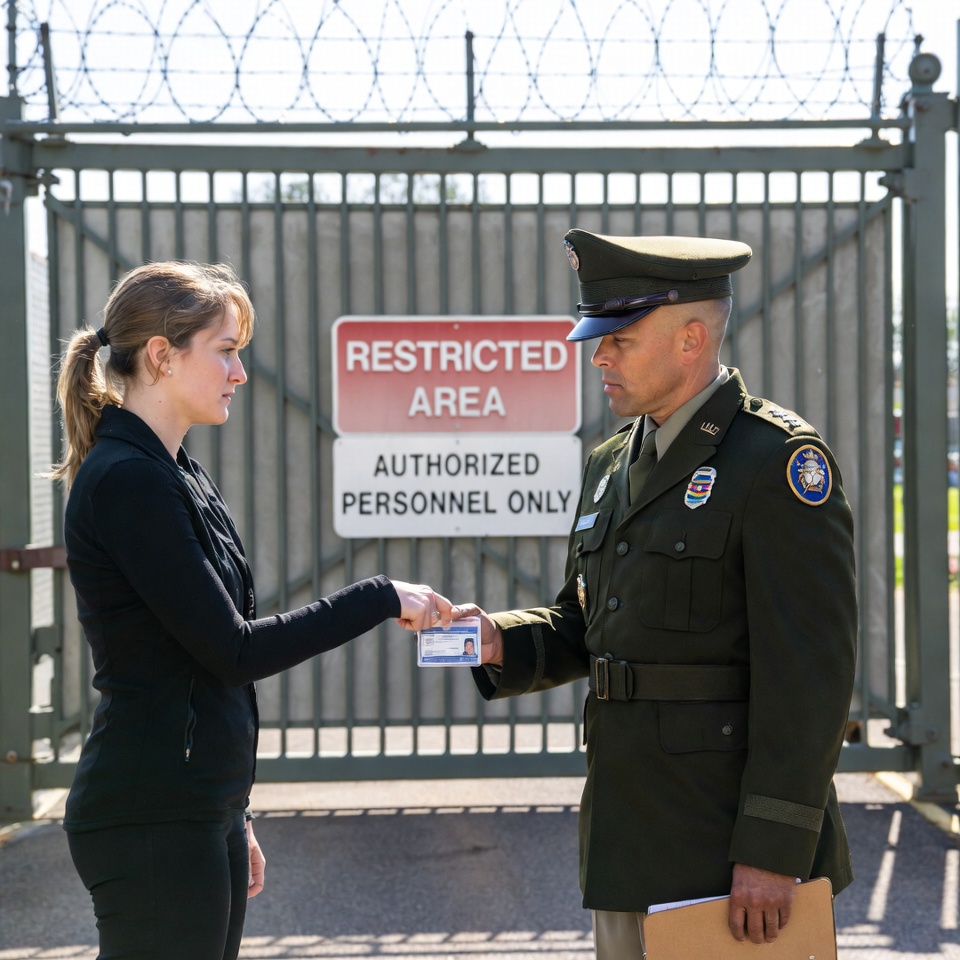
The Guard Laughed In My Face. “Ma’am, I See The General’s Daughter Every Day. She Just Walked In.” But Here’s The Thing… I Am His Daughter. I Haven’t Seen My Father In Three Years, And Suddenly, Someone Has Stolen My Life. Instead Of Causing A Scene, I Decided To Play Along To Find Out Who Was Living My Lie.
Part 1
The guard at the command annex outside Arlington looked like he’d already had a long day and it wasn’t even nine-thirty yet. He had mirrored sunglasses, a sunburned neck above his collar, and the kind of bored authority that only comes from standing in front of a secure door while everybody else has somewhere to be.
He took my ID between two fingers, glanced at it, then at me.
“Captain Monroe,” he said, dragging out the last name like he recognized it but didn’t care. “You don’t have a meeting on the schedule.”
“I’m here to see General David Monroe.”
His mouth twitched. Not quite a smile. More like he’d just been handed something annoying.
“Ma’am,” he said, leaning back in his chair, “I see the general’s daughter every day.”
For a second I honestly thought I’d misheard him.
He gave a short laugh, pointed past me toward the secured glass doors behind the desk, and said, “No offense, but unless the general suddenly grew another one, you’re wasting your own time.”
Then the doors opened.
A woman stepped through them like the building itself had approved her shape. Mid-thirties, maybe. Dark blonde hair pulled into a smooth knot at the nape of her neck. Navy dress, cream jacket, low heels that didn’t click so much as announce themselves softly on the polished floor. She didn’t fumble for a badge. She didn’t slow down. A receptionist glanced up and smiled at her with the lazy ease people use on someone they’ve already sorted into the category of belonging.
The guard nodded toward her without lowering his voice. “See?”
The woman didn’t look at me. Why would she? From where she stood, I was just another uniform by the desk.
I could have made a scene. I could have pulled rank, demanded a call up the chain, forced the issue in the dumbest possible way. Instead, I stepped aside, thanked the guard with a calm I didn’t feel, and took a plastic chair by the coffee machine in the waiting area.
The coffee smelled scorched, like somebody had left a pot on the burner since dawn. The chair bit into the backs of my thighs through my uniform slacks. I set my phone face down on my knee and watched the lobby through the reflection in the dark TV mounted near the ceiling.
People moved through that annex like water had memorized the shape of the room. Civilian aides with clipped badges. Officers carrying folders with their thumbs tucked over the edges. Contractors with rolling cases and the watchful eyes of men who’d learned how to look temporary while getting exactly where they needed to go. Nobody hurried, but nobody wandered. The place ran on repetition, and repetition always leaves tracks.
Ten minutes later the woman came back through the secured doors. This time a colonel joined her from the left corridor, falling into step beside her without breaking stride. He didn’t ask who she was. He didn’t gesture her toward the desk to sign anything. He just matched her pace like that was what the morning expected.
The receptionist offered her a familiar smile. One of the guards shifted a delivery cart out of her path without being asked. She thanked no one and explained nothing.
That was what made my stomach tighten. Not arrogance. Routine.
I stopped watching faces and started watching access points.
The main scanner by the front desk slowed everybody down. The side hallway near the service desk didn’t. Every few minutes, someone badged through the inner door and the magnetic lock released with a soft click. If another body moved at the same pace and with the same confidence, there was a split second where the door didn’t know it was making a mistake.
The first time I could’ve tried it, I didn’t. The second time would’ve been too obvious. On the third cycle, two civilian analysts came through talking about briefing packets while a maintenance contractor pushed a cart from the opposite side. The guard’s eyes went to the cart. I picked up a discarded visitor folder from the empty chair beside me and stepped into the stream like I belonged to its current.
One badge hit the scanner. The door released. The analysts kept talking. The contractor angled his cart. I walked with my shoulders set, my face neutral, one hand on the folder.
“Ma’am?” somebody called from the desk.
Too late.
The door clicked shut behind me and I was inside.
The annex smelled different past the lobby—cooler air, printer toner, carpet cleaner, and that sharp little metallic note government buildings always seem to collect in their vents. I kept my pace even and took the first corridor that offered cover without looking deserted.
Framed commendations lined one wall. Donor plaques lined the other. Then the photos started.
Holiday receptions. Outreach dinners. School supply drives. Family readiness luncheons under white tents with flags in the background. I slowed near a display case and forced myself not to freeze.
In one of the newest photos, my father stood beside a senator, two corporate sponsors, and the woman from the lobby.
She wasn’t tucked into the edge of the frame like an assistant caught there by accident. She stood one step from him, close enough to read as personal. Her smile was controlled and small. My father’s expression was the public one he’d worn my entire life—square shoulders, calm authority, a face that didn’t ask to be liked because it had already decided respect would do.
Anyone looking at that photo would’ve built a story around it. Of course they would. Human beings are obsessed with arranging strangers into families.
I moved on before anybody saw me staring.
The corridor bent toward quieter offices where the carpeting got thicker and footsteps turned muffled. Ahead of me, the same colonel from the lobby stepped out of an office carrying a black folder. A younger officer met him beside a printer alcove.
Their voices were low, but the hallway carried sound in broken pieces.
“The afternoon list changed,” the younger man said.
“Only on paper,” the colonel answered. “She still takes the west route.”
“And the packet?”
“Keep the shorter version in the room. If he wants the full file, he can ask for it himself.”
“You think he will?”
“Not if timing holds.”
I angled myself toward a bulletin board crowded with RSVP cards and color-coded schedules, pretending to read while I watched their reflections in the copier glass.
“Security already logged her for the donor reception,” the younger officer said.
“That was yesterday,” the colonel replied. “Today she walks in clean, sits where she’s told, and says nothing unless she’s brought in.”
The younger officer took the black folder. The colonel turned and headed away without checking the hallway behind him.
I kept going until I reached an office suite tucked behind the conference corridor. Visitor Coordination and Family Support was printed on a little acrylic sign beside the doorway. The room looked like the kind of place people with stars on their shoulders depended on without ever noticing who worked there.
Two printers hummed against one wall. A corkboard held seating charts. A woman in a pale cardigan sat behind the counter sorting name cards beside a half-empty cup of coffee gone cold enough to leave a skin on top.
Her badge read DANA PHELPS.
She looked up, saw the uniform, saw the folder in my hand, and filled in the rest for herself.
“You’re early,” she said. “Honestly, that helps me.”
Before I could answer, she pulled a packet from a tray labeled AFTERNOON RECEPTION, flipped through a checklist, and frowned.
“They changed the head table again. I swear these people would rearrange the Last Supper if they had enough cardstock.”
She slid the top sheet toward me while muttering, and my eyes landed on a seating chart before my hands even moved.
Under the general section, already printed in black block letters, was a place card assignment for Amber Collins.
Not donor contact. Not civilian liaison. Not consultant.
Family Representative.
I felt my fingers go cold.
Dana kept flipping pages. “Captain Carter confirmed her placement this morning, so if they move her again, they can explain it to him.”
The next sheet was a transportation route list.
Amber Collins again.
West entrance clearance. Private escort. Immediate family protocol.
It wasn’t rumor. It wasn’t gossip. It was typed, reviewed, approved, and made ordinary.
“You’re not here for the donor briefing, are you?” Dana asked, finally noticing I hadn’t touched the packet.
“No,” I said, and the sound of my own voice startled me a little.
She straightened. “Then who are you here to see?”
“The general.”
Something in my face must have reached her before the name did, because I watched confusion move through her features in stages. Politeness first. Then uncertainty. Then the tiny, ugly recognition that the paperwork in front of her suddenly no longer fit the human being standing across from her.
A deep voice behind me said, “She isn’t with the list.”
I turned.
My father stood at the mouth of the suite in service uniform, one hand at his side, his face so controlled I could only read what wasn’t there. No surprise. No warmth. No guilt obvious enough to grab with both hands.
“Come with me, Kelsey,” he said.
He led me into a smaller office off the corridor. Secure monitor on the wall. Narrow desk. Two chairs. A window overlooking a parking lot full of government vehicles baking in pale morning light. He closed the door and looked at me for one long second.
“You made it farther than I expected,” he said.
“That doesn’t sound like concern.”
“It isn’t. It’s an observation.”
I set the borrowed folder on his desk. “There’s a woman walking through your annex under immediate family protocol.”
“Yes.”
That single word hit harder than denial would have.
I stared at him. “You knew.”
“I knew something had been arranged around me,” he said. “I did not know how wide it ran.”
“So you called me.”
“Yes.”
“Why?”
He didn’t hesitate. “Because investigators move loudly, and loud men make people clean up after themselves. Because you notice patterns. Because if I was wrong, you’d know it in under an hour.”
Useful. That was what he’d reached for. Not his daughter. Not the woman he hadn’t seen in three years. A set of skills.
The old sting came back with embarrassing speed, hot and clean as a blade.
“You asked me to walk into your mess.”
“I asked an officer I trust to tell me what my own building would hide.”
“That is not the same thing as asking your daughter.”
“No,” he said quietly. “It isn’t.”
He stepped aside and pointed toward the dark monitor.
“Stay out of sight,” he said. “Let the afternoon meeting proceed. If they think the day is still normal, they’ll keep making normal mistakes.”
I looked past him. Through a narrow strip of glass I could see the conference room below being set in neat rows of paper and water glasses.
Amber Collins entered a minute later, moving with the easy certainty of a woman already fitted into someone else’s life.
Her name sat on the placement chart where mine should have been, and all at once I understood that whatever this was, it had already been happening long enough to grow roots. If that was only the surface, how deep had they buried me?
Part 2
I spent the next hour in a dark observation room above the conference corridor, watching people prepare for a meeting that hadn’t happened yet and remembering exactly why I had gone three years without seeing my father.
The room smelled faintly of dust and overheated electronics. There was a long counter under the window, a wall monitor turned to a muted camera feed, and a cheap office chair with one wheel that pulled left. Below me, aides laid out notepads in straight lines and checked water pitchers like the correctness of glass placement could hold the world together.
That was always the military illusion, especially at the top. If the surfaces stayed precise enough, maybe nobody would notice what had rotted underneath.
My mother used to joke that my father’s favorite language wasn’t English. It was order.
Leah Monroe had been the opposite of order in every way that mattered. She liked tomatoes so ripe they bled across the cutting board, paperback novels with cracked spines, yellow legal pads covered in slanted handwriting, and wind chimes that never matched the rest of the house. She had a laugh that started low and made other people lean in. She turned base housing into homes with thrift-store lamps and cinnamon candles and bowls of lemons that made every kitchen smell like sunlight.
My father had loved her. I know that. Love wasn’t the part he failed at first.
Presence was.
He missed birthdays, promotion dinners, orthodontist appointments, anniversaries, my high school regionals, and the week my appendix almost burst because he was already wheels-up to Germany by the time my mother called. We adjusted. Military kids get good at adjustment. We learn how to treat disappointment like weather—real, inconvenient, and not worth standing in the yard screaming at.
The part I never really forgave happened after my mother died.
She’d been sick for months by then, the kind of sickness that turns a whole house quiet. I came home on emergency leave. My father was in Brussels for a summit and told me he was trying to get back. He did get back. Forty-three minutes after she died.
At the funeral, while I still had dirt under my nails from touching the edge of her casket, he leaned toward me in dress uniform and said, “The press is outside. Stay near me for the receiving line.”
Not, Are you all right.
Not, I’m sorry.
Stay near me.
Like grief was something we could arrange by height and camera angle.
I walked out before the receiving line started. I ignored his calls for a week. Then a month. Then three years passed with surprising efficiency.
A soft knock at the observation room door pulled me back.
When I turned, Master Sergeant Manny Price stood there with two paper cups of coffee. He’d been my father’s aide forever, long enough that some of my earliest memories included his laugh in our kitchen and his huge careful hands fixing whatever had broken in base housing that week.
He held out one cup. “You still drink it ugly?”
I took it. “If by ugly you mean black and punitive, yes.”
“That tracks.”
The coffee was terrible. Burnt and thin. Familiar.
Manny leaned beside the monitor and looked through the glass at the room below. “I was hoping I was wrong,” he said.
“So was I.”
He rubbed a hand over his jaw. “I knew they’d gotten too comfortable with that woman. Didn’t know the paperwork ran this deep.”
“How long?”
He exhaled through his nose. “Maybe nine months? First she was at donor luncheons. Then family readiness events. Then people stopped introducing her and started assuming.”
I looked at him. “And nobody thought to call me?”
He met my eyes for a beat, then looked away. “Some of us figured your father had reasons. Around here, reasons are like mold. They spread in the dark.”
That was the most criticism Manny had ever allowed himself where my father was concerned. It landed because I knew what it cost him.
“I need records,” I said.
He nodded once. “Dana’s spooked enough to help if you ask plain. I can get you into the outer admin system before legal locks it down.”
Ten minutes later I was standing at Dana Phelps’s desk again while the printers spit out access logs.
Dana had recovered the kind of composure civilians in military buildings perfect over time: polite voice, sharp eyes, hands that keep moving while their owner is thinking too much. She slid the first stack toward me without commentary.
Amber Collins. West entrance. Forty-seven entries in nine months.
Another sheet: archive room access tied to Family Continuity Exemption.
Another: Monroe Family Resilience Fund event handling.
My throat tightened.
The Monroe Family Resilience Fund had been my mother’s project long before somebody put my father’s last name in front of it and got corporate sponsors to pose beside foam-core posters. She’d started it small—emergency grants for military spouses, rent bridge funds, tutoring for kids who had moved one too many times in one school year. She kept handwritten thank-you notes from women who mailed back twenty-dollar checks years later because they’d finally gotten steady on their feet.
After she died, the fund got bigger. More polished. More photographed.
I had never once asked what that polish had cost.
Dana pointed to a line item with the eraser end of a pencil. “This is where it shifted,” she said quietly. “Colonel Briggs approved special routing for her after the spring donors’ summit. After that, staff stopped tagging her as consultant and started tagging her as continuity support.”
“Continuity for what?”
Her mouth tightened. “For rooms that don’t like visible absences.”
That sentence hit me in the chest so hard I had to look down at the paper to steady myself.
I took the next sheet and scanned it. Amber had been granted archive access three times in the last six weeks. Once after business hours. Once on a Saturday.
“What archives?” I asked.
Dana glanced toward the hallway before answering. “Your mother’s outreach files. The old foundation records. Family event books. Legacy materials. They moved most of them out of the residence storage room last year and indexed them here.”
Manny appeared in the doorway like he’d been waiting for that exact line.
“Not all of them,” he said.
He held up a small brass key, dull with age.
“Some boxes stayed at the house,” he said. “Because your mother didn’t trust paper she loved to people who wore lanyards.”
I took the key from his palm. It felt cold and old and too small to matter as much as it did.
“Someone asked about those boxes last week,” Manny added. “Didn’t say why. I said I didn’t know where the spare key was.”
“You lied?”
He shrugged. “I served your father for twenty-six years. Doesn’t mean I never learned discretion from your mother.”
Before I could answer, a movement through the glass caught my eye.
In the outer office below, on the credenza outside my father’s conference room, a silver frame had been turned slightly toward the corridor. From this angle I could only see half the image, but I knew the frame. It used to hold a picture of the three of us in North Carolina, my mother wearing a ridiculous straw hat at a summer change-of-command picnic.
Now it held something else.
A photographer’s crop, cleaner and newer. My father at some function. Amber just inside the edge.
Maybe staff had swapped it. Maybe he had. The not-knowing felt almost worse than certainty.
I pocketed the brass key and stacked the access logs.
Below us, aides began taking their seats.
Amber Collins was due in that conference room in less than fifteen minutes, and somewhere between my mother’s files and my father’s silence, there was a version of the truth neither of them had given me yet. If Amber had been in my mother’s archives, what exactly had she gone there to steal?
Part 3
By the time the meeting started, the room below had settled into that specific kind of government quiet that isn’t peaceful so much as expensive.
Senior officers sat with their backs straight and their expressions professionally blank. Civilian advisers arranged legal pads and tablets in careful little territories. Water glasses caught the white overhead light and turned it brittle. If you didn’t know better, it could have looked dull. Most important rooms do, right up until they stop.
I stayed in the observation room with the lights off, one shoulder against the wall, coffee cooling in my hand.
My father entered last.
It was a small thing, and still weirdly theatrical. Nobody stood. Nobody needed to. His presence shifted the room all by itself, like a large object entering water. He took the chair at the head of the table, laid one hand over a closed folder, and began with routine updates in that flat, controlled voice I had grown up hearing through thin walls and partially opened office doors.
Readiness numbers. Travel adjustments. Outreach schedules. Sponsorship totals.
He sounded almost bored.
Colonel Briggs sat three seats down, silver hair neat, notes aligned with military precision. Captain Carter had a packet stacked beside him and touched the page tabs too often, which told me he was nervous before he ever opened his mouth.
Amber Collins entered after the others were already seated.
Charcoal dress. Pale jacket. Hair down this time in a low wave over one shoulder. The look was softer than the morning version, less office and more polished donor event. Nobody at the door challenged her. One staff officer glanced up, registered her, and looked back at his notes.
That tiny non-reaction made my skin crawl.
My father let the meeting settle into rhythm before he turned to Carter.
“Captain,” he said, “the revised reception packet.”
Carter cleared his throat and passed the shorter packet forward. The same one I’d heard Briggs mention in the hallway. He began walking the table through attendance, donor priorities, table placements, and messaging for the evening reception.
He almost made it through two minutes.
Then my father tapped one printed name on the seating chart.
“Explain this designation.”
Carter looked down.
Even from above, I saw the hitch in his breathing.
Amber answered before he did.
“That placement was made for continuity,” she said smoothly. “Some outside guests respond better when there’s a stable family point of contact.”
Every face in the room shifted toward her.
She kept going, calm as a woman discussing table linens. “The general’s schedule is demanding. Events move more efficiently when there’s someone familiar to absorb personal questions and preserve flow.”
Flow.
My family reduced to event flow.
Briggs leaned in with practiced restraint. “It was meant as a temporary protocol solution, sir. Nothing literal.”
My father looked at him for a long second. “Temporary by whose authority?”
Nobody answered.
The silence that followed had weight. Legal officer not writing anymore weight. Civilian adviser suddenly very interested in the table weight. Captain Carter gripping his own pen hard enough to turn his knuckles pale weight.
My father opened the folder in front of him and slid out a thin stack of documents.
“Captain Carter,” he said, “read the designation line.”
Carter swallowed. “Family representative for principal host continuity.”
“And this one?”
“Priority internal routing, west entrance clearance, reception handling under immediate family protocol.”
Another page.
“And this one?”
Carter’s voice dropped. “Legacy archive access under family exemption.”
Amber’s posture changed almost invisibly. Not enough for anyone who didn’t know how to watch bodies. Her shoulders stayed square, but the easy confidence was gone. What sat in its place was maintained composure. Effort.
Briggs reached for his answer. “Those labels were administrative shorthand. They were never intended as factual identification.”
My father pressed a control on the table.
The wall monitor behind him shifted from the meeting agenda to a lobby camera still from the day before. Amber walking in through the west side channel while a staff aide redirected two guests to clear the path. Then a corridor clip from that morning: Briggs handing the black folder to Carter. Then another still: the seating chart from Dana’s desk, zoomed close enough that Amber Collins and Family Representative filled the screen.
Nobody moved.
My father said, “Interesting. Because the same shorthand appears across three separate event packets, two access logs, archive requests, and donor routing summaries over a six-week period.”
He turned one more page over and laid it flat.
“Captain Carter. Who approved the language?”
Carter answered too fast. “Colonel Briggs reviewed all continuity language, sir.”
Briggs turned to him with a face I might once have called grandfatherly if I had never seen a man decide in real time whom he would sacrifice. “That is not accurate.”
“It is accurate,” Carter shot back, fear stripping the polish out of his voice. “You told me to make it consistent because donors responded better when she looked official.”
No one said anything.
Amber broke first.
“I never asked for those words.”
My father looked straight at her. “You accepted the access attached to them.”
That landed. I could see it.
She tried again. “I accepted a role I was told would help your office.”
“A role,” he repeated, “that required my daughter’s place card, my wife’s archives, and private family routing.”
Her jaw tightened. “I never said I was Captain Monroe.”
“No,” I said before I realized I had moved.
Every head in the room snapped upward toward the dark observation glass as I stepped into the lit doorway and started down the stairs.
The sound in the room changed when I entered. Not louder. Sharper. A whole table full of people recalculating at once.
I stopped beside the screen where Amber’s name still glowed on the seating chart.
“You didn’t have to say it,” I told her. “You just let everybody else build the lie for you.”
She looked at me in a way I understood immediately and hated even more. Not shame. Assessment.
Then she said, very quietly, “Somebody had to show up.”
I felt that line hit old scar tissue.
My father’s head turned a fraction, just enough to tell me he had heard the same thing I had.
He closed the folder.
“Colonel Briggs,” he said, his voice suddenly final in a way that made the room feel smaller, “you are relieved pending formal investigation. Captain Carter, you will surrender your credentials after this meeting and report to legal review. Ms. Collins, your access to this annex is revoked immediately. Security will escort you out.”
The words were clean. That was the difference between rage and command. Rage splashes. Command cuts.
Security entered. Nobody argued. Nobody defended Amber once the room understood the balance of power had finished shifting. Briggs stood slowly, like a man trying to preserve dignity through physics alone. Carter looked like he might be sick.
Amber rose last.
As security moved toward her, she looked at me again with those unreadable, careful eyes and said, “You should ask him what he already knew.”
Then they took her out.
The meeting dissolved with bureaucratic efficiency, which was somehow one of the bleakest parts. Chairs scraped. Notes were gathered. Legal got very busy. The building moved toward correction the way bodies move toward clotting.
I followed my father into a side hallway that smelled faintly of paper dust and floor wax.
“You let her get close enough to become normal,” I said.
He didn’t deny it.
“I let staff solve a problem I refused to handle,” he said. “That is not the same as authorizing what happened here.”
“Maybe not on paper.”
His mouth tightened. “There may be more.”
I laughed once, ugly and short. “You think?”
He ignored that. “Archive requests were pulled this morning before the meeting. If Briggs thinks he still has room to contain this, he’ll reach for the source material. I need to know what he was looking for before formal seizure locks everything down.”
“What do you need from me now?”
He held my gaze. “One more day.”
I could have walked away then. Maybe I should have. But Amber’s words were still in my ears, and the idea of there being more—more rot, more silence, more things hidden behind phrases like continuity and flow—made leaving feel too much like surrender.
“I’m not doing this for you,” I said.
He nodded once. “Understood.”
Security led Amber past the end of the hallway just then. She turned her head as she crossed the intersection. Through the glass panel between us, she mouthed two words.
Ask him.
I stood there with my pulse kicking hard in my throat, watching her disappear around the corner, and understood that the meeting had only blown open the top layer. Whatever she thought my father had buried, she was betting it could still split us wider.
Part 4
The house in McLean looked smaller than I remembered, which is one of the meaner tricks time plays on places that once felt impossible to outgrow.
My parents had bought it when my father made three-star. Brick front, white columns nobody needed, two sugar maples in the yard, and a kitchen my mother filled with enough warmth to make the rest of it feel less like a promotion prize. After she died, my father had stopped really living there. Staff maintained it. Lawn cut. Mail collected. Lamps on timers. A home reduced to upkeep.
The brass key Manny gave me fit the side door.
Inside, the air held old lemon polish, closed-up rooms, and the faint stale sweetness of cardboard. The refrigerator hummed in the kitchen. Somewhere deeper in the house a grandfather clock ticked like it resented still being asked to matter.
I stood in the mudroom for a second with my hand on the doorknob and let the quiet hit me.
Memory is physical. That’s the part people never warn you about. It lives in your shoulders, your tongue, your skin. One smell and your body starts recognizing things your mind hasn’t even named yet.
My mother’s rain boots used to live in that corner. My father’s car keys used to land in the blue bowl by the stairs. She used to leave basil cuttings in jars by the sink until they rooted.
All of that was gone.
I went straight to her study.
The room still had her desk, her books, and the faded Persian runner she’d bought at an estate sale because she said perfect rugs looked frightened. But the filing boxes stacked by the far wall had been opened and badly repacked. Tissue paper hung out in gray crumples. Folder tabs sat crooked. Somebody had rifled, not curated.
I crouched by the nearest box and started sorting.
Event programs. Handwritten donor lists. Christmas-card addresses. Grant requests in my mother’s slanted blue ink. Old seating charts from family dinners and fundraisers. A packet of Polaroids rubber-banded together so tightly the top one bowed in the middle.
Three boxes in, I started noticing the gaps.
Her silver charm bracelet was missing from the velvet tray in the desk drawer. The guest book from the first Resilience Fund dinner was gone. So were two of the early ledgers she used to track emergency grants before the fund went digital.
Not random theft. Selective.
I searched harder.
The closet held bins of holiday linens and framed photographs wrapped in old towels. A locked fire safe sat under a shelf of scrapbooks, the kind my mother bought because she never trusted technology with anything sentimental. The latch bore fresh scratches.
Somebody had tried to force it and failed.
The combination came back to me in pieces while I stared at it: my birthday, then hers, then two numbers she always said made a good ending because they “felt lucky in the mouth.”
The safe clicked open.
Inside were three leather-bound journals, a stack of envelopes tied with faded ribbon, and a slim blue folder marked L.M. PRIVATE.
I sat on the floor to read.
The journals smelled like dust and old paper and the ghost of my mother’s perfume, something citrusy and warm that used to cling to the inside of her scarves. Her handwriting was exactly the same as I remembered—forward-leaning, impatient, full of loops that crossed their own confidence.
At first the entries were ordinary. Donor complaints. Grant updates. Notes about spouses at Fort Belvoir. A line about my father forgetting to eat lunch during budget week and pretending that was noble.
Then the tone shifted.
Briggs again. Keeps pushing “streamlined family optics” for donor events. As if people are props you move nearer the flowers.
Another entry, two months later: David says Briggs only means the rooms need warmth. Men always rename exploitation until it sounds logistical.
And then one that made me stop breathing for a second.
If Kelsey is away, that does not create a vacancy to fill. I will not have substitutes brought in to soothe men who prefer appearances over the honest discomfort of absence.
My mother had seen it years earlier. Not Amber specifically. The impulse.
The idea that a family could be treated like missing décor.
I turned the page too fast and found a section torn out cleanly near the binding.
My stomach dropped.
The ripped edge was recent enough to be pale. On the back of the next page, pressed through from whatever had once been written there, was a note in my father’s block handwriting:
Burn after review.
I stared at those three words until the room blurred at the edges.
Maybe it referred to something innocent. Maybe it referred to a donor dispute, a draft memo, a piece of gossip my mother had wanted handled discreetly. But I knew my father’s handwriting. I knew the clipped impatience of it. I knew, too, the cold little sound my own pulse made when pain finds a place it recognizes.
Someone had gone into my mother’s safe.
Someone had torn out the page attached to that note.
And my father had at least seen whatever it was once.
I opened the blue folder next.
Inside were typed board memos for the Resilience Fund, annotated in my mother’s hand. One page had a whole paragraph circled so hard the pen had nearly torn through.
Community engagement events must never blur formal roles within command structures or imply family endorsements where none have been offered.
In the margin she’d written: Richard will do this if David lets him.
Richard. Briggs.
I sat back on my heels and looked around the room. Late afternoon light slanted through the shutters in narrow gold bars. Dust moved through it like the room was quietly burning from the inside out.
The floorboard outside the door creaked.
I was on my feet before the second sound came.
But it was only Manny, one hand lifted, his expression grim.
“Thought you might want dinner,” he said, holding up a paper bag from the diner my mother used to like.
I looked at the torn journal page in my hand. “Did he know?”
Manny didn’t play dumb. He glanced at the page, at the note, then back at me.
“I don’t know how much your father knew,” he said carefully. “I know how much he was willing not to look at if the room stayed quiet.”
That was somehow worse than an outright lie.
I closed the journal and felt the old house settle around us, every board and stair and closed cabinet holding more memory than either of us could name in one night. My mother had seen the shape of this years ago, and somebody had stolen the page where she might have said exactly how far it went. If my father had read it once and let it disappear, what else had he let vanish because the uniform was easier to live inside than the truth?
Part 5
Major Owen Barrett met me the next morning in a secure conference room at the Inspector General annex two buildings over from the one my father controlled.
That mattered to me more than I expected.
There’s a specific relief in walking into a room where your father’s name doesn’t function like weather. The IG space smelled like copier toner, dry carpet, and somebody’s cinnamon gum. The chairs were ugly but honest. Nobody stood up straighter when a general crossed a hallway because generals didn’t own hallways there.
Owen stood when I entered anyway, out of courtesy instead of fear.
He was taller than I remembered, or maybe I was just seeing him in a room where both of us had finally become the ages we looked. We’d crossed paths once in Kuwait years earlier when he was intel support and I was attached to a team that lived on bad sleep and worse coffee. He had the same steady eyes, same habit of listening with his head tilted half an inch like he was testing the weight of each sentence before deciding whether it could stand.
“Captain Monroe,” he said.
“Major.”
“Your father asked for quiet review before formal referral. I told him quiet review and protection are not the same thing.”
“That sounds like something he hated hearing.”
Owen’s mouth moved almost into a smile. “He did not love it.”
We spread everything out across the table—access logs, donor lists, copies from my mother’s journals, archive pulls, reimbursement forms Dana had quietly exported before legal locked her workstation.
Once the paper started talking, the pattern sharpened fast.
Amber Collins had entered the picture officially as a consultant through Collins Community Strategies, a tiny nonprofit-adjacent firm tied to Senator Malcolm Vance’s wife. The stated purpose was “family outreach continuity” for high-visibility donor events. It sounded harmless until you laid it next to the access routing.
Consultant became continuity support.
Continuity support became family representative.
Family representative became private access, archive entry, and donor-side proximity to my father.
I sat with a yellow legal pad and wrote dates in columns until my handwriting went blocky.
Spring donor summit.
West entrance clearance approved two days later.
Archive access one week after that.
Private sponsor dinner.
Family readiness brunch.
Two contractor roundtables.
A senator’s staff breakfast.
Owen slid another sheet toward me. “These are the outside guest lists cross-referenced against your father’s pending recommendation schedule.”
I looked at the names.
Defense contractors. Senior congressional aides. Procurement counsel. A lobbying firm with three different shell-style community outreach groups attached to it. The same cluster kept reappearing around evenings where Amber had been routed under continuity handling.
“This wasn’t just about making rooms comfortable,” I said.
“No.”
“What was it?”
He tapped the guest list with one finger. “Influence laundering.”
I looked up.
“People guard themselves around rank,” he said. “They relax around family. Or what they think is family. They say more. They ask more. They make softer pitches because they think they’re entering through a human door instead of an official one.”
I thought of my mother’s journals. Streamlined family optics. Temporary daughters.
The phrase made me want to put my fist through something.
Dana arrived twenty minutes later with a flash drive tucked inside a legal envelope and the strained expression of a woman who had crossed from clerical inconvenience into criminal discomfort.
“I didn’t print these from my desk,” she said before sitting. “I don’t need that on record.”
“You’re helping,” I said.
“I’m surviving,” she corrected. “Helping is a side effect.”
On the drive were archived calendar pulls. Some had been deleted from the visible schedule and restored from the backend by a tech Owen trusted. Most were coded in the vague, bloodless language administrators use when they’re hiding specificity in plain sight.
Stakeholder dinner.
Legacy outreach review.
Continuity touchpoint.
Then one entry stopped me cold.
PRIVATE FAMILY DINNER – RESIDENCE
Host: Gen. D. Monroe
Attendee: Amber Collins
Six weeks ago.
I read it twice.
Then a third time, because sometimes your eyes refuse to believe what your body has already accepted.
Owen saw my face change. “We can’t know context from the entry alone.”
I laughed, but there was no humor in it. “That’s generous.”
“He may have been sold something partial.”
“He may have known exactly what he was doing.”
Dana looked down at her hands.
Neither man rushed to defend him. I appreciated that more than any speech could have managed.
I stared at the calendar entry while anger did its ugly work inside my ribs.
A private family dinner at the house my mother had built and died in. Amber Collins sitting at a table where my mother used to leave thumbprints in pie crust. My father across from her, letting some staff-engineered counterfeit absorb the questions he didn’t want to face.
Maybe it was all tactical. Maybe it wasn’t. Either way, he’d sat there.
Dana pushed one final sheet toward me. “There’s more.”
It was a reimbursement form from Collins Community Strategies. A payment request tied to “legacy materials review” and same-day courier services for donor image packets. The date matched one of Amber’s archive visits.
“She wasn’t just using your mother’s files to learn stories,” Dana said. “She was pulling content.”
“What kind of content?”
“Family language. Biographical notes. Handwritten signatures for program cards. Anecdotes about the general’s marriage. There’s a binder—at least there was—called Personal Touch Points.”
I closed my eyes for a second.
My mother’s life reduced to a prompt sheet.
When I opened them, Owen was watching me with that careful, infuriatingly patient expression.
“You need facts, not the first version that hurts the worst,” he said.
“I’ve got both.”
He didn’t argue.
I folded the calendar entry in half and set it in front of me like a challenge coin I hadn’t earned and didn’t want. My father had asked for one more day as if time were the only thing he needed from me. But there it was in black print: he’d already made space for Amber at his table weeks before he ever called me. If he’d sat down to dinner with her under my mother’s roof, what exactly had he lied about when he told me he hadn’t known how far this went?
Part 6
I confronted my father at the residence that evening because I didn’t trust myself to do it in his office without breaking something expensive.
He was in the study with the lights on low, jacket off, tie loosened, reading glasses in his hand instead of on his face. It was the first time in years I had seen him in a posture that looked almost ordinary. The room smelled like cedar shelves, old leather, and the bourbon he poured and barely drank.
For one ugly second, that normalcy softened me.
Then I remembered the calendar entry in my pocket.
“You had dinner with her,” I said.
He didn’t ask who.
He set the glasses down. “Yes.”
The word landed with an awful steadiness. Not even a flinch.
I took the printed entry out and laid it on the desk between us.
“Private family dinner,” I said. “At the house.”
He looked at the paper, then at me. “Briggs arranged it as a donor transition meal after a canceled event. I was told she had already been serving as a continuity contact for the foundation.”
“Continuity contact.” I almost choked on the phrase. “Did you hear yourself?”
“Yes.”
“And?”
“And I let it stand.”
There are answers so blunt they sound like cruelty.
I stared at him, waiting for explanation to do what explanation always wants to do—make pain feel more reasonable. It didn’t.
“She was already in the room by then,” he said. “At functions. At outreach dinners. Staff had been using her to absorb personal questions. To move the evening along.”
“So you knew.”
“I knew some version of it.”
“Enough to invite her into this house.”
His jaw tightened. “Enough to stop correcting every assumption in rooms full of donors, senators, widows, and reporters who all wanted a cleaner narrative than the truth.”
“And what was the truth, exactly?”
He looked at me with an honesty I almost wished he’d spared me.
“That my wife was dead,” he said. “That my daughter had every right not to return my calls. That I was tired of seeing people register those facts and then rearrange their faces into pity.”
The room went still.
I could hear the grandfather clock in the hall. A car passing outside on wet pavement. My own breathing, too fast and too shallow.
“So you hired a substitute,” I said.
“I did not hire her.”
“You let her happen.”
His silence was answer enough.
I felt something in me go cold and clean.
That was the part that mattered. Not whether he’d designed the whole scheme. Not whether he’d ordered the forged paperwork or the archive access or the lies. He had permitted the foundational insult. He had allowed the existence of an empty chair to become a logistical inconvenience other people could solve.
He saw it on my face. I know he did.
“Kelsey—”
“No.” I held up a hand. “Do not do that thing where you start saying my name like it counts as repair.”
He stood, slowly, like quick motion might make me bolt.
“I was wrong,” he said.
“Yes.”
“I thought containment was different from replacement.”
“It wasn’t.”
His eyes flickered once, toward the family photo over the mantel. One of the few that still remained. My mother between us at some award banquet, laughing at something off-camera while my father looked at her like he’d forgotten everyone else in the room.
“I didn’t know about the false access designations,” he said. “I didn’t know they’d touched Leah’s archives or used immediate family protocol. I didn’t know Briggs had turned convenience into system.”
“Maybe not,” I said. “But you fed the first inch of it.”
We stood there with all the years between us exposed and useless.
Finally he said, “Amber asked to speak with you.”
I stared at him. “You think I want that?”
“I think she may tell you things she won’t tell me.”
“Of course she won’t. You’re still the institution she was trying to use.”
His face changed very slightly at that. Not anger. Recognition.
The interview room where Amber waited was down at the annex, tucked behind legal review. Fluorescent lights hummed overhead. The table was bolted to the floor. Somebody had left a paper cup of water sweating onto a ringed coaster.
Amber looked smaller without the curated settings around her.
Not fragile. Just less finished.
She wore the same cream jacket from the morning, now wrinkled at the elbows. Her lipstick had worn off. There was a shallow groove pressed into one wrist where a bracelet had recently sat, and something about that detail bothered me before I even knew why.
She didn’t stand when I entered.
“You look more like him in person,” she said.
I sat across from her. “That’s not a compliment.”
“No,” she agreed. “It isn’t.”
For a moment we just looked at each other. She had the kind of face people trust on first meeting—clear skin, level eyes, a mouth trained into warmth that never quite tipped into softness. I could see how rooms had accepted her. I could see, too, how much practice that acceptance had required.
“Why?” I asked.
She rested her fingertips against the table. “Because doors open for family in ways they don’t for consultants.”
“That’s a business answer.”
“It’s a true one.”
I leaned back. “Try again.”
Her jaw tightened. “Because Colonel Briggs recruited me after a scholarship dinner. Because I was good with donors and better with people than most officers are. Because the foundation needed somebody who could make grief look organized. Because your father’s office kept creating situations where a family face would smooth the edges, and nobody wanted the visible vacuum.”
My throat burned. “So you volunteered to wear my skin.”
“No,” she said quickly. “Not yours. I never used your name. I never introduced myself as Captain Monroe.”
“You let them call you his daughter.”
She held my gaze. “At first I corrected people. Then Briggs told me not to embarrass the room.”
I laughed once, short and mean. “How noble.”
She flinched, but only a little.
“He said your father knew,” she said. “Not all of it. But enough. Enough that he thanked me when events went smoothly.”
She reached into the evidence envelope beside her and pushed a printed voicemail transcript across the table.
I read the first line and felt my stomach drop.
Amber, appreciate you stepping in tonight. Keep things smooth. — D. Monroe
I closed my eyes for half a second.
It wasn’t proof he knew everything. It was proof he knew enough to thank her.
When I looked up again, Amber was watching me with something I didn’t want from her and couldn’t quite name. Not pity. Maybe recognition. Maybe just the ugly intimacy of two women forced into proximity by the same man’s failure.
“What were you looking for in my mother’s files?” I asked.
Her eyes shifted then, finally.
“Not for me,” she said.
“Then for who?”
“Briggs.”
“What?”
“He wanted a letter. Or a journal page. Something Leah Monroe wrote before she died. Something that mentioned him and donor routing. He was sure she documented everything.”
My skin prickled. “Why?”
“Because if she did, and if your father ever saw it, then this becomes more than bad optics. It becomes warning ignored.”
The fluorescent hum suddenly sounded louder.
“Do you have it?”
“No.”
“Did you take it?”
“I took what Briggs told me to pull. Guest books, signatures, anecdote files, old donor notes. I didn’t take the page he wanted.”
I believed that and hated myself for it.
As I stood to go, Amber said quietly, “Your father didn’t build the whole machine. But he did stop correcting it long before you showed up.”
I kept my hand on the metal door handle and didn’t turn around.
That was the problem. I already knew it was true. Somewhere between my mother’s torn journal page and my father’s voicemail thanking Amber for keeping things smooth, the story had turned from impersonation into complicity. And if Briggs had been hunting a letter from my mother, then whatever she wrote was dangerous enough to scare people who lived on power for a living.
Part 7
The foundation storage unit was in an old brick office building in Alexandria that smelled like dust, elevator grease, and the stale heat of overworked radiators.
It was the kind of place nobody notices because nothing about it announces importance. A narrow lobby. Frosted directory board. Potted plant by the stairs that had long ago given up on being alive but was still technically present. My mother would have laughed at the beige of it all.
Owen met me there just after sunrise with Dana and two IG techs carrying evidence kits.
“We got a limited preservation order overnight,” he said. “Not enough to seize every related office yet. Enough to stop shredders and copy drives.”
“Comforting.”
“It’s all I’ve got before breakfast.”
We took the freight elevator up to the third floor. The foundation suite still had my mother’s old mission statement in the lobby—updated font, sharper logo, all the humanity sanded off the edges. Families first. Resilience in every season. Beneath it sat a bowl of individually wrapped mints no one had wanted badly enough to open.
Dana unlocked the records room with hands that shook only a little.
Inside, metal shelves held labeled banker’s boxes, donor binders, program albums, and outdated event signage stacked face-to-face like a family reunion of old lies. Fluorescent lights buzzed overhead. Dust floated in the beams every time one of us moved a carton.
I went straight to the legacy files.
My mother’s system was still visible under the later reorganization if you knew how to read her habits. She color-coded by need, not by donor class. She clipped handwritten thank-yous to grant records. She marked urgent cases with little pencil stars in the corner because she thought red ink looked punitive. Somebody after her had added printed tabs and metadata stickers, but they hadn’t erased the bones.
In the third box, under two annual reports and a stack of gala menus, I found an internal board memo with my mother’s handwritten edits all over it.
Subject: Event Structure and Family Presence in Donor Settings
I stood there in the humming fluorescent light and read every line.
She objected to officers using spouses or children as “informal softeners” in donor conversations. She objected to any implication that family members endorsed command-adjacent funding priorities. She objected, very specifically, to Richard Briggs’s proposal for a “continuity liaison” when “primary family figures are unavailable.”
In the margin beside that phrase she had written: I am not dead yet, Richard. And my daughter is not a staffing problem.
The anger in that note felt so alive it nearly made me smile.
Then I reached the last page.
The paragraph had been highlighted decades later with a yellow marker that wasn’t hers.
If General Monroe prefers operational continuity over domestic unpredictability, let the record show I do not consent to my family being operationalized in my absence.
I read the sentence twice.
Then a third time.
Domestic unpredictability.
That was how somebody in a meeting had once named me. Or named the possibility of me having my own will. The words made me feel thirteen and thirty-one at once.
“Barrett,” I said, my voice sounding strange in the metal room.
He crossed to me, read the page, and exhaled slowly. “That helps.”
“Helps who?”
“Anyone trying to prove she warned them.”
Warned them. My mother, reduced to evidence. I hated how necessary it was.
An IG tech at the back station lifted a hand. “We’ve got a wipe attempt on the shared donor archive.”
Owen was beside him in two steps. “Can you isolate?”
“Trying.”
Dana went pale. “Richard must know we’re in here.”
“He doesn’t need to know we’re in here,” Owen said without looking up. “He just needs to know somebody’s finally pulling the thread.”
I moved faster after that.
In a side cabinet marked Legacy Image Materials, I found a binder full of program cards and speech notes. On several pages, my mother’s signature had been scanned, cleaned up, and dropped into layouts she’d never approved. Beside them sat bullet-point summaries under the heading Personal Touch Points.
Leah loved late-summer tomatoes and disliked lilies.
General prefers coffee black; daughter takes same.
Reference family resilience, not grief.
If asked about Captain Monroe, redirect to service demands.
I had to put the binder down.
Somebody had turned us into cheat codes.
Dana swore quietly from two shelves over. “I found reimbursement approvals tied to Senator Vance’s outreach council.”
That fit too cleanly.
Owen took the forms, skimmed them, and muttered, “Here we go.”
The influence network widened as the morning went on. Sponsor dinners lined up beside recommendation dates. Archive pulls lined up beside donor packets. Briggs sat in the middle of it like a man who believed bureaucracy was just power wearing sensible shoes.
And then, tucked beneath a stack of old holiday cards in a box no one had relabeled since my mother died, I found a cream envelope sealed with a strip of tape yellowed by age.
My name was on the front in my mother’s handwriting.
For Kelsey, if your father ever lets strangers speak for us.
I just stared at it.
The room around me kept moving—techs speaking in low voices, paper rustling, Owen on the phone to legal, Dana opening another file box—but all of it went distant and thin. There is no adult age at which seeing your dead mother’s handwriting stop feeling like a hand through your ribs.
I slid a finger under the tape and stopped.
Not there. Not yet.
Maybe I was afraid of what she’d known. Maybe I was afraid of how completely she might have known me.
Owen came over, saw the envelope in my hand, and didn’t ask to read it.
“Take your time,” he said.
That almost made me laugh. Time was the one thing everybody in this story seemed to want from me as though it were neutral, as though more of it didn’t just mean more space for the rot to spread.
I tucked the letter into my jacket.
Down the hall, somewhere beyond the records room door, an elevator chimed.
Owen’s head lifted.
The tech at the terminal said, “There’s another remote access attempt.”
The building suddenly felt porous, like we were standing in a place more people had keys to than we understood. My mother had left me a letter for the exact day my father let strangers stand where family should have been. Whatever she wrote inside that envelope, she had expected the betrayal before I ever did. And if she had, then the worst possibility was no longer that I’d been replaced. It was that I was only the last person to find out.
Part 8
I read my mother’s letter in Owen’s car because I couldn’t bear to open it in a room full of evidence labels and fluorescent lights.
The windows were fogged at the corners from the cold. Somebody had left a wrapper from peppermint gum in the cup holder. The heater clicked softly as it cooled. Outside, Alexandria traffic moved past in gray ribbons under a low winter sky.
My hands shook opening the envelope.
The letter inside was three pages long, written on cream stationery she used to save for thank-you notes and things she wanted people to keep.
Kelsey,
If you are reading this, then your father has done the thing I always feared he would do when life became too painful and too public at the same time: he has let capable strangers smooth over the honest shape of loss.
He will tell himself it is temporary. He will call it practical. Men who live inside institutions become fluent in language that makes betrayal sound procedural.
Do not stand beside him to make that easier.
Do not smile for any room that treats family like décor.
And do not let anyone convince you that being absent from a performance means you forfeited your place in the truth.
Your father loves deeply and badly. Both things can be true. One does not excuse the other.
Choose the life that does not require you to disappear in order to be considered useful.
Love,
Mom
I sat there with the pages in my lap and felt something inside me settle into place with a terrible calm.
Not relief. Relief is too gentle.
More like alignment.
All morning I had been moving through other people’s frameworks—continuity, optics, influence, access, proof. My mother had cut through all of it in six lines. She had seen the exact trap waiting for me before I had even finished becoming myself.
Owen didn’t look at me while I folded the pages back into the envelope. He just handed me a clean napkin from the glove compartment.
“You look like you want to either cry or commit a felony,” he said.
“Can’t I multitask?”
That earned the smallest corner of a smile.
By evening, we were at the gala.
It was held at a private museum event space in D.C., the kind of place where every glass surface reflected soft gold light and every donor badge came clipped to satin ribbon instead of plastic. A brass quartet played near the staircase. Champagne moved through the room on trays with tiny rosemary skewers stuck into things no hungry person would ever recognize as food. Outside, black sedans lined the curb. Inside, money wore navy and pearl and called itself public service.
I wore a black dress Dana loaned me and hated how easy it was to disappear in it.
Owen was in a dark suit with an earpiece so discreet only trained eyes would notice. IG had plainclothes personnel layered through the room, but not enough to make me feel safe. Safety wasn’t really the point anymore. We were there to catch Briggs trying to recover what he thought the morning search might already have found.
My father stood on the stage beside Senator Vance and two sponsor executives, every inch the four-star. Clean lines, measured gestures, face carved into controlled attentiveness. He looked exactly like the man the country trusted with impossible things.
I wondered how many versions of him could stand in the same body before the seams started to show.
Then Amber entered.
She was in deep green this time, silk catching the light when she moved. At her wrist, flashing once as she accepted a program card from an usher, was my mother’s silver charm bracelet.
The sight of it went through me like a current.
“That’s mine,” I said into the mic at my throat.
Owen’s voice came back low in my ear. “I see it.”
“No. It’s my mother’s.”
Amber drifted through the room with a smile trained to look effortless. People greeted her with the warm familiarity reserved for someone who has already survived enough introductions to become part of the landscape. I watched her stop beside two donors, nod at something, then slip toward the service hallway behind the stage.
I followed.
The service corridor smelled like coffee grounds, hot lights, and industrial dish soap. The music from the gala came through the wall as a muted thump. Catering staff moved in quick practiced lines, heads down, hands full. I took the second turn left and stopped just short of the linen storage alcove when I heard Briggs’s voice.
“…tomorrow morning,” he was saying. “Once Monroe signs, the board follows.”
Another man answered. Senator Vance’s chief of staff. I’d heard him on enough C-SPAN clips to know the nasal certainty of it. “And the daughter?”
A pause.
Then Briggs, flat as a knife: “She is a distraction, not a variable.”
I stepped closer, staying in the shadow between a steel prep table and a rolling rack of folded chair covers.
Amber spoke next. “You told me the archive page would be in tonight’s packet.”
“It will be if Carter wasn’t completely worthless.”
“And if it isn’t?”
“Then we proceed with the image materials we have. Monroe will not detonate his own command over family embarrassment.”
There it was again. The bet everything else depended on.
My father would choose containment.
I looked around fast.
A black leather portfolio sat on the catering counter beside a tray of untouched dessert forks. No guard on it. No hand resting near it. Just arrogance. The kind that grows when people spend too long moving through systems that mistake confidence for legitimacy.
I slid the portfolio off the counter and backed away just as a caterer pushed through with a rack of plates.
The noise covered the motion.
I got three steps before Briggs saw me.
“Kelsey.”
My name in his voice sounded obscene.
He moved faster than I expected for a man his age. He cut around the prep station and caught my arm hard enough to bruise.
“That doesn’t belong to you,” he said.
I looked down at his hand on my skin. “Funny. That seems to be a theme.”
His face stayed composed. That was the sick thing. He still thought this could be talked into a shape.
“You don’t understand the scale of what your father manages,” he said. “Institutions do not survive on sentiment. They survive on continuity.”
“My mother had a better word for that.”
He tightened his grip. “Your mother confused moral clarity with operational reality.”
I yanked my arm once. He held.
The bracelet on Amber’s wrist flashed in the doorway behind him as she stared at us, pale now, finally less practiced.
Briggs lowered his voice. “Your father did not need a daughter in those rooms, Captain. He needed a stable symbol. Your absence created vulnerability. I solved it.”
The words hit me like ice water.
I didn’t even realize my phone was already recording in my other hand until later.
Owen arrived out of nowhere and drove Briggs’s arm off me with one brutal, efficient motion. Two plainclothes agents closed from both sides. Somebody shouted. A tray crashed somewhere farther down the corridor.
Amber backed into the wall, breathing too fast.
I clutched the portfolio against my ribs and looked at Briggs while agents pinned his wrists.
“You solved nothing,” I said. “You just taught a whole building how to disrespect the dead.”
Back in the museum office, Owen opened the portfolio while I sat with my pulse still trying to claw its way out of my throat.
Inside were donor talking points, altered briefing summaries, event introductions, and a flash drive taped under the inner flap.
On the drive was a folder labeled MONROE_FAMILY_STATEMENTS.
I opened the first document and felt the room tilt.
It was a scanned page with my mother’s signature lifted from one of her old foundation letters and pasted onto a statement endorsing a donor initiative she had fought against in her own handwriting.
They hadn’t just borrowed her voice.
They had forged the dead.
Part 9
We spent most of the night in a secure review room under fluorescent lights that made everybody look guilty.
The flash drive gave up its secrets in layers.
Draft donor letters with my mother’s signature pasted onto them.
Talking points for event staff on how to introduce Amber without technically lying: “General’s family representative,” “close to the family,” “supports continuity for the Monroe outreach mission.”
Briefing summaries routed through Briggs before reaching my father, some shortened, some selectively stripped of risk language where certain sponsors were concerned.
And then the emails.
That was where the room really went cold.
I sat with Owen and a JAG lieutenant while files opened one after another in neat ugly lines across the monitor. Briggs to Carter. Carter to donor liaisons. Senator Vance’s outreach office to Collins Community Strategies. Amber scheduling appearances. Dana copied on logistics she clearly thought were harmless at the time.
Then one thread from four months earlier.
Briggs: Press concern over repeated questions re: family attendance at legacy dinners. Recommend continuity presence to reduce distraction.
General Monroe: Handle it. Keep the evening focused.
I read it once.
Then again.
Not approval of fraud. Not explicit authorization. But not ignorance, either. Permission in the language men use when they don’t want the details because detail creates obligation.
Owen watched me read it and said nothing.
He didn’t need to.
By three in the morning my head hurt, my eyes felt full of sand, and I wanted to put every monitor in the room through a wall. Instead I stood, walked to the vending machine, and bought a stale granola bar I never opened.
My father arrived just before four.
He looked older than he had yesterday. Not theatrically older. No dramatic slump. Just worn at the edges in a way rank can’t hide forever. His tie was gone. The lines beside his mouth were deeper. He nodded at Owen, at the JAG lieutenant, then at me.
“May we speak alone?”
“No,” I said.
He absorbed that without visible reaction.
“Then in earshot,” he said.
We stepped into the adjoining hall anyway, where the air smelled like floor cleaner and bad coffee.
He held a printed copy of the email thread.
“I should have shut it down months ago,” he said. “I did not understand what Briggs had built beneath the surface language.”
“You understood enough to tell him to handle it.”
“Yes.”
He said it cleanly. No dodge. No self-pity.
“That sentence gave him room,” I said.
“I know.”
The hallway lights buzzed softly overhead. Somewhere far down the corridor a copier started and stopped.
He looked directly at me. “There will be a press briefing tomorrow. Rumors are already moving. I need to contain the blast radius before it swallows the foundation and every family who depends on those grants.”
I laughed because if I didn’t, I was going to scream. “There it is. Contain.”
“This is not about me.”
“Everything is about you when you decide it is.”
His jaw flexed. “I am asking you to stand beside me.”
I stared at him.
Not because I hadn’t heard. Because I had.
“You want the real daughter when the counterfeit breaks,” I said.
“That is not what I’m asking.”
“It is exactly what you’re asking.”
“Kelsey—”
“No.” I stepped closer, quiet now, which was always more dangerous than volume with me. “You do not get to lose me in private and then borrow me back in public because the optics turned on you. You don’t get to turn my mother into donor stationery, let your staff build a replacement around my absence, and then reach for my face when you need legitimacy.”
Pain flashed across his features so quickly somebody else might have missed it.
I didn’t.
It changed nothing.
He lowered his voice. “I am trying to preserve what your mother built.”
“No,” I said. “You are trying to preserve the version of yourself that still gets to stand next to it.”
He looked like I’d struck him. Maybe I had.
Before he could answer, Owen opened the door from the review room.
“Ms. Collins is ready to cooperate,” he said. “You’ll want to hear this.”
Amber looked exhausted in a way expensive makeup can’t really cover. Someone had finally taken the bracelet from her as evidence. The pale line at her wrist irritated me less than I wanted it to.
She didn’t waste time.
“Briggs kept originals offsite,” she said. “Not at the annex. Not at the foundation. In a hidden panel behind the credenza in his executive office.”
“Why tell us now?” Owen asked.
She laughed once, brittle and humorless. “Because I was useful until I became visible. Because he was going to let me wear all of it once the uniforms closed ranks. Pick one.”
I believed that too.
She gave us the panel latch sequence. She gave us a passcode pattern based on Briggs’s old West Point class year. She gave us a list of which forged letters had already gone out to donors under my mother’s name.
Then, just as Owen was wrapping, she looked at me.
“I never hated you,” she said.
I didn’t soften.
“That would’ve been cleaner,” I said.
At dawn we opened Briggs’s hidden panel.
The space inside was deep enough for a slim file box and a hard drive. The hard drive was there.
The file box was empty.
Taped to the back panel was a single cream note card in Briggs’s crisp block handwriting.
He always chooses the uniform.
I read it and felt the exhaustion burn off in one cold wave.
It was a taunt, yes. But it was also the whole architecture of his confidence. Briggs had built his little empire on a simple bet: that when everything got painful enough, men like my father would protect the institution first, even if it meant losing the people who once made them human. And now the missing page was gone again, which meant the final proof still existed somewhere outside our reach.
Part 10
Briggs made his mistake at 8:12 that morning.
People like him always do, eventually. Not because they get sloppy in the obvious ways. Because they spend so many years believing they understand every other person’s threshold that they stop respecting the possibility of being wrong.
The hard drive from his office panel held a backup sync map. Most of it was encrypted, but one of the IG techs found a courier receipt buried in a metadata folder tied to “legacy document preservation.” Same day as my mother’s archive was first accessed. Destination: a storage locker facility outside Falls Church, paid under a shell LLC that mapped back to one of Senator Vance’s outreach entities.
By 9:05, IG had the warrant.
The storage facility smelled like wet concrete and motor oil. Rows of orange metal doors ran under fluorescent strips that made the place feel endless and temporary all at once. Rain ticked on the roof. My boots left damp marks on the floor as we moved down the corridor with two federal agents, Owen, and a locksmith whose face suggested he regretted every career choice that had led him into government mornings.
Unit 314 rolled open with a screech.
Inside were plastic bins, banker’s boxes, one file cabinet, and a garment rack draped in plastic covers. I saw the covers first and knew before we opened them what they’d be.
Event dresses.
Amber’s costumes.
Navy. Charcoal. Cream. Green silk. A whole weather system of curated womanhood hanging under clear plastic.
I stood very still.
Owen said quietly, “Kelsey.”
“I’m fine.”
I wasn’t. But I was standing, and in that moment that counted as fine.
The file cabinet held donor drafts, burner phones, and envelopes of petty cash reimbursements. Box two held photo binders and speech cards. Box three held the thing I had come there for without letting myself believe we’d actually find it.
My mother’s torn journal page.
It had been slipped into a clear sleeve, as if somebody thought preservation could absolve theft.
My hands were steady when I lifted it out.
The entry was dated eleven days before she died.
Richard brought me another ridiculous continuity proposal today. A “family-facing liaison” for rooms where David cannot tolerate visible loss. I told him if he ever turns my absence into administrative opportunity, I will haunt every polished hallway he walks through.
David read the memo. He said nothing for too long, which is how he tells on himself. Silence is still consent when you benefit from it.
If Kelsey ever sees this: do not confuse regret with repair. Some men regret the damage and still expect the women around them to carry the cost of their absolution.
I read the page once.
Then I folded it with more care than I thought I could still manage and put it inside my jacket.
Behind me, agents catalogued evidence. One of them swore under his breath while opening the last banker’s box.
“Major, you need this.”
Inside were press contingency drafts.
Scandal containment statements.
And a packet labeled CAPT. K. MONROE – INSTABILITY NARRATIVE.
I didn’t touch it. Owen did. His face changed as he flipped through.
“He was preparing to discredit you,” he said.
Of course he was.
Estranged daughter. Emotional history. Questions of objectivity. Quiet suggestions about unresolved grief and chain-of-command resentment. Not enough to destroy me outright. Just enough to make any accusation I made feel personal first and factual second.
Briggs had accounted for everybody.
Everybody except the dead, apparently. My mother kept rising.
By noon he was in custody.
The formal review that followed wasn’t dramatic in the cinematic sense. No one pounded tables. No one confessed in monologues. Real power almost never sounds like that when it starts cracking. It sounds administrative. Recorded. Controlled.
I testified in a secure hearing room with water sweating on the table and a seal on the wall that seemed much too clean for the kind of damage being discussed beneath it. Owen submitted the recordings. Dana submitted records. Amber gave her statement. The forged signatures went in. The access designations went in. My mother’s memo and journal page went in.
Then my father spoke.
He did not deny the emails. He did not deny seeing my mother’s warnings. He did not deny permitting “continuity language” to survive because it spared him public scrutiny and private pain. He called it failure of judgment, failure of leadership, failure of family. The panel chair asked whether he had directly authorized fraud. He said no. The chair asked whether his omissions created the conditions for it. He said yes.
That yes mattered.
Not because it healed anything. Because it stopped one more lie from being born in the room.
After the hearing, he found me in the hallway outside while lawyers and aides moved around us pretending not to notice history collapsing in civilian carpet.
He had my mother’s bracelet in his hand, sealed now in a small evidence bag already cleared for release.
“I asked that this come back to you,” he said.
I took it.
The silver charms clicked softly against one another when I closed my fingers around them. Tiny sounds from another life.
Then he reached into his pocket and pulled out a four-star challenge coin, the kind commanders give out to commemorate service and loyalty and all the clean nouns institutions love. He set it on the windowsill beside us.
“I have no right to ask for forgiveness,” he said.
“No,” I agreed.
“I am sorry anyway.”
The thing about real apologies is that they can be true and still arrive too late to change the outcome.
I looked at the coin. At the hard gold shine of it. At the rank stamped into metal as if symbols could carry remorse.
“My mother was right,” I said.
He waited.
“Regret isn’t repair.”
His throat moved once. “I know.”
I placed the evidence bag with the bracelet into my purse and left the coin where he’d set it.
Then I walked out into the thin, bright noon light feeling something I hadn’t expected after all of it.
Not victory.
Relief.
For the first time since the guard at the annex laughed in my face, I wasn’t trying to get back into any room. I was stepping out of one. And with the missing page in my jacket, Briggs in custody, and my father finally forced to say yes to the damage he had enabled, the only question left was what kind of life I would build once I stopped standing in doorways that had only ever made space for me when they needed the picture corrected.
Part 11
Six months later, the sign over the old brick building in Alexandria read Leah House in clean navy letters my mother would have considered too serious and then secretly loved.
Not Monroe House. Not General Monroe Family Center. Not Resilience Initiative by any committee-approved title that sounded like it had been drafted by people afraid of actual humans.
Just Leah.
The building had once been a pediatric dental office, which meant the waiting room had absurdly cheerful windows and an electrical layout designed by optimists. We tore out cabinets, kept the wide sink, repainted everything the color of warm paper, and turned the back rooms into legal aid offices, counseling rooms, and a transition lounge for military spouses and junior service members trying to survive the boring emergencies that wreck lives more often than combat does.
Rent assistance paperwork. Emergency childcare referrals. Resume help. Quiet couches. Strong coffee.
My mother would’ve approved of the coffee first.
The formal investigation had done what investigations do. Briggs took a plea once the forged signatures and smear files surfaced. Carter was discharged. Senator Vance announced an “unexpected decision not to seek reelection,” which was political language for running before the walls collapsed all the way in. Amber cooperated, testified, and vanished from the circles where polished women with donor smiles survive by proximity. My father retired three months earlier than planned under a public report that used words like oversight, climate, and failure of command judgment.
He wrote to me twice.
The first letter apologized again. The second asked whether he could attend today’s opening quietly, just to stand in the back.
I sent one reply.
No.
Not cruel. Not long. Just final.
People always act like finality is violence when it’s used by women on men who are accustomed to access. I stopped caring about that somewhere around month two.
The bracelet rested cool against my wrist as I stood in the front office arranging programs on a folding table. Dana adjusted name tags by the door with the no-nonsense efficiency of a woman who had discovered mid-scandal that she preferred truth to employment anxiety. Manny supervised coffee setup in the kitchenette like a decorated officer conducting a caffeine campaign. Owen carried in two boxes of donated legal pads and pretended not to notice that everybody had already decided he was one of ours.
He caught me looking and lifted an eyebrow. “What?”
“You alphabetized the intake forms.”
“I respect systems.”
“Dangerous admission around me.”
His smile this time was real.
There was never anything dramatic between us. No sudden declarations. No convenient reward-man at the end of a painful story. Just steadiness. Messages answered. Tools carried. A dinner after a planning meeting where we spent half the time arguing about whether mac and cheese counts as a side or a main. It was enough. More than enough, actually. I had spent too many years around love distorted by duty to mistake quiet consistency for something small.
By eleven, people began arriving.
A staff sergeant’s wife with twin toddlers and a folder full of overdue notices. A retired command sergeant major volunteering tax help. A Navy spouse who had moved four times in five years and still apologized for taking up space in a chair. Two local attorneys. One social worker. A county school liaison. Three young soldiers in uniforms that still looked stiff from the dry cleaner.
The room filled with coat sleeves damp from the cold, paper cups of coffee, low introductions, and the specific human noise of people choosing to trust a place before it has had time to prove itself.
I stood near the front with my notes folded in my pocket and didn’t use them.
“Thank you for coming,” I said. “This place exists because too many military families are expected to be resilient in public and invisible in private. We’re not doing that here. If you need help, ask. If you have help to give, stay. If you’re tired of being treated like a supporting character in someone else’s important job, you’re in the right building.”
A few people laughed softly at that. One woman in the second row wiped at her eyes and pretended she wasn’t.
Good. Honest reaction. My mother would’ve liked that too.
After the short remarks and the awkward but sincere applause, the room loosened into conversation. Kids found the basket of crayons Dana had set out. Manny got recruited into moving a donated bookshelf. Owen disappeared toward the back office with the volunteer attorneys and reappeared carrying a step stool because apparently he had accepted his fate.
Near the door, one of the young soldiers waited until I was free.
He looked about twenty-two, maybe twenty-three. Fresh haircut. Nervous hands. A face still carrying the last soft edges of boyhood under the strain of new responsibility.
“Captain Monroe?” he said.
“Yes.”
He glanced toward the newspaper photographer in the corner, then back at me. “I hope this isn’t rude, but are you related to General Monroe?”
For a long second, the old answer sat there between us. The one that had followed me into rooms since I was eighteen. The one that had made some people straighten up and others sharpen their smiles. The one that had opened doors I hadn’t asked to enter and complicated every accomplishment I’d ever wanted to own cleanly.
I looked around at the room instead.
At Dana laughing with a client by the copier. At Manny pouring more coffee. At Owen kneeling on the floor to tighten a crooked table leg because he couldn’t live with it wobbling. At the sign on the wall with my mother’s name standing alone and sufficient.
Then I looked back at the soldier.
“I’m Captain Kelsey Monroe,” I said. “And this is Leah House.”
He smiled, maybe sensing the answer inside the answer, maybe not.
“Yes, ma’am,” he said.
When he walked away, I touched the bracelet once at my wrist and felt the little charms shift against my skin. My father had lost me long before Amber Collins ever stepped through those annex doors. The scandal just forced everyone, including him, to stop pretending otherwise.
I didn’t forgive him.
I didn’t go back.
And I didn’t need anybody to return my place to me, because it turned out my place had never been inside his polished hallways to begin with.
It was here, in a building full of paper forms, cheap coffee, tired people, and the kind of useful love that shows up without asking to be photographed.
THE END!