
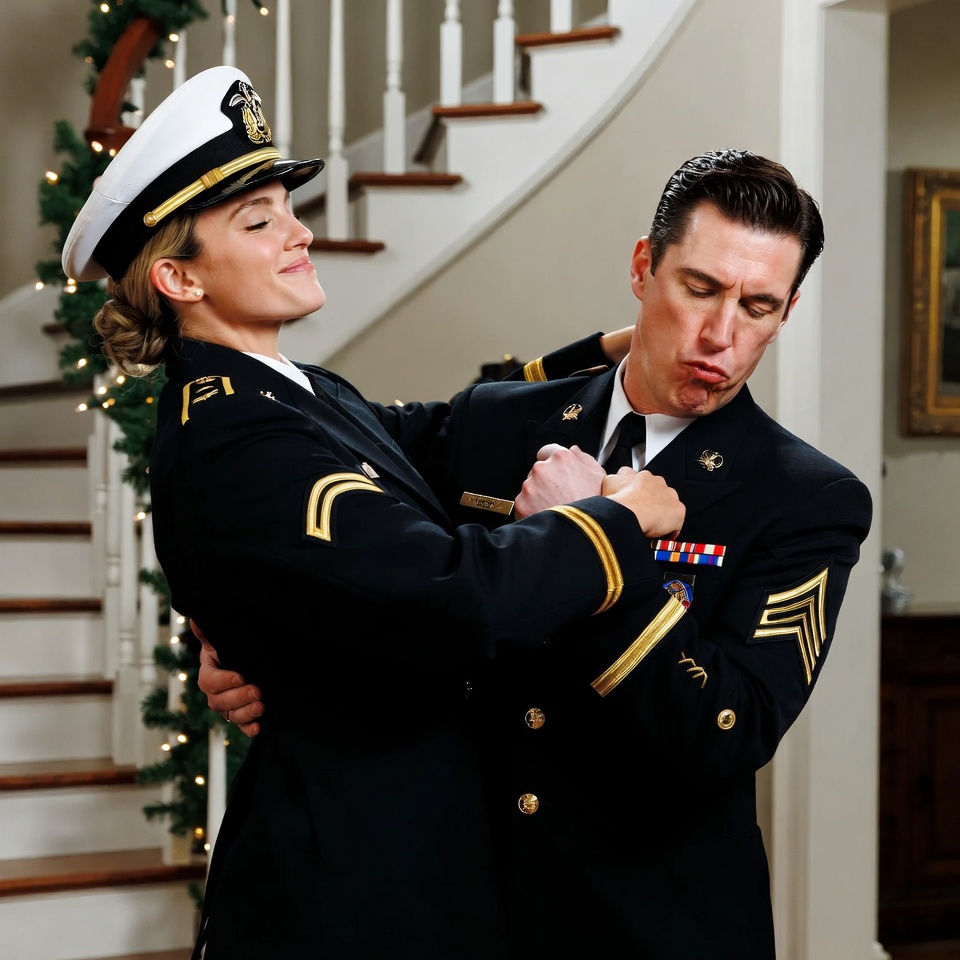
My Billionaire Father Slapped Me in Uniform Before 212 Guests—Until My Teacher Fiancé and a Retired Colonel Brought Him Down…
The slap came so fast that for one suspended second, I thought the sound belonged to someone else’s life.
I was standing in my father’s living room in my Navy dress uniform, Christmas lights burning gold against twelve-foot windows, two hundred and twelve guests holding crystal glasses and private opinions, when Robert Callaway—my father, billionaire founder of Callaway Capital, the man who believed money could explain every human decision—lifted his hand and struck me across the face.
Not in an alley.
Not in a war zone.
Not in secret.
In his own house, under his own chandelier, with clients, partners, family friends, and half the Connecticut financial world watching.
My cheek went hot first. Then cold.
No one moved.
The orchestra playlist still hummed through hidden speakers. Ice clinked in somebody’s glass. Pine garlands lined the staircase. Somewhere behind me, a woman inhaled so sharply it sounded like a cry strangled before birth. And in the center of all that holiday perfection, I saw my father’s face still arranged in the stunned arrogance of a man who had finally gone one step too far and had not yet realized it.
He had meant to control me.
He had meant to send me upstairs like a disobedient child, to erase the part of the evening he hadn’t approved of—my recognition in uniform, the applause I had earned, the dignity he could neither buy nor command. Instead, he had exposed the ugliest truth of our family in front of the only audience he had ever truly feared: people whose judgment affected his status.
Beside me, Daniel stepped forward.
My fiancé was a public school history teacher from Bridgeport with a ten-year-old Honda, a worn winter coat, and a moral spine stronger than anything I had seen in hedge fund boardrooms or military briefings. He caught my father’s wrist in both hands—not violently, not theatrically, just firmly enough to stop the next disaster—and the room went dead still.
My father looked at him with pure disbelief.
Daniel said nothing.
That silence was somehow worse than shouting. It gave the moment shape. It forced every person in that room to see exactly what had happened without the mercy of confusion.
Then a chair scraped across hardwood.
Mayor Gerald Holt, retired Army colonel, rose from the far side of the room and walked toward us with the deliberate calm of a man who had buried fear in harder places than Westport, Connecticut. He stopped a few feet away, looked directly at my father, and in a voice that cut through the room like steel, said:
“You just struck an officer of the United States Navy.”
No one breathed.
Then he added, “Twice.”
That was when the night broke open.
I watched my father’s face change—not into shame, not yet, but into the first raw flicker of understanding that something precious to him had just begun to die.
Not his daughter’s trust. He had spent that years ago.
His image.
His authority.
His carefully built illusion that power and respect were the same thing.
And while two hundred and twelve witnesses stood frozen in the wreckage of his perfect Christmas party, I realized with a strange, terrible calm that the worst wound my father had ever given me was not the slap.
It was all the years that had taught him to think he could do it.
I am Sara Callaway, and when this happened, I was twenty-nine years old, recently returned from my second deployment as a Navy Nurse Corps officer. I had spent fourteen months at a forward operating base in Djibouti and eight months in Okinawa before that. I had come home with a promotion to lieutenant, a Bronze Star in a shadow box above my desk, and the kind of clarity that only arrives after you’ve held pressure on a wound while someone else prayed out loud in a language you didn’t understand.
War had taught me many things. Mostly that courage was rarely loud, and almost never glamorous.
What I had not expected was to come home and discover that the most difficult battlefield in my life was still my father’s house.
The Bronze Star sat above my desk in the small apartment I rented near the hospital in New Haven after I returned stateside. Every morning before work, I looked at it for three seconds. Not because it made me proud. Pride was too easy a word for what service had done to me. I looked at it because it reminded me that I had survived things I once believed would crush me.
The odd truth was that the medal had less to do with my father than the shadow box did.
Tucked in the corner behind the ribbon was an old photograph of my grandfather in Vietnam-era uniform, younger than I had ever known him, his expression sober and unsentimental. He died when I was sixteen, but he had once told me, during a thunderstorm that knocked out power in Westport, “Don’t ever let anybody teach you that usefulness and worth are the same thing, sweetheart. Useful things get used up. Worth is different.”
My father never liked that kind of talk. He liked metrics. Targets. Outcomes. The clear, measurable language of acquisition. He built Callaway Capital from a hedge fund office in Hartford into a two-billion-dollar asset management firm because he understood fear and appetite better than most men understood their own children. He could read a room the way meteorologists read radar. He knew when people were greedy, when they were bluffing, when they were panicking, and how to extract advantage from all three.
He also believed, with total conviction, that the world sorted itself into winners and cautionary tales.
My older brother, Marcus Callaway, fit neatly into my father’s preferred version of success. Wharton graduate. Sharp suits. Early start at the firm. Strong jaw, carefully neutral voice, endless tolerance for spreadsheets and structured ambition. My sister Diane had married Dr. Andrew Feldman, a cardiologist in Greenwich with a tasteful home, tasteful children, and a tasteful life that looked exactly how my father liked family to look in photos.
Then there was me.
The youngest daughter. The nurse. The one who joined the Navy at twenty-two because I wanted my life to mean something that couldn’t be priced.
My father never directly said he was ashamed of that. He was too strategic for bluntness when contempt could be delivered more elegantly through tone. The pause before he answered when someone asked what I did. The way he introduced Marcus with specifics, Diane with warmth, and me with a vague, “She’s in the military.” As if I had briefly wandered into service the way a teenager might briefly experiment with vegetarianism.
When I was ten, I told him I wanted to be a nurse because nurses were the ones who stayed. He had looked over the top of the Wall Street Journal and said, “People say that when they don’t know how to lead.”
I remember standing there in the breakfast room, still in braids, holding a science fair ribbon, not yet old enough to understand that adults can spend decades mistaking emotional limitation for wisdom.
My mother had been in the room when he said it. She kept buttering toast as if her hands belonged to someone else.
That was the pattern of my childhood: my father’s pronouncements, my mother’s silence, and the rest of us learning how to live inside both.
My mother was not weak. I understand that now in a way I did not as a child. She was a woman who had spent thirty-five years married to force disguised as certainty. Survival often looks passive from the outside. Inside it, survival can be exhausting labor. She managed holidays, social obligations, emotional weather systems, and the daily work of preventing Robert Callaway from colliding too directly with the softest parts of his family. She did not always succeed. But she tried.
The first time I understood money could become a family religion, I was fourteen. Diane had gotten a new car for her seventeenth birthday—a Lexus, silver, beautiful, absurdly expensive for a teenager—and Marcus got a summer internship arranged through one of my father’s friends in Manhattan. At dinner, my father asked me what I wanted for my own future.
“I want to work in an emergency room,” I said.
He smiled without humor. “That’s not a future, Sara. That’s a job.”
I remember looking at Marcus, hoping he might say something, but he had already learned the first rule of Callaway peacekeeping: never volunteer disagreement in open view. Diane cut her salmon into tiny pieces and stared at the plate. My mother asked whether anyone wanted more asparagus.
That was how values calcified in our house—one small surrender at a time.
By the time I left for nursing school, I had become skilled at moving around my father instead of through him. I told him I was considering the Navy only after I had already signed papers. He looked at me for a long moment in the study, hands clasped behind his back, and said, “You are choosing scarcity as a moral identity.”
“No,” I answered. “I’m choosing service.”
He gave me a look I would come to recognize as his version of pity. “That is what people tell themselves when they choose a ceiling.”
I wish I could say I left that room untouched. I didn’t. My father’s words had a way of lodging under the skin even when I knew better than to believe them. That was one of his gifts: he could make self-betrayal feel like realism.
But then life happened away from him, which is often how healing begins.
continue 👇
I became a nurse. I commissioned. I learned how to read blood loss in skin tone and fear in breathing patterns. I learned to sleep in fragments. I learned that some people die with grace, some with fury, and some with apologies that arrive too late. I learned that rank mattered, but competence mattered more. I learned that service strips vanity from language.
And over time, the voice in my head that sounded like my father became less persuasive.
Then I met Daniel Mercer.
It happened at a wedding in the spring, the kind of wedding where everyone under forty is half-resigned to being seated at the singles table and pretending that’s funny. I had been home from deployment for only six weeks and still felt slightly out of sync with civilian life. The room was all hydrangeas and string quartet and expensive champagne, and I was standing by the coffee station wondering whether leaving immediately after cake would count as antisocial when a man beside me said, “That’s the expression of someone doing emergency exit calculations.”
I turned and found a face that was not conventionally dazzling but instantly trustworthy. Warm brown eyes. Crooked smile. Navy suit that had been pressed carefully but not expensively. He held two coffee cups and offered me one.
“I teach high school,” he said. “Reading escape plans is part of the job.”
I laughed. “Navy nurse. Same skill set.”
That was Daniel.
No performance. No strategic charm. Just directness softened by humor.
We talked for forty minutes beside the coffee station while the reception swelled around us. He taught history at a public high school in Bridgeport. He coached debate. He brought homemade lunches to school in a beaten-up cooler because he claimed cafeteria food had defeated him emotionally in 2018 and he never recovered. He could make the Constitution sound alive and spoke about his students the way some people speak about family members they would defend with their bodies.
When I asked what kept him teaching after seven years, he said, “Every year there’s some kid the world has already quietly written off, and then one day they say something brilliant and you get angry at how close we came to missing it.”
That was the moment I knew my father would hate him.
Not because Daniel lacked value. Because he embodied a kind of value my father had no category for.
We started seeing each other after that. At first, it felt improbably easy. Daniel wasn’t intimidated by my service, which surprised me. Some men tried too hard to admire it; others treated it as a problem they’d have to compete with. Daniel just asked better questions.
“What do you miss when you come home?”
“What part of it stays in your body?”
“What do people get wrong about military medicine?”
No one had ever asked me questions like that—not to impress me, not to prove they were empathetic, just because they wanted to understand. Daniel listened in full. It changed the temperature of my life.
The first time he came to my apartment, he noticed the shadow box on the wall and stood beneath it for a long moment.
“You don’t look at that like a trophy,” he said.
“It isn’t one.”
He nodded once, as if that made perfect sense. “That’s what I thought.”
He kissed me two minutes later, and it was the least performative thing that had ever happened to me.
By summer, I had met his mother, who hugged me with both arms and sent me home with baked ziti and a container of lemon cookies. I had watched him stay late after school to help a sophomore named Javier rewrite a scholarship essay line by line. I had listened to former students call him just to tell him where they’d gotten accepted. One young woman stopped him in a grocery store aisle and said, with tears in her eyes, “Mr. Mercer, I passed organic chem. You said I would.” Daniel looked happier than if someone had offered him stock options.
My father, predictably, remained unconvinced.
The first time Daniel came to dinner at my parents’ house in Westport, my father treated him with the kind of politeness that is more cutting than open hostility. The dining room glowed with candlelight. My mother had arranged a dinner too elegant for a Tuesday. Diane and Andrew were there, and Marcus arrived late from Hartford, loosening his tie as he came in, which my father noticed with immediate disapproval.
Daniel brought wine and flowers.
My father accepted both as if reviewing proposals.
Conversation stayed safe through salad and the first half of dinner. Daniel charmed my mother by asking about her garden. Diane warmed to him when he remembered a pediatric charity gala she had helped organize and asked thoughtful questions instead of the usual donor-class flattery. Even Marcus, who had developed a professionally bland public personality, cracked a real smile when Daniel told a story about a debate tournament where one student cited Hamilton incorrectly with unearned confidence.
Then my father asked, “So, Daniel, what does your five-year financial plan look like?”
The table went still.
Daniel set down his glass. “Honestly?”
“That is usually what I prefer.”
Daniel smiled. “To keep as many kids as possible from falling through the cracks.”
There it was. Clean. Calm. Unadorned.
My father nodded in the slow, almost anthropological way he had when mentally classifying people he had decided were not serious. “Noble,” he said.
Daniel looked directly at him. “Necessary.”
My mother dropped her fork.
It was such a tiny sound, but in our family, tiny sounds often meant tectonic movement.
The rest of dinner survived, but only barely. After Daniel left, my father found me in the kitchen while my mother wrapped leftovers in brittle silence.
“He’s a nice young man,” my father said quietly, “but you’ve seen the world, Sara. You’ve done something real. Don’t shrink yourself to fit someone else’s ceiling.”
I was thirty, decorated, and still he spoke to me as if my life was a draft he expected to edit.
“I’m not shrinking,” I said.
“Public school teaching in Bridgeport,” he replied, “is not a future equal to yours.”
I leaned against the counter and looked at him. “Equal by whose math?”
He gave me a glance that suggested the answer was obvious and therefore not worth stating.
That was my father’s favorite maneuver: declare his values universal and call the rest sentiment.
I did not argue further. I had spent enough of my life throwing words into that furnace.
Daniel proposed in October on a Tuesday evening near Seaside Park after finishing tutoring one of his students. No photographer. No violinist hiding in the bushes. No champagne chilling in a basket. Just cold air, orange leaves, a ring that had belonged to his grandmother, and a man whose hands shook slightly because he cared enough for the moment to be afraid of ruining it.
He got halfway through, and I said yes before he reached the formal question.
He laughed, relieved and embarrassed and happy in a way that made me love him harder.
When I told my mother, she cried and said, “He is the kind of man who never leaves a room worse than he found it.”
When I told my father, he said, “Congratulations,” then immediately asked whether we had discussed a prenuptial agreement.
Daniel and I laughed about that in the car later, because sometimes if you don’t laugh, family history becomes a toxin. But under the laughter was something heavier. My father did not hear joy without first searching for liability. That habit had shaped us all more than we admitted.
We planned a small wedding for early spring. A church in New Haven. About sixty guests. Daniel wanted meaningful. I wanted survivable. We met in the middle.
And then Christmas came.
My parents’ annual holiday party in Westport was legendary in the ecosystem of moneyed Connecticut. Clients, partners, local officials, cultural board members, polished spouses, people with soft hands and hard opinions. The house transformed every December into a stage set for my father’s preferred mythology: success as elegance, power as inevitability, family as controlled accessory.
He curated everything. Which vintages would be poured. Which musicians would be hired. Which clients needed personal greeting and which could be safely charmed by proximity alone. He moved through those parties like a conductor with a balance sheet instead of a baton.
I had never liked them. But that year was different because Daniel would be there as my fiancé, and because a week before Christmas I got a call from Mayor Gerald Holt’s office.
Holt was the mayor of Bridgeport and a retired Army colonel. He had served three tours in Iraq before coming home and entering public life. His office explained that he planned to recognize a few Connecticut veterans at a private gathering that evening, and my name had been suggested through the Veterans Outreach office. Would I be comfortable receiving the recognition in dress uniform?
I said yes immediately.
Of course I did.
When I told my father, he stood in his study with one hand on the back of a leather chair and said, after a pause, “It’s a Christmas party, Sara, not a ceremony.”
“It’ll be brief. Fifteen minutes.”
His mouth tightened. “Business clients don’t attend for military pageantry.”
“Then they can survive four minutes of gratitude.”
He looked at me, and there it was again—that stillness that meant my resistance had become data he disliked.
At the time, I believed his silence meant reluctant acceptance.
I should have known better.
The night of the party, my parents’ house looked exactly the way memory always insists childhood looked before you understood what had been wrong inside it. White lights wrapped the trees. Pine garlands climbed the staircase. A string trio played near the sunroom. The air smelled like cedar, roast beef, expensive perfume, and the sugar-heavy warmth of catered desserts.
Daniel wore a navy blazer and the tie I had given him for his birthday. I wore my dress whites.
When he saw me at the top of the stairs before we left, he paused and said quietly, “You look formidable.”
“That’s the idea,” I answered.
He smiled. “Terrifyingly attractive, too.”
I laughed, and for a moment I felt steady.
For the first hour, the evening held. We moved through the room greeting people. Daniel was exactly himself—kind, observant, uninterested in hierarchy. He talked to a junior analyst and a senator’s wife with the same attentive respect, which I noticed my father noticing. Some people in those circles take warmth from modest men as evidence of insecurity. My father read it that way at first.
Then he started seeing how people responded.
Daniel had a way of disarming even polished strangers because he was never trying to extract anything from them. It made him powerful in rooms that worshiped gamesmanship. Several guests laughed more genuinely with him than they did with my father all night.
Mayor Holt arrived around 7:15, broad-shouldered in a dark suit, carrying the specific self-possession of a man who had outlived needing approval. He found me near the fireplace and shook my hand first, then Daniel’s.
“To Daniel Mercer?” he said after hearing the name. “Bridgeport Central?”
Daniel nodded. “Guilty.”
Holt smiled. “Three people on my staff came through Bridgeport public schools. Good teachers don’t get enough credit in this country.”
Daniel replied, “I’d say they get exactly the right amount. It’s just distributed very unevenly.”
The mayor laughed—real laughter, delighted and unexpected.
I saw my father see that too.
At eight o’clock, he made his annual remarks. Everyone gathered with drinks. He spoke about the market, partnerships, resilience, gratitude, and the performative humility of successful men who know they’re being admired. Then, with one polished gesture, he yielded the floor to Mayor Holt for “a brief moment of recognition.”
The mayor spoke for four minutes.
Four measured, devastatingly human minutes.
He talked about the Navy Nurse Corps. About forward operating bases and combat medicine and the people who kept others alive not with weapons but with skill, endurance, and the refusal to look away. He said my name clearly. He spoke about service in a tone that gave it weight without theatrics.
When I walked forward, the room applauded.
It wasn’t wild applause. It was something better—real applause. Slightly surprised. Slightly moved. The kind people give when a curated evening accidentally collides with truth.
When I turned back toward the room, I looked for my father.
He wasn’t clapping.
He was watching me with a face so still it might as well have been carved.
The recognition ended. Conversation resumed. Music returned. Glasses refilled. On the surface, the evening recovered.
It had not.
About thirty minutes later, I was near the bar speaking with the wife of one of my father’s partners when I felt a hand touch my elbow.
“Sara.”
My father’s voice.
Measured. Private-sounding. Dangerous.
I turned. He stood close enough that from a distance we probably looked like father and daughter in conversation. His expression was composed. Only his eyes were wrong.
“I need you to go upstairs and change,” he said.
I blinked. “Excuse me?”
“The recognition was lovely. It’s done. You’re making people uncomfortable.”
The room did not stop. But it slowed.
“Dad—”
“You’re wearing military decorations to a business party. At this point it’s a costume.”
He said it just loud enough for the nearest cluster of guests to hear. An old skill of his: public injury delivered at conversational volume.
“It is not a costume,” I said.
His jaw tightened. “You’ve made your point. Now go change.”
“My point?”
“This is not about you.”
That sentence lit something in me.
No, I thought. This is exactly the problem. That anything honorable in this house becomes offensive the moment it does not orbit you.
I kept my voice even. “I’m not changing.”
My father’s expression hardened into the one I had seen across dinner tables and charity galas and family photographs whenever anyone forced him off script.
“You are embarrassing this family.”
“By wearing my uniform?”
“By creating a scene.”
That was always his logic. Resistance, no matter how calm, became aggression if it interfered with his will.
“Robert.”
Daniel’s voice came from my left.
He stepped beside me, not dramatic, not loud, simply present.
My father turned slowly. “I’m speaking to my daughter.”
“I know,” Daniel said. “I’m asking you to stop.”
There was no tremor in him. No performance of masculinity. Just a line drawn.
My father looked at Daniel with that familiar expression of smooth contempt. The look reserved for people he considered beneath the dignity of full conflict.
“You are in my house,” he said.
“And she is not a child,” Daniel replied.
My father’s nostrils flared. “This is a family matter.”
Daniel held his gaze. “It became everyone’s matter the second you decided to humiliate her in public.”
I felt something around us shift.
Not because the room approved. At first, people were simply stunned that anyone had spoken to Robert Callaway that way inside his own home.
My father took one small step toward me and reached for my arm.
Not hard. Firmly.
Possessively.
The old reflex of a man who believed access to your body followed from authority.
“Upstairs,” he said.
Daniel moved between us.
He did not shove my father. He did not touch him. He simply stepped into the space and blocked the path between my father’s hand and my arm.
And that, more than any insult, undid Robert Callaway.
My father’s hand came up.
Open-palmed.
Fast.
He meant to strike the obstacle. Or perhaps he simply struck where control failed. Even now, I do not know.
But he hit me.
Across the left side of my face.
The sound cracked through the room.
I did not fall. I did not cry out. My head turned with the force of it, and for a strange, detached second I noticed one of the tree lights reflected in the polished black edge of the piano.
Then silence.
Absolute, enormous silence.
Two hundred and twelve people holding still at once.
Daniel caught my father’s wrist with both hands. Calmly. Completely. No twisting. No violence. Just enough pressure to make impossible the next motion.
My father stared at him.
Daniel stared back and said nothing.
And then a chair scraped.
Mayor Holt stood.
He did not hurry. That was what made it frightening. He walked through the parted crowd with the composure of a man accustomed to acting only after deciding what action required. He stopped three feet from my father and looked at him for one long second.
Then he said, in a voice that reached every wall:
“You just struck an officer of the United States Navy.”
My father opened his mouth.
Holt cut him off with one more word.
“Twice.”
The room understood at once.
The grabbing. The slap. The double assault. The symbolic obscenity of it.
And for the first time in my life, my father stood inside a silence he did not control.
A young man rose from the stairs at the back of the room. I didn’t recognize him immediately. Then Daniel whispered, “Marcus Webb.”
One of his former debate students. Twenty-three years old. Home for the holidays. Officer Candidate School. He wore his OCS cover and walked forward with his shoulders squared, stopping beside Mayor Holt without a word.
That small act shattered whatever remained of the evening’s illusion.
A client near the windows set down his drink and murmured to his wife. One of my father’s partners looked at the floor like it had become unstable. Three women turned away first. A man by the piano reached for his coat before anyone had formally moved.
And then my mother came to me.
She had been standing near the kitchen threshold, frozen not by indifference but by the old paralysis of a woman who has spent years calculating the cost of each visible choice. She crossed the room slowly, as if stepping through water. She took my hand.
She did not look at my father.
She looked only at me.
Something in my chest loosened so suddenly it hurt.
For years, my mother’s love had lived mostly in hidden places—altered subject lines, softened consequences, meals sent after arguments, phone calls disguised as small talk when she knew I was lonely. It had often felt too quiet to protect anything.
But that night she chose public witness.
I think that was the moment I nearly broke.
Not from the slap.
From being seen.
The party did not explode. There was no screaming, no dramatic confrontation, no shattered glass. Real power often dies more quietly than people imagine. It leaves through doors, in cashmere coats, carrying formal smiles and permanent conclusions.
Guests began to depart.
One by one. In clusters. Murmured goodnights. Tight expressions. Avoided eye contact. A few people crossed the room to say something kind to me, or to Daniel, or to Mayor Holt. Most did not. Most simply left, which was statement enough.
My father remained standing near the bar as if movement might confirm reality. He tried twice to speak. Holt let him start each time. The words collapsed before they became sentences.
Because what could he say?
That he had misunderstood?
That the room had misread him?
That his hand had reached the wrong century and forgotten where it was?
By 10:15, the living room held only family, Mayor Holt, Marcus Webb, and the aftermath.
Marcus Callaway—my brother—had said nothing during the incident. He stood six feet away, face bloodless, hands open at his sides like a man who had discovered too late that all his training applied only to numbers. Diane had cried quietly in the powder room and reemerged with ruined mascara and a determined expression that suggested she was trying to decide whether being a wife and mother exempted her from moral action. It didn’t, but I knew how our family worked. None of us had been raised for moments like this. We had been raised for composure.
Mayor Holt finally spoke to my father in a lower voice. “This ends now.”
My father looked past him at me, then at Daniel, then at the room stripped of status. “I did not mean—”
“Meaning,” Holt said, “has very little to do with what everyone here saw.”
No one defended him.
Not Marcus.
Not Diane.
Not my mother.
The quiet of that mattered more than outrage ever could have.
Daniel took me upstairs to my childhood bathroom and handed me a cold washcloth. When I looked in the mirror, there was already a faint rise of color along my cheekbone.
He stood behind me in the doorway.
“Do you want to leave?” he asked.
“Yes.”
“Then we leave.”
No speeches. No revenge fantasies. No performative fury.
Just exit.
I loved him most in moments like that.
We went downstairs. My mother intercepted us in the hall, pressed my coat into my hands, and whispered, “I’m sorry.” Her voice sounded as if it had been scraped raw. “I am so, so sorry.”
I touched her wrist. “Come with us.”
Her eyes filled instantly. She looked toward the living room where my father stood alone in the debris of his social authority.
“Not tonight,” she said.
I wanted to argue. But I understood. Escape is rarely one clean motion. Sometimes people need one more night inside the house that hurt them before they can imagine leaving.
Daniel drove me home.
The whole ride, I kept one hand against my cheek as if I could hold the shape of the moment in place long enough to believe it had happened. The world outside the car was all winter-black roads and red taillights. Daniel did not flood the silence with comfort. He let me have it.
Halfway to New Haven, I said, “I knew he was ashamed of me. I just didn’t know he was willing to prove it.”
Daniel kept his eyes on the road. “He wasn’t proving your shame.”
I stared out the window.
“He was proving his.”
I cried then. Not elegantly. Not in controlled tears. I cried like something old had finally torn. Daniel pulled the car onto the shoulder, put it in park, and let me fold into him.
There is a kind of grief that comes not from learning who someone is, but from having what you always knew finally become undeniable.
That was the grief I felt.
The weeks that followed were ugly in the way real aftermath is ugly—incremental, administrative, emotionally uneven.
My father called in early January.
His first call was strategic.
He opened by asking how I was, but his voice carried the careful cadence of a man preparing a position. Then came language about optics, misunderstandings, emotional atmosphere, and how things had “looked worse than they were.”
I listened until he ran out of phrases polished enough to hide from truth.
Then I said, “Dad, you hit me.”
Silence.
The longest silence I had ever heard from him.
He started to say my name. I ended the call.
The second call came two weeks later.
I almost didn’t answer. Something in me—curiosity, maybe, or fatigue—did.
His voice was different.
Smaller is not quite the word. My father had spent too many decades building his vocabulary around certainty for smallness to come naturally. What I heard instead was disorientation. A man standing in the ruins of a worldview he had confused with identity.
“Sara,” he said, and stopped.
I waited.
“I made a mistake.”
Even then, the phrasing reached for the corporate. Not sin. Not cruelty. A mistake.
But he kept going.
“I don’t know when I started believing that how things look matters more than what they are. I think…” He exhaled. “I think I built my life around performance and then mistook performance for structure.”
I closed my eyes.
He had never spoken to me like this before. Not because he had become vulnerable overnight, but because consequences had cracked something. He was finally speaking from damage instead of above it.
“I thought I was building something permanent,” he said. “I may have just been building a stage.”
No request for forgiveness followed. That was the first honest thing about the call.
I said, after a long pause, “I hear you.”
It was not absolution.
It was acknowledgment.
Sometimes that is all truth can earn at first.
Outside our family, the incident moved through Connecticut’s social bloodstream the way these things always do—too carefully to be called gossip, too widely to be called private. There were no viral videos. No public scandal pages. The guests at my father’s party were too invested in discretion for that. But phones rang. Stories traveled. Reputations shifted.
Three of my father’s partners requested internal reviews of fund positions in January. No one cited the party. They didn’t need to. His largest institutional client, a Boston pension fund that had been with Callaway Capital for over a decade, sent a letter in February requesting transition of assets. Professional. Controlled. Final.
By March, the Hartford Business Journal ran a piece about “leadership culture in regional financial firms,” never naming my father, but describing a pattern of private conduct and public authority in terms so recognizable that anyone in his world knew exactly who stood behind the article’s shadow.
Callaway Capital did not collapse.
Men like my father rarely fall in a single dramatic motion.
Instead, the firm contracted. Investors left. Board conversations turned colder. People who had once interpreted Robert Callaway’s ruthlessness as evidence of brilliance began to reconsider whether they had mistaken volatility for strength.
For the first time in his life, my father discovered that respect withdrawn is heavier than money lost.
My brother called me in February.
Marcus had always been the child most trained to survive by identification. He thought like my father, dressed like him, anticipated rooms the same way. But in the weeks after Christmas, something in his voice changed whenever we spoke—less control, more friction.
“I stood there,” he said over the phone. “I didn’t do anything.”
His guilt was not strategic. That was what struck me.
I leaned against the counter in my apartment and said, “You stayed.”
He laughed once, bitterly. “That’s not exactly heroic.”
“No,” I said. “But some people left before it cost them anything.”
He was silent.
Then: “I kept thinking if I spoke, I’d make it worse.”
“That’s how this family works,” I said. “We all thought silence was management.”
Marcus exhaled hard. “I don’t know what to do with him now.”
I looked at the shadow box above my desk. “That makes two of us.”
Still, the call mattered. It was the first honest conversation my brother and I had ever had that wasn’t organized around protecting someone else’s comfort.
Diane came later.
Not in language—she was still too practiced in diplomacy for that—but in action. She stopped bringing her children to Sunday dinners at my parents’ house when my father was there. She started spending more time alone with my mother. Once, in March, she showed up at my apartment with soup and a bag of baby hand-me-downs from one of her neighbors “in case your future children ever need them,” and then burst into tears on my couch because she had spent years training her daughters to use their indoor voices around men who had never earned gentleness.
The most surprising shift came from my mother.
In late January, she moved into the guest suite above a friend’s carriage house in Southport for “a little time.” That was how she phrased it. Not separation. Not leaving. Just time. In our family, naming things plainly had never come easy.
But time became weeks. Weeks became conditions. My mother told my father she would not return to the house as if nothing had happened. She wanted counseling. She wanted him to step back from family events unless invited. She wanted him to stop referring to what had happened as a misunderstanding. She wanted, in essence, a vocabulary of reality.
I do not know which of those demands hurt him most. Probably the last one.
Daniel and I kept planning the wedding.
There was something almost absurd about cake tastings and seating charts in the middle of emotional wreckage. But perhaps that is how life protects us. It insists that love keep making appointments.
The church we chose was small, old, and sunlit in the afternoon. The stained-glass windows threw color onto the pews in fractured pieces around four o’clock. Daniel wanted his students involved somehow, but not in a way that turned the ceremony into a tribute event. So two former debate team members did readings. Marcus Webb, newly commissioned as an ensign by then, agreed to attend with Mayor Holt.
The invitation list included my father.
I wrestled with that decision for weeks.
Daniel told me he would support either choice. My mother said only, “Make the invitation you can live with, not the one other people will judge.” Mayor Holt, who had somehow become a steadier presence in my life than many relatives, said, “Forgiveness and access are not the same thing. Don’t confuse them.”
In the end, I invited him.
Not because he had earned normalcy. Because I did not want my wedding day to be organized around the absence of a man I had spent too long reacting to. I wanted the invitation to come from freedom, not fear.
He sent no dramatic reply. Just a card with three words inside:
I will come.
April arrived cold and bright.
The morning of the wedding, I woke before dawn and sat on the edge of the bed in my robe, watching pale light gather on the floorboards. For a moment, I could not breathe properly. Not from panic. From the strange emotional pressure of joy arriving in a body trained for vigilance.
Daniel and I had decided I would wear my dress uniform for the ceremony.
That mattered more than fashion. It mattered because I had almost let one violent moment poison an entire symbol. I refused to surrender that. I refused to let my father define what the uniform meant in my own life.
When I stepped into the church vestibule that afternoon, my mother cried instantly. Not the contained tears of formal emotion, but sharp, relieved, helpless tears. She touched the sleeve of my uniform as if reassuring herself it was really there.
“You look like your grandfather,” she whispered.
I swallowed hard. “That’s the nicest thing anyone could say to me.”
Daniel stood at the altar in a dark suit, hands clasped, face open in that way that had first disarmed me months earlier. When he saw me, all the noise in the church seemed to recede. That is not a poetic exaggeration. It felt physically true.
The ceremony was simple. Honest. Beautiful in the unmanufactured way beauty becomes when no one is trying to impress a room. The readings were from Baldwin and the Book of Ruth. The vows were our own. Daniel promised to tell me the truth even when silence would be easier. I promised never to confuse strength with distance again.
Mayor Holt sat in the second row beside Marcus Webb, who wore his ensign uniform with the solemn pride of someone still becoming the person he hoped to be. A few rows behind them sat Marcus Callaway, my brother, looking ten years older than he had at Christmas and far more human for it.
My father arrived late.
Of course he did.
He slipped into the last pew alone, dark suit, no theatrical entrance, no effort to draw notice. I felt him there the way animals probably sense storms. But he did not disrupt anything. He did not claim anything. He sat.
After the ceremony, during the reception in the parish hall, sunlight poured through old windows and turned dust into gold. Daniel’s students hovered near the cake table, trying not to eat before permission. My mother smiled more openly than I had seen in years. Diane danced with her daughters. Marcus Webb and Mayor Holt spoke with Daniel near the punch bowl about civics education and service academies. The whole room felt improbably light.
My father remained mostly at the edges.
I watched him once from across the room as he stood near a bulletin board covered with parish announcements, holding a cup of coffee as if he were uncertain what hands were for in unstructured space. A few people greeted him politely. No one circled. No one deferred.
It was the most ordinary he had ever looked.
Near the end, after many guests had gone, he approached.
Daniel and I were standing near the altar rail, half-exhausted, flowers wilting slightly in vases, my mother folding tissue paper into her purse because she came from a generation that saved useful things.
My father stopped in front of us.
For a moment, no one spoke.
Then he held out his hand to Daniel.
Daniel took it.
My father held on a fraction longer than convention required. It was not dominance. It felt almost like gratitude translated poorly.
Then he looked at me.
His eyes moved over the uniform, the church, the thinning room, all of it. When he spoke, his voice was low.
“Your grandfather would have loved to see this.”
I stared at him.
He had never once, in all my life, linked my service to my grandfather’s. It was as if he had finally found a door in a house he had owned for decades and only now discovered it opened.
I felt tears rise instantly and hated that he could still do that to me. But emotion is not endorsement. It is only evidence that history remains alive inside the body.
“I think he would have,” I said.
My father nodded once.
Then, because he had spent his whole life mastering exits once terms were no longer favorable, he stepped back and left.
I did not cry until Daniel and I were in the car.
He drove. I looked out the window at the passing dark and let the tears come, slow at first, then harder. Daniel did not ask me to explain them. He knew me well enough by then to understand that grief often grows heaviest right before release.
Marriage changed many things. Some dramatically, most quietly. The most profound change was this: home stopped being a place I had to survive and became a place where my body could finally unclench.
Daniel and I bought a small house two years later in a neighborhood where teachers, nurses, city employees, graduate students, and retired couples all shared the same cracked sidewalks and overcommitted tomato gardens. We painted the kitchen ourselves and argued over bookshelves and laughed about money in the practical, unromantic way of people who actually share a life. We were not rich. We were not trying to be.
We were useful to each other in ways that did not erode worth.
I continued nursing, eventually moving into a trauma education role that let me work with younger medical officers rotating through difficult cases. Daniel stayed in Bridgeport schools, later becoming department chair because one principal was smart enough to realize that moral authority is a form of leadership no spreadsheet can teach.
Marcus Webb visited sometimes. He was commissioned, then deployed, then returned, each year looking slightly more settled inside himself. Watching him with Daniel always moved me. Their relationship was proof that the invisible labor of decency accumulates. A ride to an interview. A recommendation letter. Two years of insisting a young man’s mind mattered. None of it looked dramatic while it was happening. But when the moment came to stand up in a silent room, all that invisible scaffolding held.
My brother changed too.
Not all at once, and not into a saint. Real change is usually less cinematic. Marcus began pushing governance reforms at the firm. He fought for board oversight that my father would once have considered insulting. He started volunteering with a scholarship nonprofit Daniel recommended, at first awkwardly, then sincerely. Once, after a fundraiser, I found him in our backyard helping Daniel carry folding chairs and thought: grief is doing its work.
Diane grew sharper around the edges in the best possible way. She stopped over-explaining herself. She began saying no with fewer apologies. Her daughters adored Daniel because he listened to their opinions about books as if they were cabinet-level briefings.
And my mother—my mother became the quiet miracle of the whole story.
She did not transform into a loud woman. That was never her shape. But she became unmistakably herself. She rented a studio space. Started painting again after twenty-eight years. Traveled alone to Vermont one fall “just to see if I still liked my own company,” which made me laugh and ache at the same time. She and my father did not divorce, but they never fully returned to the old arrangement either. Some marriages survive not by healing cleanly, but by refusing to continue under the old lies.
As for my father, he stepped down as managing partner eighteen months after the Christmas party.
Officially, it was succession planning.
Unofficially, consequence had finally reached him.
We saw each other only occasionally at first—holidays carefully negotiated, family dinners in neutral locations, conversations that were civil and sometimes even genuine, though always shadowed by what had happened. He did not ask me to forget. Perhaps because for once he understood forgetting was not his to request.
One autumn, three years after the slap, he showed up at our house with a box.
Inside were old letters from my grandfather, military records, photographs, and a tarnished service pin I had never seen before.
“He wanted you to have these,” my father said.
“When?”
“He told me years ago. I never gave them to you.”
“Why not?”
He looked past me toward the kitchen where Daniel was helping one of our neighbors’ kids with a history project. “Because I was arrogant enough to think withholding could change you.”
The honesty of that hit me harder than I expected.
I took the box.
“Thank you,” I said.
It was not redemption. But it was real.
That night I opened the letters at the kitchen table while rain tapped against the windows. One line from my grandfather stopped me cold: The measure of a person is not whether they dominate a room. It is whether other people become safer, steadier, or braver because they were there.
I read it twice. Then a third time.
Daniel looked up from grading papers. “That one worth framing?”
“Maybe living,” I said.
A year later, Daniel and I helped establish a scholarship for Bridgeport students pursuing public service—teaching, nursing, social work, military service, community health, civic law. We named it for my grandfather. Mayor Holt gave the first keynote. Marcus Webb, by then a lieutenant junior grade, spoke to the students about hesitation and courage. Marcus Callaway wrote a check large enough to fund two full years and asked for no public acknowledgment.
My father attended the ceremony quietly and sat in the back row.
Toward the end, one of the scholarship recipients, a young woman headed into nursing school, spoke about growing up watching people confuse prestige with purpose. She said, “The older I get, the more I think character is what you choose when there is nothing to gain.”
The room applauded.
I glanced toward the back.
My father was looking at the floor.
Sometimes I wonder whether shame can become useful if a person stays with it long enough. I don’t know. I only know what I have seen: men destroyed by the refusal to change, and others humbled into a narrower, truer shape. My father became, if not good in the easy sense, then at least less defended from reality. For a man like him, that was a kind of miracle.
The truth is, I do not think often anymore about the slap itself.
Not because it no longer matters. Because memory is selective in self-protection, and because one act of violence, however defining, is rarely the only thing worth carrying forward.
What I think about most is the standing up.
Daniel stepping between my father and me without performance or hesitation.
Mayor Holt crossing that room with the authority of a man who knew exactly what public cowardice looked like.
Marcus Webb rising from the stairs, a young officer candidate with no obligation except conscience, and choosing visibility.
My mother walking across that room and taking my hand.
Those are the images that stayed.
Years after the party, I still look at the shadow box for three seconds every morning. The Bronze Star is there. My grandfather’s photograph is there. The service pin my father once withheld is there too, not because I consider the story neat, but because truth rarely comes neat. It comes layered. It comes with damage and witness and people who fail you and others who stand up at the exact moment standing up matters most.
One morning not long ago, I stood there in the half-light before work and heard Daniel in the kitchen packing his lunch into that ridiculous old cooler he still refused to replace. We had a child asleep down the hall by then—a daughter with my mother’s eyes and Daniel’s stubborn chin. On the refrigerator was a drawing from one of his students and a magnet from the veterans clinic where I taught trauma response workshops twice a month.
An ordinary life.
The kind my father once would have called too small.
I touched the edge of the shadow box and thought how wrong he had been.
Because worth was never in the chandeliers. Not in the hedge fund. Not in the guest list of two hundred and twelve witnesses.
Worth was in the hand that reached for mine when silence broke.
Worth was in the teacher who stood between power and harm.
Worth was in the mother who finally crossed the room.
Worth was in the young officer who rose from the stairs.
Worth was in every person who chose courage over comfort when the cost became visible.
That Christmas night did not destroy my father in the way people sometimes hope for when cruel men are finally exposed. He did not lose everything at once. He did not collapse under one perfect sentence. Real life is not arranged for our emotional convenience.
But it ended something.
It ended the mythology.
And once a family stops worshiping the myth of a man, everyone inside it has a chance to become more truthful.
That was the real aftermath.
Not revenge.
Release.
And on the mornings when I look at the shadow box before leaving for the hospital, that is what I remind myself of.
Not what he did.
What we did next.