
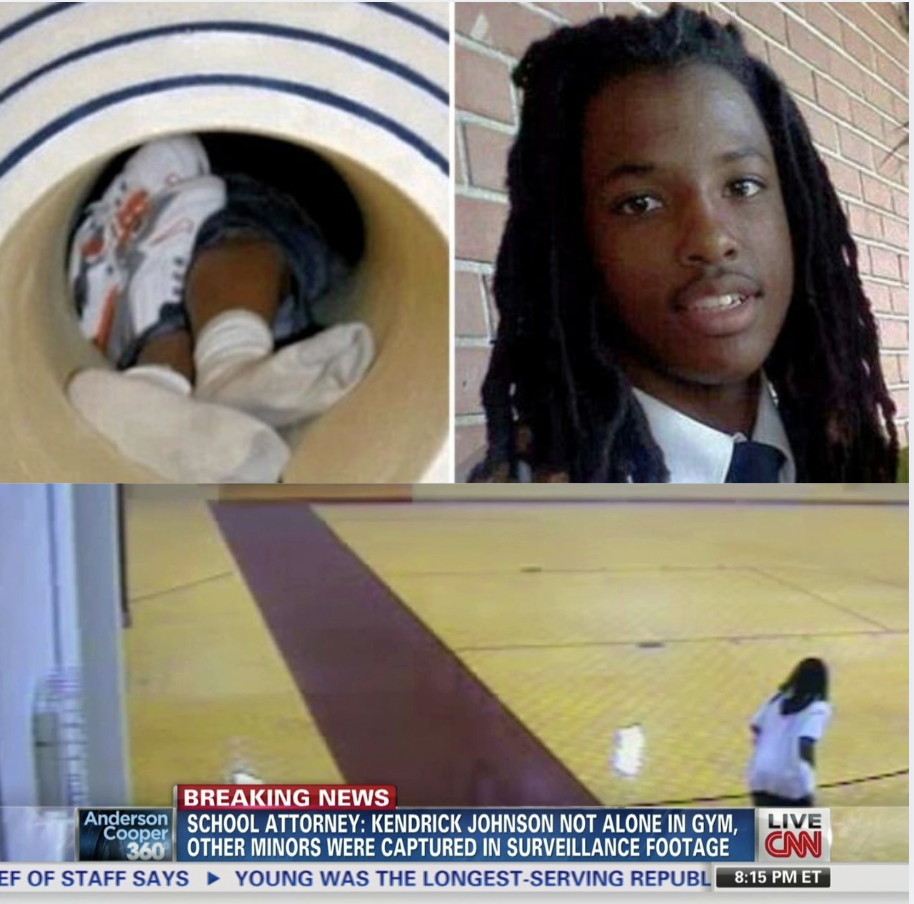
More than a decade after the death of Kendrick Johnson, the questions that have surrounded his final moments remain unresolved in the eyes of his family—and, increasingly, in the public conversation. Now, with confirmation from the Lowndes County Sheriff’s Office that the case is not definitively closed, attention has once again turned to one of the most debated deaths in recent American memory.
A Tragic Discovery in 2013
On January 11, 2013, students at Lowndes High School in Valdosta, Georgia, made a discovery that would shock the community. The body of 17-year-old Kendrick Johnson was found inside a rolled-up gym mat in the school’s gymnasium.
According to the initial investigation, Johnson had reportedly entered the mat headfirst, possibly attempting to retrieve a shoe, and became trapped. Officials later ruled the death accidental, citing positional asphyxia as the cause.
But from the very beginning, that explanation did not sit well with Johnson’s family.
A Family That Never Stopped Asking Questions
For Johnson’s parents, the ruling of “accidental” has never provided closure. They have consistently maintained that their son’s death involved foul play, raising concerns about injuries they believe were not adequately explained and pointing to what they see as inconsistencies in the investigation.
Over the years, the family has pushed for further review, independent examinations, and renewed scrutiny of the evidence. Their efforts have kept the case in the public eye long after most investigations would have faded from headlines.
“This case has never felt finished,” a family representative said in a previous statement. “We are still searching for the truth.”
Conflicting Findings and Ongoing Debate
The case has been reviewed multiple times by different authorities, including state and federal agencies. Each review has largely upheld the original conclusion that Johnson’s death was accidental.
However, independent analyses commissioned by the family have at times offered differing interpretations, contributing to the ongoing controversy. Disputes over forensic evidence, autopsy findings, and the handling of the scene have fueled a divide between official conclusions and public skepticism.
Legal experts note that such conflicts, while not uncommon in high-profile cases, can significantly prolong uncertainty.
“When families and official findings diverge this strongly, the case often remains alive in the public sphere,” one analyst said.
Why the Case Still Matters
The renewed attention surrounding the case is not only about what happened in 2013—it’s also about broader concerns regarding transparency, accountability, and trust in the investigative process.
Cases like Johnson’s raise critical questions:
- Were all investigative steps handled thoroughly and impartially?
- Was evidence interpreted correctly?
- And how should authorities respond when a family continues to challenge official conclusions?
For many, the fact that the case continues to be discussed more than a decade later reflects a deeper need for clarity.
The Sheriff’s Office Speaks
Recent statements from the Lowndes County Sheriff’s Office have confirmed that while no new charges have been announced, the case remains a subject of interest and has not been completely put to rest in the eyes of law enforcement.
Officials have not detailed what specific factors are keeping the case active, but they emphasize that any credible new evidence would be reviewed.
“We remain committed to evaluating information as it comes forward,” a spokesperson noted. “Our goal is always to ensure that the truth is fully understood.”
A Community Still Divided
In Valdosta and beyond, opinions about the case remain sharply divided. Some believe the original findings should stand, pointing to repeated reviews that reached the same conclusion. Others argue that unanswered questions—and the family’s persistence—warrant continued investigation.
Social media and online forums have amplified both perspectives, turning the case into a national conversation about justice and accountability.
The Passage of Time—and the Absence of Closure
Twelve years is a long time for any case to remain unresolved in the public consciousness. For the Johnson family, it has been twelve years of advocacy, grief, and unanswered questions.
Experts say that cases without clear closure often endure because they touch on something fundamental: the human need to understand what happened and why.
“Closure isn’t just about legal outcomes,” one criminologist explained. “It’s about confidence in the truth.”
What Comes Next?
As of now, there are no announced breakthroughs or new findings that definitively change the trajectory of the case. But the continued attention—from both the public and law enforcement—suggests that the story is not over.
Whether new evidence will emerge remains uncertain. What is certain is that the case of Kendrick Johnson continues to resonate, not only as a tragic loss but as a symbol of unresolved questions.
A Story That Refuses to Fade
In the years since 2013, many cases have come and gone. But this one endures.
It endures because of a family that refuses to stop asking questions.
It endures because of conflicting interpretations that have never fully aligned.
And it endures because, even now, there are those who believe the full truth has yet to be told.
For Kendrick Johnson’s family, the passage of time has not brought answers—only a continued determination to find them.
And for the public, the case remains a reminder that sometimes, even after twelve years, a story can still feel unfinished.