
Part 1
The first thing I noticed about Fort Bannon was the smell.
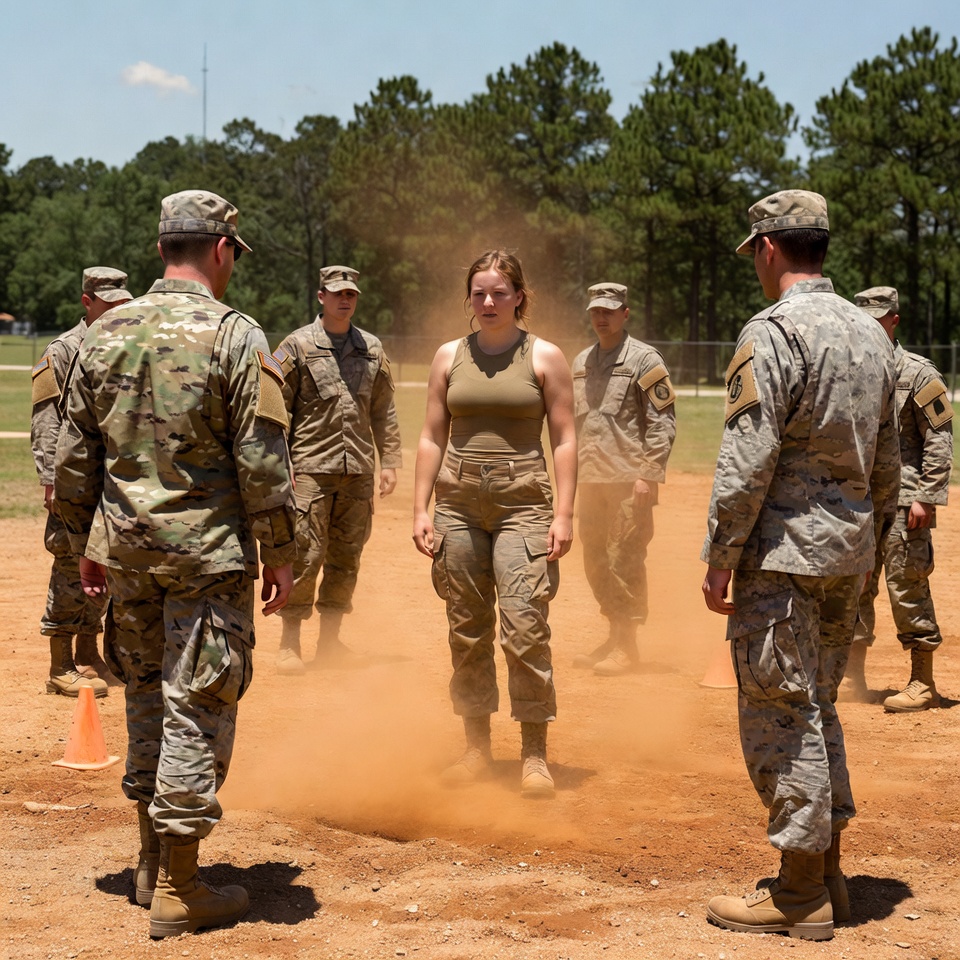
Not the clean-cut pine trees around the perimeter road, not the diesel from the transport trucks, not even the sour old-coffee breath that seemed to hang around every operations building in America. What I noticed was red dust. Georgia clay, baked into powder, lifting off the training yard every time a boot hit the ground. It got on your laces, inside your cuffs, between your teeth. It made everything look older than it was.
That afternoon, it turned the sunlight copper.
I was standing in the middle of the yard with my hands loose at my sides, listening to boots drag into a circle around me. Somebody had set up orange cones as if that made this an official drill instead of what it really was. A message.
Major Nathan Reddick stood at the eastern edge of the yard with his arms folded. Square jaw, iron-gray temples, mirrored sunglasses even though the light had started to flatten. He looked like the kind of man who ironed his socks. Around him, soldiers from three different units had drifted close enough to watch without looking like they were watching. That was how bases worked. Nobody ever admitted they came for the show. They just happened to be there when humiliation was scheduled.
I’d been on base less than six hours.
Officially, I was there as a temporary training evaluator attached to JSOC readiness. Unofficially, I was the woman who had survived Rasheed Valley when three men hadn’t, the woman half the rumor mill said had frozen, and the other half said had snapped. I’d learned a long time ago that people hated a blank space. If they didn’t know what happened, they filled it with whatever story made them feel safest.
Reddick looked at the five men closing in around me, then at me.
“Last chance to take a stance, Quinn.”
His voice carried easy. He wanted the yard to hear it.
I rolled my shoulders once. “I’m good.”
A few guys along the perimeter smirked. One of the men inside the circle, a thick-necked sergeant with acne scars and hands like cinder blocks, cracked his knuckles for effect. Another bounced lightly on his feet. They were good soldiers, physically strong, quick, probably proud of that. None of that was the problem.
The problem was that they thought this was about force.
Reddick tilted his head like he was disappointed in me already. Then he gave the order.
“Break her nose.”
A short laugh moved through the crowd. Not loud. More like the sound of people settling into the outcome they’d already decided on.
I didn’t bring my hands up. I didn’t widen my stance. I just breathed in dust and hot metal and listened.
The first one came straight in. That was almost always how it started with men who’d been told violence was permission. He was fast, I’ll give him that. Real speed, not movie speed. Weight over the balls of his feet, chest committed, jaw locked.
I waited until his momentum belonged to me.
Then I shifted a few inches off his line, caught the wrist he’d offered me, turned my hips, and borrowed all the force he’d brought. His boots left the ground so cleanly the yard made a single surprised sound, like one body inhaling. He hit hard on his back, air going out of him in a grunt.
The second one came before the first finished landing. Smarter angle, lower center. I dropped my elbow across his forearm, rotated under, trapped the shoulder, and sent him face-first into the dirt. His cheek plowed a rust-colored streak through the yard.
The third hesitated for half a beat. That half beat killed him.
I stepped in, finally moving forward for the first time, clipped his knee with mine, folded his posture, and used the back of his neck like a handle. Down. Clean. Controlled. He landed on his side and skidded.
Someone outside the circle said, “Holy—” and then stopped talking.
The fourth tried to grab from behind.
That one almost made me smile.
People who grabbed from behind always thought they were introducing surprise. They never understood that once bodies start moving around you, surprise becomes geometry. I felt the heat of him before his hands closed. I sank my weight, trapped one arm, rolled my shoulder under his chest, and threw him over my hip. He slammed down so hard dust kicked up in a sheet.
The fifth had held back the longest. He was the only one whose eyes changed before he moved. Confidence out, calculation in. Better. Better made people honest.
He rushed the opening the fourth had left, and that was the smartest thing anybody had done so far. It was still wrong. I met him with both hands, one at the jawline, one at the elbow, turned his own line against him, and walked him straight into the ground.
Then it was over.
No dramatic finish. No blood. No stomp, no extra strike, no proving point for people too slow to catch the point already proven. Five men were in the dirt around me, and I was standing about a step from where I’d started.
The whole thing took maybe seven seconds.
The training yard went quiet in a strange, complete way. Not silence like peace. Silence like a room after somebody drops a plate and everyone is waiting for the second sound.
I could hear a distant generator humming behind the motor pool. I could hear fabric rubbing as somebody at the edge shifted his stance. I could hear one of the men on the ground breathing through his mouth, stunned more than hurt.
I looked at Reddick.
He had lowered his arms.
That was the first honest thing I’d seen on his face.
He took off his sunglasses slowly, and his eyes were not the eyes of a man embarrassed in public. They were the eyes of a man adding up numbers that no longer fit. His gaze went from the men on the ground to me and settled there.
“Where did you learn that?” somebody whispered behind the circle.
I didn’t answer because it wasn’t for him.
Reddick stepped forward one pace, boots grinding in the dust. “Medical check on the men,” he said without taking his eyes off me.
A medic team that had definitely been waiting nearby moved in. That told me plenty. So did the fact that nobody laughed now.
I turned to leave.
“Captain Quinn.”
I stopped.
Nobody on base should have known to call me captain. My transfer orders had me coming in as a civilian readiness contractor for exactly one reason: to bury the name people in my old world knew. I turned back slowly.
Reddick held my stare. “My office. Ten minutes.”
“Am I being invited?”
“No.”
“Then I’ll bring my own coffee.”
That got the faintest twitch at one corner of his mouth. Not a smile. More like a crack in plaster. I walked off the yard with red dust sticking to my boots and fifty sets of eyes on my back.
In the women’s locker room, the air smelled like bleach and wet canvas. Somebody had left a hair tie on the sink and a broken compact on the bench. I opened the temporary locker assigned to me and found a folded note tucked inside my spare shirt.
No name. No greeting. Just one line in block print.
Don’t sleep in your room. They know what really happened in Rasheed Valley.
For the first time all day, my skin went cold.
I read it twice, then turned the paper over.
On the back was a number written so faintly it nearly disappeared into the fibers.
Room 214. Hangar Annex. Midnight.
I folded the note back along its original crease, and my hands were steady. That was the part people always got wrong about fear. It didn’t make me shake. It made me exact.
Because somebody here knew my past.
And somebody here was either about to help me… or finish what Rasheed Valley started.
Part 2
I didn’t go to my assigned room.
That was the first smart decision I made after the note, which meant I was due for a dumb one eventually.
Fort Bannon after dark had a different personality. In the daytime it was loud and performative, trucks rattling past, radios clipping out call signs, men trying on authority like it came off a shelf. At night the place went thin and electrical. Sodium lights buzzed over empty walkways. Moths battered themselves against glass. Somewhere near the flight line, a helicopter engine spun up and died with a tired metallic whine that made the whole base feel temporary.
I cut behind the admin building and headed for transient barracks instead. My duffel strap dug into my shoulder. The Georgia air was thick enough to drink, warm and damp and full of cut grass. Sweat gathered under my collar before I got halfway there.
I didn’t make it to the door.
“Quinn.”
The voice came from shadow to my right, low and calm. I shifted my weight before I even saw the man attached to it.
He stepped under a yellow security light: mid-thirties, rangy, dark hair cut close, sleeves rolled, warrant officer bars on his chest. Not polished like staff. More like somebody who worked for a living. He held a ring of keys in one hand and a Styrofoam cup in the other.
“Chief Warrant Officer Lucas Reyes,” he said. “Base aviation support. Also the guy who got voluntold to show you where things are.”
“I’m already where things are.”
He glanced at my duffel. “You’re standing in the dark behind admin like you’re about to rob it.”
“Depends what’s in the safe.”
That earned me a quick look, measuring but not offended. “Reddick asked me to walk you to housing.”
“Did he.”
“Yeah.”
“I’m not going.”
He took a sip of coffee, considered that. “Good.”
I watched him over the parking lot stripe of light. “You say that to all the women the major sends after midnight?”
“You’re the first one he’s sent me to with a busted knuckle and half the base pretending they weren’t impressed.”
I looked down. The skin across my right hand had split a little when I drove somebody into the dirt. Dust had dried in the crease. I hadn’t noticed.
Reyes set his coffee on the hood of a Humvee and reached into his back pocket. “Here.”
He handed me a key card with a handwritten room number taped to it.
“Transient officers’ quarters?” I asked.
“Old aircrew room over maintenance. Nobody checks it. Mattress is terrible. Lock works.”
“You hand out secret rooms a lot?”
“Only to people who find notes in their lockers.”
I went still.
He saw it and lifted one hand. “Easy. I didn’t write it. But I did see Sergeant Phelps from supply hovering where he didn’t belong about twenty minutes before you got there. Then he clocked me looking and suddenly remembered he had a whole different place to be.”
“Phelps.”
“Already checked. He’s on leave as of an hour ago.”
That turned over in my head with a small hard click. “Convenient.”
“Yeah.”
A cricket started up somewhere in the scrub by the fence. Another answered it. Reyes didn’t crowd me with questions. I liked him a little for that and distrusted him for making it easy.
“You work for Reddick?” I asked.
He shrugged. “I work for the Army. Some days that overlaps.”
“That sounds exhausting.”
“You have no idea.”
We crossed the maintenance bay together, boots ringing dull on concrete. The hangar annex smelled like hydraulic fluid, hot dust, old rubber, and the ghost of jet fuel. Somebody had left a fan running in the corner, and it clicked once every rotation like a weak heartbeat. Reyes let me into a narrow second-floor room with cinderblock walls, a single bed, a desk bolted to the floor, and a window that overlooked the dark flight line.
He was right. The mattress looked criminal.
“It’ll do,” I said.
“Bathroom down the hall. Ignore the mural of the eagle. A guy named Benton painted it in 2009 and I think it’s cursed.”
I set down my duffel and turned. “Why are you helping me?”
He leaned on the doorframe, not quite relaxed. “Because I’ve been on this base eight years, and I know the difference between training and theater. What happened in the yard was theater. What happened after looked like somebody getting nervous.”
“About me?”
“About what you remember.”
He let that sit between us.
The room hummed softly with the old wall unit air conditioner. I could taste metal in the recycled air. Outside, blue runway lights blinked in long patient rows.
“Rasheed Valley,” he said finally, careful. “That where you lost your team?”
I didn’t answer right away. The name still brought back details first and meaning second. Burned insulation. Sand in my teeth. Eli Dawson’s glove on a concrete floor with no hand inside it. The sound a drone feed made when it cut out mid-sentence.
“Part of my team,” I said.
Reyes nodded once like I’d given him enough. “You planning to go to that room at midnight?”
“Yes.”
“You planning to tell me what you’re hoping to find there?”
“No.”
His mouth almost smiled. “Fair.”
After he left, I checked the door, the window, the vent, the screws in the outlet plate, the underside of the desk, and the ceiling tile over the closet. Old habits. Good ones. Then I sat on the edge of the bed and unfolded the note again.
They know what really happened in Rasheed Valley.
That sentence had weight. Not because plenty of people had theories, but because very few knew the parts that mattered. The official story said our convoy route had been compromised by local militia chatter. The unofficial story—spread by men who liked their tragedies simple—said I had pushed too hard, gone off script, gotten good people killed.
Neither one fit the silence that followed the mission.
Too many files locked too fast. Too many phone calls from lawyers before funerals. Too much pressure from my father to let the investigation “run its course” when he had spent my entire childhood teaching me that official stories were where truth went to die.
At 11:32, I heard footsteps in the hall.
I killed the light and moved to the door.
The steps passed, paused, came back. A shadow cut under the gap. Somebody tested the handle once, gently. Not enough to make noise. Just enough to confirm whether it was locked.
I stood with one hand on the frame, breathing through my nose.
After three seconds, the shadow moved on.
I waited another full minute before opening the door. The hallway was empty, washed in weak fluorescent light that flattened everything into ugly green. At the far end, taped to the eagle mural, was a fresh piece of paper.
I crossed the hall and pulled it free.
Wrong room.
Below that, in the same block print:
Check your assigned quarters.
I was already moving before the page stopped shaking in my hand.
By the time I got to the women’s barracks, MPs were outside my room with flashlights cutting white bars through the dark. One of them turned as I approached, expression tightening when he recognized me.
“What happened?” I asked.
“Small electrical fire,” he said. “Contained.”
The word contained didn’t match the smell. Even from the door I could catch plastic smoke and something sharper underneath, something chemical. Burned wiring maybe. Maybe not.
I looked past him and saw black scorch marks climbing the inside wall near my bunk.
Then my eyes landed on the bed.
The pillow had been slit open.
Not by fire. By a knife.
Feathers and gray stuffing were scattered across the mattress like dirty snow, and pinned to the center with a boot knife was a photo I had not seen in two years.
Me, Eli Dawson, and Daniel Holt, shoulder to shoulder in a dim operations tent, all of us younger by one deployment and one betrayal.
Across my face, somebody had written in red marker:
ONE OF THEM LIED.
I felt heat rise clean and dangerous from my stomach to my throat.
Because whoever left that photo didn’t just know Rasheed Valley.
They knew exactly which ghost hurt the most.
Part 3
I slept two hours total and woke up angry.
That helped.
Anger was useful if you held it right. Too loose and it burned your judgment. Too tight and it turned brittle. The trick was to wear it like a good blade—clean, balanced, close to the body.
At 0600 I was standing outside Reddick’s office with stale coffee in one hand and the photo in the other.
His clerk, a specialist with perfect eyeliner and the thousand-yard stare of somebody who handled powerful men’s schedules for a living, looked at me over her monitor and said, “He’s in a briefing.”
“Then he can multitask.”
She took one glance at my face and buzzed me in without another word.
Reddick’s office smelled like leather polish, printer toner, and the kind of aftershave men bought when they wanted to smell like consequences. His desk was too clean. That always told me more than mess did. A tidy desk meant either discipline or a man who liked other people cleaning up for him.
He was on the phone when I walked in. “Call me back in five,” he said, and hung up without waiting.
I put the photo on his desk.
His eyes dropped to it, then lifted to me. “That’s a problem.”
“That’s one word.”
“You didn’t sleep in your room.”
“No.”
“Good.”
The calm in his voice hit me wrong. “You knew.”
“I suspected.”
“You suspected somebody would torch my quarters and pin a photo to my bed?”
“I suspected somebody would make a move.”
There are moments when your body decides before your mouth does. I leaned over his desk so fast his chair squeaked against the floor.
“You put five men on me in front of half the base, ordered one of them to break my face, and then failed to mention I was walking into a threat environment?”
He didn’t flinch. I disliked him for that too.
“I put five men on you,” he said, “because if the rumors about Rasheed Valley were true, you’d have folded. If they were false, I needed certain people here to see it with their own eyes.”
I stared at him.
That answer was ugly enough to be honest.
“Certain people,” I repeated.
“People who have been asking questions about your assignment since before your tires rolled through the gate.”
“Who?”
“Still working on that.”
I laughed once, short and mean. “You’ve got a weird idea of working.”
He reached into a folder and slid a paper toward me. Security still from outside the women’s barracks at 01:17. Hooded figure, baseball cap, shoulders turned away. Face impossible to read.
“Camera three glitched for forty-one seconds,” he said. “Conveniently.”
“What do you actually know?”
“I know whoever did this has access, confidence, and at least partial knowledge of a mission they should not know anything about. I know they wanted you rattled, not dead. If they wanted you dead, they would’ve chosen better than smoke and notes.”
“That’s comforting.”
“It shouldn’t be.”
He sat back. In daylight, without the sunglasses and theatrics, he looked older than he had in the yard. Not weak. Just less carved. There was a white scar tucked behind one ear I hadn’t noticed before.
“Why bring me here at all?” I asked. “If you knew I’d stir this up.”
“I didn’t bring you here.” His gaze held mine. “Someone above me did.”
“Who?”
He was quiet just long enough to annoy me. Then he said, “Your father signed the recommendation.”
That landed exactly where it was meant to. Hard.
My father, retired Lieutenant General Thomas Quinn, had not spoken to me in person since the closed hearing after Rasheed Valley. He’d sent flowers to Eli’s funeral and a lawyer to my apartment. He’d told me, in a voice polished smooth by decades of command, that grief made people reckless and reckless people ruined careers.
I had hung up on him.
Now Reddick was telling me that same man had arranged to place me on a base where somebody was leaving threats in my bed.
I felt my pulse in the cut on my knuckle.
Before I could answer, the clerk knocked once and opened the door. “Sir, Ms. Quinn is here.”
My stomach turned before the rest of me did.
Erin stepped into the office in cream slacks and a navy blouse that probably cost more than my monthly truck payment. My older sister always looked like she had been steamed and folded by professionals. Dark hair pinned back, lipstick exact, expression controlled. She smelled faintly of citrus and expensive shampoo, a smell that used to mean holidays and now mostly meant paperwork.
For half a second, surprise showed on her face. Then it was gone.
“Mara.”
“Erin.”
Reddick’s eyes moved between us and got out of the blast zone by standing. “I’ll give you two a minute.”
“No,” I said, not looking at him. “Stay.”
Erin set a leather folder on the chair without sitting. “I came as counsel liaison.”
“For who?”
She gave me the kind of patient look she used on clients and children. “For the review board.”
I laughed in disbelief. “There’s a review board.”
“There has been one, technically, since the incident at Rasheed.”
“Two years late. Efficient.”
Her mouth tightened. “I’m trying to help.”
That sentence from my family usually meant the opposite.
Reddick moved to the window. He wasn’t pretending privacy; he was giving me line of sight. Another thing I noticed.
Erin’s gaze dropped to the photo on the desk. I watched the exact moment she recognized Daniel. Her face did something tiny. Not guilt. Not quite. More like impact absorbed fast.
“You’ve seen this before,” I said.
“No.”
“You know more than you’re saying.”
“I know you are walking into a situation with more eyes on it than you realize.”
“That’s not an answer.”
“It’s the one I have.”
I stepped closer. “Did Dad send you?”
Her jaw set. “He asked me to make sure you didn’t blow up your life.”
“There it is.”
“Mara, listen to me. The board is willing to revisit findings if you cooperate.”
“Cooperate with what?”
“Limit media exposure. Follow the process. Stop antagonizing command staff.”
I almost smiled. “You came all the way here in those shoes to tell me not to antagonize people?”
Her nostrils flared a little. That was the Quinn family version of screaming. “You think this is about pride because that’s easier than admitting what real damage can follow if you keep digging.”
“Damage to who?”
She didn’t answer.
My gaze slipped to the leather folder she’d brought. A corner of glossy paper showed from inside. I moved faster than she expected, hooked two fingers under it, and pulled.
A photograph.
Not family. Not legal paperwork.
Daniel Holt in uniform, shaking hands with Major Nathan Reddick outside what looked like a conference center. Both smiling for a camera. Date stamp from three months earlier.
I looked from the photo to Reddick.
He didn’t look surprised.
“You know Daniel,” I said.
Reddick’s voice came flat. “I know of him.”
Erin took a step forward. “Give me that.”
I held it out of reach. “Why is my ex-fiancé taking pictures with the man who arranged my transfer?”
Nobody answered quickly enough.
That was answer enough.
I looked down at the date stamp again, and the room seemed to sharpen around the edges: toner smell, the low rattle of the air vent, the little nick in Reddick’s desk where some ring or coffee mug had worn through the finish.
Daniel hadn’t spoken to me in nineteen months.
Now his face was in Reddick’s office, smiling.
I handed the photo back to Erin, all at once too calm. “When does he get here?”
Erin’s expression shifted from guarded to alarmed. “Mara—”
“When.”
She swallowed. “This morning.”
Right then, a knock sounded behind me, and the clerk opened the door.
“Sir,” she said carefully, “Captain Holt just checked in.”
The air in the room changed so fast it felt like a pressure drop before a storm.
Because I had spent two years wanting answers.
And the man who might finally give them was already on base.
Part 4
Seeing Daniel Holt again felt like biting into a tooth you thought had healed.
The pain wasn’t new. That was the problem. It was old pain, deep pain, the kind that had learned your shape and waited.
He met me outside the admin building twenty minutes later because apparently the universe had decided subtlety was for civilians. Morning sun flashed off parked windshields. Somebody nearby was mowing a strip of grass, and the smell of gasoline and wet cut blades drifted through the heat. Daniel came across the lot in service khakis, sleeves rolled once, no cover, carrying himself with that same clean-cut confidence that had once made me trust him in rooms where I trusted no one else.
He had more lines around his eyes now. Less softness in the mouth. He was still handsome in the way honest disasters often are.
“Mara.”
I folded my arms. “You look expensive.”
He glanced down at himself. “Good to see you too.”
“No, it isn’t.”
That landed. Good.
For a second we just stood there with twenty months of silence between us. I noticed stupid details. A small scar at his chin I didn’t remember. The way he kept his left thumb rubbing the edge of his right index finger when he was tense. The faint smell of cedar soap. You can hate someone and still know the map of them too well. That might be the ugliest part.
“I asked for a chance to explain,” he said.
“You had nineteen months.”
“It wasn’t safe.”
I laughed. “There it is. The line. You used to only pull that one when you were lying or trying to get me into bed.”
His jaw flexed. “I deserve that.”
“You deserve worse.”
A forklift beeped somewhere behind the motor pool. Men shouted over pallets. Life went on all around us with the usual military genius for ignoring emotional explosions unless paperwork was involved.
Daniel took a careful breath. “Rasheed Valley wasn’t what they told you.”
I stared at him. “Amazing. I picked that up around the time my room got torched.”
He glanced toward the admin building. “You need to keep your voice down.”
“You need to say one useful thing.”
He stepped a little closer, not enough to touch. “There was a secondary objective on that mission.”
I felt my stomach go hard. “No.”
“Yes.”
“No, Daniel. Don’t do this halfway. Don’t walk in here smelling like cedar and regret and toss me one classified breadcrumb like I’m supposed to thank you for honesty. Eli died on that route. Benning and Cho died on that route. I almost died on that route. You signed a statement saying the intel packet was sound.”
His eyes flickered. There. Hurt, shame, something. “I signed what I was ordered to sign.”
“And there it is again. The second line.”
He looked down once, then back at me. “There was a source extraction built into the route. You were never told because the source wasn’t part of your chain.”
That punched through more than I wanted it to. Hidden assets happened. Hidden assets that got your team killed happened too. But the way he said it—tight, controlled, practiced—told me he had said some version of this in his own head a thousand times.
“Who was the source?” I asked.
“I can’t say that here.”
“You can’t say that anywhere, apparently.”
“Mara.”
My name in his mouth still had old weight, and I hated that. I hated him for knowing it.
Before I could answer, boots slapped the pavement fast behind us. One of the sergeants from yesterday’s drill came jogging up, breath high, face pale under his tan.
“Major wants both of you at the range annex,” he said. “Now.”
“Why?” Daniel asked.
The sergeant swallowed. “Because Specialist Pike is dead.”
I knew the name a second before I knew why I knew it. Then it clicked. Pike had been the fifth man in the circle yesterday. The one who had held back, measured, chosen the opening.
“Dead how?” I asked.
“Fell from the catwalk in storage bay three.”
“Accident?” Daniel said.
The sergeant’s eyes flicked between us. “That’s not what it looked like.”
Range annex storage bay smelled like rope, machine oil, and the hot copper scent of blood trying very hard not to be blood anymore.
They had covered Pike with a green sheet, but one boot was still sticking out, toe bent at the wrong angle. MPs had taped off the area. Reddick stood near the catwalk with Reyes and two CID agents. Fluorescent lights buzzed above us so hard the whole building felt irritated.
Reddick looked at me as I came under the tape. “Did you touch anything in your room besides the photo?”
“No.”
“Good.” He jerked his chin at the floor.
A broken phone lay near Pike’s hand. Screen spiderwebbed. One of the CID agents was photographing it.
“Witness?” Daniel asked.
Reyes answered before Reddick could. “Maintenance guy heard a shout, then the fall. Didn’t see who else was up there.”
I looked up. The catwalk ran the length of the bay, narrow and caged, with shelves stacked high below it full of mats, dummy rifles, crates of training armor. One section of railing hung bent outward.
“Pike say anything after yesterday?” I asked.
Reddick’s eyes narrowed slightly. “Why?”
“Because he was the only one who looked like he understood something had gone wrong before he hit the dirt.”
Reyes glanced at me like he was filing that away.
A CID tech held up the broken phone. “There’s an unsent text draft.”
Reddick nodded once. “Read it.”
The tech squinted through the cracked glass. “It says… ‘I didn’t know they’d really do it. Quinn needs to know about the ammo—’”
He stopped.
“That’s all?” I asked.
“Rest got cut off.”
The building seemed to lean around that sentence.
Ammo.
Yesterday’s drill had been unarmed, but training days never happened in a vacuum. Soldiers came from ranges, from cages, from loadouts. Somebody always touched equipment. Somebody always tracked who got what. If Pike had seen something connected to ammunition, it meant this wasn’t just about scaring me. It touched supply, records, chain of custody.
Daniel looked at Reddick. “Who had access to his phone?”
“Everyone with rank and bad intentions,” Reddick said.
A dark scrape near Pike’s sleeve caught my eye. I crouched before anyone could tell me not to. Under the edge of the sheet, something small had snagged in his Velcro cuff.
A shred of laminated paper.
CID started protesting, but I was already holding it by the corner. Half an access badge insert, torn. On the fragment was a printed number and one word.
ANNEX B-214
The room from the note.
Reyes saw it over my shoulder. “That’s your ghost room.”
“Yeah.”
Daniel’s gaze sharpened. “Somebody lured him there.”
“Or he lured somebody,” I said.
Reddick took the badge fragment from me with a gloved hand. “Either way, Pike was about to talk.”
One of the CID agents stepped away to answer a call. His voice stayed low, but in the metal echo of the bay I still caught three words.
“…Quinn’s sister here…”
I straightened. “Erin?”
The agent turned his back, but not before I saw the flash of discomfort in his face.
Reyes saw it too.
Reddick’s mouth flattened. “She’s in legal. That doesn’t mean anything.”
“No,” I said. “It means it might mean five things.”
A medic rolled Pike away. The sheet shifted just enough for me to see bruising high on his neck. Finger marks. Not a fall. Not first.
Daniel stepped closer, lowering his voice. “Mara, listen to me. If you start pulling on supply records, do it quietly. If there are serial discrepancies, they’ll know what you found.”
I turned to him slowly. “How would you know there might be serial discrepancies?”
He opened his mouth, then shut it.
That was when I knew he still wasn’t here to confess. He was here to manage. To shape. To get ahead of something.
I hated that my chest still hurt looking at him. I hated even more that part of me still wanted one clean impossible thing from him: the truth without bargaining.
Reyes touched my elbow lightly. It was barely a contact, just enough to redirect my attention without claiming me.
“Come see something,” he said.
He led me toward the storage log desk near the back wall, where a clipboard had been left open beside a dented metal fan. Names, times, equipment issue numbers. Ordinary scribbles. Ordinary lies.
He tapped a line from yesterday afternoon.
Training demo lot, five helmets, five pads, no weapons, sim rounds requested then canceled.
Requested by: S. Pike.
Below that, approved by: D. Holt.
I felt the room go cold around the edges.
When I looked up, Daniel was already watching my face.
And for the first time since he arrived, he looked afraid of what I might do next.
Part 5
By noon, the whole base knew Pike was dead and had developed eight different versions of why.
That was another thing about military posts: rumor traveled faster than medevac. By lunch, people were saying he slipped, he was drunk, he was pushed, he had gambling debt, he had a girlfriend in town, he was undercover, he’d mouthed off to the wrong sergeant, he’d stolen opioids, he’d been having an affair with somebody’s wife. Truth didn’t stand a chance against that kind of creativity.
I grabbed a protein bar from the PX, chewed two bites, and threw the rest away.
Reyes found me outside the range office under a warped awning where the shade smelled like mildew and hot plywood. He had two cold bottles of water in one hand and a thumb drive in the other.
“Tell me you stole something useful,” I said.
“Borrowed,” he corrected. “And yes.”
He handed me one bottle. Condensation ran cold over my palm.
“What is it?”
“Copy of yesterday’s cage issue logs before CID can sanitize them.”
The word sanitize came out dry enough to be a joke, except neither of us was joking.
We went to the old aircrew room because it was private and the eagle mural already knew too much. Reyes plugged the drive into a battered desktop that took forever to wake up, its fan whining like an old man with opinions. The screen threw flat blue light across the cinderblock walls.
Rows of inventory entries filled the monitor.
Training pads. Marker rounds. Blank-fire adapters. Sim pistols. Protective masks.
Then a discrepancy.
A crate of UTM training rounds had been checked out at 1320, returned at 1605, but the count was off by twelve. The note in the remarks field read: adjusted by supervisor per demonstration requirement.
“Supervisor?” I asked.
Reyes clicked the internal routing.
Approved by Major N. Reddick.
Override entered by Captain D. Holt.
I leaned back in the chair slowly. The air conditioner coughed lukewarm air at my knees.
“This drill was supposed to be hand-to-hand.”
“Yep.”
“Then why were sim rounds touched at all?”
“That,” Reyes said, “is the part I thought you’d enjoy.”
He opened another file. Camera stills from the range cage loading area. Grainy, overhead, timestamped. Men coming and going. At 14:02, Pike appeared. At 14:04, Daniel. At 14:06, a third figure in civilian clothes and a baseball cap.
The angle only caught half his face, but it was enough.
My father.
Retired Lieutenant General Thomas Quinn stood in a supply corridor on a military base he had no business being on, talking to my ex-fiancé and the soldier who died twelve hours later.
Every muscle in my body went quiet.
Reyes didn’t say anything for a few seconds, which was smart.
Then, very carefully: “You want to tell me why your dad’s in my grainy little horror movie?”
“No,” I said. “Because I don’t know.”
That was the truth, and it tasted awful.
I stood and paced once across the room. The floor tiles clicked under my boots. Old anger came up first, then the older thing beneath it: disappointment so permanent it had calcified into expectation. My father had always loved systems more than people. He loved order, narrative, strategic sacrifice. He used to tell me, when I was thirteen and crying because he’d missed another birthday, “History never thanks the people who hesitate.” At the time I thought that sounded noble. Later I realized it mostly meant he never apologized.
Reyes swiveled in the desk chair to keep me in sight. “Could he get on base that easily?”
“He’s Thomas Quinn. He could probably get into heaven’s motor pool if he said it was a national security issue.”
“Comforting.”
“He likes to be.”
A knock hit the door once. We both froze.
Reyes muted the monitor and crossed to the side wall, not dramatic, just ready. I went to the door and opened it two inches.
Erin stood there.
She looked worse than she had this morning, which on Erin meant one piece of hair had escaped near her ear and her lipstick was gone. Her eyes cut past me into the room, registered Reyes, the computer, the shut blinds, and got harder.
“I need to talk to you alone,” she said.
“No.”
“Mara.”
“Not a great pitch.”
She took one step closer, lowering her voice. “Dad is on his way.”
I stared at her. “To the base.”
“Yes.”
“Why?”
“Because you are making this impossible to contain.”
I let out a laugh so sharp it almost hurt. Reyes made a small motion behind me, not interference, just readiness.
“Contain,” I repeated. “That the family word now?”
Her gaze flicked over my shoulder again. “You should not be with him.”
I glanced back at Reyes. “You hearing this? She makes it sound like I dragged a drifter home from a truck stop.”
“This is not funny.”
“No, Erin, it isn’t.”
She looked tired suddenly. Not polished, not managed. Just tired. “There are things in motion you do not understand.”
“Then explain them.”
“I can’t here.”
“Can’t or won’t?”
She pressed her lips together. It was answer enough.
I stepped out into the hall and pulled the door nearly shut behind me. The eagle mural stared over Erin’s shoulder with dead painted eyes.
“Did you know Dad was with Daniel and Pike yesterday?” I asked.
She went completely still.
That told me more than words could have.
“Oh my God,” I said softly.
“It isn’t what you think.”
“That sentence should be printed on our family crest.”
“Mara, listen. Dad believed there were personnel vulnerabilities tied to your presence here.”
“What does that even mean?”
“It means he thought bringing you onto base might force certain actors to expose themselves.”
I looked at her. Really looked. The fine strain around the eyes. The way her hand tightened on the strap of her leather bag. Erin had always been the one who cleaned up after storms. Bills, funerals, school forms, legal messes, all the human wreckage of powerful men. Somewhere along the line she had mistaken management for morality.
“So he used me as bait,” I said.
“He thought he was protecting you.”
I laughed right in her face. “From what? The consequences of whatever he did?”
Her own temper finally showed. “You think you’re the only person who lost something in Rasheed? Mom died six months later, Mara. Dad barely held together. The board was closing in. There were classified equities—”
“Do not say equities to me like that means lives.”
Her voice snapped like a wire. “You have no idea what Eli Dawson was mixed up in.”
The hallway changed temperature.
She saw it happen in my face and knew she’d said too much.
I took one step closer. “You don’t get to use his name if you’re going to lie after it.”
Her eyes flashed wet for a second, then hardened again. “Dad can explain better than I can.”
“I’m sure he’s practiced.”
Behind me, the room door opened a crack. Reyes’ voice came easy, but I could hear the steel under it. “Company coming.”
Boots pounded on the stairs at the far end. Not a patrol pace. Purpose.
An MP lieutenant appeared in the hall with two officers behind him.
“Captain Mara Quinn,” he said, “you need to come with us.”
“For what?”
He glanced at a paper in his hand. “Questioning regarding unauthorized access to restricted inventory and interference in an active investigation.”
Erin closed her eyes briefly like this was exactly what she had been trying to avoid.
I smiled without humor. “That was fast.”
The lieutenant took another step. “Ma’am.”
From inside the room, Reyes killed the monitor. Somewhere beneath the hum of the lights, my pulse slowed instead of speeding up. That was how I knew things were bad. My body only got that calm when it had finally chosen a direction.
I looked at Erin. “Did you know this was coming too?”
She didn’t answer.
And that silence told me I wasn’t about to be escorted to a conversation.
I was about to be boxed.
Part 6
There’s a special kind of rage that comes from realizing your family has been discussing your containment like you’re a weather event.
I went with the MPs because sometimes the cleanest move is to let people think they still have control. The lieutenant led me to an interview room in the admin annex, one of those windowless boxes with a metal table bolted to the floor and walls painted a beige color that might have been selected to erase memory. The room smelled like coffee grounds, old carpet glue, and the lemon cleaner people use when they want official spaces to seem harmless.
They left me alone for fourteen minutes.
I counted.
At minute fifteen, Major Reddick came in instead of CID.
He shut the door behind him, stayed standing, and looked tired for the first time. “You weren’t officially detained,” he said.
“Terrific. Love being unofficially ambushed.”
“They’re stalling for Thomas Quinn.”
There was my father’s name again, moving through rooms before he did.
I leaned back in the chair. “You want to explain why my retired father is running traffic on your base?”
Reddick dragged a hand over his mouth. “Because twenty years ago, he was my battalion commander. Ten years ago, he was one of the men who signed off on my promotion board. Two years ago, he called me personally after Rasheed Valley and told me if you ever resurfaced in the system, I was to notify him.”
I let that settle.
“And you said yes.”
“I said yes because when a three-star with friends on every committee tells you a volatile asset may resurface, you listen.”
“Volatile asset.”
“You were a captain with a sealed personnel jacket, a dead team, and a classified black mark nobody would explain. Pick your preferred phrasing.”
I almost smiled. I appreciated honesty even when it insulted me.
Reddick put both palms on the table. “Then you walked into my yard and dropped five men in under ten seconds without taking a backward step.”
“So your opinion improved.”
“My certainty changed.”
There was a difference. I respected him a little for knowing it.
“What do you actually believe now?” I asked.
He held my gaze. “I believe your father has been trying to manage the fallout of something bigger than a bad mission. I believe Holt came here to steer it. I believe Pike panicked after yesterday because he saw people he thought were untouchable start sweating. And I believe someone is close to making a terminal mistake.”
I watched him for a beat. “That’s almost useful.”
He slid a slim recorder across the table.
“Listen.”
I pressed play.
Static. Footsteps. Then voices, muffled but clear enough.
Daniel: “…she was never supposed to see the logs.”
Unknown male, older, controlled, the voice I’d spent my whole life hearing from podiums and holiday dinners: “Then why did you approve the override?”
Daniel: “Because Reddick insisted on the demo.”
My father: “Don’t say names when you’re nervous.”
The file ended.
I didn’t move. Didn’t breathe much either.
Reddick watched my face, probably looking for fracture lines. I’d gotten good at not giving people those.
“You recorded them?” I asked.
“By accident at first. My office system catches after-hours motion. Once I realized who I had in the room, I kept the copy.”
“Why not turn it in?”
“Because copies disappear when the wrong people handle originals.”
There it was again. The part of military life civilians never quite got. The chain of command was real. So was the chain underneath it, made of favors, fear, old loyalties, and men who knew where each other’s careers were buried.
I sat back. The chair creaked under me.
“What was Rasheed really?” I asked.
Reddick exhaled through his nose. “I don’t know all of it. I know the target packet your team received was not the only packet in play. I know there was a second list—names, routes, extraction windows. Human assets. Somebody in or adjacent to your mission had access to it. Somebody monetized it.”
A second list.
My skin went tight.
“You’re saying the ambush wasn’t incidental.”
“I’m saying too many people got rich or protected afterward for it to have been random.”
The overhead light hummed. In the next room somebody laughed, a short ugly bark, then stopped. The normal life of buildings went on while whole histories changed inside them.
“What about Daniel?” I asked.
Reddick’s mouth flattened. “He was either following orders from your father or using your father as cover. Maybe both.”
“And Erin?”
He hesitated. That was answer enough too.
Before I could push, his phone buzzed. He looked down, expression sharpening.
“What.”
He listened. Said nothing for three seconds. Then: “Keep him there. Do not let CID touch the vehicle.”
He ended the call and looked at me.
“Holt just requested access to hangar nine and an outbound bird.”
“Why?”
“He says he has to leave for D.C.”
“That man has the survival instincts of a moth in a welding shop.”
Reddick pocketed the phone. “Or he thinks he’s about to lose leverage.”
I stood. “Then I’m going.”
“To hangar nine? Absolutely not.”
“Cute.”
“Quinn—”
“No. You dragged me into this, tested me in public, let my father run bait on my life, and now you want me to sit in a beige closet while my ex-fiancé runs for the door?”
His jaw set. Mine probably matched.
For a second, we were just two people with military training and terrible communication skills seeing who moved first.
Then he reached into his pocket, took out a keycard, and set it on the table.
“Service entrance, west side,” he said. “You were never here.”
That actually surprised me.
“Why help me?” I asked.
His expression went hard in a different way. “Because whatever your father became, I’m done saluting it.”
Outside, the sun had gone white and hot. The concrete shimmered. I cut across the vehicle bay, ducked behind stacked pallets, and made the west side of hangar nine in under three minutes. The metal skin of the building radiated heat like a stove. My shirt stuck to my spine. Somewhere inside, tools clanged, then stopped.
The service door opened on a dim maintenance corridor smelling of aviation grease and old rainwater. I moved down the narrow passage until voices floated from the main floor.
Daniel’s voice first, tight and urgent. “I can’t keep smoothing this over.”
Then my father’s, crisp as pressed linen. “You don’t need to smooth it over. You need to contain her until the board closes.”
I stopped breathing.
“She’s not stupid,” Daniel said. “She saw the logs.”
“You were supposed to have handled the logs.”
“I handled the packet like you asked. I testified like you asked. I buried myself with her because you said it was the only way to protect—”
A metal crash cut him off. Maybe a dropped wrench. Maybe my pulse in my ears.
My father spoke again, lower now. “This is not the place for conscience.”
Daniel let out a laugh that didn’t sound sane. “You think this is conscience? Eli Dawson called me from the route. He knew. He knew somebody sold them out.”
Everything in me went still.
Then I heard a third sound. A shoe scuff behind me in the corridor.
I turned just as a shape came out of the shadows fast, arm swinging.
I caught the wrist by reflex.
The knife flashed silver under the emergency light.
And the hand holding it belonged to my sister.
Part 7
If Erin had wanted me dead, she would have missed.
That was the first thing I knew.
The second thing I knew was that she didn’t understand how obvious the difference was.
I trapped her knife wrist, drove her forearm into the cinderblock wall, and pinned her there before the blade made a second arc. The sound that came out of her was half gasp, half fury.
“What are you doing?” I hissed.
Her perfume had gone sharp with sweat. Up close I could see her makeup had cracked under one eye. She looked less like a polished attorney now and more like what she really was in that moment: a scared woman doing a bad job of a desperate thing.
“Let go of me,” she snapped.
“Not with the knife.”
“It isn’t for you.”
That stopped me.
Not because I believed her yet, but because it was such a stupid sentence to say while trying to stab someone that it had a decent chance of being true.
Behind the corridor door, voices still floated from the hangar floor, blurred now by the blood pounding in my ears.
I twisted the knife gently from Erin’s grip and held it out of reach. “Talk.”
Her chest rose and fell hard. “Daniel set this meeting. He told me if I wanted proof, real proof, I needed to come armed.”
“Proof of what?”
“That Dad was going to make him disappear.”
That landed ugly because it sounded possible. My father never liked weak links, and Daniel had been leaking weakness all over the place since he arrived.
“You could’ve opened with words,” I said.
She laughed once, breathless and bitter. “You never listen to words from me.”
“That’s because they usually come gift-wrapped.”
A forklift rolled somewhere on the hangar floor and beeped in reverse. Then Daniel’s voice cut sharper through the noise.
“…I kept quiet for you.”
My father answered, colder now. “No. You kept quiet for yourself.”
Erin’s eyes flicked toward the door. “Please.”
I let her go and handed the knife back handle-first.
Her gaze snapped to mine, startled.
“Point it somewhere useful,” I said.
We moved to the doorway together and looked through the narrow wired-glass pane.
The main floor of hangar nine was mostly empty except for a Black Hawk parked nose-in under work lights. Tool chests stood open. One mechanic at the far end pretended not to hear anything and was doing a very bad job of it.
Daniel and my father stood near the helicopter’s tail boom, about eight feet apart. Daniel looked wrung out, tie gone, sleeves rolled higher now, his face red with heat and anger. My father looked immaculate in a pale summer suit that somehow never sweated, as if the climate itself respected rank.
I knew then what hurt most about seeing him.
Not fear. Not rage.
Recognition.
The way he stood with his chin slightly lifted when he believed he had already won. The way one hand rested near his pocket instead of inside it, ready. The look of deep offense whenever somebody else’s feelings became inconvenient.
Daniel was saying, “She deserves the whole truth.”
My father’s expression didn’t change. “Deserve is a child’s word.”
“She watched Eli die.”
“And if she had known what he was carrying, she would have died too.”
There. Another piece.
I pushed through the service door and stepped onto the hangar floor.
Both men turned.
For just a second, all three of us were held in the white wash of the overhead work lamps. The helicopter blades above us sat motionless, casting huge crooked shadows over the concrete. The whole hangar smelled like hot metal and hydraulic fluid.
“Perfect,” I said. “Now nobody has to speak in code.”
My father’s face hardened first, then smoothed. “Mara.”
“Don’t.”
He glanced at Erin emerging behind me with the knife. “Interesting choice of escort.”
“She’s not with you?” I asked without taking my eyes off him.
Erin’s answer came from my left. “Not anymore.”
For the first time, something like real irritation crossed his face.
Daniel looked between us, then back at my father. “Tell her.”
My father actually sighed. Like this was tedious. “Rasheed Valley was a compromised theater. Eli Dawson discovered a secondary asset list tied to an off-book resettlement program. Names, routes, foreign cooperators. If that list had surfaced publicly, it would have burned half a dozen active channels and triggered congressional exposure on programs you are not cleared to understand.”
I took one step closer. “So you let us walk into an ambush?”
“No.”
“Yes,” Daniel said.
My father shot him a look that could have stripped paint.
Daniel kept going, voice shaking now. “He changed the route forty-three minutes before wheels up. He said a source had to be picked up. He said your team didn’t need to know because compartmentalization protected everyone.”
“Protected who?” I asked.
Silence.
My father answered with the same maddening control. “The country.”
I laughed in his face.
It came out ugly and loud in the hangar, and the mechanic at the far end quit pretending not to watch. “There it is. The giant patriotic napkin you wipe blood up with.”
“Mara,” he said, and now there was warning in the voice I’d grown up obeying.
But I was done being twelve.
“Eli called Daniel from the route,” I said. “He knew.”
Daniel nodded once, miserable. “He saw a duplicate comms sheet in the vehicle. He knew somebody had inserted a pickup.”
“And instead of aborting, you—what? You hoped it would work?”
Daniel looked wrecked. “I thought the leak was external. I thought the source might still save the operation.”
“God, you idiot.”
He flinched because I wasn’t wrong.
Erin took another step onto the floor, heels clicking on concrete. “Dad, tell her about the payments.”
That hit him harder than anything else had.
He turned slowly. “Erin.”
“Tell her.”
He looked almost pitying. “You never had the stomach for strategic silence.”
“Stop calling it that,” she snapped. “You paid families. You laundered condolence money through the contractor fund and called it settlement support.”
I stared at her. “You processed it.”
Tears sprang into her eyes at once, angry tears, not cleansing ones. “I told myself it was to keep them from years of litigation. I told myself nobody could survive what the truth would do. I told myself a hundred things, Mara. None of them brought anyone back.”
That was probably the first honest thing my sister had said to me in years.
My father’s voice dropped into that dangerous calm he used before detonations. “You are all confusing grief with governance.”
“No,” I said. “We’re confusing you with a father.”
For one clean second, I saw through him.
Not all the way. Men like him rarely came fully apart in public. But enough. Enough to see rage under the discipline, panic under the contempt. Whatever machine he’d built after Rasheed was starting to shake.
He reached into his jacket.
Erin raised the knife.
Daniel stepped forward, hand half out like that would solve anything.
I moved before I consciously decided to.
My father wasn’t drawing a gun. He was drawing a phone.
He never got to use it.
I slapped it from his hand so hard it skidded under the helicopter. Daniel lunged at the same moment, maybe to stop me, maybe to stop him. My father shoved him. Daniel stumbled backward into a maintenance stand, which toppled with a scream of metal.
The mechanic finally did the smart thing and ran.
Then the side door banged open and voices shouted from outside.
“MPs!”
My father looked at me, and that was when I saw it.
Not remorse. Not fear.
Calculation. A new line forming instantly.
He lifted both hands. “My daughter is unstable,” he said loudly. “Disarm her.”
I nearly smiled at the speed of it.
Because there it was, the family truth in one sentence.
Not protect. Not confess. Not grieve.
Frame.
The MPs flooded in, boots hammering the floor, and for half a heartbeat everybody froze in a shape that could become any story somebody powerful wanted.
Then Daniel looked at the MPs, at my father, at me, and made his choice.
He pointed straight at Thomas Quinn and said, “Arrest him.”
I had just enough time to register the shock on my father’s face before the first shot cracked from somewhere above us on the catwalk.
Daniel jerked.
A red bloom opened across his shirt.
And suddenly every lie in the hangar was too slow to matter.
Part 8
Gunshots inside a hangar don’t sound like they do in movies.
They sound wrong.
Sharper, flatter, more mechanical. The crack ricochets off steel and concrete so fast your ears can’t locate it cleanly. One second Daniel was upright with his finger pointed at my father, and the next he folded, clutching his side, blood darkening khaki like spilled paint.
Everybody moved at once.
MPs shouted. Somebody yelled “Catwalk!” Somebody else yelled “Down!” My father actually did go down, dropping to one knee behind a wheel jack with a speed that told me he’d been closer to violence lately than his tailored suit suggested. Erin screamed Daniel’s name.
I didn’t scream. I ran.
There was a ladder bolted to the far support beam and I hit it hard, boots ringing metal, hands sliding on old grease. Above me the catwalk rattled with retreating footsteps. The shooter had a suppressor on the second shot—smarter now that chaos had started—and the muted pop hit somewhere below and left a bright spark in my peripheral vision.
I kept climbing.
The catwalk smelled like hot dust and oxidized steel. Through the grating under my boots I could see the helicopter roof, the MPs fanning out, Daniel curled on his side with both hands pressed to the wound, Erin crouched beside him in cream slacks that were no longer cream.
The shooter was twenty yards ahead, moving fast in dark utility gear and a ball cap. Not a soldier I recognized. Lean build, efficient gait. He didn’t glance back until he reached the far corner.
When he did, I saw a beard, sunglasses, and a face I didn’t know.
Which was somehow worse.
I sprinted the last stretch. He shoved a rolling tool rack behind him to slow me and I vaulted it, one hand on the frame, landing ugly but upright. He hit the side stairs and took them two at a time. I cut inward and dropped from the catwalk to a stack of mats below, absorbing the impact through my knees and shoulder, then drove after him through the training bay door.
He was heading for the old combatives room.
Of course he was.
The room on the other side smelled like old sweat baked into canvas, floor disinfectant, and the faint rubber stink of cracked mats. Daylight came through high wired windows in thin white bars. The shooter threw open the rear exit, but the warped door caught on swollen wood just long enough for me to close distance.
I hit him at the hips and we went through in a tangle.
We landed in the alley behind the building, gravel biting through my palms, heat rising off the concrete wall. He rolled fast, came up with a knife this time. Nice. Personal.
He slashed low first, testing.
I backed a half step and saw the patch on his sleeve where a logo had been torn off. Ghost rectangle. Contractor maybe. Not unit.
He came again, harder, and I finally gave him what he thought he wanted: centerline.
Then I took it away.
I trapped the wrist, drove my forearm into the hinge of his elbow, felt the knife hand jolt, rotated under his shoulder, and stripped the blade free. He tried to bull through with weight. Men loved that. Weight had worked for him most of his life and he couldn’t imagine being billed differently.
I put him into the wall face-first.
Brick dust flaked loose. He grunted, rebounded, and caught me with a glancing punch above the ribs. Pain flashed hot and narrow. Good. Pain told me where I was.
He reached for his sidearm.
I was faster by one beat.
My knee smashed into his thigh, deadening the draw. I peeled his gun from the holster, threw it over the fence into scrub, and wrapped one arm around his neck from behind. Not a choke. A lever. His own spine became the threat.
“Who sent you?” I said.
He tried to throw me off.
I tightened.
“Who.”
His voice came out as a rasp. “Too late.”
People always said that when they still thought mystery was power.
I drove him to his knees. Gravel crunched. Sweat ran down my neck into my collar. Somewhere beyond the alley wall, sirens started up on base, thin and rising.
“Name.”
He laughed. Really laughed. “You think Quinn’s the top of it?”
My grip changed without my deciding. Not enough to cripple. Enough to introduce consequences.
He sucked in air. “Blackridge,” he choked. “Contractor cell… second list… assets already moved…”
Blackridge.
The name hit a corner of memory. Private logistics contractor. Procurement. Low profile, high access. The kind of company that made fortunes in the shadows between official need and public oversight.
“What second list?”
He tried to twist away again. I bounced his forehead lightly off the wall. “Do not make me drag this out.”
He spit blood onto the gravel. “Safe deposit… county bank… Dawson copied it…”
Eli.
My chest clenched hard enough to blur the alley for a second.
“You’re lying.”
He laughed again, weaker. “Holt wasn’t the leak. Just the coward.”
That one I believed.
Boots pounded at the far end of the alley. MPs incoming. Good. Bad. Both.
The shooter heard them too and made a final desperate move, going slack all at once to drop his weight. I adjusted automatically, but he’d kept one last blade taped inside his boot. By the time I saw the flash, it was already coming up.
It sliced my forearm, hot and bright.
I swore, trapped his ankle, and slammed it into the gravel hard enough for the blade to skitter away. Then I put him down flat and drove my knee between his shoulders until the MPs arrived.
“Hands!” one shouted.
“Already busy,” I snapped.
Two MPs hauled him up. One pulled off his cap and glasses.
I knew him then.
Not by name. By the training yard.
He had been standing near Reddick’s left shoulder during the drill, dressed like just another observer. Same watch, same scar at the chin, same blank professional boredom.
He’d been there from the start.
An embedded watcher.
An executioner if needed.
The MP lieutenant looked between my bleeding arm and the prisoner. “Who is he?”
The man smiled redly through split lips. “Ask Quinn senior.”
Then he bit down.
Hard.
Foam touched the corner of his mouth almost immediately.
“Damn it,” I said.
The MPs lowered him fast, but I could already see the seizure taking him. Cyanide or something close. Old-school, theatrical, effective. His body jerked once, then again.
I stood over him with blood running down my wrist and felt nothing noble. Just fury. Fury that every answer came half-chewed. Fury that Eli’s name was in this now deeper than I’d feared.
The lieutenant swore into his radio for a medic.
I took one step back and leaned against the hot brick, breathing through the burn in my arm.
Then I heard running footsteps from the other side of the alley and turned.
Reyes came around the corner first, eyes sweeping, face tight. Behind him, one of the medics shouted that Daniel was alive but crashing.
Reyes looked at the dead contractor, then at me. “You okay?”
“No.”
He nodded like that made sense. “Good.”
I almost laughed.
Then his gaze dropped to my hand.
The contractor, in the instant before he died, had shoved something into my palm.
A tiny brass key on a red motel keychain tag.
Stamped into the plastic were four numbers.
214B9.
The ghost room. The hangar. And maybe a box somewhere only one dead man thought I’d reach first.
Reyes looked up. “What’s that?”
I closed my fist around it.
“The next lie,” I said.
And across the base, a helicopter engine began to spin.
Part 9
Daniel didn’t die.
Part of me was annoyed.
That sounds cruel, but survival after betrayal is complicated. If he died, he became a tragedy people could tidy up. If he lived, he had to stay a man. Bleeding, frightened, compromised, accountable. I preferred that.
They got him stabilized at the base hospital, and within fifteen minutes the building was crawling with people who smelled like starch and authority. CID, legal, command, two men in civilian suits who never introduced themselves, and my father’s private security detail pretending not to be private security. The whole place had that hospital mix of antiseptic, old coffee, and hidden panic.
Reyes wrapped my forearm in the ER while a medic with pink hair and zero patience stitched the deeper slice.
“You’re going to scar,” she said.
“I collect them.”
“Yeah, well, this one’s ugly.”
“Most useful things are.”
She snorted and tied off the bandage.
Reyes waited until she left, then leaned against the counter and crossed his arms. “You going to tell me about the key now?”
“No.”
He nodded. “Cool. Hate being included.”
I looked at him. “You should back off.”
“Because?”
“Because men are dying.”
He tipped his head. “That your way of saying you’re worried about me?”
“My way of saying you still have options.”
His mouth twitched. “So do you. Yet here we are.”
A nurse stepped in to tell us Daniel was asking for me by name. Reyes looked at me. I looked at the wall.
Then I got up.
Daniel’s room was dim except for monitor glow. Machines clicked and breathed around him. He looked washed out against the white pillow, skin gray under the tan, one side of his shirt cut away, bandage taped tight across his abdomen. The cedar soap smell was gone. Now he smelled like saline, iron, and fear.
He managed a weak smile when I came in. “You always did make an entrance.”
“I learned from selfish men.”
That hurt him. Good again.
I pulled the chair close and sat, forearms on my knees. “You have two minutes before I decide your pain meds are adequate company.”
His breathing hitched once around a laugh. “Fair.”
He looked at the door, then back at me. “Your father didn’t build this alone.”
“I know.”
“Blackridge handled the off-book logistics. Asset transfers, supply masking, payout channels. The second list was leverage. If foreign cooperators went public, so did everything else.”
“What else?”
His eyes closed briefly. “Domestic names. Lawmakers. donors. officers. People who used the program to move money, favors, sometimes people.”
I stared at him.
Human trafficking and covert resettlement were not the same thing, but in the wrong hands the paperwork could be bent until morality snapped. I’d seen enough of the world to know that. Hearing it tied to my father still felt like swallowing broken glass.
“Eli found copies?” I asked.
“Yes.”
“Where?”
“He made a dead drop.”
“Where.”
Daniel swallowed. The monitor ticked faster. “County bank in Mason Ridge. Safe deposit under a front name. I don’t know the number.”
“Then what good are you?”
His eyes shone suddenly. Not from pain. From something older and uglier. “I loved you.”
I almost stood up and left right there.
Instead I stayed and let him finish ruining himself.
“I did,” he said. “That’s what made me weak. I kept thinking I could protect you from the truth and still fix the damage.”
“That isn’t love,” I said quietly. “That’s vanity with flowers on it.”
He shut his eyes. Tears slipped out sideways into his hairline. I felt nothing soft at the sight. The well for him had gone dry and stayed dry.
“You testified against me,” I said.
“Yes.”
“You watched me bury Eli and say nothing.”
“Yes.”
“You let me think I failed them.”
His face twisted. “Yes.”
I stood then.
He caught at my wrist weakly. “Erin knows about the second list.”
I stopped.
“She processed one of the shell entities,” he said. “Not the whole thing. Enough to find the path if she wanted to. She was scared of your father, Mara. We all were.”
I looked down at his hand on my bandage.
Slowly, I removed it.
“That’s not the same as innocence,” I said.
Outside the room, I found Erin sitting in a molded plastic chair with her shoes off and her face in her hands. The hallway smelled like bleach and microwaved soup. Families of actual innocent patients moved past with balloons and paper cups and exhausted hope.
Erin looked up at me, eyes rimmed red. “Is he—”
“Alive.”
Relief crossed her face and embarrassed me for her.
I held out the brass key. “What does 214B9 open?”
Her gaze locked on it. “Where did you get that?”
“From the man who shot Daniel.”
She went pale. “Mara…”
I crouched in front of her chair so she couldn’t look anywhere else. “No more management. No more careful words. You know something about this key.”
She nodded once, tiny.
“Say it.”
Her voice shook. “There’s a storage unit off Highway 9. Blackridge used motel key tags on field caches because they looked forgettable. B-nine is the unit. Two-fourteen is the account prefix.”
I exhaled through my nose. “And you know this how?”
She rubbed both palms against her eyes, smearing mascara. “Because I found one in Dad’s briefcase six months after Rasheed. Because I asked questions. Because he told me if I loved this family I would stop asking.”
I let silence do what it does.
Finally I said, “Come with me.”
She looked up. “Where?”
“To see whether you’re finally ready to be useful.”
We left through the ambulance bay because the front entrance was full of men who liked clipboards too much. Reyes was waiting by his truck like he knew exactly what I’d choose. The late afternoon sun turned everything harsh and overexposed. Cicadas screamed from the treeline.
“You stole a vehicle?” I asked.
“I signed one out for transport support,” he said. “Stealing has such a negative tone.”
Erin climbed into the back seat without a word.
The drive to the storage yard took forty minutes through pine scrub and sun-blasted roadside strips where fireworks stands and pawn shops sat shoulder to shoulder like bad decisions. Nobody talked much. The truck cab smelled like dust, vinyl, and Reyes’ coffee, which had become a steady note in my day.
Mason Ridge Storage had a chain-link fence, a bored teenager in the office, and a row of peeling orange doors baking in the heat. Unit B9 was at the far end, half in shadow. I could hear traffic from the highway and the metallic tapping of a loose sign in the wind.
My hands were steady as I slid in the key.
Inside: one folding table, one portable file safe, one plastic crate, one duffel bag, and enough silence to feel staged.
Erin whispered, “Oh God.”
Reyes scanned corners, then the ceiling, then the threshold. “No tripwires I can see.”
I stepped in.
The plastic crate held burner phones, motel receipts, a spiral notebook full of dates and initials, and a stack of photographs. Not family photographs. Surveillance shots. Men in suits. Men in uniforms. Men meeting in parking lots, on golf courses, at airport curbs.
The duffel held cash.
The safe was locked.
I set it on the floor and turned it over. Eli’s style hit me before I consciously recognized it. On the bottom, scratched into the metal with something sharp, was a tiny mark he used to leave on gear he didn’t trust other people with: a crooked star.
My throat closed.
“Stand back,” I said.
I drove the heel of a pry bar Reyes found in the corner into the latch housing. Once. Twice. On the third strike the metal buckled.
Inside the safe were three flash drives, a stack of passports, and one sealed envelope with my name written on it in Eli Dawson’s messy block letters.
My vision tunneled.
I knew his handwriting the way some people know prayers.
I opened the envelope with shaking fingers for the first time all day.
Inside was a single page.
If you’re reading this, I ran out of time. Trust route changes less than tears. The second list isn’t just assets. It’s buyers. If Quinn knows, Quinn is in. If Holt cries, don’t let him near the wheel.
At the bottom, underlined twice:
Key evidence duplicated to courthouse hearing archive, Friday only.
Today was Thursday.
I looked up at Reyes and Erin. The storage unit suddenly felt too small, too hot, too exposed.
Because Eli had reached farther than a safe deposit box.
And somebody else might already be on the way to erase his final copy.
Part 10
Courthouses in small Georgia towns always smell like paper, air-conditioning that never quite wins, and old varnish baked through with a hundred summers.
Mason Ridge County Courthouse sat off the square with white columns, a war memorial out front, and one oak tree shedding brown leaves onto the steps like it was tired of maintaining dignity. Friday mornings were for traffic hearings, probate nonsense, and whatever boring things people needed government to bless. Which made it perfect. Nobody guarded boring things well.
We got there at 8:07.
The hearing archive was in the basement.
Of course it was.
A clerk with nicotine-yellow nails and readers on a chain told us archives didn’t open until nine. Erin leaned in with her legal smile and a stack of emergency language sharp enough to cut drywall. The clerk stalled until Reyes mentioned federal obstruction and badge numbers. Then suddenly she found a key.
Basements always bring out the past in me. The smell does it. Damp concrete, dust, old cardboard, recycled air. It feels too much like forward operating sites and after-action rooms where men with fresh haircuts explain why the dead died correctly.
Archive room B was long and cool, rows of shelves lined with banker boxes, old microfilm drawers, and metal cabinets labeled in fading tape. The fluorescent lights flickered just enough to annoy the soul.
I found the Friday hearing intake cabinet while Erin checked docket logs and Reyes watched the hall.
Inside the drawer marked Special Sealed Filings sat a plain legal envelope with no return information and a date from two days before Rasheed Valley.
I opened it.
Inside: a drive. A packet of printed emails. A notarized statement from Eli Dawson written three days before the mission. And a list.
The second list.
My eyes moved over names, shell companies, movement dates, payout amounts. Some entries were foreign assets and their families. Others were not. “Consulting retainers.” “Resettlement handling.” “Legislative outreach.” Every line was a bridge between war and money. At the bottom of one page, signed approval initials: TQ.
Thomas Quinn.
Not theory. Not implication. Ink.
Erin made a small broken sound beside me.
Reyes was already photographing pages with his phone. “We need duplicates in three places.”
“Five,” I said.
Then footsteps hit the basement stairs all at once.
Too many.
Reyes cursed softly. “We’ve got company.”
He killed the overhead light nearest the door, and the archive room fell into alternating bars of dimness and hum. I shoved the pages back into the envelope, tucked the drive into my waistband, and moved behind a shelf endcap.
The first man through the doorway wasn’t an MP.
Black tactical polo. Earpiece. Contractor beard. No badge visible.
Blackridge.
He saw Reyes first and reached inside his jacket.
Reyes launched a banker box at him before the gun cleared leather. Paper exploded through the air like startled birds. The man stumbled backward into the hall, and all hell came in after him.
There are fights you win with strength and fights you win with tempo.
This one was tempo.
The second man entered low and fast. I stepped into him before he could orient in the dark, drove his wrist into the file cabinet, stripped the pistol, and racked the slide out of battery. He grunted and came with his free hand. I head-butted him hard enough to send him into a stack of county tax records.
Another grabbed at me from my blind side. Erin shouted. I turned on sound, not sight, caught cloth, elbow, heat, and used the shelf upright like a third arm. He folded over the metal edge and lost interest in ambition.
Gunfire cracked once from the hall. Splinters jumped from the doorframe. Somebody screamed upstairs.
“Move!” Reyes shouted.
We moved deeper into archives, weaving between shelves. I could smell old paper ripped open by panic, hot dust from the lights, sweat, gun oil.
One contractor cut left to flank me. Big guy. Too confident. He lunged to tackle, probably expecting exactly what men had expected in the yard yesterday—that forward force solved women. I sidestepped just enough, guided his shoulder past mine, and sent all that momentum straight into a steel microfilm cabinet. The impact boomed through the basement.
He bounced once.
Didn’t get back up.
Erin was pressed against a shelf clutching a metal hole punch like it was a sacred relic. One attacker saw her and smiled in that ugly way men do when they think they’ve found the weak point.
I got to him before his second step.
My forearm smashed his throat. My heel hooked his ankle. He went down backward so hard the air left him in one human animal sound. I didn’t hit him again. Didn’t need to.
Control beats strength because strength gets emotional. Control doesn’t.
The last contractor in the room saw the shape of the fight changing and did something smart. He ran.
Reyes put a shoulder into the basement door and slammed it shut behind him, then dropped the crossbar. “That buys thirty seconds.”
“Plenty.”
We took the back service stairs two at a time. The stairwell smelled like mop water and panic. Above us, alarms started wailing. Good. Noise complicated narratives.
We burst out behind the courthouse into a narrow alley of dumpsters and heat. My phone, which I’d set to auto-upload the minute we opened Eli’s packet, vibrated against my hip.
Upload complete.
I almost sat down right there.
Instead I sent the files to five places: an inspector general contact Eli once trusted, a Senate oversight staffer my father hated, two investigative reporters, and one dead man’s mother.
Reyes saw my expression. “Done?”
“Done.”
A black SUV swung around the alley mouth too fast.
My father stepped out before it fully stopped.
Even then he looked composed. Tie back on. Jacket buttoned. Face clean. He might as well have been arriving for a luncheon, except for the men fanning out behind him and the look in his eyes.
Erin froze beside the dumpster.
He saw her first. That seemed to hurt him more than seeing me.
“Come here,” he said.
She didn’t move.
“I mean it.”
“I know,” she whispered.
His gaze shifted to me. “You have no idea what you’ve just unleashed.”
I laughed once, breathless from fighting and running and finally, finally being done with his version of events. “That line only works if the monster was sleeping.”
He took one step into the alley. “Hand me the originals. We can still contain this.”
“There’s that word again.”
“You think exposing this helps anyone? Families will be named. Assets will be burned. People will die.”
“People already died.”
“You are behaving like a child.”
Something in me settled so completely it felt like a door closing.
“No,” I said. “I’m behaving like the part of this family that remembers names.”
His face hardened. “You always wanted righteousness more than reality.”
“And you wanted power so badly you taught yourself not to tell the difference.”
One of his men started to move.
Reyes lifted the contractor’s pistol just enough to change that idea.
Then a new sound rolled into the alley—sirens, several this time, closer and official in a way even my father couldn’t wave off. County deputies. State investigators. Maybe federal too if somebody had read my upload fast enough.
My father heard it. So did his detail.
For the first time in my life, I watched Thomas Quinn calculate and come up short.
He looked at me, and behind the anger there was something like pleading trying to be born and failing.
“Mara,” he said quietly. “You are my daughter.”
That almost got me.
Almost.
But then I thought of Eli’s handwriting. Daniel on a hospital bed. Pike under a green sheet. My room burned out. My sister with a knife because fear had become our family language. I thought of all the times he had chosen system over flesh and called it duty.
So I told him the truth.
“Not in any way that matters.”
Deputies flooded the alley.
My father straightened instinctively, ready to occupy the role that had always saved him. Decorated general. Public servant. Grieving parent. National security steward.
Then one of the deputies took the packet from my hand, glanced at the signed initials, and another officer stepped directly to Thomas Quinn with cuffs.
The sound they made snapping shut around his wrists was small.
Beautifully small.
And it did not heal one thing.
Part 11
Three months later, the dust still showed up in my boots.
Not Georgia dust anymore. Arizona this time. Pale beige, finer, easier to shake loose and somehow harder to get rid of. It collected on the threshold of the small training gym I’d leased outside Tucson, where the mornings smelled like creosote after sprinkler runoff and the afternoons smelled like sun-baked rubber mats.
The sign on the front window read Dawson Control Lab.
I’d argued with myself for two weeks before using Eli’s name. In the end I figured he’d hate the branding and approve of the mission. The place trained women veterans, law enforcement rookies who actually wanted to learn restraint, and the occasional overconfident man who walked in thinking this was a “self-defense cardio” studio and walked out with a more realistic relationship to gravity.
On the far wall I’d painted one line in simple black letters:
You don’t win by force. You win by control.
I never told students where it came from. Some things work better if they arrive without a sermon attached.
The hearings in D.C. had been ugly, public, and hungrier than justice usually is. Blackridge folded under subpoenas and immunity deals. Three officers retired early. Two were indicted. A senator gave a speech about betrayal of public trust while pretending not to know his own staffer’s name was in Eli’s packet. My father’s case split into six separate investigations. He got a tailored suit for court and a cell anyway.
Daniel cut a deal. He testified. He named names. He cried once on camera. America loves a remorseful man if he times it right. I did not watch. The first time he wrote me from protective custody, I burned the letter unopened in a metal bucket behind the gym. The second time, I sent it back stamped RETURN TO SENDER. The third time, his lawyer called.
I said, “Tell him late love is still garbage,” and hung up.
Erin called more than once too.
At first she called crying. Then defensive. Then careful. Then simply honest. She had surrendered her law license, testified about the shell entities, and moved into a condo no one in our old circle would visit. I believed her regret. I even believed her fear had been real all along.
I still did not forgive her.
People confuse understanding with absolution because absolution is neater. It lets everyone return to dinner. Real life doesn’t always do that. Sometimes the truth is a locked door you keep shut because what’s behind it poisoned the house.
I answered Erin’s calls eventually, but only for logistics. Medical updates on Daniel until I asked her to stop. Court dates. The disposition of our mother’s things. Practical scraps. We did not become sisters again. Maybe we never really had been in the way I wanted.
One Tuesday evening after class, I was mopping sweat marks off the mats when the front bell jingled.
Lucas Reyes stood in the doorway holding two coffees and squinting against the orange desert light behind him.
He wore jeans, boots, and a T-shirt that said BANNON AVIATION like he’d stolen it on principle. The dry air had roughened him around the edges in a way that suited him. He looked like the kind of man who fixed things with both hands and knew better than to brag about it.
“You stalking me across state lines?” I asked.
“Absolutely. Terrible boundaries.”
I leaned the mop against the wall. “That should worry me.”
“It would, but I brought coffee.”
He handed one over. It smelled dark and bitter and good. I took a sip and winced. “This could strip paint.”
“I remembered your personality.”
“Flirting through insult. Bold.”
He looked around the gym, at the painted wall, the heavy bags, the intake desk stacked with waiver forms. A slow nod. “This is good.”
“Yeah.”
“Peaceful?”
I considered that. Outside, a pickup rolled past on the frontage road. Somewhere nearby a dog barked twice and stopped. The desert evening light turned the windows gold. My shoulder still ached in cold weather. My forearm scar pulled a little when I overextended. Some nights I still woke up smelling Rasheed Valley, hot concrete and blood and burned electronics.
But peace didn’t have to mean empty.
“Real enough,” I said.
He smiled at that, small and genuine.
We sat on the edge of the mat for a while without filling the room just to prove we could. That was one of the things I liked about him. He didn’t rush silence to make himself feel useful.
After a minute he said, “Heard your father tried to get a message to you through counsel.”
“Mm-hmm.”
“You answer?”
“No.”
Reyes nodded once. “Good.”
I glanced at him. “That all?”
“What more is there?”
I looked down into the coffee cup. The surface trembled slightly from the ceiling fan.
“My whole life,” I said, “I thought if I got him to finally tell the truth, it would make me lighter.”
“And?”
“It made me accurate.”
Reyes let that sit. “Accuracy’s underrated.”
I laughed softly. “You should put that on a mug.”
“I work in aviation. We just write it on accident reports.”
The light faded another shade. Students’ voices from the last class still seemed to linger in the walls, along with the rubber smell of the mats and the clean sting of disinfectant. My gym. My rules. My name on the lease. My dead friend’s name on the window. No father’s rank. No fiancé’s excuses. No sister’s smoothing hands.
Just the life I built after everything that broke.
My phone buzzed on the desk.
Unknown number.
I let it ring out.
Voicemail notification came in a second later. Then a text from the same number.
It’s your father. Please.
I looked at the screen for a long moment.
Then I blocked the number, set the phone face down, and finished my coffee.
Reyes didn’t ask what it said. Another point in his favor.
After a while he stood, took my empty cup, and said, “There’s a place twenty minutes from here that does green chile fries and doesn’t ask personal questions. You hungry?”
I looked around the gym once more, the quiet of it, the evidence of work, the clean honest ache in my body.
Then I looked at the door, the evening, the road beyond it.
“Yeah,” I said, getting to my feet. “I am.”
I turned off the lights, locked up, and walked out without looking back.
THE END!