
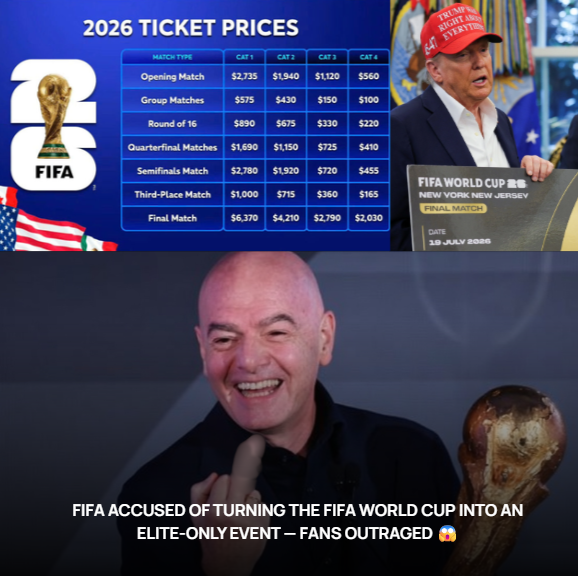
The announcement that FIFA plans to raise ticket prices for the World Cup final to an eye-watering $11,000 has sent shockwaves through the global football community. As reported by the Daily Mail, this unprecedented price point for “Category 1” or premium hospitality seating represents not just a new record, but a fundamental shift in how the world’s most popular sporting event is marketed and consumed. While FIFA justifies these increases through the lens of infrastructure costs and the expanded 48-team format, fans and critics argue that the “Beautiful Game” is rapidly becoming an exclusive playground for the global elite.
This article explores the multi-faceted implications of this pricing strategy, examining the economic drivers behind FIFA’s decision, the historical context of World Cup ticketing, and the potential long-term damage to the sport’s cultural fabric.
1. The Numbers Behind the Outrage
According to reports, the top-tier tickets for the 2026 World Cup final—to be held at the MetLife Stadium in New Jersey—could reach the $11,000 mark. To put this in perspective:
- Inflation vs. Greed: Even accounting for inflation, the jump from previous tournaments is astronomical. In 2022, the most expensive non-hospitality tickets were priced around $1,600.
- The Secondary Market Influence: FIFA appears to be trying to capture the “scalper premium” for itself. By setting primary prices closer to what tickets eventually command on resale sites (like StubHub), the organization maximizes its direct revenue.
- Revenue Targets: FIFA has set a staggering revenue target of $11 billion for the 2023-2026 cycle. Ticket sales are a cornerstone of this financial ambition.
2. The US Market: A Unique Catalyst
The 2026 World Cup, co-hosted by the United States, Canada, and Mexico, presents a unique economic environment. The U.S. sports market is accustomed to “dynamic pricing” and high-cost luxury suites.
- The Super Bowl Comparison: In the U.S., the Super Bowl frequently sees average ticket prices exceeding $8,000. FIFA is clearly benchmarking the World Cup final against American sporting spectacles rather than traditional European or South American football standards.
- Corporate Dominance: The MetLife Stadium and other U.S. venues are designed with a heavy emphasis on corporate hospitality. The $11,000 price point is often aimed at Fortune 500 companies rather than individual families, further squeezing the “average fan” out of the equation.
3. Historical Context: The Erosion of Accessibility
For decades, the World Cup was seen as a global festival. While never “cheap,” it was once accessible to a middle-class fan who saved for four years.
- Mexico 1986 & Italy 1990: Tickets were relatively affordable, ensuring stadiums were filled with passionate, local supporters and traveling fans from all socio-economic backgrounds.
- The Qatar Shift: The 2022 tournament in Qatar already saw a significant uptick in costs, partly due to the high cost of living and limited accommodation. However, the 2026 pricing suggests that Qatar was merely a stepping stone toward a permanent high-luxury model.
4. The Fan Perspective: “Football Without Fans is Nothing”
The famous quote by Jock Stein resonates more than ever. The backlash from fan groups like Football Supporters Europe and various international supporters’ trusts has been fierce.
- The Gentrification of the Stands: Critics argue that high prices change the atmosphere of the stadium. A crowd of corporate executives and “influencers” rarely generates the same raw, spine-tingling passion as die-hard supporters.
- Exclusion of Developing Nations: The World Cup is a global event, yet how can fans from nations with lower GDPs—many of whom provide the world’s best players—possibly afford to watch their heroes? This pricing creates a geographical and class-based hierarchy in the stands.
5. FIFA’s Justification: The Cost of Expansion
FIFA’s defense typically centers on the rising costs of hosting a modern tournament.
- Logistics: Managing 48 teams across an entire continent is a logistical nightmare with massive security, transport, and technology overheads.
- Redistribution of Wealth: FIFA claims that the profits from these high-end tickets are redistributed to develop football in smaller nations. While noble in theory, critics point to the lack of transparency in how these billions are actually spent.
6. The Economic Ripple Effect
The $11,000 ticket is just the tip of the iceberg. When the “anchor” price of a final is that high, it pulls up the prices for every other game in the tournament.
- Group Stage Inflation: Fans can expect to pay hundreds, if not thousands, for standard group-stage matches involving high-profile teams like Brazil, England, or Argentina.
- Tourism Costs: Host cities in the U.S. are already seeing hotel prices skyrocket for the summer of 2026. The total cost of attending a single match could easily reach $15,000 for an international visitor.
7. The Future of the “Beautiful Game”
If the $11,000 ticket becomes the new standard, what does the future hold for football?
- Digital Consumption vs. Physical Presence: We may see a future where the live experience is reserved for the 1%, while the 99% are relegated to watching via increasingly expensive streaming subscriptions.
- The Threat of the Super League Mindset: This pricing strategy mirrors the philosophy behind the failed European Super League—prioritizing high-yield “consumers” over traditional “fans.”
8. Conclusion: A Dangerous Path
FIFA is walking a tightrope. On one side is the undeniable allure of record-breaking profits and the commercial sophistication of the American market. On the other is the soul of the sport. By pricing tickets at $11,000, FIFA risks alienating the very people who made the World Cup the most-watched event on earth.
Football’s power lies in its universality. When you put a five-figure price tag on a seat, you aren’t just selling a ticket; you are selling a message that the pinnacle of the sport is no longer for everyone. As 2026 approaches, the pressure will be on FIFA to prove that they still value the supporter in the cheap seats as much as the executive in the $11,000 suite.