
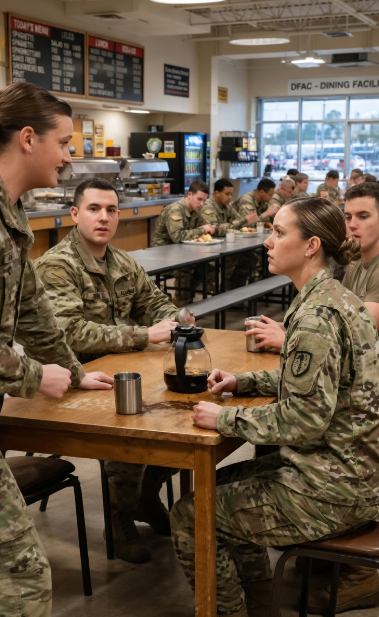
When the woman first arrived at Redstone Barracks, nobody stood up.
She came in just after dawn, the Alabama sun still a pale, bruised purple on the horizon. She wore a faded woodland BDU—a pattern that had long been phased out for the modern digital OCPs, yet on her, it looked like a second skin. There was no glint of brass on her shoulders, no velcro patches advertising elite schools, no “Tab” to command immediate fear. She was in her late eighties-born era, somewhere in her mid-forties, lean as a whip and composed in a way that felt like a low-frequency hum.
The clipboard at the front gate listed her simply: Lauren Hayes. Status: Temporary Observer. Attachment: Logistics Support.
To Sergeant Tyler Grant, she was just another body to fill the gaps in his fatigue detail. Grant was a man who measured worth by the volume of a person’s voice and the shine of their rank. He saw a woman with graying temples and an old duffel bag, and he saw a servant.
The Five Days of Silence
For the first five days, Redstone Barracks became a masterclass in underestimated power.
On Monday, Grant noticed Lauren standing near the motor pool, observing the maintenance logs. He didn’t like the way she looked at the trucks—too steady, too knowing. “Hey, Logistics,” Grant barked, wiping grease from his forehead. “Since you’re standing there doing a whole lot of nothing, these crates aren’t going to move themselves. Shift ’em to Warehouse B. Now.”
They were heavy crates, filled with engine parts. Most soldiers would have asked for a forklift or at least a partner. Lauren Hayes simply nodded, slung her duffel over one shoulder, and began moving the crates one by one. She didn’t use her back; she used her legs, her movements precise and efficient. She didn’t break a sweat until the tenth crate. Grant watched her from the shade, smearing a sandwich, waiting for her to complain. She never did.
On Wednesday, the heat hit ninety-four degrees with eighty percent humidity. A field antenna mast needed to be held perfectly level while the technicians calibrated the long-range comms. It was a grueling, static task. “Hayes!” Grant shouted. “Get over here. Hold this mast. Don’t let it tilt a fraction of an inch.” He left her there for two hours. He rotated his own squad every fifteen minutes, sending them for water and shade. Lauren Hayes stood like a statue. Her hands turned a raw, angry red against the hot aluminum. Sweat tracked through the dust on her face, but her eyes remained fixed on the horizon, cool and unblinking.
“She’s a robot,” one of the privates whispered. “She’s a nobody,” Grant countered, loud enough for her to hear. “Just a civilian-adjacent paper-pusher who doesn’t know how to say ‘no’.”
The VIP Gala
By Friday, the base was buzzing. A high-level delegation was arriving—three-star generals, defense contractors, and the “High Brass” from JSOC. The VIP lounge was being prepped for a closed-door gala that was as much a political theater as it was a military briefing.
Sergeant Grant was in charge of the floor staff. He was stressed, sweating through his dress blues, and looking for someone to kick. He found Lauren Hayes in the hallway, looking at a series of portraits of former base commanders. She looked tired, her boots dusty from the yard.
“You,” Grant hissed, grabbing her by the shoulder—a mistake he would later regret in his nightmares. “The catering staff is short-handed. You’re not doing anything useful in that ragtag uniform anyway. Go to the kitchen, put on an apron, and get the coffee service ready for the VIP table.”
Lauren Hayes turned her head slowly. She looked at his hand on her shoulder, then up at his face. For the first time in five days, she spoke. Her voice wasn’t high or shaky; it was a low, resonant rasp that sounded like gravel over silk. “I’m an observer, Sergeant. Not a waitress.”
Grant laughed, a harsh, jagged sound. “You’re a logistics attachment, Hayes. That means you provide support. And right now, the most important support this base needs is caffeine for people who actually matter. Now move, before I write you up for insubordination so fast your head spins.”
Lauren stared at him for three seconds. In those three seconds, the air in the hallway seemed to drop ten degrees. Then, she blinked, and the intensity vanished. “The VIP table, Sergeant?” “The center one. The big shots. Move it!”
The Service
The gala was in full swing. The room was a sea of medals, ribbons, and expensive cologne. At the center table sat Admiral Richard Vance and General Marcus Thorne—men who held the keys to the kingdom.
Grant stood by the door, feeling proud of his handiwork, until he saw her. Lauren Hayes was walking toward the center table. She hadn’t put on an apron. She was still in her faded woodland camouflage, her boots still dusty, carrying a silver coffee carafe.
Grant’s heart skipped. The idiot. She’s going to embarrass me in front of the Admiral. He started to move forward to intercept her, but he was too late.
Lauren Hayes reached the table. She didn’t lean in tentatively. She stood at the head of the table, the carafe held casually at her side.
Admiral Vance was mid-sentence, laughing at a joke, when he looked up. He froze. The laugh died in his throat. His face went from a healthy, scotch-flushed red to a ghostly, translucent white. Beside him, General Thorne dropped his fork. It clattered against the china like a gunshot.
“Coffee, Richard?” Lauren asked.
The entire table went silent. The surrounding tables, sensing the shift in the atmosphere, followed suit. Within ten seconds, the only sound in the room was the hum of the air conditioning.
Admiral Vance stood up. It wasn’t the slow, dignified rise of a superior; it was the frantic, reflexive snap of a man facing a firing squad. “Commander,” Vance stammered. “I… I didn’t know you were on site.”
Lauren Hayes didn’t pour the coffee. She set the carafe down on the white linen cloth with a definitive thud. “I’ve been here for five days, Admiral. I’ve moved engine parts, held antennas in the sun, and apparently, I’ve been promoted to lead barista for your morning briefing.”
Grant, who had reached the edge of the table, felt his knees turn to water. Commander?
“Commander Hayes,” General Thorne breathed, standing up as well. “We were told the Inspector General’s office was sending a logistics observer. We didn’t realize they were sending The Ghost.”
Lauren Hayes—formerly Commander of a Tier 1 SEAL element and now the most feared “Quiet Professional” in the Pentagon’s oversight office—finally looked back at Sergeant Grant.
“Sergeant Grant told me to serve coffee,” she said calmly, her eyes never leaving the Admiral. “He felt my rank was… insufficient for the room.”
Admiral Vance turned his gaze to Grant. If looks could kill, the Sergeant would have disintegrated into ash. “Sergeant,” Vance said, his voice trembling with rage. “Do you have any idea who this woman is? This is Lauren Hayes. She has more confirmed combat hours than your entire squad has hours in the gym. She is the woman who redesigned the JSOC logistics chain after the Kandahar breach. And you told her to… serve coffee?”
The Night of Reckoning
The “overnight” fall of Redstone Barracks began at 21:00 hours.
Lauren Hayes didn’t go to bed. She went to the base commander’s office. By 22:00, the base commander was relieved of duty. By midnight, the logistics logs she had been “observing” were seized by a team of Federal Marshals who arrived via Blackhawk.
It turned out, Lauren hadn’t been there just to see how soldiers treated “nobodies.” She had been tracking a multi-million dollar theft ring where high-grade equipment was being “lost” in transit and sold to private contractors.
Sergeant Grant wasn’t part of the ring, but his arrogance had been the final nail in the coffin. His “testing” of Lauren had allowed her to see exactly how the culture of the base had rotted. If the NCOs were bullies, the officers were negligent.
By 04:00, thirty-four personnel were under arrest. By 06:00, the “temporary observer” was standing on the tarmac, her old duffel bag over her shoulder.
Sergeant Grant was there, stripped of his stripes, waiting for his transport to the brig for his involvement in the cover-up of the maintenance logs he’d forced Lauren to ignore while she moved those crates. He looked at her, his face a mask of ruin.
“Why?” he whispered. “Why didn’t you just tell me who you were on the first day?”
Lauren Hayes stopped. She looked at the man who had tried to break her with heat and heavy lifting. “In the field, Sergeant, the enemy doesn’t care about your rank. They care about your competence. I wanted to see what happened to this base when it thought no one important was watching.”
She slung her bag into the waiting helicopter. “It turns out,” she said over the roar of the rotors, “you failed the test.”
The helicopter rose, leaving the dust of Redstone Barracks behind. Lauren Hayes sat in the dark cabin, closed her eyes, and finally, for the first time in a week, she let herself lean back. The quiet woman in camouflage had finished her work.
The base didn’t just fall; it was dismantled. And every soldier who had ever looked past her, or pushed a heavy crate her way, spent the rest of their careers wondering if the next “nobody” they met was the one who would end them.