
PART 2: “NO. I’VE GOT TIME.”
Rachel didn’t know what to say.
So she didn’t say anything.
Daniel appreciated that.
After a while, she sat across from him.
“You kept his number?”
“Yeah.”
“For the voicemail?”
Daniel nodded.
His mother hadn’t disconnected the line immediately after Frank died.
There had been paperwork.
Accounts.
Bills.
All the ordinary administrative things that somehow continue even when somebody doesn’t.
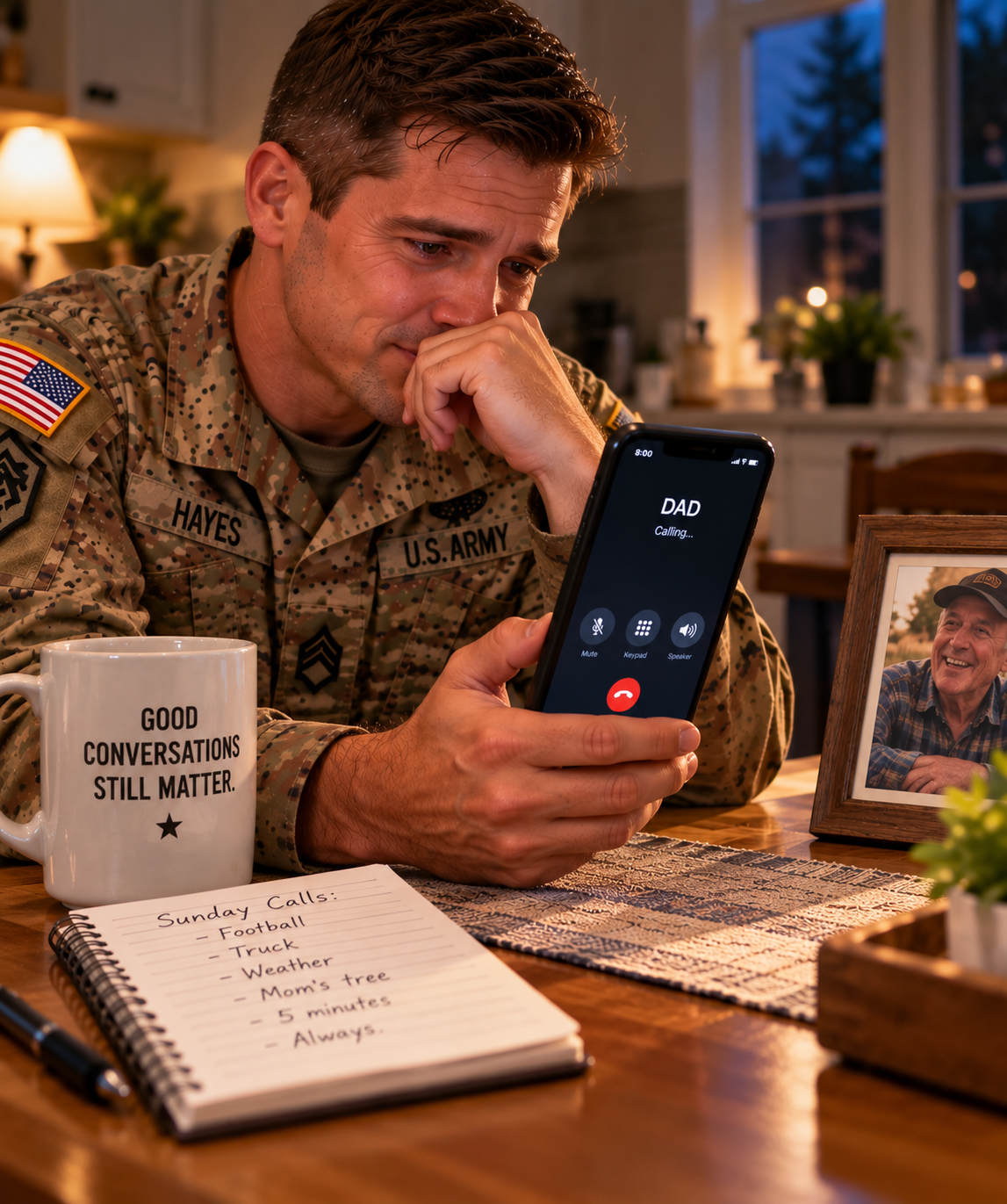
When the time finally came to cancel Frank’s phone, Daniel asked her not to.
He took over the bill.
Twenty-eight dollars a month.
Rachel blinked when he told her.
“You’ve been paying twenty-eight dollars every month just to hear that?”
Daniel looked mildly defensive.
“It’s a good voicemail.”
Rachel almost laughed.
Almost.
Daniel leaned back.
“My dad wasn’t much of a phone guy.”
Frank Hayes believed calls had a purpose.
Need something?
Call.
Car won’t start?
Call.
Need directions?
Call.
Calling simply to talk seemed inefficient.
Then Daniel moved away.
One Sunday, Frank called at 8:03 p.m.
“You watching the game?”
“Yeah.”
“That penalty was garbage.”
“Probably.”
Three minutes later, Frank said:
“Alright. Talk next week.”
And hung up.
The following Sunday, he called again.
Then the next.
Eventually it became automatic.
Sunday.
8:00.
Frank.
Some conversations lasted two minutes.
One consisted almost entirely of Frank complaining about a lawn mower.
Another was Daniel explaining for ten minutes that restarting the Wi-Fi router did not mean buying a new router.
“You unplug it.”
“I did.”
“Then wait thirty seconds.”
“Why?”
“I don’t know, Dad. It gives the internet time to think.”
Frank had called that “nonsense.”
It worked.
There were serious conversations too.
But fewer than Daniel remembered.
That surprised him after Frank died.
He couldn’t recall some of the important advice.
But he could remember his father’s voice saying:
“Rain tomorrow.”
“Your mother bought another lamp.”
“Truck’s making that noise again.”
“Call your mother.”
Ordinary sentences.
At the time, Daniel sometimes rushed them.
Once he’d answered while cooking.
Another time while checking emails.
More than once, he had said:
“Dad, can I call you later?”
Frank always answered the same way.
“Sure.”
Daniel rarely did.
“I thought we’d have thousands more Sundays,” he told Rachel.
That was why he kept calling.
Not because he believed Frank would answer.
Not because Daniel couldn’t accept that his father was gone.
He knew.
He simply wasn’t ready for Sunday at 8:00 to become nothing.
Rachel reached across the table.
“Do you want me to sit with you next Sunday?”
Daniel thought about it.
“No.”
She nodded.
Then Daniel added:
“But thanks.”
The calls continued.
Spring became summer.
Eleven months became a year.
Then fourteen months.
One Sunday Daniel sat at the kitchen table.
7:58.
His phone was beside him.
7:59.
He opened Frank’s contact.
His thumb hovered over the call button.
Then stopped.
For the first time, Daniel asked himself a question.
Was he calling because hearing his father’s voice still helped?
Or because he was afraid that stopping meant leaving Frank behind?
8:00.
Daniel didn’t call.
He simply sat there.
8:01.
His phone rang.
Daniel startled.
The screen showed:
MIKE.
His younger brother.
Daniel answered.
“Hey.”
Mike sounded surprised.
“You busy?”
Daniel glanced at the clock.
8:01.
For years, that question would have received a quick answer.
Watching something.
Eating.
Working.
About to go somewhere.
Instead Daniel leaned back.
“No.”
He smiled.
“I’ve got time.”
Mike called because his kitchen sink was leaking.
At least that’s how the conversation started.
Daniel told him where the shutoff valve was.
Mike complained about plumbing.
Daniel made fun of him.
Then somehow they started talking about their father.
Mike remembered Frank’s obsession with keeping every screw and bolt in coffee cans.
Daniel remembered how he labeled none of them.
Mike remembered the lawn mower.
Daniel remembered the Wi-Fi router.
They laughed.
Then Mike became quiet.
“You know what I miss?”
“What?”
“Those stupid calls Dad used to make.”
Daniel stared at the phone.
“Yeah.”
“He’d call and have absolutely nothing to say.”
“Every Sunday.”
“Exactly.”
The brothers talked for forty-seven minutes.
It was probably the longest phone conversation they’d had since high school.
When Mike finally said goodbye, Daniel remained at the table.
8:49.
He looked at his father’s contact.
Then smiled.
The following Sunday, Daniel didn’t call Frank.
At 8:04, Mike called him.
“You busy?”
“No.”
The Sunday after that, Daniel called first.
“What do you want?” Mike answered.
“Nothing.”
“Then why are you calling?”
Daniel smiled.
“Dad trained me.”
It became their routine.
Not perfectly.
Some Sundays Mike forgot.
Sometimes Daniel was busy.
Sometimes they called Monday instead.
There were no rules.
That mattered.
Daniel wasn’t trying to replace his father.
Some people couldn’t be replaced.
He was simply allowing an old tradition to become something new.
Months later, Daniel finally told his mother she could disconnect Frank’s number.
“You sure?” she asked.
Daniel stared at the contact on his phone.
“Yeah.”
Before the line was canceled, he played the voicemail one last time.
“Hey, you’ve reached Frank. Leave a message. If this is Daniel, call your mother too.”
Daniel laughed.
“Still bossing me around.”
Rachel was beside him.
“What now?”
Daniel looked at her.
“Apparently I call my mother.”
So he did.
Years later, Sunday calls remained part of the Hayes family.
Sometimes Mike called Daniel.
Sometimes Mom joined.
Eventually nieces and nephews appeared in the background.
Dogs barked.
Children yelled.
Someone was always cooking.
The conversations remained mostly unimportant.
Work.
Football.
Cars.
Weather.
What everyone was making for dinner.
And that was exactly the point.
Daniel had once believed meaningful conversations required meaningful subjects.
Losing his father taught him otherwise.
The value wasn’t always in what Frank said.
It was in the interruption.
The familiar ringtone.
The predictable voice.
The knowledge that somewhere else, someone had looked at the clock and thought:
I should call him.
People often save their biggest words for later.
Thank you.
I’m proud of you.
I miss you.
I love you.
Those words matter.
But a lifetime isn’t built only from big sentences.
Sometimes love sounds much less impressive.
“You watching the game?”
“Truck’s acting up again.”
“Rain tomorrow.”
“Call your mother.”
And sometimes the conversation you thought was about nothing—
turns out to have been about everything.