
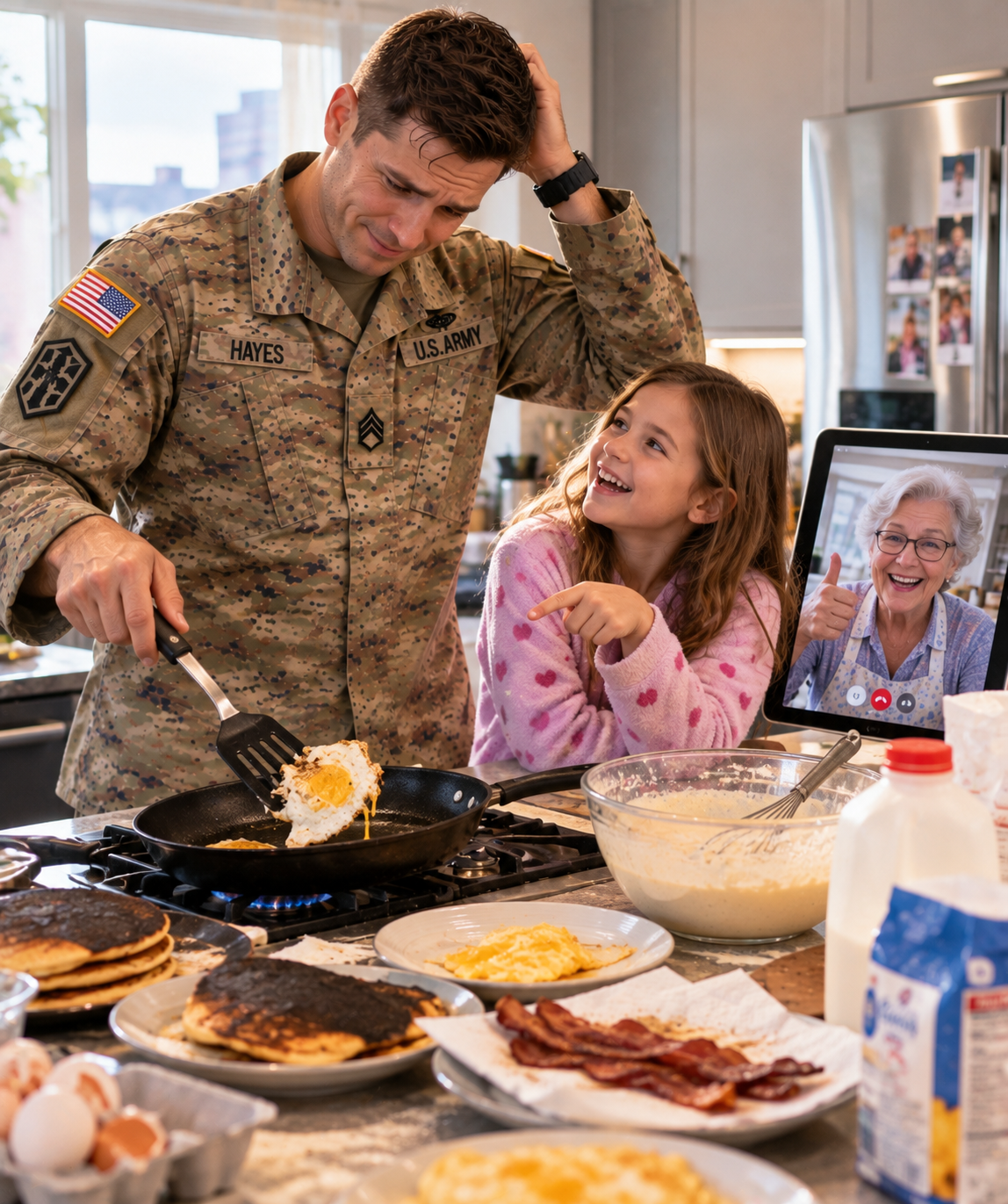
PART 2: BREAKFAST, ACCORDING TO THREE GENERATIONS
Sophie burst out laughing.
Ryan pointed toward her.
“This is not funny.”
She looked at the pancake on the floor.
“Dad, that one’s under the table.”
“I’m aware.”
Grandma’s voice came through the phone.
“Ryan, what’s burning?”
“Nothing.”
“Something is burning.”
Ryan looked behind him.
The remaining bacon.
He grabbed the pan.
Sophie laughed harder.
“Dad!”
“I’ve got it.”
“You definitely don’t.”
Ryan switched off the burner.
Then he looked at his daughter.
“Okay.”
He took a breath.
“New plan.”
Sophie dropped her backpack.
“Cereal?”
“No.”
“Toast?”
“No.”
“Restaurant?”
“Absolutely not.”
Ryan picked up the phone.
“Mom, you’re staying.”
His mother smiled.
“I assumed.”
He placed the phone against a container on the counter.
Sophie pulled over a chair.
“What are we making?”
“Breakfast.”
“You already made breakfast.”
Ryan looked at the blackened bacon.
“That was reconnaissance.”
Sophie nodded seriously.
“Did we learn anything?”
“Several things.”
“Like?”
“Your father should not be left unsupervised with bacon.”
Grandma laughed.
Ryan pointed at the screen.
“You’re supposed to be helping.”
“I am helping.”
She began again.
Slowly.
Heat the pan.
Not too hot.
Crack the egg into a bowl first.
Ryan did.
Shell.
Sophie reached in and removed it.
“I got it.”
Ryan frowned.
“How are you better at this than me?”
“Mom taught me.”
That answer stung slightly.
Not because Sophie had said anything wrong.
Because Ryan suddenly realized how many ordinary things happened when he wasn’t there.
Cooking.
School mornings.
Hair brushing.
Packing lunches.
Finding missing shoes.
Before the divorce, he’d been involved.
But he’d never understood how much of family life existed in tiny routines.
Now he was learning.
One egg at a time.
“Okay,” Grandma said. “Into the pan.”
Ryan poured.
Sophie leaned closer.
“Now what?”
“We wait.”
Ryan looked suspiciously at the egg.
“How long?”
His mother sighed.
“Ryan, stop treating breakfast like a timed exercise.”
Sophie laughed.
“Dad does that with everything.”
“I do not.”
“You scheduled movie night.”
“So?”
“You put it in the calendar.”
“That’s organization.”
“You scheduled popcorn.”
“That was logistical preparation.”
Grandma interrupted.
“Egg.”
Ryan looked down.
“Oh.”
He flipped it.
Poorly.
Half folded over.
Sophie gasped.
Ryan froze.
His mother stared through the screen.
Nobody spoke.
Then Sophie said:
“I’ll eat that one.”
Ryan looked at her.
“You don’t have to.”
“It looks funny.”
“That’s not normally a compliment for food.”
“I want it.”
So Ryan placed the crooked egg on her plate.
They made another.
Better.
Then another.
Almost normal.
Sophie handled toast.
Ryan tried bacon again under strict supervision.
By 8:35, they had breakfast.
Some bacon was too dark.
The pancakes looked like maps of countries that didn’t exist.
One egg had been folded into a shape nobody could identify.
Ryan sat across from Sophie.
“Well?”
She took a bite.
Ryan waited.
“It’s good.”
“You don’t have to lie because I’m your father.”
Sophie chewed.
“The egg’s good.”
“And everything else?”
She examined the bacon.
“Needs work.”
“Fair.”
Grandma was still on the phone.
“Can I go now?”
Sophie grabbed the phone.
“No! Eat breakfast with us.”
“I already ate.”
“Get coffee.”
So Grandma made coffee at her house.
Ryan poured himself some.
For the next twenty minutes, three generations sat in two different kitchens and ate breakfast together.
They talked about school.
Sophie told Grandma about a science project.
Ryan discovered his daughter had volunteered to present in front of her class.
“You hate speaking in front of people.”
“I used to.”
“When did that change?”
Sophie shrugged.
“A while ago.”
There it was again.
Another small thing Ryan hadn’t known.
But this time, instead of feeling guilty, he asked:
“What changed your mind?”
Sophie told him.
Ryan listened.
After breakfast, they cleaned the kitchen together.
Sophie found another piece of pancake beneath a cabinet.
“How did it get there?”
Ryan stared.
“Classified.”
She took a picture.
“I’m sending this to Mom.”
“Absolutely not.”
Too late.
Later that afternoon, Ryan’s ex-wife texted him.
Heard breakfast went well.
Attached was the pancake photo.
Ryan replied:
Nobody was injured.
A moment later:
That’s a low standard for pancakes, Ryan.
He smiled.
The following Sunday, Sophie arrived carrying a notebook.
On the cover she’d written:
DAD’S COOKING MANUAL
Ryan opened it.
Page one:
RULE #1: CALL GRANDMA BEFORE THE SMOKE ALARM.
Ryan laughed so hard he had to sit down.
Over the next few months, Sunday breakfast became their routine.
Ryan learned pancakes.
Then French toast.
Then omelets.
One Sunday he made eggs without calling his mother.
He immediately sent her a photograph.
Her response:
Finally. I can retire.
But Ryan had learned something bigger than cooking.
For years, his daughter had seen him as the person who knew what to do.
Captain.
Father.
Problem solver.
Ryan thought maintaining that image made Sophie feel safe.
Instead, some of their funniest and most meaningful moments came when she watched him admit:
“I don’t know.”
Then figure it out.
Years later, Sophie barely remembered the apartment itself.
But she remembered Sunday breakfasts.
Grandma shouting through the phone.
Her father burning bacon.
The pancake under the table.
And the ridiculous seriousness with which Captain Ryan Hayes approached his first successful fried egg.
One day, when Sophie was older, Ryan asked:
“Was that first breakfast really as terrible as I remember?”
She smiled.
“The food?”
“Yeah.”
“Absolutely.”
Ryan laughed.
“But,” Sophie continued, “it was my favorite.”
“Why?”
She shrugged.
“Because you were trying.”
Ryan went quiet.
He had spent that morning worrying that his daughter would discover he didn’t know how to create the perfect Sunday breakfast.
Instead, she discovered something better.
Her father could fail.
Laugh.
Ask for help.
Try again.
And still make the morning feel special.
Ryan eventually became a much better cook.
But he never improved on the lesson behind that first terrible breakfast:
Sometimes the people you love don’t need you to know exactly what you’re doing.
They just need to see that you’re willing to learn.