
Part 2: Open It When We’re Old
Mason forgot about the cattle for a moment.
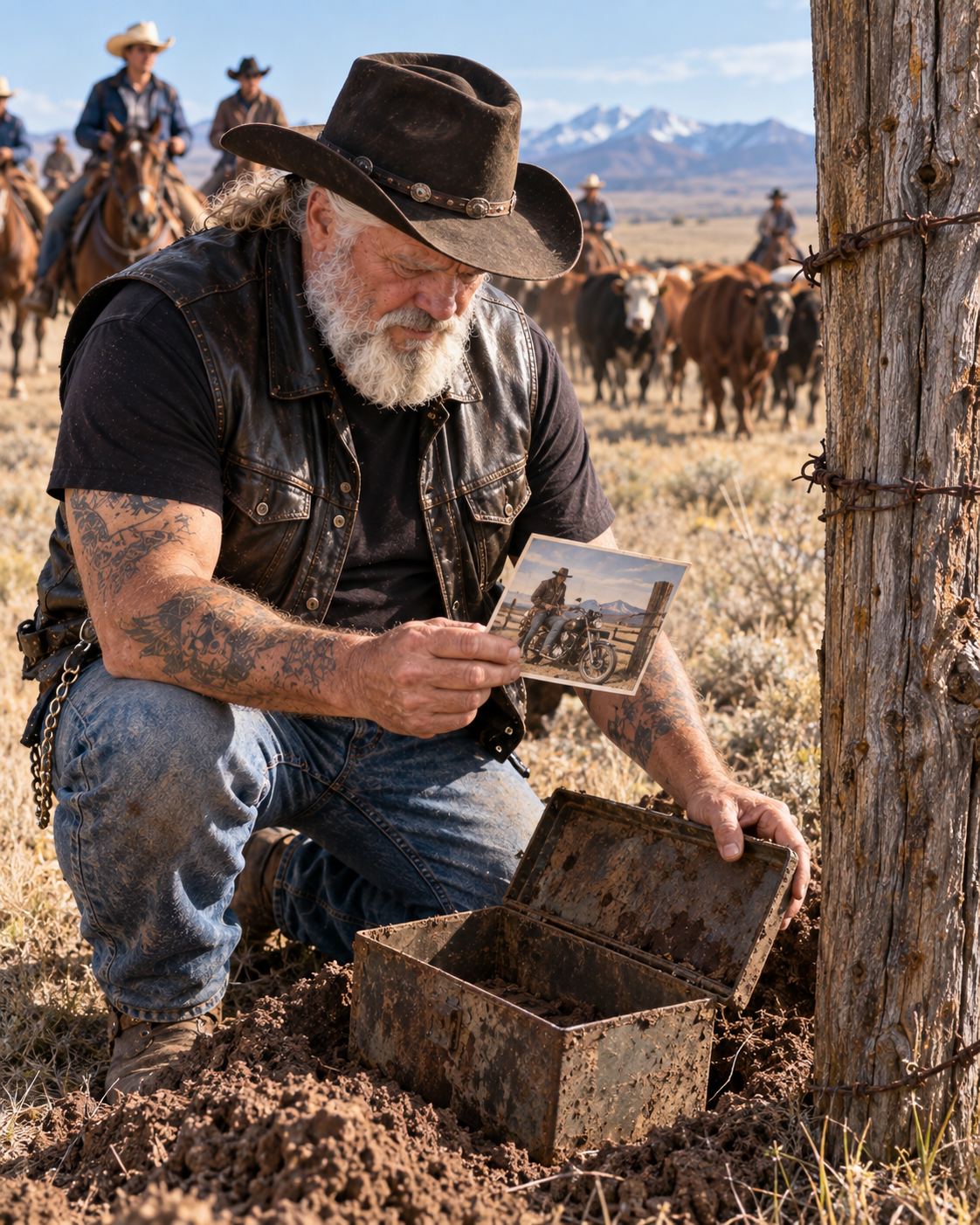
He stared at the photograph.
The motorcycle was a faded 1981 black-and-red machine he’d owned before he could afford anything reliable. Mason had sold it decades ago after years of repairs and cross-country miles.
There was no possible reason for it to be standing in Wyoming.
But the cowboy mattered more.
Older now.
Thinner.
White beard.
Bent shoulders.
Still wearing his hat slightly crooked.
Cal Turner.
Mason turned the photograph over.
A date had been written there.
Last Tuesday.
Nothing else.
One of the drive supervisors approached.
“You okay?”
Mason held up the picture.
“Who put this here?”
The man studied it.
Then his expression gave Mason the answer before his words did.
“You should probably finish today’s route.”
Mason narrowed his eyes.
“You knew?”
“Not everything.”
That was enough.
Mason returned the photograph to the box and carefully replaced it. The cattle drive continued.
For the next six miles, he barely spoke.
Near sunset, the herd entered the final holding pasture.
Families and ranch volunteers waited beyond the fence.
Mason scanned every face.
No Cal.
Then he heard an engine.
Not a modern motorcycle.
Something older.
Rougher.
Painfully familiar.
Mason turned.
A small trailer was being pulled slowly toward the ranch workshop.
Strapped securely to it was the motorcycle from the photograph.
And walking beside the trailer was Cal Turner.
For several seconds neither man moved toward the other.
Thirty-six years is too long for an easy greeting.
Finally Cal stopped.
“You’re late.”
Mason looked at him.
“We said when we were old.”
Cal glanced at Mason’s silver beard.
“I figured this qualified.”
Mason laughed.
So did Cal.
Then the laughter disappeared.
There were too many missing years standing between them.
Inside the workshop, Cal placed the original metal box on a workbench.
Everything was there.
The coins.
The broken spur.
The old photograph.
Both letters.
Cal had opened the box the previous week because he’d learned Mason had registered for the cattle drive.
“I cheated by seven days,” Cal admitted.
Mason picked up his unopened letter.
“Why?”
“Because I needed to know whether I still wanted you to read mine.”
Cal’s letter had been written by a young cowboy convinced he’d own a ranch, raise a family there, and never leave Wyoming.
Life hadn’t followed the plan.
Years of drought and debt had eventually forced Cal to sell most of his original acreage. He’d rebuilt his life on a smaller ranch nearby.
Mason’s letter was equally naive.
He had written that he would ride across America, never settle down, and never become “one of those old men who talks about the past.”
Cal smiled at that line.
Mason groaned.
“Burn it.”
“Absolutely not.”
Then Mason pointed through the workshop door.
“The motorcycle.”
Cal explained.
Years earlier, he’d started searching for Mason’s first bike—not to restore it secretly into something new, but simply to locate the machine that represented the road Mason had chosen.
Serial records and former owners eventually led him to a collector several states away.
The bike was worn and incomplete.
Cal bought it only after confirming its history.
He hadn’t rebuilt it.
“That part isn’t mine to decide,” Cal said.
Mason ran a hand lightly across the old fuel tank.
Then he noticed something attached to the handlebar.
The broken spur from their box.
Mason smiled.
“You put cowboy gear on my motorcycle?”
Cal shrugged.
“You wore a leather vest on my cattle drive.”
Fair enough.
But one question remained.
“Why did we stop writing?”
Cal looked down.
“No big reason.”
Mason waited.
Cal continued.
“One letter didn’t get answered. Then another didn’t get sent. After enough years, both of us probably thought the other guy had chosen silence.”
That hurt more than a dramatic betrayal would have.
Nothing had destroyed their friendship.
They had simply stopped maintaining it.
Cal opened his old letter again.
At the bottom, their younger selves had added one final instruction neither remembered writing:
If we’re still friends, put everything back.
If we’re not, start over.
Mason stared at it.
Then he took the two old coins from the box.
He handed one to Cal.
Kept the other.
He left the remaining objects on the workbench.
“We’re not putting it back.”
Cal raised an eyebrow.
Mason smiled.
“We’re starting over.”
The next morning, Mason didn’t ride the old motorcycle.
He and Cal rolled it into the workshop together.
Cal knew leather and ranch equipment.
Mason knew engines.
Neither man would restore the motorcycle to some perfect showroom condition.
They would preserve its scars and repair only what needed repairing.
Before Mason left Wyoming, the two men returned to the fence post one more time.
They buried the metal box again.
But this time there were no grand predictions inside.
No promises about who they would become.
Only the photograph taken the week before, the two old letters, and a new photograph of two seventy-something men standing together beside an unfinished motorcycle.
Cal lowered the lid.
“When do we open it?”
Mason thought about it.
Then shook his head.
“We don’t.”
“Then who does?”
Mason looked toward the cattle trail stretching across the valley.
“Whoever finds it someday.”
Forty years earlier, two young men had buried a box because they believed friendship meant making a promise that could survive forever.
It took them four decades to learn something harder.
Sometimes friendship survives because, after far too much time has passed, somebody is willing to come back and start again.