
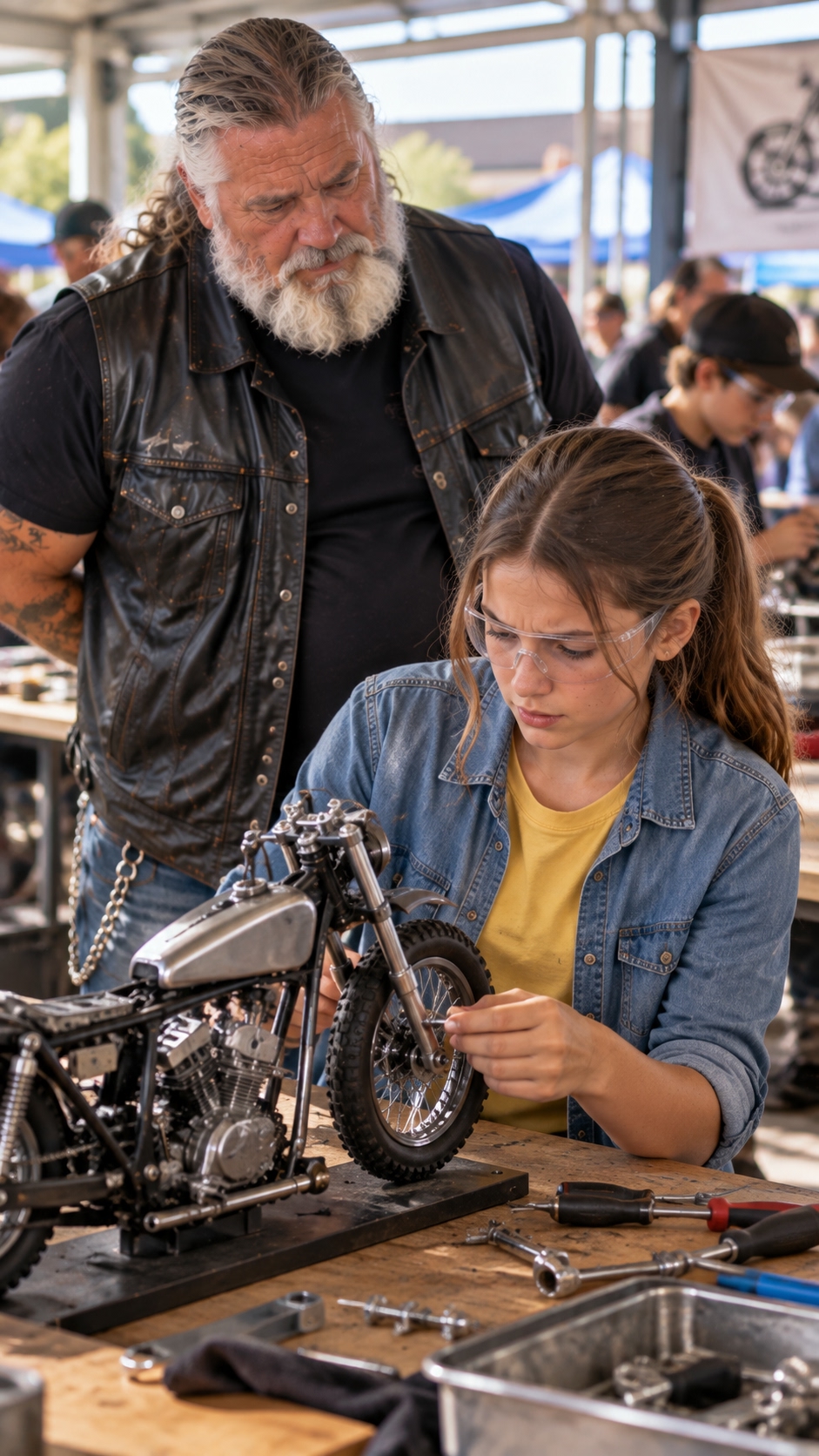
Part 2: The Man Who Never Took the Wrench Away
Duke stared across the workshop.
Walter Hayes was eighty-three now.
Thinner.
His shoulders curved slightly with age.
His hair had gone completely white.
But Duke knew the eyes.
“Walter?”
The judge stopped.
For several seconds, the noisy workshop seemed to disappear around them.
Then Walter smiled.
“Took you long enough, Harrison.”
Sophie looked between them.
“You know each other?”
Duke laughed once, almost in disbelief.
“He taught me everything important.”
Forty-three years earlier, Duke hadn’t been the patient mechanic Sophie knew.
At twenty-seven, he was fast, talented—and convinced speed proved skill.
Walter ran the small repair shop where Duke worked.
Whenever Duke became frustrated, Walter refused to grab the wrench from him.
Instead, he’d put his hands behind his back.
Then came the same question.
What is the machine telling you?
Duke hated it.
“Just tell me what’s wrong.”
Walter wouldn’t.
“Then you’ll know my answer. You won’t know how to find yours.”
Eventually Duke learned to listen before replacing parts.
Feel before forcing something.
Diagnose before assuming.
But Walter taught him something beyond machinery.
If someone was learning, taking the tool away might make the repair faster.
It didn’t necessarily make the learner better.
Years later Walter sold the shop and moved away to care for his wife. Addresses changed. Phone numbers changed. Duke’s letters eventually came back unopened.
The connection simply disappeared.
Until today.
Walter looked toward Sophie.
“I watched your whole round.”
“We lost,” Sophie said.
“You finished seventh.”
She shrugged. “That’s losing.”
Walter smiled.
“No. Seven teams finished before you.”
He pointed toward the mechanical model.
“You found three faults your captain never identified for you.”
Duke raised both hands.
“Wasn’t allowed to.”
Walter gave him a look.
“You wouldn’t have anyway.”
Sophie turned toward Duke.
“Would you?”
Duke thought about it.
“Forty years ago? I’d have taken the wrench out of your hand.”
“And now?”
“Now I’d probably annoy you with questions.”
“You already do.”
Walter laughed.
Then came the special award.
It wasn’t for speed.
The organizers had created a Diagnostic Thinking Award for the team demonstrating the strongest independent problem-solving during the challenge.
Walter presented it to Sophie, not Duke.
That mattered.
She had diagnosed the model.
Duke had only created room for her to think.
Afterward, Walter brought an old metal toolbox from behind the judging station.
He opened it.
Inside were ordinary, heavily used tools.
Nothing valuable to a collector.
Everything valuable to Duke.
He recognized the scratched ratchet.
The narrow pliers.
And one old wrench with a shallow groove across its handle.
Duke had made that groove accidentally during his first month in Walter’s shop.
“You kept these?”
Walter nodded.
Then Sophie reached toward the wrench but stopped before touching it.
“May I?”
Walter smiled.
“That’s already better manners than Duke had at twenty-seven.”
Duke laughed.
Walter handed Sophie the wrench himself.
She examined it.
Then she noticed an unfinished mechanical assembly sitting beside Walter’s toolbox.
“What’s wrong with that?”
Walter looked at Duke.
Duke looked at Sophie.
For an instant, the old mechanic in him wanted to answer.
Instead, he put both hands behind his back.
Walter noticed.
So did Sophie.
Duke nodded toward the mechanism.
“What do you think?”
Sophie rotated one component gently.
Stopped.
Listened.
Checked it again.
Walter leaned toward Duke.
“You finally learned.”
Duke shook his head.
“No.”
He watched Sophie work.
“I finally learned not to be the person who has to know everything first.”
Sophie eventually pointed toward a misaligned spacer.
Walter smiled.
Duke smiled wider.
Three generations stood around the same workbench.
One had taught.
One had learned.
And now the youngest was discovering something for herself.
Duke had entered a contest where the strangest rule was that the best mechanic in the team couldn’t use his hands.
By the end, he understood why that rule mattered.
Sometimes the most useful thing an experienced person can do with a tool is leave it in somebody else’s hands.