
One Of The Most Heartbreaking War Romances You’ll Ever See? This Haunting Epic Turns A Lost Memory Into A Love Story Born Beneath The Endless Desert Sky. It Begins In The Final Days Of World War Ii, Inside An Isolated Italian Monastery Where A Badly Burned Man With No Memory Is Cared For By A Young Nurse. He Remembers Almost Nothing. Then The Memories Begin Returning. Slowly, The Story Carries Us Away From The Ruins Of Wartime Italy And Into The Vast Deserts Of North Africa, Where A Married Woman Once Fell Into A Passionate Affair With A Mysterious Explorer. What Seemed Like An Unforgettable Romance Becomes Something Far More Painful As Betrayal, Longing And The Chaos Of War Begin Closing In Around Them. The Past Refuses To Stay Buried, And Every Recovered Memory Brings The Man Closer To A Love Story Whose Consequences Have Followed Him Across Years, Borders And Battlefields. Two People Found Each Other Beneath The Desert Sun. War Tore Their World Apart. Memory Kept The Wound Alive.

Few films inspire such a complicated reaction as The English Patient. The 1996 romantic epic became an Oscar favorite, but its reputation has also been shaped by one of the most memorable pieces of sitcom mockery in Seinfeld, where Elaine Benes famously vents her frustration with the film.
For some viewers, that joke became impossible to forget. The film’s 162-minute running time, slow-burning romance and sweeping desert imagery can make it feel like an endurance test if its particular rhythm does not connect.
Yet revisiting Anthony Minghella’s adaptation of Michael Ondaatje’s novel can reveal something more complicated. It is undeniably ambitious, beautifully made and deeply committed to its romantic vision, even if its enormous scale does not always work equally well.
Two Love Stories Across Two Timelines

Set against the final years of the Second World War, The English Patient unfolds through two interconnected love stories separated by time.
In 1945, Québécoise nurse Hana, played by Juliette Binoche, cares for a badly burned English patient, portrayed by Ralph Fiennes, inside a damaged Italian monastery that has been turned into a field hospital.
The mysterious patient remembers neither his name nor his past. As Hana and David Caravaggio, a Canadian recovering nearby and played by Willem Dafoe, gradually hear fragments of his story, the truth begins to emerge.
He is actually Hungarian Count Laszlo de Almásy, a man who worked in the Sahara Desert mapping the region for the British government before the war.
His earlier life was intertwined with the married couple Katharine and Geoffrey Clifton, played by Kristin Scott Thomas and Colin Firth. Almásy and Katharine eventually begin an affair, one that develops amid the uncertainty and danger surrounding their work in North Africa.
Meanwhile, back in 1945, Hana finds a different kind of relationship with Kip, a Sikh engineer serving in the British Army, played by Naveen Andrews.
The film therefore moves between two very different forms of love: the passionate, complicated affair buried in Almásy’s memories and the more immediate relationship developing around Hana in the ruins of war-torn Italy.
The Desert as Memory

Minghella gives the North African sections an enormous visual scale.
The Sahara dominates the screen through vast landscapes and intensely warm imagery, while Stuart Craig’s production design fills the more intimate locations with intricate details that make them feel lived in rather than merely decorative.
At the same time, the film repeatedly moves from those enormous environments into extreme close-ups of Fiennes and Scott Thomas.
That contrast is one of its greatest strengths. The movie uses an immense landscape to explore intensely personal emotions, placing it within the tradition of large-scale psychological epics such as Lawrence of Arabia.
Cinematographer John Seale and composer Gabriel Yared are particularly important to this approach. Their work helps create an atmosphere that feels less concerned with straightforward plot progression than with memory, desire and emotional sensation.
The effect can be beautiful.
It can also be exhausting.
When Romance Becomes Repetitive

The central criticism of The English Patient is not that its individual scenes lack power. Many of them are extraordinary.
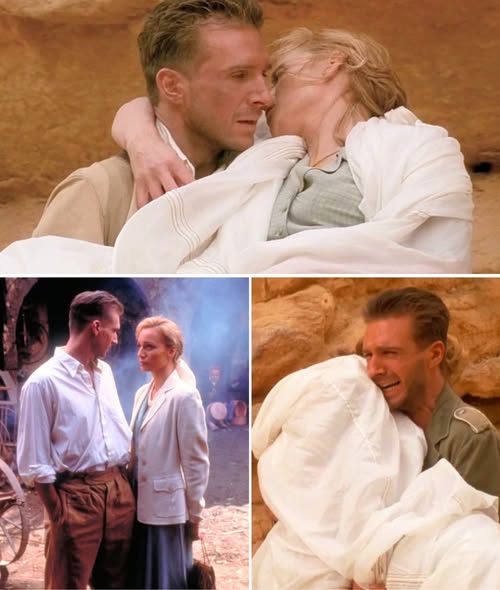
One of the film’s most striking sequences comes when Almásy carries Katharine from the wreckage of a plane toward distant caves. It is the kind of grand cinematic moment the film repeatedly reaches for.
The problem is what surrounds those moments.
At 162 minutes, The English Patient has considerable room to breathe, but not every stretch of that time feels equally necessary. Some scenes seem to reinforce emotions and information that the audience already understands.
The romance between Almásy and Katharine is deliberately intense and sensual, with Scott Thomas and Fiennes spending long passages communicating through glances, physical presence and restrained emotion.
For viewers who respond to that style, the patience is part of the appeal. For others, the film can feel as though it is lingering on the same emotional note for too long.
That division helps explain why reactions to the film often depend on which storyline a viewer finds more compelling.
Hana and Kip Bring the Story Back to Earth
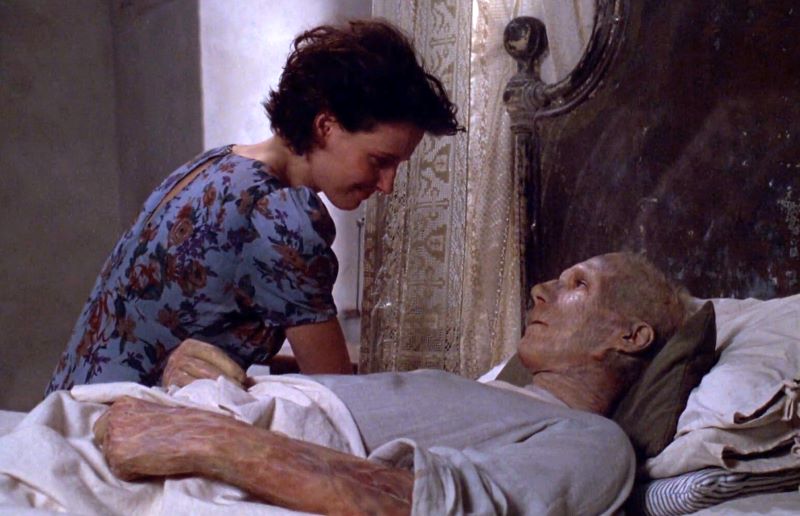
For me, the Italian storyline is the stronger half of the film.
Hana is not simply an embodiment of romantic longing. Binoche gets to play a fully grounded human character dealing with the immediate realities of war, loss and responsibility.
Andrews, despite having a more limited role than his character receives in the source novel, is especially effective whenever he is given the opportunity to speak and engage with Hana.
The setting also changes the film’s texture.
Instead of the overwhelming openness of the desert, the Italian sections unfold inside a physical environment of old brick, stone and shadow. The atmosphere feels cooler, damper and more tangible.
That distinction mirrors the film’s broader structure.
The desert sequences evoke memory — fragmented, sensual and subjective. The Italian framework is about existing in the present, surrounded by the physical remains of a war that is still happening.
That contrast is one of Minghella’s smartest ideas.
A Film That Fully Embraces Its Excess
There is something undeniably luxurious about The English Patient.
It is romantic, sensual and visually sumptuous in a way that recalls the grand European productions of the 1960s, while retaining the more mature sensibility of an R-rated Miramax film.
The comparison with movies such as Fargo and Secrets & Lies makes the distinction particularly clear. Those films are sharper and more intellectually driven, whereas The English Patient aims directly for the senses.
It wants to overwhelm the viewer with landscape, music, romance and atmosphere.
Sometimes that ambition works beautifully. Sometimes it becomes too much.
But even when the film feels overextended, its commitment is difficult to dismiss. Minghella and his collaborators clearly wanted to make the fullest, richest version of this story they could.
That makes The English Patient an unusual kind of cinematic experience: enormous, indulgent and occasionally exhausting, yet remarkably sincere about everything it wants to be.
It may not inspire the same affection in every viewer, but its beauty, ambition and emotional intensity remain difficult to ignore.