
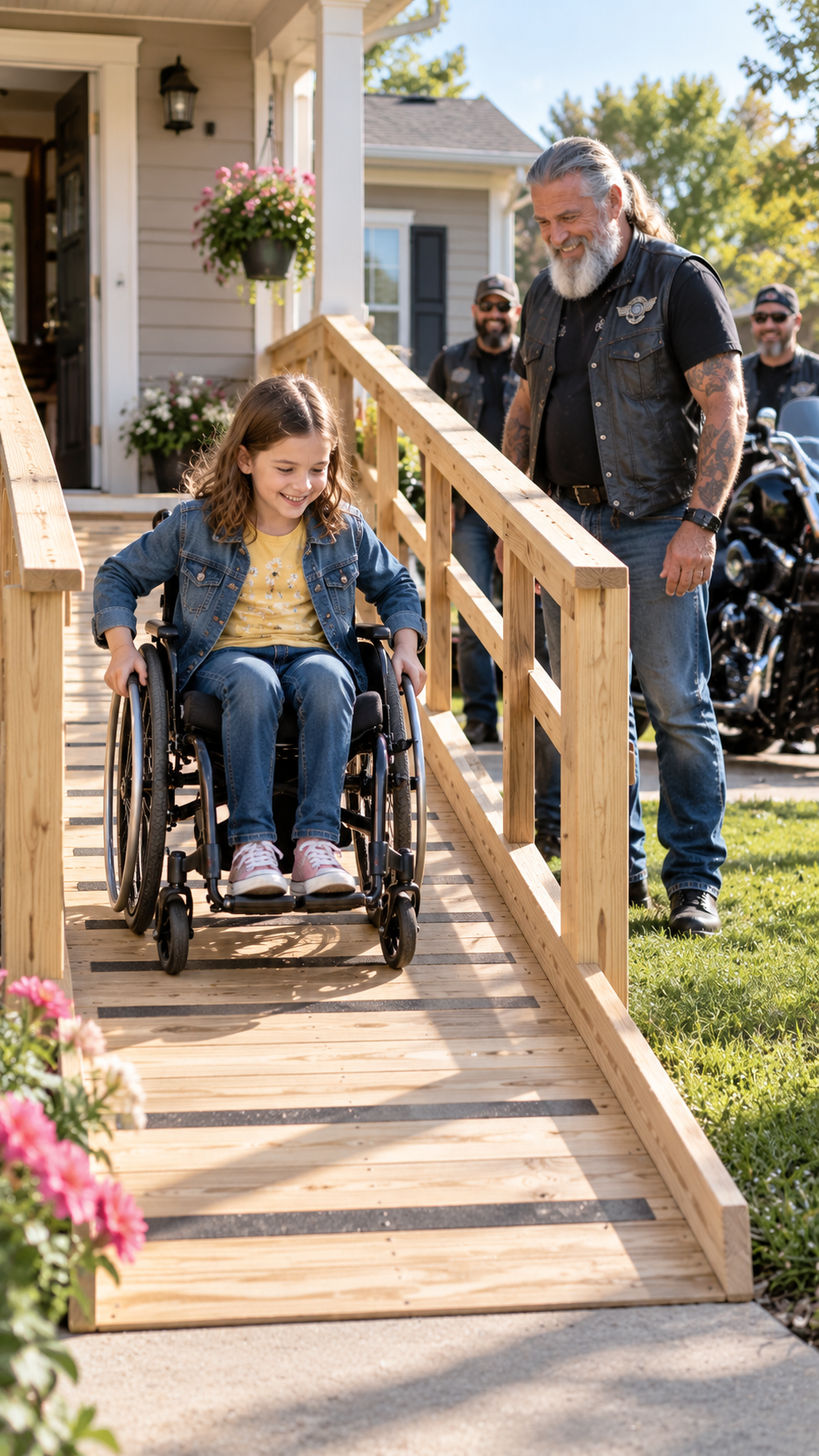
Part 2: The Second Ramp Was Much Harder
Jack studied Lily’s drawing.
“You drew this?”
Lily nodded.
It showed a side entrance at her elementary school.
Her friend Emma, another student with mobility needs, sometimes had to use a longer accessible route around the building because the nearest entrance to one activity room wasn’t accessible.
Jack looked at Lily.
“So you want us to build another ramp?”
Lily nodded enthusiastically.
One of the bikers smiled.
“We’ve still got lumber.”
Jack raised his hand.
“No.”
Lily looked disappointed.
Jack crouched several feet away so they could speak comfortably.
“Your house belongs to your family. A school doesn’t belong to us.”
“So we can’t help?”
“I didn’t say that.”
Jack tapped the drawing.
“I said we can’t just show up with tools.”
That Monday, Jack and Lily’s parents contacted the school.
They didn’t demand permission to start construction.
They asked what accessibility improvements were already planned and what formal process was required.
That question uncovered something unexpected.
The school had already identified the entrance as a problem.
There were drawings.
Cost estimates.
Even an accessibility improvement proposal.
But funding had delayed the work.
When Lily heard that, she didn’t ask Jack to secretly build anything.
Instead she asked:
“What can we do legally?”
Jack smiled.
“Now you’re thinking like a contractor.”
The bikers organized a community fundraiser with the school and local partners.
Their motorcycles became attention-getters, but Lily became the person explaining the goal.
At the event, she displayed her drawing.
She didn’t talk about wanting sympathy.
She talked about independence.
“If there are two doors,” she told the crowd, “everyone should be able to use the one that gets them where they need to go.”
Donations came in.
Local businesses contributed materials and professional services.
A licensed contractor reviewed the project.
The school obtained the required approvals.
Only after that did construction begin.
Jack’s group volunteered where they were permitted, working alongside qualified professionals.
Weeks later, Lily returned to watch the final inspection.
The new accessible route wasn’t identical to the ramp at her house.
It couldn’t be.
Different building.
Different measurements.
Different requirements.
But when everything was approved, Emma became one of the first students to use it.
Lily waited on the other side.
Emma reached her and grinned.
“You did this?”
Lily shook her head.
“We did.”
Jack watched from farther back.
One of his biker friends nudged him.
“Not bad for a birthday present.”
Jack smiled.
But Lily was already rolling toward them.
And Jack recognized the expression on her face.
She was carrying another sheet of paper.
“Oh, no,” he muttered playfully.
Lily unfolded it.
This time it wasn’t another ramp.
It was a drawing of an accessible community garden with raised planting beds and wide paths.
Jack stared at it.
“How many projects are in that backpack?”
Lily smiled.
“A lot.”
Jack laughed.
Then he noticed something written carefully at the top of her drawing:
THINGS PEOPLE SHOULD BE ABLE TO DO BY THEMSELVES.
Jack looked back at the new school entrance.
The bikers had believed they were giving a ten-year-old girl a birthday present.
Instead, they had given her something far more useful.
They had shown her that when a barrier exists, she can identify it, speak up about it, understand the rules, bring people together—
and help change it.
Jack handed the drawing back.
“All right, boss.”
Lily smiled.
“What?”
He pointed toward the garden design.
“Show me the plan.”