
In Room 3C, the blinds were always drawn exactly halfway.
That was just one of the countless, suffocating little rules at St. Jude’s Medical Center. Everything had a place. Everyone had a strict hierarchy. And at the absolute bottom of that pristine, bleach-scented food chain was me.
To the rest of the staff on the surgical floor, I was just “The Shadow.” I was the quiet, twenty-six-year-old first-year nurse who never engaged in the breakroom gossip, never complained about the grueling twelve-hour shifts, and absolutely never talked back to the attending physicians. I did my job in complete silence. I restocked the crash carts. I changed out the empty saline bags. I blended into the beige walls so perfectly that half the staff didn’t even know my last name.
Dr. Richard Sterling, the Chief of Surgery, barely even recognized I was a human being.
To him, I was just a walking pair of hands meant to hold clipboards and fetch coffee. He was a man who wore custom-tailored scrubs and treated the hospital like his own personal kingdom. He had built his reputation on scheduled, predictable, highly-paid cosmetic reconstructive surgeries. He liked his operating rooms perfectly quiet and his nurses entirely subservient.
“Maya, for the love of God, can you move slightly faster?” Sterling sneered at me that Tuesday morning.
We were standing in the middle of the crowded ICU hallway. He had just snatched a patient’s chart right out of my hands, nearly clipping my fingers with the heavy plastic clipboard.
“I swear, they are handing out nursing degrees to anyone with a pulse these days,” he muttered loudly, making sure the cluster of eager surgical residents standing nearby could hear his joke. A few of them chuckled nervously. “Get these filed. Fix the IV drip in bed seven. And try not to look so completely lost while you do it. You’re lucky to even be standing inside a Tier-1 trauma center.”
I didn’t blink. I didn’t flush with embarrassment. I just kept my eyes locked on his perfectly polished loafers, gave a tiny nod, and whispered, “Yes, Dr. Sterling.”
He scoffed, turning his back on me to continue holding court with his residents.
I picked up the charts and walked away. My hands were perfectly steady. My breathing was slow and measured.
Sterling loved to remind me how “lucky” I was to witness the intense, life-or-death pressure of his hospital floor. He had absolutely no idea that his version of “pressure” was a joke to me.
He didn’t know that three years ago, my daily commute involved riding in the back of a heavily armored Stryker vehicle over roads wired with improvised explosives. He didn’t know about the jagged, star-shaped shrapnel scars hidden beneath the fabric of my scrub top. He didn’t know that I could successfully intubate a grown man with a crushed trachea in the pitch dark, using only my fingers to guide the tube, while the deafening crack of sniper fire echoed right outside the canvas walls of my medical tent.
In the dusty, blood-soaked valleys of Kandahar, nobody called me “The Shadow” because I was timid.
They called me “The Ghost” because if you were bleeding out in the dirt, and I appeared beside you, it meant you were going to live. You had cheated death. The Ghost had come to pull you back.
But that life was over. Or so I thought.
I had come back to the States. I had gotten a quiet, civilian job. I just wanted the silence. I liked being ignored. I liked the boring, agonizingly predictable routine of St. Jude’s, where the biggest emergency was usually a delayed lab result.
Until Tuesday at 2:14 PM.
It didn’t start with a frantic page over the hospital intercom. It didn’t start with ambulance sirens wailing in the distance.
It started with a vibration.
I was standing near the nurse’s station, organizing a stack of discharge papers, when I felt it. It started in the soles of my cheap hospital clogs. A deep, rhythmic, heavy thumping that seemed to travel right up through the concrete floorboards.
My hands stopped moving. My civilian mask slipped for a fraction of a second. I knew that vibration. My muscle memory knew that exact frequency.
Then came the roar.
It was a deafening, mechanical thunder that swallowed the entire building. The heavy glass windows lining the ICU hallway began to rattle violently in their metal frames. The coffee in the mug on the desk vibrated so hard it spilled over the rim.
“What the hell is going on?” Sterling shouted, bursting out of his corner office. His perfectly combed hair was slightly out of place. He looked genuinely alarmed. “Did a medevac come in? We don’t have any scheduled air-evacs! Who authorized a landing on my roof?”
“Dr. Sterling, it’s not an ambulance bird,” one of the older nurses stammered, pointing a trembling finger toward the ceiling. “The dispatcher… they just called a Code Black.”
Sterling froze. Code Black wasn’t a medical emergency. It was a severe security threat. It meant an unauthorized, potentially dangerous breach of the hospital perimeter.
The roaring above us grew incredibly loud. It sounded like the roof was going to cave in.
I didn’t need to look out a window to know what was hovering inches above the hospital’s reinforced helipad. The distinct, heavy chop of the twin turboshaft engines gave it away instantly. It wasn’t a flimsy civilian life-flight chopper. It was a Sikorsky MH-60 Seahawk. A military bird. And it was running hot.
Before Sterling could even pick up the phone to call hospital security, the heavy double doors at the far end of the ICU hallway were violently kicked open.
They didn’t just open; they smashed outward, the metal handles denting the drywall.
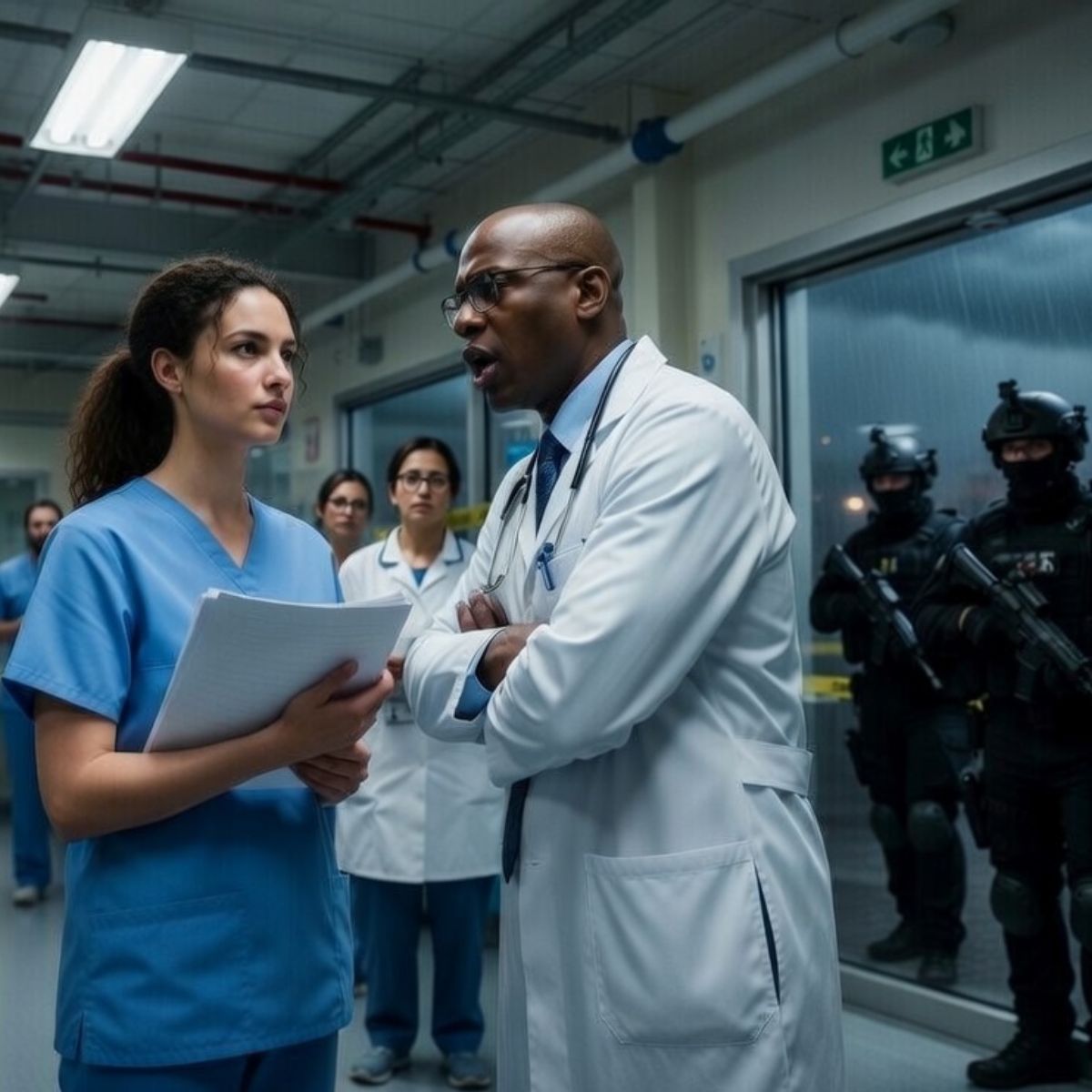
Four massive men surged into the pristine, brightly lit corridor. They brought the smell of aviation fuel, hot brass, and raw, coppery blood with them. They were covered in dirt and wearing full, heavy tactical gear. Plate carriers, drop-leg holsters, communication headsets, and dark ballistic helmets. Their faces were partially obscured, but their eyes were wild, scanning the room with terrifying, predatory intensity. They held compact assault rifles at low-ready.
The entire ICU descended into absolute pandemonium.
Patients screamed from their rooms. Two civilian security guards, who usually just dealt with angry family members in the lobby, literally dropped their radios and froze in utter terror, pressing their backs against the wall.
“Hey!” Dr. Sterling screamed, his face turning bright red as his arrogance temporarily overrode his fear. “What do you think you’re doing?! This is a sterile surgical floor! You cannot bring weapons in here! I am the Chief of Surgery and I demand to know—”
The lead operator—a man built like a brick wall, his tactical vest smeared with fresh, dark blood—didn’t even slow down. He didn’t look at Sterling. He didn’t acknowledge the title “Chief of Surgery.” He walked right past the doctor as if Sterling were nothing more than a piece of furniture in his way.
The operator’s frantic, scanning eyes swept over the terrified medical staff cowering behind the desks.
Then, his eyes locked onto me.
He stopped dead in his tracks. The three heavily armed men behind him instantly stopped too, forming a tight, protective wedge behind him.
“Specialist Maya Vance?” the giant man barked. His voice was raw, gravelly, and cut right through the chaotic screaming of the hallway like a jagged knife.
I felt the sudden, icy drop in my stomach. The sterile walls of St. Jude’s seemed to melt away. For the first time in three years, someone was using my real title.
I didn’t cower. I didn’t hide behind the desk like the other nurses.
The “clueless new nurse” persona evaporated into thin air. My spine snapped perfectly straight. My shoulders rolled back. The clipboard I was holding slipped from my fingers and clattered onto the linoleum floor.
“Report,” I commanded. My voice didn’t shake. It dropped an octave, projecting with a cold, hard authority that echoed down the hallway.
The entire room went dead silent. The screaming stopped.
Dr. Sterling’s jaw literally unhinged. He stared at me, his eyes wide with disbelief, as if I had just morphed into an alien right in front of him. “Maya?” he choked out, his voice squeaking. “What… what is this? What are you doing? You know these armed men?!”
The operator completely ignored the doctor. He took one step closer to me, his chest heaving.
“The Commander is down,” the operator said, his voice dropping into a desperate, urgent tone that only I was meant to hear. “Shrapnel in the sub-clavian artery. Massive hemorrhage. We bypassed three other hospitals. The civilian trauma team on the bird couldn’t stabilize him. They’re losing him, Maya.”
He paused, looking at me with a mixture of immense respect and absolute desperation.
“We need the best,” the soldier pleaded. “We need ‘The Ghost’.”
I looked over the operator’s shoulder at Dr. Sterling. The arrogant, untouchable Chief of Surgery looked like a man who had just realized he’d been using a loaded grenade as a paperweight for the last six months. The color had completely drained from his face.
I reached deep into the pocket of my oversized scrub pants. My fingers brushed past the standard-issue medical tape and pulled out something I had secretly carried every single day since I left the service.
A pair of reinforced, black tactical medical gloves.
I pulled them onto my hands, the familiar, tight snap of the material sounding incredibly loud in the dead-silent hallway.
“Dr. Sterling,” I said, my voice carrying the weight of a commanding officer. I didn’t look away from the lead operator. “You might want to step back. You’re in the way of a classified military operation.”
I didn’t wait for his permission. I didn’t wait to see the shock register on the faces of the nurses who had ignored me for months. I shoved past the Chief of Surgery, sprinting toward the stairwell that led up to the roof, running straight back into the fire.
<chapter 2>
The stairwell of St. Jude’s Medical Center was designed for quiet fire drills, not a full-scale tactical sprint.
But as I hit the first metal step, taking them two at a time, the echo of heavy combat boots thundering right behind me told me that the rules of this hospital no longer applied. I didn’t look back. I didn’t need to. I could hear the synchronized, heavy breathing of the four SEALs forming a protective diamond formation around me as we ascended.
Three years.
It had been three years since I had moved like this. Three years of forcing myself to walk at a slow, non-threatening pace. Three years of biting my tongue, fetching ice chips, and letting arrogant men like Dr. Sterling treat me like I was invisible.
But the moment my hands slipped into those black tactical gloves, “Nurse Maya” ceased to exist.
The Ghost woke up. And she was already calculating blood volume loss, clotting cascades, and field-expedient tourniquet failures before we even reached the roof access door.
“Talk to me!” I shouted over my shoulder, my voice bouncing off the concrete walls as we hit the fourth-floor landing. “Mechanism of injury!”
The lead operator—a giant of a man whose name tape read ‘MILLER’ beneath a thick layer of dust and dried blood—didn’t hesitate. He spoke in the clipped, precise cadence of a man who had delivered a hundred casualty reports under fire.
“IED blast, secondary fragmentation,” Miller barked, keeping pace right on my heels. “Hot shrapnel. Entry point is left anterior shoulder, just below the clavicle. It’s deep, Maya. It severed the subclavian. The civilian flight medics tried to pack it, but it’s a geyser. They can’t find the bleeder.”
My stomach turned to ice.
The subclavian artery. It was a nightmare injury. It wasn’t like a leg or an arm where you could just slap a high-and-tight tourniquet on it and buy yourself an hour. The subclavian sits deep in the upper chest, protected by the collarbone. When it gets severed, the artery acts like a rubber band, snapping back into the chest cavity, pouring massive amounts of blood directly into the lungs and the open spaces of the torso.
You can’t tourniquet it. You can barely compress it.
You have to go in and dig for it. With your bare hands.
“How long since the injury?” I demanded, hitting the heavy push-bar of the roof access door.
“Twenty-two minutes,” Miller grimaced.
Twenty-two minutes of free-flowing arterial bleeding. The Commander wasn’t just dying. By all medical logic, he should already be a corpse. He was running on pure, stubborn adrenaline and whatever blood volume he had left in his lower extremities.
I shoved the door open.
The immediate roar of the MH-60 Seahawk hit me like a physical wall. The heat radiating off the twin turboshaft engines was suffocating, instantly burning away the sterile, air-conditioned chill of the hospital. The rotor wash whipped across the flat tar roof, kicking up dust, loose gravel, and the overwhelming, metallic stench of aviation fuel and raw blood.
The massive black helicopter was sitting heavy on the hospital’s painted ‘H’. Its side doors were pinned wide open.
Inside the cabin, it was absolute, terrifying chaos.
Two civilian flight medics in high-visibility St. Jude’s jackets were screaming at each other over the deafening noise of the rotors. They looked completely panicked, their hands slipped and sliding, covered up to the elbows in thick, dark arterial blood.
They were frantically trying to press white gauze into the chest of a man strapped to a titanium transport litter, but the gauze was turning soaking, dripping red the second it touched him.
“We’re losing the pulse!” one of the civilian medics shrieked, his eyes wide with utter terror. “The packing isn’t holding! He’s bleeding out into his chest cavity! Where is the trauma team?!”
I didn’t wait for the rotors to spin down. I didn’t wait for permission.
I sprinted directly under the spinning blades, keeping my head low, Miller and his men right beside me.
I vaulted up onto the edge of the helicopter cabin. The metal floor of the bird was as slick as an ice rink, completely coated in a thick, pooling layer of crimson.
“Get out of the way!” I roared, grabbing the panicked civilian medic by the shoulder of his jacket and physically yanking him backward.
“Hey! You can’t be in here! You’re just a floor nurse!” the medic screamed, trying to shove me away. “We need a trauma surgeon! He’s dying!”
Before the medic could take another step toward me, a heavy, gloved hand clamped down on the back of his neck.
Miller effortlessly lifted the civilian medic off his feet and tossed him out of the helicopter cabin onto the hard tar of the roof like a ragdoll. The other civilian medic took one look at the four heavily armed, blood-soaked SEALs forming a solid wall of muscle and Kevlar around the aircraft, dropped his hands, and immediately backed away, his hands raised in surrender.
“Perimeter!” Miller shouted to his men.
Instantly, the three other operators turned their backs to the helicopter, their weapons raised to the low-ready, forming a 360-degree defensive ring around the bird. They weren’t protecting the helicopter from enemies. They were protecting me from the hospital staff.
I dropped to my knees on the slick, blood-covered floorboards and looked down at the man on the litter.
Commander Hayes.
His face was a ghastly, translucent shade of gray. His lips were blue. His tactical uniform had been violently cut away, exposing a massive, jagged, violently pulsating hole just below his left collarbone. Dark, oxygen-depleted blood was bubbling and surging out of the wound with every weak, fluttering beat of his failing heart.
“Hayes,” I yelled, leaning close to his ear, my voice cutting through the roar of the engines. “Hayes, it’s Maya. It’s The Ghost. Do you hear me? You are not dying on my watch. Do you understand me?!”
His eyelids fluttered. They were heavy, rolling back into his head. But for a split second, his dilated pupils locked onto my face. A tiny, almost imperceptible twitch of a smile touched the corner of his pale mouth.
He knew I was there.
“Miller! Hold his shoulders down!” I commanded, my hands moving with a terrifying, mechanical precision. “He’s going to shock. If he thrashes, he’ll tear what’s left of the artery.”
“Got him,” Miller grunted, throwing his massive body weight over the Commander’s upper chest, pinning him to the metal litter.
I didn’t have a scalpel. I didn’t have a sterile surgical suite. I didn’t have Dr. Sterling’s million-dollar robotic assistants.
I had my hands.
I shoved my fingers directly into the pooling lake of blood in the Commander’s chest. The heat of his blood soaked instantly through my tactical gloves. I bypassed the useless, soaked gauze the civilian medics had left behind.
I had to find the bleeder. Blind.
I pushed my fingers deep under his collarbone, feeling the slick, torn edges of muscle and shattered bone. It was agonizingly tight. I closed my eyes, tuning out the deafening roar of the helicopter, tuning out the chaotic screaming coming from the roof access door.
I focused entirely on the tips of my fingers.
Come on, I thought frantically. Where are you? Talk to me.
There.
A faint, frantic pulsing against my index finger. The severed end of the subclavian artery had retracted deep into the cavity, exactly as I feared. It was firing blood directly into his lungs like a loose firehose.
I pinched it.
I clamped my thumb and index finger down on the slippery, tearing vessel with bone-crushing force.
Instantly, the bubbling geyser of blood filling his chest cavity stopped. The sudden drop in blood flow was immediate.
“I have the bleeder!” I shouted, my arm buried up to the wrist in his chest. “I have it pinched off! Get me a hemostat! Now!”
Miller frantically tore open a trauma kit on the wall of the bird and slapped a steel surgical clamp into my free hand. Using my left hand to guide the clamp down the shaft of my right wrist, I slid the cold metal into the wound, opened the jaws, and clamped it brutally hard exactly where my fingers were squeezing.
Click. Click. Click.
The locking mechanism of the clamp engaged.
I slowly pulled my fingers out of the wound. The clamp held. The bleeding was stopped.
“Airway!” I barked. “He’s aspirating! He needs to be intubated right now!”
But before I could reach for the plastic endotracheal tube in the trauma bag, a furious, hysterical voice echoed across the roof.
“Stop what you are doing immediately! Arrest her!”
I looked up, sweat stinging my eyes.
Dr. Sterling had finally made it to the roof. He was flanked by three hospital security guards and the Chief of Hospital Administration. Sterling’s face was purple with rage. He was pointing a trembling finger directly at me.
“Specialist or whatever the hell you call yourself, you are violating every single hospital protocol!” Sterling screamed, trying to push past the wall of SEALs. “You are an unlicensed floor nurse! You are performing an unauthorized surgical procedure on my roof! You are fired! Do you hear me? Fired! Security, remove her from that patient right now!”
The three security guards nervously took a step forward, reaching for their handcuffs.
They didn’t even make it a full yard.
The SEAL nearest to them—a massive, silent operator with a jagged scar across his jaw—simply took one half-step forward and casually lowered the barrel of his rifle until it was pointing directly at the center of the lead security guard’s chest.
He didn’t say a word. The safety switch on the rifle clicked off with a loud, incredibly distinct snap.
The security guards froze instantly, their hands shooting up into the air in sheer, unadulterated terror.
“Are you insane?!” Sterling shrieked, backing up so fast he nearly tripped over the roof ledge. “You can’t point guns at us! This is a hospital! This is a massive legal liability! If that man dies, his blood is on your hands, Maya!”
I didn’t let go of the surgical clamp buried in the Commander’s chest. I slowly turned my head and locked eyes with the Chief of Surgery.
The silence that stretched between us seemed to overpower the deafening roar of the helicopter blades.
“Dr. Sterling,” I said, my voice no longer the quiet, timid whisper of ‘The Shadow’. It was the cold, absolute authority of a combat veteran who held a man’s life in her bare hands. “This man’s blood is already on my hands. And it’s the only thing keeping him alive.”
I stood up, my scrub top soaked in dark red, the heavy tactical gloves dripping onto the floorboards.
“He is stabilized for transport, but he has massive internal hemorrhaging,” I stated, staring Sterling down. “I need an operating room. I need five units of O-negative blood waiting. I need a cardiothoracic team prepped for a sternotomy. And I need it in exactly two minutes.”
“Absolutely not!” Sterling sputtered, his ego refusing to let him back down in front of his administrators. “My ORs are fully booked for the next six hours! I have a state senator coming in for an elective bypass! I am not bumping my schedule for an unauthorized, unregistered patient who was dropped on my roof by a bunch of armed thugs!”
Miller, still kneeling beside the Commander, slowly stood up. He wiped a streak of his Commander’s blood across his tactical vest. He stepped down from the helicopter and walked slowly toward Dr. Sterling.
The Chief of Surgery physically shrank backward, terrified of the giant operator.
Miller leaned in, his face inches from Sterling’s perfectly manicured nose.
“Listen to me very carefully, Doctor,” Miller whispered, his voice shaking with a terrifying, barely controlled rage. “That man bleeding out on your roof is a Navy SEAL Commander. Thirty minutes ago, he jumped onto a live explosive device to shield three civilian aid workers during a classified extraction. He gave his life so others could walk away.”
Miller slowly reached out and grabbed the lapel of Sterling’s pristine, white doctor’s coat.
“So you are going to pick up that radio,” Miller growled. “You are going to clear your absolute best operating room. And you are going to let ‘The Ghost’ do what she does best. Because if he dies on this roof because you were worried about your schedule… I promise you, I will make sure you never hold a scalpel again.”
Sterling swallowed hard. The color completely drained from his face. He looked at the guns. He looked at Miller’s eyes. Then, he looked at me, standing in the helicopter, holding the clamp that was keeping the Commander tethered to the living world.
With a violently shaking hand, Sterling unclipped the radio from his belt.
“O.R. One,” Sterling stammered into the mic, his voice cracking. “Cancel the Senator’s bypass. Clear the room. Prep for immediate, massive trauma surgery. Code Black patient is coming down.”
“Good,” I said, dropping back down to my knees beside the litter. “Miller, grab the front handles. Let’s move him! Go, go, go!”
We hoisted the heavy titanium litter off the floor of the helicopter. The SEALs formed a tight perimeter around us, physically shoving the terrified hospital administrators out of the way as we sprinted for the roof access elevator.
We slammed into the oversized freight elevator, the metal doors sliding shut, finally cutting off the roar of the helicopter.
The sudden silence inside the elevator car was suffocating.
I kept my hand locked tightly around the surgical clamp buried in his chest. I watched the portable heart monitor the medics had attached to his vest.
Beep… Beep… Beep…
The rhythm was weak, thready, but it was there. We were going to make it. The O.R. was only two floors down. I had stopped the primary bleed. I just needed to get him on a table. I let out a massive, shuddering breath, the adrenaline finally starting to plateau.
“You did it, Maya,” Miller whispered, standing beside me in the cramped elevator, staring down at his Commander. “You actually pulled him back.”
I offered a tight, exhausted smile.
But as the elevator passed the fourth floor, the glowing green line on the portable heart monitor didn’t just slow down.
It violently spiked.
BEEP-BEEP-BEEP-BEEP!
The machine began to scream in a rapid, frantic pitch.
“What’s happening?” Miller demanded, his eyes widening in panic. “The clamp! Did the clamp slip?!”
“No!” I yelled, checking my grip. The clamp was perfectly secure. The subclavian was still closed. “The bleeding is stopped! This is something else!”
I ripped open the front of the Commander’s shredded uniform, exposing his bare chest.
My heart completely stopped.
The left side of his chest wasn’t just bruised from the explosion. It was physically expanding. The skin was stretching tight, turning a horrifying, bruised purple, ballooning outward with every single second that passed.
“Tension pneumothorax,” I breathed, the absolute worst-case scenario unfolding right in front of my eyes.
The shrapnel hadn’t just severed the artery. It had punctured his lung. The air he was desperately trying to breathe was leaking out of his lung and getting trapped inside his chest cavity. The pressure was building up like a balloon ready to pop, physically crushing his heart against his spine.
BEEEEEEEEEEEP.
The monitor flatlined.
A solid, continuous, sickening tone filled the elevator.
“He’s coding!” Miller screamed, slamming his fist against the metal wall of the elevator. “Maya, his heart stopped! Do something!”
The elevator doors chimed, sliding open to reveal the pristine, brightly lit surgical floor. Dr. Sterling and a massive team of shocked, paralyzed nurses and surgical techs were standing there, waiting for us.
“Move!” I roared, dragging the litter out of the elevator.
“He’s flatlining!” Sterling yelled, pointing at the monitor as we rushed past him. “We have to run a code! Give him epinephrine! Get the defibrillator!”
“We can’t shock him!” I screamed back, sprinting down the hallway, shoving a medical cart out of the way. “His heart is physically crushed! The electricity won’t do anything! He’s in PEA arrest!”
“Then he’s dead!” Sterling shouted, chasing after us. “There’s nothing we can do! We can’t decompress a chest that fast without a sterile field!”
We crashed through the double doors of Operating Room One. The blinding surgical lights snapped on.
“Lift him!” I ordered the SEALs.
Miller and the operators hoisted the Commander onto the surgical table. The monitor continued to scream its endless, flatline tone. Ten seconds. He had been dead for ten seconds. The brain starts taking irreversible damage at three minutes.
“Maya, what do we do?!” Miller pleaded, grabbing my shoulder.
I looked at the sterile, silver trays of surgical instruments the hospital staff had laid out. They were beautiful. Clean. Perfect.
And entirely too slow.
I didn’t have time to prep his skin with iodine. I didn’t have time to properly drape him. I didn’t have time to wait for the anesthesiologist to hook up the machines. If I didn’t relieve the pressure in his chest in the next thirty seconds, Commander Hayes was never waking up.
I turned my back on the sterile trays.
I reached down to my own hip.
My hand wrapped around the heavy, textured grip of the titanium tactical knife I kept clipped inside the waistband of my scrub pants—the same knife I had carried through three combat deployments.
With one fluid motion, I ripped the knife from my hip.
The blade caught the bright surgical lights, gleaming with a deadly, silver reflection.
Dr. Sterling, standing in the doorway of the O.R., let out a horrified, blood-curdling scream.
“What are you doing?!” Sterling shrieked, watching me raise the hunting knife over the dying Commander’s chest. “You cannot cut a patient with a dirty weapon! I will have you arrested for murder!”
I didn’t listen. I didn’t hesitate.
I found the second intercostal space on the Commander’s bruised, ballooning chest, right above the third rib.
I gripped the handle of my tactical knife with both hands, raised it high above my head, and brought the blade violently down.
<chapter 3>
The blade didn’t just cut; it hissed.
As the tip of my tactical knife breached the skin and sliced through the thick, intercostal muscle between the second and third ribs, a violent, high-pitched spray of trapped air and frothy, bright-red blood erupted from the wound. It sounded like a tire blowing out at sixty miles per hour. The pressure was so immense that it sprayed across my face shield, momentarily blurring my vision in a crimson haze.
But I didn’t blink. I didn’t pull back.
“There it is!” I yelled over the screaming flatline of the EKG.
The “hiss” was the sound of life trying to claw its way back. The tension pneumothorax—the air that had been crushing Commander Hayes’s heart like a grape—was finally escaping. His chest, which had been stretched tight and purple like an overinflated basketball, visibly began to deflate. The pressure on his mediastinum shifted. His heart, finally freed from its pneumatic prison, had room to move again.
I didn’t wait for the monitor to catch up. I dropped the knife onto the floor and shoved two fingers into the hole I had just made, widening the tract to ensure the air didn’t get trapped again.
“He’s in PEA! Start compressions!” I roared at the room.
The surgical team was paralyzed. They were staring at me, then at the bloody knife on the floor, then at the four giant men with assault rifles standing at the corners of the operating room. They looked like they were waiting for a command from a god that had abandoned them.
“I said start compressions!” I screamed, my voice cracking with the raw authority of a battlefield commander. “Nurse Jenkins! Get on that chest! Right now!”
Jenkins, an older nurse who had spent six months telling me I was ‘too quiet for the ICU,’ suddenly snapped out of her trance. She scrambled over, climbed onto a step-stool, and began rhythmic, bone-crushing compressions on the Commander’s chest.
Thump. Thump. Thump.
“Sterling! Get over here!” I barked, not even looking at the Chief of Surgery.
Dr. Richard Sterling was backed against the scrub sink, his hands shaking so violently he had to grip the edge of the porcelain to keep from falling. His face was the color of a sheet. He was watching his sterile, controlled world be torn apart by a girl he had called ‘incompetent’ three hours ago.
“This is… this is assault,” Sterling whispered, his voice trembling. “You used a non-sterile weapon. You’ve contaminated the entire field. The legal ramifications… the board will…”
“The board isn’t here, Richard!” I snapped, my eyes locked on the monitor. “A man is dead on your table. If you don’t step up and help me ligate this artery, he stays dead. Do you want to be the Chief of Surgery who watched a Medal of Honor recipient die because you were worried about a lawsuit, or do you want to help me save him?”
The word ‘Medal of Honor’ seemed to hit Sterling like a physical blow. He looked at Miller, the giant SEAL who was staring at him with a gaze so cold it could have frozen the blood in Sterling’s veins.
Miller didn’t say a word. He just slowly adjusted the grip on his rifle. The message was clear: Do your job or get out of the way.
Sterling swallowed hard. Something in his eyes shifted. The ego didn’t vanish, but the survival instinct took over. He grabbed a pair of sterile gloves from a tech and began snapping them on with frantic speed.
“Fine,” Sterling hissed, stepping toward the table. “But if he dies, it’s on your record, Maya. Not mine.”
“Fine by me,” I said, my focus already back on the wound. “I’m used to carrying the weight.”
For the next forty-five minutes, the operating room turned into a scene from a fever dream. Outside, the hospital was in a state of total lockdown. I could hear the distant sounds of sirens—more than just ambulances. The local police, the FBI, maybe even more military. But inside OR 1, the world was reduced to a five-inch circle of shredded flesh and pulsing vessels.
I was the conductor of a chaotic, bloody orchestra.
“Push two milligrams of Epi!” I ordered. “And get that Level-1 infuser going! We need blood in him faster than it can leak out!”
“We’re out of O-negative!” the tech yelled from the door. “The blood bank is lagging!”
“I’m O-negative,” Miller’s voice boomed from the corner of the room. He was already ripping the Velcro strap off his tactical sleeve, exposing a massive, corded forearm. “Take it from me. Direct line. Right now.”
“We can’t do a direct transfusion in a civilian OR!” a young resident stammered. “The risk of—”
“Do it!” I overrode him. “Jenkins, get a large-bore IV. Hook Miller up. We don’t have time for the blood bank’s bureaucracy. That’s his brother on the table. It’s the cleanest blood he’s ever going to get.”
While Miller sat in the corner, his rifle still across his lap while a plastic tube drained his life force into a bag for his Commander, I went back into the chest.
Sterling was working opposite me. I have to give him credit—once he stopped panicking, his hands were steady. He was a talented surgeon, but he was a ‘peace-time’ surgeon. He was used to clean lines and scheduled incisions. He wasn’t used to what I was doing: sticking my hand into a cavity filled with bone shards and metal fragments.
“I can’t see the distal end of the subclavian,” Sterling grunted, his forehead dripping with sweat. “There’s too much shredding. We’re going to have to clamp the aorta just to stop the flow.”
“No,” I said, my fingers dancing through the blood. “If you clamp the aorta, you’ll starve his kidneys. We don’t have the time for a bypass. Look here.”
I moved his retractor two centimeters to the left.
“The fragment didn’t just sever the artery,” I whispered, my heart racing. “It’s lodged against the vertebral column. It’s acting like a jagged plug. If we move it the wrong way, he’ll bleed out in seconds.”
“How did you know that?” Sterling asked, looking at me with genuine wonder. “You haven’t even seen an X-ray.”
“I don’t need an X-ray,” I said, my voice drifting back to a memory of a dusty ridge in the Korengal Valley. “I’ve seen this exact wound before. Three times. The first two men died because we waited for the ‘proper’ equipment. The third one lived because I stopped following the manual.”
I reached for a pair of long, curved Forceps.
“Everyone, hold your breath,” I commanded.
The room went silent. Even the hum of the ventilation system seemed to fade away. I could hear Miller’s heavy, rhythmic breathing from the corner.
I slid the forceps deep into the Commander’s chest, feeling for the cold, hard edge of the shrapnel. I found it. It was a piece of a jagged engine block from the IED blast, no bigger than a quarter, but it was positioned like a guillotine over the most vital highway in his body.
With a flick of my wrist, I twisted the fragment and pulled it out.
A jet of blood hit the ceiling.
“Clamp! Now!” I screamed.
Sterling was ready. He dove in with the vascular clamp, snapping it shut on the pulsing artery. The spray stopped.
The silence that followed was broken by a single, beautiful sound.
Beep.
Then, a second later.
Beep.
“We have a rhythm,” the anesthesiologist whispered, his voice thick with emotion. “Sinus tachycardia. 110 beats per minute. Blood pressure is climbing… 80 over 40… 90 over 60…”
“He’s back,” Miller breathed, his head leaning back against the wall, a look of pure, unadulterated relief washing over his face.
I stepped back from the table, my legs suddenly feeling like lead. My scrub top was so soaked with blood that it felt heavy, dragging against my skin. I looked down at my hands. The black tactical gloves were stained a deep, dark maroon.
“Finish the repair, Dr. Sterling,” I said, my voice barely a whisper. “The vessel is stable. He needs a primary graft, but the danger of immediate hemorrhage is over. You can handle the rest.”
“Where are you going?” Sterling asked, his voice lacking any of its former bite. He looked at me not as a subordinate, but as a peer. “Maya, stay. You should be the one to close.”
“No,” I said, turning toward the door. “I’m just a floor nurse, remember? I have charts to file.”
I walked out of the O.R. and into the scrub room. I ripped off the mask and the face shield, throwing them into the biohazard bin. I leaned over the sink and splashed cold water on my face, trying to wash away the copper smell of the trauma.
I looked into the mirror.
The girl looking back wasn’t “The Shadow.” She wasn’t the quiet, timid nurse who let people walk all over her. The Ghost was staring back—the woman who had survived the worst the world had to throw at her and came out the other side with her soul intact.
The door to the scrub room opened.
It was Miller. He had a bandage on his arm from the transfusion, but he was standing tall. He looked at me for a long moment, then slowly reached up and removed his tactical helmet. He was younger than I thought, maybe thirty, with eyes that had seen too much.
He didn’t say ‘thank you.’ Between people like us, ‘thank you’ is a hollow phrase.
Instead, he reached into his vest and pulled out a small, tarnished metal coin. He stepped forward and pressed it into my hand. It was a Commander’s Challenge Coin, embossed with the insignia of his unit.
“He told us if anything ever happened to him on US soil, we weren’t supposed to call the Pentagon,” Miller said quietly. “He told us to find ‘The Ghost.’ He said you were the only one who could navigate the transition between the two worlds.”
“How did he even know I was here?” I asked, looking at the coin.
“Hayes has been tracking your papers for years, Maya,” Miller said. “He knew you were hiding. He respected it. But he also knew that the world is getting darker. He wanted you close. Just in case.”
I closed my fingers around the coin.
“The hospital is going to be crawling with MPs in ten minutes,” Miller continued. “Sterling is going to try to take the credit, and the administration is going to try to bury what you did because it was ‘off-book.’ They’ll probably suspend you for using that knife.”
I shrugged. “Let them. I’ve been fired from better places than this.”
“You don’t understand,” Miller said, a small, knowing smile touching his lips. “You aren’t going back to the floor, Maya. Look out the window.”
I walked over to the small, reinforced window that looked down onto the hospital’s main entrance.
The parking lot was no longer filled with civilian cars. It was filled with black SUVs and olive-drab transport trucks. Men in suits were talking to the hospital security guards, who looked like they were about to faint.
But it was the man standing by the lead SUV that made my breath hitch.
He was wearing a charcoal suit, but he carried himself with the unmistakable posture of a four-star general. He was looking up at the surgical floor, his eyes scanning the windows.
“The Secretary of Defense?” I whispered.
“Hayes is more than just a Commander, Maya,” Miller said. “He’s the architect of the next decade of special operations. And you just saved his life in a way that can never be officially acknowledged.”
Miller put his helmet back on and adjusted his mask.
“In an hour, this hospital will be told that a specialized military surgical team performed the operation. Your name will be redacted from every file. To the world, you will still be the quiet nurse in Room 3C. But to us…”
He snapped a sharp, crisp salute.
“To us, you’re the reason we get to go home.”
He turned and walked back into the O.R. to guard his Commander.
I stood there in the quiet scrub room, the weight of the coin in my pocket. I knew what was coming. I would go back to my apartment. I would wash the blood out of my hair. I would show up for my shift tomorrow. I would listen to the nurses gossip about the ‘crazy military incident’ and I would say nothing.
I would be the Shadow again.
But as I walked out of the surgical wing, I passed Dr. Sterling’s office. I saw him sitting at his desk through the glass, his head in his hands, staring at the bloody tactical knife that someone had placed on a sterile tray on his desk.
I didn’t stop. I didn’t say a word.
I just kept walking, out into the cool afternoon air, where the roar of the Navy Seahawk was finally fading into the distance.
I had saved the Commander. I had kept my secret.
But as I reached my car, I saw a small, white envelope tucked under my windshield wiper. There was no stamp. No return address. Just my name written in a precise, military hand.
Maya Vance.
I opened the envelope. Inside was a single piece of paper with a GPS coordinate and a date for three days from now.
At the bottom, it simply said:
The Ghost doesn’t stay in the shadows forever. We need you for what’s coming next.
I looked up at the hospital, at the hundreds of windows where people were living their safe, quiet, civilian lives. They had no idea how close the darkness had come today. They had no idea that their safety was bought with the blood of men like Hayes and the secrets of women like me.
I got into my car and started the engine.
I didn’t know where those coordinates would lead. I didn’t know if I was ready to leave the quiet life behind.
But as I looked at my hands—hands that were steady, strong, and capable of holding back death itself—I knew one thing for certain.
The quiet was over.
The Ghost was back.
<chapter 4>
The rain in Baltimore doesn’t just fall; it clings. It’s a heavy, grey mist that smells of salt from the harbor and the lingering scent of exhaust from the busy streets. It felt appropriate as I sat in my tiny, one-bedroom apartment three days later, staring at the GPS coordinates on that slip of paper.
The silence of my living room was deafening.
For months, I had curated this silence. I had chosen the beige curtains, the generic IKEA furniture, and the single, struggling spider plant on the windowsill specifically because they were forgettable. This was the life of a ghost who didn’t want to be found. But the adrenaline from Tuesday was still thrumming in my veins, a low-frequency vibration that made the quiet feel like a lie.
My phone buzzed on the coffee table.
It was a text from the hospital’s HR department. “Nurse Vance, your presence is required at an emergency administrative hearing at 0900 hours tomorrow. Attendance is mandatory. Failure to appear will result in immediate termination.”
I leaned back, a dry, humorless laugh escaping my throat. Termination. They wanted to fire me for saving a life that their “best” doctors had already written off.
I looked at the black tactical gloves sitting on my counter, still stained with a faint, dark shadow of Commander Hayes’s blood. I hadn’t washed them. I couldn’t bring myself to. They were the only thing in this room that felt real.
The boardroom at St. Jude’s was the polar opposite of the rooftop helipad.
It was a sanctuary of dark mahogany, plush leather chairs, and the smell of expensive roast coffee. Six men and three women sat around a massive table, looking at me as if I were a biological hazard they hadn’t quite figured out how to incinerate.
Dr. Richard Sterling was there, too. He wasn’t sitting with the board; he was slumped in a chair near the back, looking ten years older than he had on Monday. His eyes wouldn’t meet mine.
“Ms. Vance,” began a woman in a sharp grey suit—the hospital’s Chief Legal Officer. “We have reviewed the footage from the hallway. We have the statements from the flight medics. And we have the… instrument you used in Operating Room One.”
She slid a clear plastic evidence bag across the table. Inside was my titanium tactical knife. It looked brutal and out of place against the polished wood.
“You performed an invasive surgical procedure using a non-sterile, unauthorized weapon,” she continued, her voice cold and measured. “You bypassed every safety protocol, ignored the direct orders of the Chief of Surgery, and placed this institution under a liability risk that is frankly incalculable.”
I sat perfectly still. I didn’t fidget. I didn’t explain. I didn’t apologize. I used the “thousand-yard stare” I’d learned in the desert, looking right through her until she shifted uncomfortably in her seat.
“The patient lived,” I said quietly.
“That is irrelevant to the breach of protocol!” a man from the board barked, slamming his hand on the table. “You are a floor nurse! You aren’t even authorized to administer certain meds without a signature, let alone perform a thoracic decompression with a hunting knife! Do you have any idea what the headlines would have looked like if he had died?”
“I know exactly what the headlines would have looked like,” I replied, my voice sharpening. “They would have read: ‘Navy SEAL Commander Dies on Hospital Roof While Chief of Surgery Argues Over Scheduling.’”
The room went cold. Sterling flinched.
“We are terminating your employment effective immediately,” the legal officer said, sliding a document toward me. “Furthermore, the board is recommending the permanent revocation of your nursing license. We will be filing a formal complaint with the state board for gross malpractice and endangerment.”
I looked at the paper. Then I looked at Sterling.
“Richard?” I asked. “Nothing to say? You were there. You saw his heart stop. You saw the tension pneumothorax. You know he’d be in a body bag right now if I hadn’t moved.”
Sterling finally looked up. His mouth opened, then closed. He looked at the board members, at the power and the money represented in that room, and then he looked at me.
“Protocol exists for a reason, Maya,” he whispered, his voice cracking. “I can’t… I can’t support what you did. It was reckless.”
I nodded slowly. I wasn’t surprised. Cowardice is a very common side effect of a high salary.
I picked up the pen, but before I could sign the termination papers, the heavy oak doors of the boardroom were shoved open.
Two men in dark suits entered, followed by a woman in a military uniform. She wasn’t just any officer; she was a Brigadier General. The air in the room seemed to get sucked out as she walked to the head of the table.
“The meeting is over,” the General said. It wasn’t a suggestion.
“Excuse me?” the legal officer gasped. “This is a private administrative hearing. You can’t just—”
“This is now a matter of national security,” the General interrupted, placing a folder on the table. “As of five minutes ago, the Department of Defense has enacted a full non-disclosure agreement regarding the events of Tuesday. Every person in this room will sign it, or you will be escorted to a federal holding facility for questioning.”
The board members looked at each other in stunned silence.
“As for Maya Vance,” the General said, turning her gaze to me. Her eyes were like flint. “Her ‘malpractice’ has been reclassified as a field-expedient life-saving measure performed under the direction of military authority. Her license is not only intact; it has been upgraded to a specialized trauma certification.”
The General looked at the legal officer. “And if I hear one more word about ‘termination,’ I will personally oversee an audit of this hospital’s federal funding. Am I understood?”
The legal officer turned a shade of white that matched the hospital walls. “Yes, General.”
The General turned back to me. “Specialist Vance. My car is outside. You have an appointment.”
We drove in silence. The black SUV moved through the Baltimore streets with a purpose that ignored traffic lights. We headed toward the coordinates on the paper—a small, private airfield on the outskirts of the city.
A lone Gulfstream jet sat on the tarmac, its engines idling with a low, hungry growl.
Standing by the stairs was Miller. He wasn’t in tactical gear anymore. He wore a simple flannel shirt and jeans, but the way he scanned the perimeter told me he was still “on the clock.”
“How is he?” I asked as I stepped out of the SUV.
“Awake,” Miller said, a genuine smile breaking through his rugged exterior. “And grumpy. He’s already tried to fire his physical therapist twice this morning. That’s how we know he’s going to be fine.”
He gestured toward the plane. “He’s waiting for you.”
I climbed the stairs into the cabin. It was a flying command center—screens, secure comms, and a medical suite in the back.
Commander Hayes was propped up on a specialized bed. He looked pale, and his chest was heavily bandaged under his gown, but his eyes were sharp. They were the eyes of a man who saw everything.
“Ghost,” he rasped, his voice still shaky from the intubation.
“Commander,” I said, standing at the foot of his bed. “You look terrible.”
He let out a weak, pained chuckle. “I’ve felt better. But I’ve also been dead. I prefer this.”
He looked at me for a long moment. “They tried to take your license, didn’t they?”
“They tried,” I said. “Your General friend stepped in.”
“She’s not just a friend. She’s my boss. And soon, she’ll be yours,” Hayes said, his expression turning serious.
I shook my head. “I told Miller. I’m done. I just want the quiet, Hayes. I want the 12-hour shifts and the boring charts. I can’t go back to the dirt.”
“The dirt is coming to us, Maya,” Hayes said, his voice dropping. “The IED that took me out wasn’t an insurgent trap in a foreign land. It was a targeted hit. Right here. On US soil.”
I felt a chill that had nothing to do with the plane’s air conditioning. “What?”
“There’s a shadow war starting, Maya. One that the public can’t know about. We need a team that doesn’t exist. People who can move between the civilian world and the combat zone without leaving a footprint. People like you.”
He reached out a shaky hand and pointed to a tablet on the table beside him.
“The coordinates I sent you? They weren’t for this airfield. They were for a facility in the mountains. A training center for a new unit. Unit 77. ‘The Ghosts’.”
I looked at the screen. I saw names I recognized—men and women I had served with, people I thought had retired or vanished. All of them were elite. All of them were ‘dead’ on paper.
“I can’t,” I whispered.
“You already did,” Hayes said. “The moment you picked up that knife on the roof, you chose a side. You chose the man over the protocol. You chose the mission over the safety of the hospital.”
He leaned forward, his eyes boring into mine.
“You can go back to St. Jude’s, Maya. You can file charts for Dr. Sterling and pretend you didn’t see the world for what it really is. But every time a siren goes off, every time a helicopter flies over, you’ll be wondering. You’ll be wondering if you could have been there to stop the next one.”
I looked out the window of the jet. I saw the hospital in the distance, a small, square building full of people who thought they were safe. I thought of Dr. Sterling’s cowardice and the board’s greed.
Then I looked at the metal coin in my pocket.
I thought of the feeling of the knife in my hand—the weight of it, the absolute certainty of the moment when life and death are separated by a single millimeter of steel.
I wasn’t a floor nurse. I never was. I was a lie I had been telling myself for three years because I was afraid of the dark.
“Where are we going?” I asked, my voice finally steady.
Hayes smiled, a slow, predatory look that told me I had just made the most dangerous decision of my life.
“To work, Specialist. To work.”
The jet engines roared to life, the vibration shaking the floorboards just like the Seahawk had. We taxied onto the runway, leaving the gray mist of Baltimore behind.
As the plane lifted off, I didn’t look back at the city. I looked ahead, into the clouds, where the real war was waiting.
The Shadow was gone. The Ghost was home.