
PART 2: THE PROMISE THAT TOOK FORTY YEARS
Walter Hayes closed his fingers around the medal.
“Your father gave it to me.”
Colonel Bennett stared at him.
“My father?”
Walter nodded.
The room had become completely silent.
Lieutenant Dalton no longer looked confident.
Bennett pulled out a chair.
“Please sit.”
Walter shook his head.
“I’ve been sitting long enough.”
Then he opened the wooden box.
Inside were several photographs, two folded letters and an old unit patch.
Bennett immediately recognized one photograph.
He had a copy at home.
His father stood in the center.
Young.
Smiling.
Alive.
Beside him was Walter.
Bennett looked up.
“You served with him.”
“Six years.”
Walter carefully placed the photograph on the table.
Then he explained why he had come.
Decades earlier, during a difficult evacuation after severe weather isolated part of their unit, Walter had been injured.
Thomas Bennett refused to leave him behind.
The details Walter remembered weren’t cinematic.
Thomas didn’t defeat an army by himself.
He didn’t make some impossible charge.
He simply stayed.
When Walter couldn’t move quickly, Thomas supported him.
When Walter wanted him to leave, Thomas refused.
Eventually, others reached them.
Walter survived.
Thomas later died during a separate deployment.
Before that final deployment, Thomas had left several personal items with Walter.
Among them was the medal.
“He told me his son was still young,” Walter said. “He didn’t want it disappearing into storage if something happened.”
Bennett looked down.
“I was nine.”
“I know.”
Walter reached into the box and removed one of the letters.
The envelope had yellowed with age.
Across the front was written:
For Robert.
Bennett’s expression collapsed.
“My mother never had this.”
“No.”
“Why?”
Walter swallowed.
“Because I failed to deliver it.”
Nobody moved.
Walter explained that after leaving the Army, life had scattered everyone.
Addresses changed.
Records became difficult to trace.
Walter tried more than once to locate the Bennett family.
Eventually the box went into storage.
Years became decades.
Then, several months earlier, Walter saw an article about Colonel Robert Bennett taking command of the same installation where his father’s old unit was being honored.
The photograph beside the article stopped him cold.
Robert had his father’s eyes.
“So I came here.”
Bennett stared at the unopened letter.
Then his attention shifted toward the medal.
“Lieutenant Dalton.”
Dalton stepped forward.
“Yes, sir.”
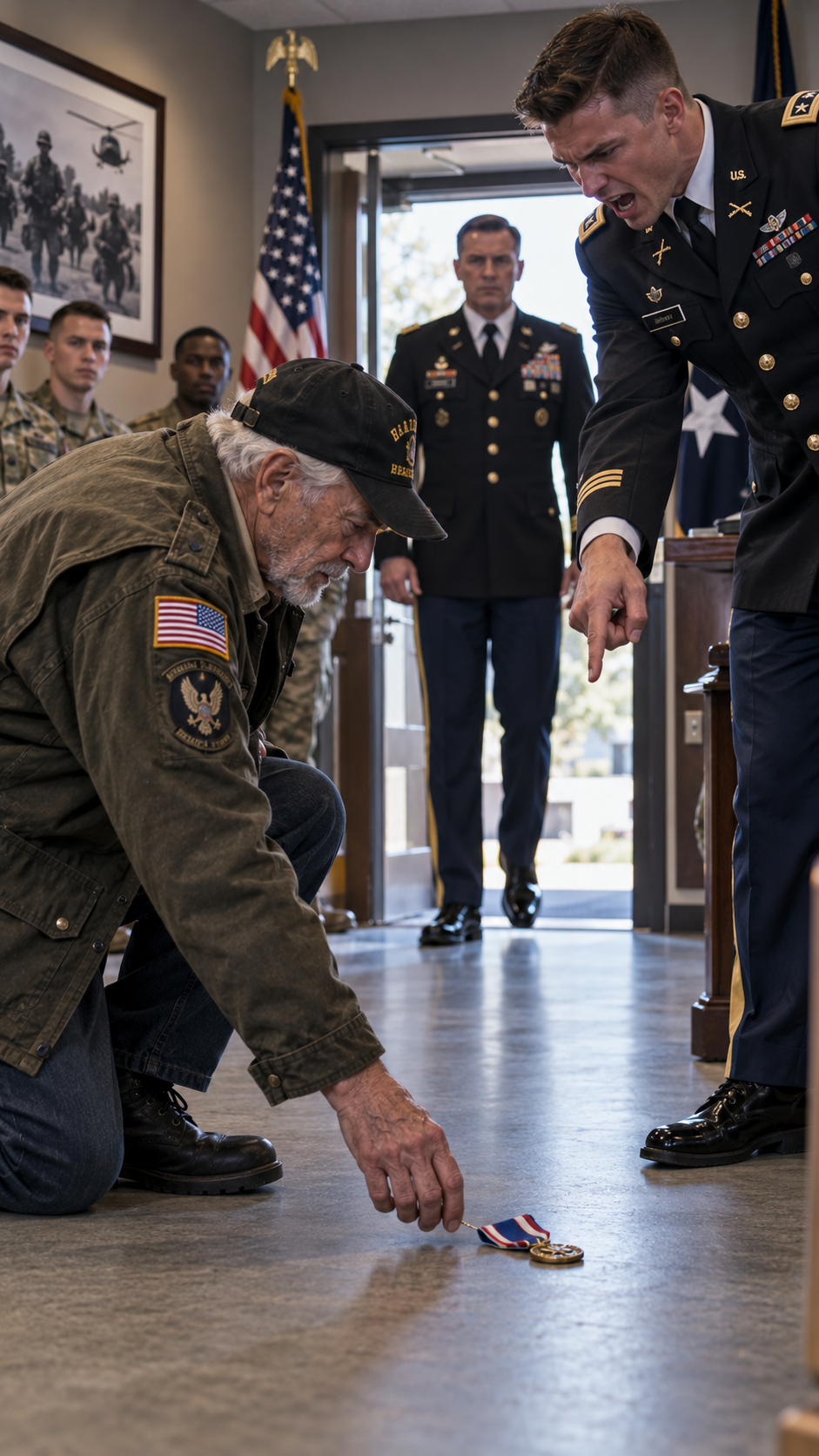
“Did you throw this on the floor?”
Dalton’s face tightened.
“Yes, sir.”
“Why?”
“I believed it might be fraudulent.”
Bennett looked directly at him.
“Questioning evidence is part of your responsibility.”
Dalton seemed relieved.
Then Bennett continued.
“Humiliating an elderly man isn’t.”
The relief vanished.
Dalton looked toward Walter.
“Mr. Hayes…”
Walter waited.
“I was wrong.”
Dalton took a breath.
“I treated your story like it had no value because you couldn’t immediately prove it. And I treated that medal like an object instead of something that might matter to someone.”
Walter studied him.
Then he handed Dalton the medal.
The young officer looked startled.
“Sir?”
“Hold it.”
Dalton carefully took it.
Walter said quietly:
“That’s how you should’ve held it the first time.”
Dalton lowered his eyes.
“Yes, sir.”
Walter took the medal back.
Then he walked toward Colonel Bennett.
For forty years, Walter had believed his job was to return a piece of metal.
Standing there, he finally understood.
The medal wasn’t the most important thing in the box.
He handed Bennett the letter.
“This belongs to you.”
Bennett accepted it with both hands.
He didn’t open it immediately.
Instead, he looked at Walter.
“You carried my father’s last letter for forty years.”
Walter’s voice softened.
“Too long.”
Bennett shook his head.
“But you brought it.”
Later that afternoon, Walter was invited to stay for the unit ceremony.
This time nobody sent him toward the back.
Colonel Bennett placed an empty chair beside his own.
Before the ceremony began, Dalton personally carried it over.
Walter noticed.
Neither man said anything.
They didn’t need to.
At the end of the ceremony, Bennett finally opened his father’s letter privately.
Walter never asked what it said.
Some words belonged only to a father and his son.
But when Bennett returned, his eyes were wet.
He walked directly toward Walter and embraced him.
“Thank you for coming back.”
Walter looked toward the old medal resting safely inside its wooden box.
Then he smiled.
“I made a promise.”
Bennett nodded.
“And you kept it.”
Forty years late.
But kept.
And Lieutenant Dalton never forgot the lesson either.
Years later, whenever someone entered his office carrying an old photograph, a faded ribbon or a story that sounded impossible, he remembered the sound of that medal hitting the floor.
Clink.
And before judging the person standing in front of him, he listened.